
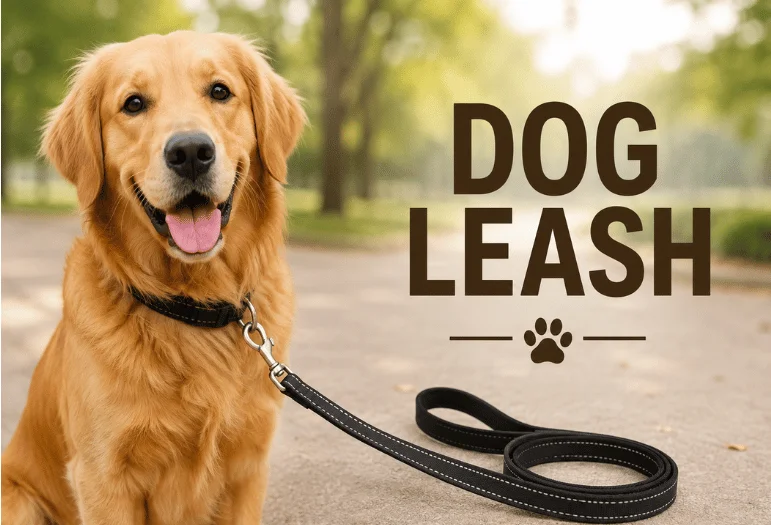
Length is the spec most buyers skim past, and it shapes a walk far more than color or brand does. Four feet holds a dog in a tight orbit beside your knee. Six feet gives enough slack to move at a natural pace. Anything past fifteen feet is a training tool, not something you carry down a busy street. Dog Stroller is a useful companion read here.
Short answer: most owners need one six-foot dog leash for daily walking. Add a four-foot version for traffic and crowds, plus a 15- to 30-foot-long line for recall practice. Flat nylon or leather beats a retractable model on the sidewalk, because a thin cord concentrates force and quietly rewards pulling.
Length to situation, mapped
Start here, and the rest of the decision gets easy. Material, width, and hardware all follow from where you actually walk.
| Length | Where it works | What it does to the dog |
| 1 to 2 ft (traffic handle) | Vet waiting rooms, elevators, crowded doorways | Keeps her at your knee with no decisions to make |
| 4 ft | City sidewalks, road crossings, passing strangers | Tight orbit, control first, very little sniffing |
| 6 ft | Standard neighborhood walking | Slack without constant tension, natural pace |
| 8 to 10 ft | Quiet streets, wide park paths | More sniffing, needs some handling skill from you |
| 15 ft long line | Recall practice in a park | Real freedom to explore, still catchable |
| 30 to 50 ft long line | Open fields, empty beaches | Full exploration, only for low-traffic space |
Key takeaways
- Six feet is the default. Four feet is the city tool. Fifteen feet and up is for training, not walking.
- The clip and its swivel fail long before the webbing does, so buy hardware first.
- Retractable models train pulling and have caused documented injuries to handlers and dogs.
- Nylon is cheap and light; leather grips better as it ages; biothane wins in mud and rain.
- Width follows body weight: 3/8 in under 20 lbs, 1/2 to 3/4 in mid-size, 1 in over 60 lbs.
Why length changes what your dog does
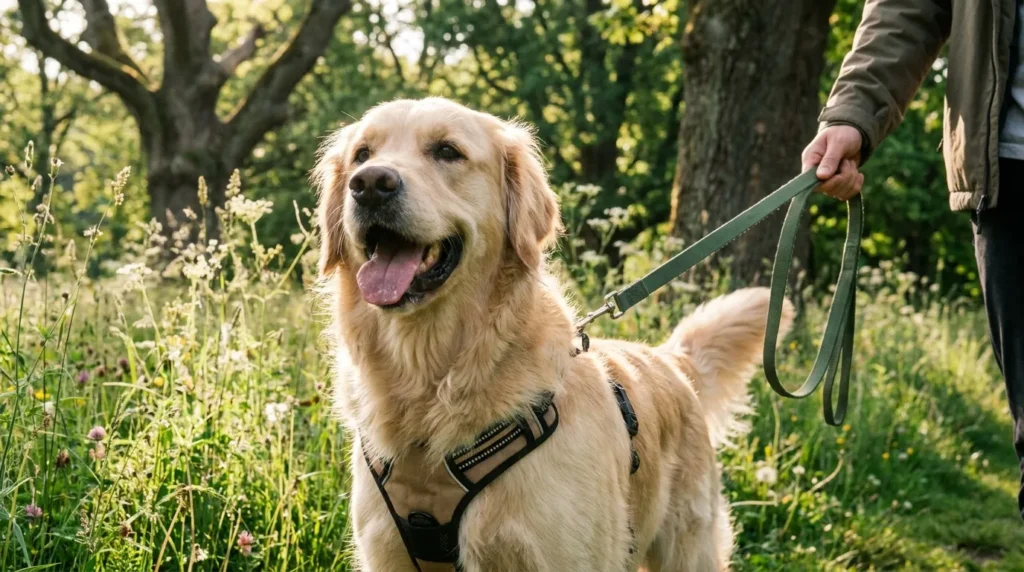
A short line removes choices. Your dog can move a stride forward and a stride sideways, which is exactly what you want at a curb, and exactly what makes a long walk frustrating for her. Control and enrichment pull in opposite directions, and length is the dial between them.
Six feet sits in the middle for a reason. It gives a dog room to swing wide around a hydrant, drop her nose, and come back to your side without the line ever going tight. That matters because dogs push against steady pressure by reflex. A line held under constant light tension teaches her that leaning into the pressure is normal, which is the opposite of what you want.
A long line does something different again. It is a training aid that lets a dog make her own choices at 20 feet while you keep a physical backup for the recall you are building. You are not walking her on it. You are letting her practice coming back to you when nothing is forcing her to. The same principle shows up from the training side in our pet care and behavior guides.
One practical note. A long line in a crowded park is a tripping hazard for everyone around you, including your dog.
Retractable leashes: what actually goes wrong
This is the category most buyers are weighing up, and most guides handle it with a shrug. Here is the specific version. A retractable holds a thin cord or a flat tape under spring tension inside a plastic housing. The cord is the first problem. It is narrow, so any force it carries is concentrated into a few millimeters of contact, and hands that grab a running cord get deep cuts.
Emergency physicians and hand surgeons have documented finger amputations from exactly this mechanism. Dogs on the other end have taken neck injuries when they hit the end of an extended line at a sprint.
Injury from ordinary walking gear is not rare. A 2020 study by Mathias Forrester in the American Journal of Emergency Medicine estimated 356,746 leash-related injuries treated at US emergency departments between 2001 and 2018. It drew on 18 years of Consumer Product Safety Commission NEISS surveillance data. Fractures were the most common diagnosis at 95,677 cases, or 26.8 percent. Pulls caused 193,483 of them.
The mechanism matters as much as the count. Four things go wrong with retractables:
- The brake fails or never gets pressed. The lock is a plastic button under your thumb, and in the half second a dog lunges, plenty of people miss it.
- Handles get dropped. A startled owner lets go, the housing clatters along the ground behind the dog, and now the dog is running from the noise.
- It trains the behavior you are trying to stop. The spring keeps light tension on the line at all times, and extending it rewards forward pressure. Your dog learns that pulling buys distance.
- Distance kills your recall. A dog 15 feet ahead of you at a driveway cannot be pulled back before a car arrives. You are relying on the brake and your reaction time.
Plenty of trainers and veterinary groups advise against them for street walking on those grounds. That is not the same as saying they are useless.
Where they make sense: open, low-traffic space with a calm dog who does not lunge. An empty field, a quiet trail, a fenced area where you want a bit of range without a 30-foot line tangling in undergrowth. If you buy one, buy a flat tape model rather than a cord model. Flexi, the German maker that popularized the design, sells tape versions such as the One S at 16 ft and the Giant L at 26 ft. Tape spreads force across a wider surface than round cord does.
| Retractable pros | Retractable cons |
| Range without carrying a bulky long line | Thin cord cuts hands and can amputate fingers |
| Quick recovery of slack near your feet | Brake can fail, jam, or simply be missed |
| Useful for potty breaks at a rest stop | Constant tension rewards pulling |
| Tape models reduce the cutting risk | No way to reel a dog in fast from 15 feet |
Dog Leash: Why the Clip Is the Part That Breaks Most and How to Prevent It

Webbing rarely snaps. Hardware does, and the cheap swivel barrel between the clip and the strap is the single most common failure point on any budget model. It is usually cast zinc; it wears at the rivet, and it lets go under a hard sideways load.
Three clip styles cover almost everything on sale:
- Bolt snap. A spring-loaded bar you slide back with your thumb. Cheap, light, easy one-handed. The gate sits proud of the body, so a collar ring can catch it and push it open under load.
- Trigger snap. A lever pulls the gate inward instead of sideways. Stronger and harder to open accidentally, at the cost of a little weight. This is the sensible default for a dog over 40 lbs.
- Carabiner style. A screw gate or auto-locking gate borrowed from climbing gear. Heaviest and slowest to clip, and the hardest to open by accident. Worth it on a strong dog or a long line.
Two checks before you buy. Hold the clip and twist the swivel: it should turn smoothly with no grit and no play at the rivet. Then look at the casting, because visible seams, flashing, and a dull gray finish mean pot metal rather than solid brass or aluminum.
Materials compared on what matters
Grip when your hands are wet, whether it burns your palm when it runs, how much it weighs on a long walk, and how you get mud off it. Those four things separate materials in daily use. Price barely does.
| Material | Grip when wet | Rope burn risk | Weight | Cleaning |
| Nylon webbing | Slick, hardest to hold | High if it runs through your hand | Lightest | Machine washable |
| Leather | Good, improves as it softens | Low | Medium to heavy | Wipe and condition, never soak |
| Biothane (coated webbing) | Best of the four | Medium | Light | Rinse under a tap, dries instantly |
| Kernmantle rope | Good, thick enough to hold | High if it slides | Medium | Hand wash, slow to dry |
Leather outlasts nylon by years if you keep it conditioned, and it softens into something genuinely nicer to hold. Nylon frays at the stitching and goes stiff with grit. Biothane is the honest answer for long lines, because a 30-foot nylon line dragged through wet grass becomes a heavy, filthy rope in one outing.
Width tracks body weight rather than height. Under 20 lbs, 3/8 in is plenty. Between 20 and 60 lbs, 1/2 to 3/4 in gives you something to hold. Over 60 lbs, go to 1 in, which spreads the load across your palm instead of cutting into it.
Hands-free, bungee and double-ended designs
Hands-free versions clip to a padded waist belt, and runners like them because your arms stay free and your stride stays even. The trade is real: you cannot shorten the line fast, and a hard lunge transfers straight to your hips. Use one on quiet paths with a dog who does not chase.
Bungee sections absorb shock and save your shoulder on a dog who stops dead at every scent. They also stretch, and stretch is forward pressure, which is why trainers working on loose leash walking usually take the bungee off.
The double-ended design is the underrated one. Two clips and several adjustment rings let you run one end to the front ring of a harness and the other to the back. That gives you steering rather than a tug of war. The same piece of gear shortens to four feet for traffic, extends to eight for a park, or goes over your shoulder when you need a hand free.
Named picks worth a look in 2026
Every product below was checked on the maker’s own product page on July 24, 2026. Prices are the maker’s list price at that date, not a tested street price, and none of these were tested by us.
| Product | Length | Material | Hardware | Listed price |
| Leashboss 6-ft Reflective | 6 ft | Double-thick webbing, padded handle | Snap | $19.99 |
| Ruffwear Front Range | 5 ft | Polyester webbing, 3/4 in | Lockable aluminum Crux Clip with swivel | $24.99 |
| Ruffwear Knot-a-Leash | 5 ft | Kernmantle rope, 7 or 11 mm | Auto-locking aluminum carabiner | $49.99 |
| Mendota Slip Lead | Standard | Braided rope, made in Minnesota | None, it is a slip design | From $23.49 |
| Leashboss Padded Long | 15 ft | Webbing, padded handle | Snap | $22.95 |
| Leashboss Extra Long | 50 ft | Webbing | Snap | $34.99 to $64.99 |
| Flexi One S Tape | 16 ft | Flat tape, not cord | Thumb brake housing | Street price varies |
A word on the Mendota slip design, since it looks odd next to the rest. It has no clip at all, which removes the hardware failure mode entirely, and shelters and groomers use it for that reason. It tightens when a dog pulls, so it belongs with a handler who already walks on slack.
The verdict, by case
No single product wins for everyone, so pick by how you walk.
- City walker on sidewalks: a 5 to 6 ft webbing model with a locking clip. The Ruffwear Front Range is the pick here, with a 4 ft spare for rush hour.
- Big dog who pulls: 1 in width, a trigger snap or carabiner, no bungee. Pair it with a front-clip harness and work on the pulling itself.
- Runner: a hands-free belt with a short bungee, used only on quiet routes.
- Training a recall: a 15 ft padded line in a park, or a 30 to 50 ft biothane line in an open field.
- Set on a retractable: buy tape rather than cord, and keep it for open ground with a calm dog.
Buy the hardware you would trust on the worst day, not the average one. Then check the swivel every few months and replace the whole thing when it grinds. More dog gear and behavior guides are in the Petistra blog archive if you want to read further before you shop.
Dog leash FAQ
Six feet for everyday walking. Drop to four feet for traffic, crowds, and vet visits, and move to 15 feet or more only for recall training in open space.
Not for street walking. The thin cord can cut hands badly, the brake can fail or be missed, and the constant tension trains a dog to pull. They are defensible in open, low-traffic areas with a calm dog.
Leather, comfortably, provided you condition it once or twice a year. Nylon is cheaper and lighter and washes easily, but it frays at the stitching and stiffens with grit.
One inch for anything over 60 lbs. Wider webbing spreads the load across your palm, and it pairs with the heavier trigger snaps and carabiners that a strong dog needs.
Not on its own. A fixed-length line stops rewarding forward pressure, which removes one cause, but the habit itself needs training. Gear buys you control while you do that work.