

Almost every roundup ranks chewing toys by how long they survive a determined dog. That axis is wrong, and following it is how owners end up at a dental specialist. The best dog toys for chewers are the ones that give a little under pressure, because a chew is harder than a tooth and can break a tooth instead. There is more on this in Dog Diapers That Work.
Press a thumbnail into any chew before you buy it. If the surface will not dent or flex at all, it is hard enough to fracture a premolar on the first hard bite. Firm rubber passes that check. Hard nylons, antlers, hooves, and real bones fail it, however long they last in the toy box.
| best dog toys for chewers | Dents under a thumbnail? | Main risk | Safety rank |
| Firm, slightly yielding rubber | Yes, it flexes | Chunks torn off a worn toy | 1st |
| Stuffable rubber and slow feeders | Yes | Overfeeding, sticky calories | 2nd |
| Rope and fabric | Yes, but it shreds | Swallowed strands, a linear foreign body | 3rd, supervised only |
| Edible chews | Varies by product | Calories, gulped end pieces | 4th, sized and watched |
| Antler, hoof, bone, hard nylon | No | Slab fracture of the upper premolar | Skip |
Key takeaways
- Rank on safety first and durability second, not the other way round.
- Two field tests decide it: the thumbnail press and a rap on your own kneecap.
- Buy a toy your dog cannot fit fully behind the back teeth, so size up.
- Retire any toy with chunks missing, split seams, or pieces small enough to swallow.
- Nothing sold to you is indestructible, and even the makers say so in writing.
The Hardness Rule That Should Pick the Best Dog Toys for Chewers
Tooth enamel on a dog is thinner than most owners assume. The large upper fourth premolar does the crushing work on the side of the mouth, and it takes the worst of a bad chew. When it meets something that refuses to yield, a slab of the tooth shears off along its outer face.
This is why choosing the best dog toys for chewers means looking beyond durability and considering how safely the toy interacts with a dog’s teeth. Slab fractures hurt. In the worst cases, they expose the pulp and never heal on their own, so the fix is extraction or a root canal at a specialty clinic. Neither one is cheap.
Two checks settle any purchase, and you can do both in the aisle:
- The thumbnail test. Press your nail hard into the surface. If it leaves no mark and the material never gives, the toy is too hard.
- The knee test. Rap the toy against your own kneecap. A toy that hurts you will crack a tooth.
Real bones fail both tests, raw or cooked. Cooked bone adds a second problem on top of the dental one, because it splinters into sharp shards. Our guide to raw chicken and bone risks for dogs covers what those pieces do on the way down.
Chew toy classes, ranked by safety then durability
Firm rubber that flexes: the best answers live here
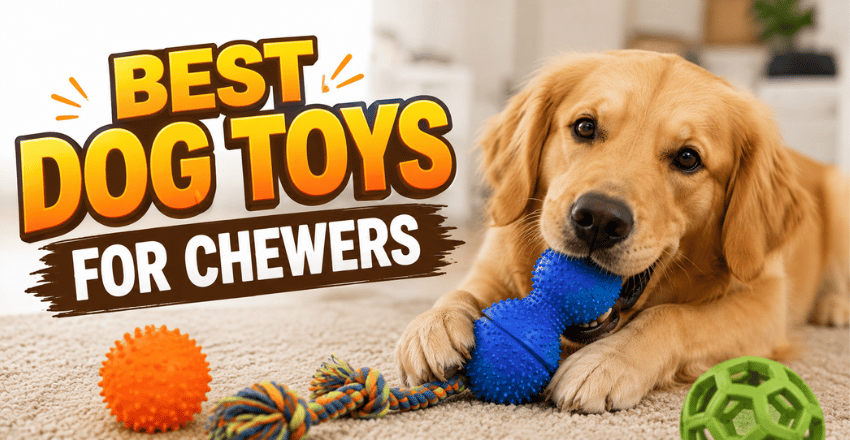
Natural rubber built for power chewers bends before a tooth does, and it fails gradually rather than shattering. KONG lists its black Extreme formula as “the most durable strength of KONG natural rubber” and points power chewers there rather than at the red Classic.
West Paw rates the Hurley bone as “Built for Tough Chewers” and pitches it as a bone alternative that will not splinter. They do have a weakness. Cost per month climbs with a real destroyer, because a dog that settles in on a rubber toy every single evening will eventually shave pieces off the rim.
Stuffable rubber doubles as a slow feeder.
Destructive chewing is often boredom with teeth attached. Pack a hollow rubber toy with part of the daily meal, and the reward becomes twenty minutes of licking and working. That is the part that settles a dog down.
KONG suggests stuffing the Extreme with kibble, topping it, and freezing it for a longer challenge. WesPaw’s Toppl holds a quarter cup in the small size and a cup and a quarter in the XL. The company also calls it top-rack dishwasher-safe. Either route is cheap enrichment next to a replacement sofa cushion.
Rope and fabric toys: supervised, never left out
Rope is fine for tug and fetch with you holding the other end. Alone is different. Shredded rope gives up long threads, and a bored dog swallows them without noticing.
Swallowed strands are a specific danger. One end anchors while the gut keeps trying to move the rest along. That is what makes a linear foreign body a surgical emergency rather than a wait-and-see. Take rope away the moment it frays.
Edible chews and what they really cost
Bully sticks and beef tendons are softer than antlers, so they treat teeth kindlier. They still carry two costs. The first is calories, because a chew is food and counts against the same daily allowance as biscuits. Our piece on peas and the 10 percent treat rule makes the same point about any extra you hand over.
The second is the end piece. A dog that gulps the last two inches of a bully stick has swallowed something the size of a wine cork. A holder such as West Paw’s Qwizl, which the company designed to grip bully sticks and dental chews, keeps that last stub out of reach.
The hard group to skip
Antlers, hooves, buffalo horns, nylon bones and weight-bearing beef bones share one property: they do not move under a thumbnail. Several of the biggest chew roundups still rank them highly because they last a week, which is exactly the durability trap this article is arguing against.
A chew that outlasts the tooth is not a bargain.
Named picks and how to size them
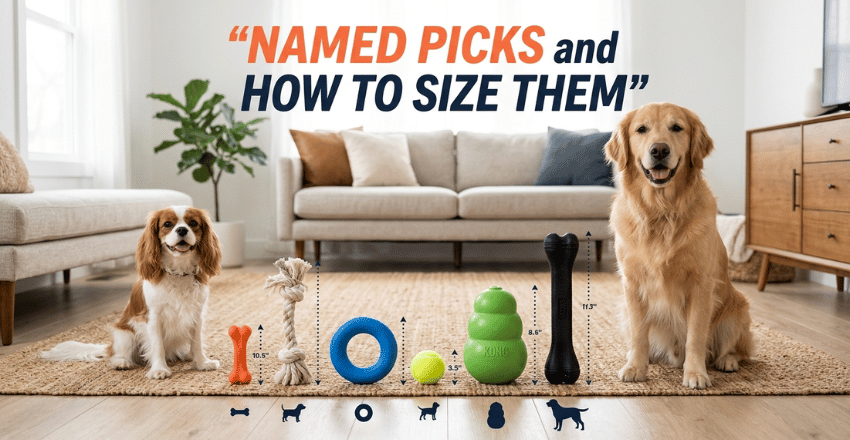
| Toy | What the maker claims | Sizes | Listed price | Where it wins | Where it falls short |
| KONG Extreme | “The most durable strength of KONG natural rubber”, made for power chewers | Small (up to 20 lbs) to XX-Large (85+ lbs) | From $8.99 | Stuffable, freezable, sized by weight | Heavy chewers still shave the rim |
| West Paw Hurley | “Built For Tough Chewers”, a bone alternative that will not splinter | 4.5 in, 6 in and 8.25 in | $12.95 to $20.95 | Floats, dishwasher safe, one solid piece | No cavity, so no feeding work |
| West Paw Toppl | “Built For Moderate Chewers” | Small, Large, XL (quarter cup to 1.25 cups) | $20.95 to $29.95 | Best slow feeder of the group | Not rated for the hardest chewers |
| West Paw Qwizl | “One of our toughest toys”, built to hold bully sticks | 5.5 in and 6.5 in | $21.95 to $26.95 | Stops the gulped end piece | Only useful if you buy edible chews |
| KONG Classic | Red rubber for “average chewers” | X-Small through XX-Large | $7.99 | Cheapest way to test stuffing | KONG sends power chewers to Extreme |
Prices are KONG and West Paw listings from August 2026, before retailer discounts.
Size up, never down
A toy small enough to sit fully behind the back teeth is a choking risk, and dogs grow into that risk as a toy wears down. KONG’s sizing runs by weight, from Small for dogs up to 20 lbs to XX-Large for dogs over 85 lbs. West Paw sizes by length instead, so a 65 lb Labrador wants the 8.25-inch Hurley rather than the 6-inch one.
When to throw a chewed toy away
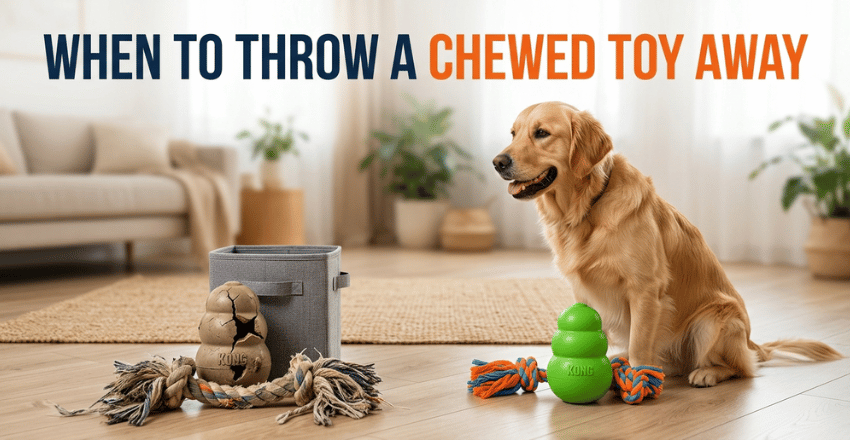
This is the section owners never see, and it matters more than the purchase. A destroyed toy is not a bargain that lasted well. It is an obstruction risk sitting on your floor.
Retire a toy when any of these show up:
- A chunk is missing, or you cannot account for a piece.
- Fragments come off small enough for your dog to swallow the whole.
- A seam is splitting, or rope has started to unravel into strands.
- The toy has worn down to where it fits behind the back teeth.
- Stuffing, squeakers, or plastic parts are exposed.
Swallowed rubber does not digest and does not show a plain X-ray the way a coin does. It behaves like any other indigestible object, and our breakdown of nectarine pit risks in dogs lays out that timeline, including what the imaging and the surgery cost.
The verdict: best dog toys for chewers by chewer type
There is no single winner here, because the right pick depends on how your dog works a toy.
- Power chewer, unsupervised. KONG Extreme in the size above your dog’s weight, stuffed and frozen.
- Power chewer who needs a job—WestPaw Toppl for meals, with a Hurley for open play.
- Moderate chewer. KONG Classic first, and move up only if the red rubber starts coming apart.
- Shredder who destroys plush. Rubber only, with rope kept for supervised tug.
- Gulper. Qwizl with a bully stick, so the end piece never gets swallowed.
Note what is not on that list. : nontler, no hoof, no nylon bone.
FAQ
No, and honest makers say so. West Paw’s guarantee page states that it does not guarantee a toy is “totally indestructible”, because “normal wear and tear is, well, normal”. The company replaces a toy that fails its job within six months, once per design per household. Treat the word indestructible as marketing.
The best dog toys for chewers are durable but not rock-hard. Look for flexible rubber, reinforced toys, and designs that protect teeth while satisfying chewing habits.
Both fail the thumbnail test and the knee test, so both can fracture a premolar. Elk antler and buffalo horn still appear near the top of major chew roundups on durability grounds alone. Hardness is the reason to pass on them.
Leave them out and a dog will eventually swallow strands, so keep rope for tugs you take part in. Mammoth sells its Flossy Chews range through Amazon and Chewy rather than direct. Any brand of cotton rope carries the same risk once it frays.