
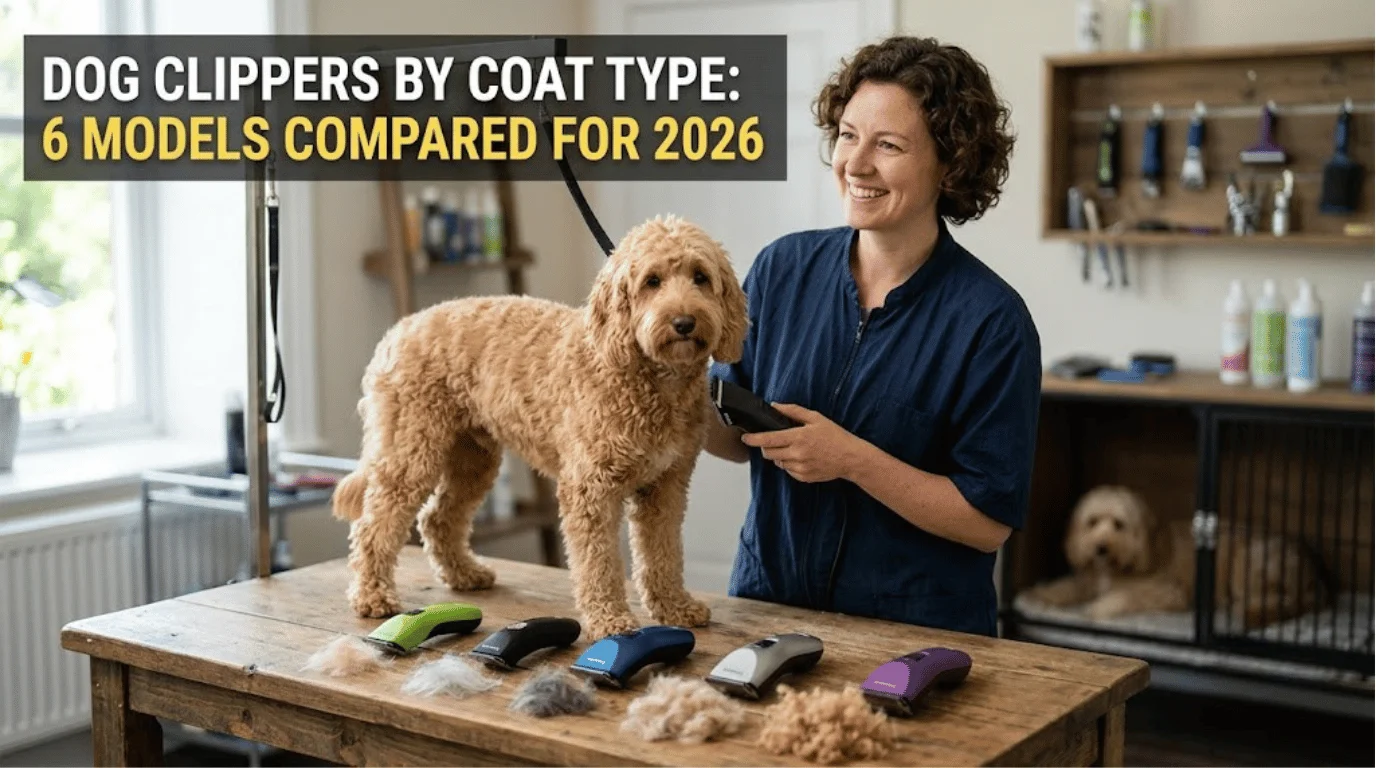
Coat type decides which dog clippers will work for you. Price does not. A machine that glides through a Beagle can stall on a Goldendoodle’s back, and the difference is the blade system and the motor. So this guide picks one for each coat instead of one winner for all of them. Our related guide, Dog Pool, goes further into this.
Short answer: buy for the coat. Fine silky hair wants a light cordless machine with a 5-in-1 blade. Dense double coats and curly doodle coats want a two-speed motor and detachable A5 blades. Wiry coats want torque and a very sharp blade. Short smooth coats barely need a clipper at all. You might also like Dog Names From Movies.
Match the machine to the coat, not to the price
Almost every roundup on page one hands you a single “best overall” pick, as though a Maltese and a Husky presented the same job. They don’t. Here is what each coat actually asks of the tool.
| Coat type | Example breeds | What the coat demands | Blade system that suits |
| Fine and silky | Yorkshire Terrier, Maltese, Shih Tzu | Lightweight, low vibration, quiet running | 5-in-1 adjustable |
| Dense double | Siberian Husky, Golden Retriever, German Shepherd | Steady power through packed undercoat | Detachable A5 |
| Curly and dense | Poodle, Goldendoodle, Bichon Frise | Two speeds, torque, and a spare blade | Detachable A5 |
| Wiry | Schnauzer, Airedale, Wire Fox Terrier | A sharp blade and a cool-running motor | Detachable A5 |
| Short and smooth | Labrador, Beagle, Boxer | Sanitary trims and tidy-ups only | 5-in-1, or a small trimmer |
Key takeaways
- The blade system, not the housing, is what you are really buying.
- A curly doodle coat is the one that kills cheap motors. Husky undercoat is easier.
- Detachable A5 blades cost $30.99 to $36.99 each at Andis list prices, so the blades outrun the machine fast.
- A 5-in-1 blade tops out near an eighth of an inch, so longer trims need guard combs.
- Heat is the real hazard. Budget for a spare blade and a can of coolant spray from day one.
Six dog clippers compared side by side
| Model | Blade system | Speed | Power | Noise and vibration | Best-fit coat | Maker’s list price |
| Wahl KM10+ | Detachable A5 | 3,000 and 3,700 SPM | Corded | Brushless; Wahl says it runs cooler and quieter | Dense double, curly | $199.99 |
| Andis AGC2 | Detachable A5 | Two speeds, SPM not published | Corded, 14 foot cord | Rotary, ordinary for the class | All-round workhorse | $149.99 |
| Andis Pulse ZR II | Detachable A5 | Five speeds, SPM not published | Cordless, dockable | Rotary, gentler on the lowest setting | Curly and dense, cord-free | $369.99 |
| Oster Turbo A5 2-Speed | Detachable A5 | Over 4,000 SPM | Corded, 45 watts | Heaviest here at 2.05 lbs | Wiry and coarse | Not listed |
| Wahl Bravura Lithium | 5-in-1 adjustable | Single speed | Cordless | 1 lb, light in the hand | Fine silky, tidy-ups | $210.99 |
| Wahl Arco | 5-in-1 adjustable, #9 to #40 | Single speed | Cordless, two 80-minute batteries | Wahl calls it quiet and low vibration | Fine silky, nervous dogs | Not listed |
Two notes on that table. Prices are the makers’ own listed US prices on August 2, 2026, and two models showed no price that day. Nobody publishes decibel figures here, so the noise column reports motor type and the maker’s wording, not a measurement.
Detachable blades or a 5-in-1: the cost you don’t see

This choice decides what you spend over the next five years, and most buying guides skip it in a sentence. An A5 detachable system takes one blade per cutting length: unclip a #10, clip on a #4F. A 5-in-1 blade stays on the machine and slides through five settings with a lever.
The lever sounds like the obvious win until you price the coverage. Andis lists its CeramicEdge detachable blades at $30.99 to $36.99 each, so four working lengths add roughly $125 to $148. That is nearly the cost of the $149.99 AGC2 all over again. A Wahl 5-in-1 replacement blade is $37.99 and covers its whole range. Our coat care and grooming guides go deeper on how often each coat needs the work done.
Detachable A5, the trade-off
- Pro: each blade is a proper steel cutting edge, and it can be resharpened for years.
- Pro: it reaches long finish lengths that a lever blade cannot.
- Con: the blade collection costs more than the clipper.
- Con: swapping mid-groom interrupts you, and a dropped blade chips.
5-in-1 adjustable, the trade-off
- Pro: one blade, five lengths, no shopping list.
- Pro: lighter machines, which matters on a wriggling small dog.
- Con: Wahl’s own settings run from #9 down to #40, and the longest is about an eighth of an inch.
- Con: Anything longer than that needs guard combs snapped over the top.
So the teddy bear trim owners want on a doodle, roughly half an inch of fluff, is beyond a bare 5-in-1 blade. Buy combs, or buy a #4F.
Motor speed, and why a doodle stalls a cheap motor
Strokes per minute tells you how fast the cutting blade travels across the still one underneath it. Higher usually means the machine pushes through density instead of grabbing at it. Wahl puts the KM10 at 3,000 and 3,700 strokes per minute and the KM5 at 3,000 and 3,500. Oster rates the Turbo A5 at over 4,000.
Andis is the interesting one. Its AGC pages list a dual-speed rotary motor and a 14-foot cord, and publish no strokes-per-minute figure at all. Roundups quote numbers for those machines anyway. They are copying retailer listings, not the maker.
Now the part nobody says out loud. A Husky’s undercoat is thick, but it is loose, and it lifts. A doodle’s coat is curly and springy, and it grips the blade from every angle. That loads the motor continuously rather than in bursts, which is why two speeds matter more on a Goldendoodle than on a Malamute. Use low for legs and faces, high for the body.
Blade heat is the part most owners get wrong
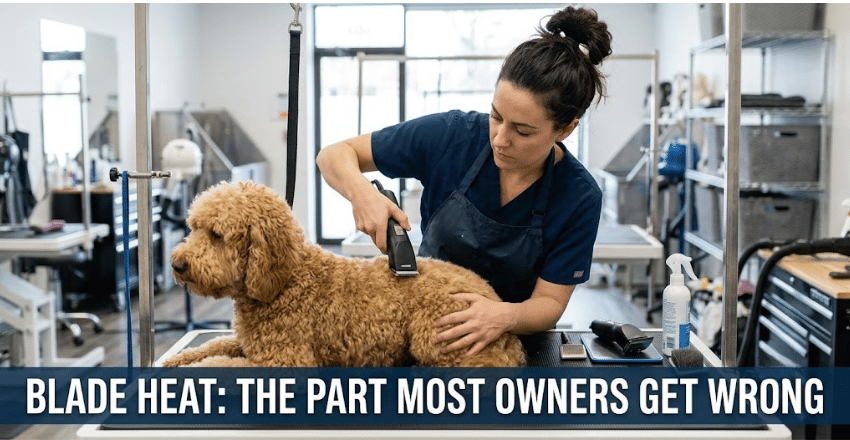
Blades warm up. On a dense coat, a #10 can get uncomfortably hot within about fifteen minutes of steady work. Skin marks from a hot blade are a genuine risk, not a scare story. Ceramic cutters shed heat faster than steel ones.
Four habits fix almost all of it:
- Touch the blade to the inside of your wrist every few minutes. If you flinch, stop.
- Keep a second blade in the same size and swap them, letting one cool while the other works.
- Spray coolant on the blade, then oil the teeth again once it has cooled.
- Take the coat down in stages instead of forcing one long pass through a pelt.
The spare blade is not a luxury. It is what lets you finish the groom.
Blade sizes and what they leave behind
Blade numbers run backwards from what people expect. The bigger the number, the shorter the cut. An F on the end means finish cut, which leaves a smoother surface.
| Blade | Cut length left | Typical job |
| #40 | 1/100 inch | Surgical prep, for a vet rather than a groomer |
| #30 | 1/50 inch | Pads of the feet, under a guard comb |
| #15 | 3/64 inch | Close work on face and feet |
| #10 | 1/16 inch | Sanitary areas, belly, inside the ears |
| #7F | 1/8 inch | Short summer body clip |
| #5F | 1/4 inch | General body work on most coats |
| #4F | 3/8 inch | The everyday doodle body length |
| #3F | 1/2 inch | Teddy bear trims, fluffier finish |
The verdict: one pick per coat type

Fine silky coats: Wahl Arco
Yorkie and Maltese hair parts under the blade rather than resisting it, so power is beside the point. What matters is a light body and a calm motor next to a small ear. Wahl lists the Arco at 1 pound, with a 5-in-1 blade running #9 to #40 and two batteries at up to 80 minutes each. Pro: groom two dogs without waiting. Con: single speed, and no long lengths without combs.
Dense double coats: Wahl KM10+
Golden and Husky undercoat needs steady torque and a machine that shrugs off heat over a long session. Wahl’s brushless motor is rated for over 10,000 hours and carries a five-year limited warranty, against two years on the rotary KM5. At 12.3 ounces, it beats the Oster on weight. Pro: five years of cover, more than double the KM5. Con: corded, at $199.99.
Curly and dense coats: Andis Pulse ZR II
Doodle and Poodle coats are the ones that expose a weak machine, so this is where five speeds earn their keep. The Pulse ZR II runs cordless, docks on a charger, and takes virtually all Andis blades. Pro: speed control plus freedom from the cord. Con: $369.99 is a lot, and the KM10+ handles the same coat for less if you accept the cord.
Wiry coats: Oster Turbo A5 2-Speed
Wire coats blunt edges quickly, so the answer is blade speed and a sharp #7F. Oster rates this one at over 4,000 strokes per minute and ships it with a #10 CryogenX blade. Pro: brute speed for coarse hair. Con: 2.05 pounds is heavy after twenty minutes. Terrier owners should read up on hand stripping first, because clipping softens a wire coat’s texture permanently.
Short smooth coats: honestly, skip the big machine
A Labrador does not need clipping. Neither does a Beagle. You want a small cordless unit for sanitary trims and paw tidy-ups, and the 1-pound Wahl Bravura Lithium covers that at $210.99. Pro: quiet and light for nervous dogs. Con: professional money for occasional work, so a basic trimmer may serve you better. There is more on routine coat care across the pet care articles on Petistra.
What to do next
Pick your dog’s coat off the first table, then buy the machine beside it. Order one spare blade in the length you will use most, plus coolant spray, before the first groom. Start on a back leg where a mistake hides, not on the face.
If you want to know about Dog Nail Clippers then visit our Pet Care category.
Dog clippers FAQ
Can you use human hair clippers on a dog? No. Human machines are geared for one hair type at one density, and dog coat loads them until they overheat or jam. Their blade teeth also catch loose undercoat.
Makers list the machines in this guide from $149.99 to $369.99. Add $30.99 to $36.99 for each detachable blade, or $37.99 for a 5-in-1 replacement, plus coolant spray and oil.
Cordless suits small dogs and short sessions. Corded suits a full body clip on a big coat, because you never lose power halfway down a flank.
Never cut mats out with scissors, and never bathe a matted dog, since water tightens the mat. Slide a #10 blade flat underneath and take the pelt off in one piece. If the mat is tight to the skin or the skin looks sore, book a groomer instead.
A blade that pulls, leaves tracks, or stops biting on a clean coat wants sharpening. That costs a fraction of a new blade, several times over.