

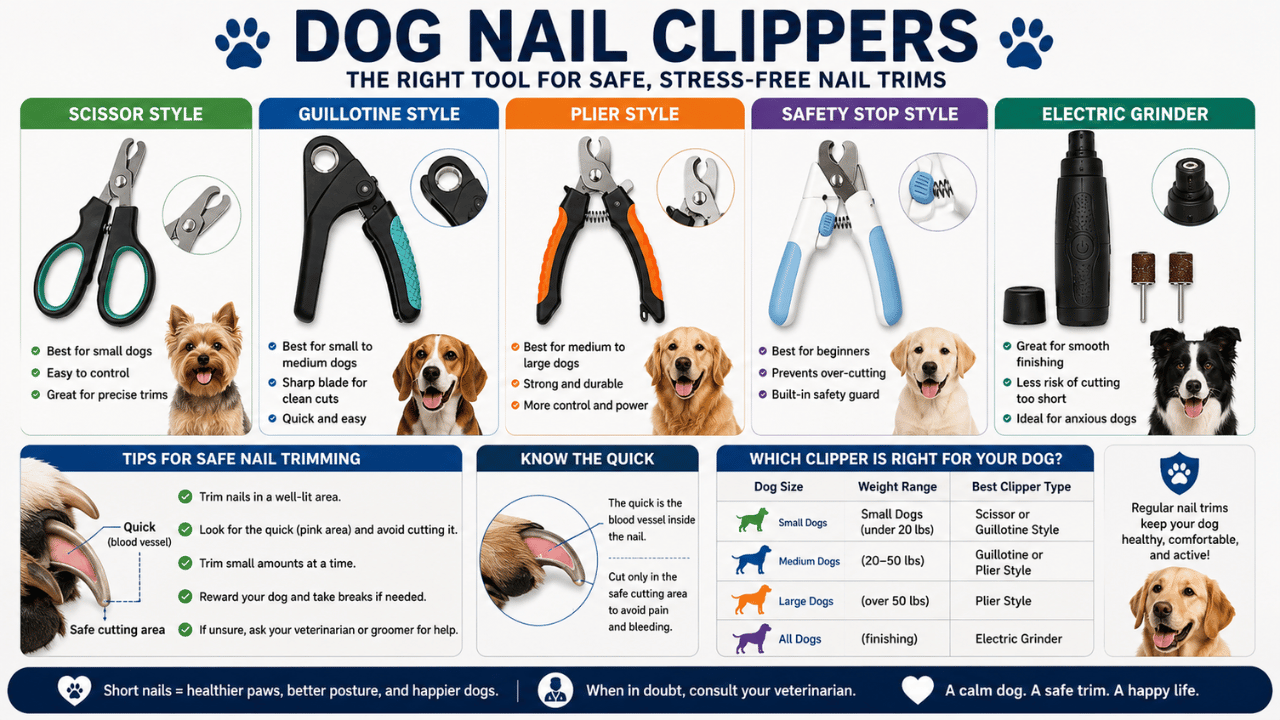
Almost every guide sorts dog nail clippers by how much the dog weighs, and that is the wrong axis. A 35 lb terrier often grows denser, thicker nails than a 70 lb greyhound. Buy for the greyhound, and the blade stalls halfway through the terrier’s toe. There is more on this in Best Dog Clippers by Coat Type.
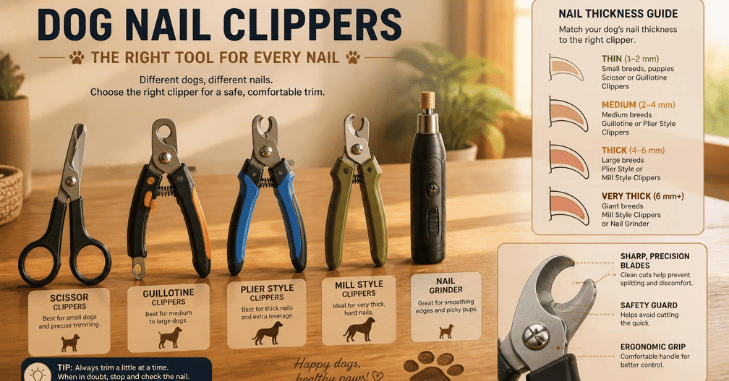
Short answer: match the tool to the nail, not the dog. Thin, flat nails cut cleanly with any sharp plier-style trimmer or a small LED model. Thick, oval nails need a large plier-style tool like the Millers Forge orange handle or a grinder such as the Dremel PawControl. Avoid guillotines on thick nails.
| Nail type | Mechanism that works | What to check before buying |
| Thin and flat (many toy breeds, sighthounds, puppies) | Small-piercer-style, or an LED clipper | Blade sharpness, a jaw small enough to see past |
| Medium, slightly oval (most 25- to 55-pound dogs) | Medium-piercer style | Spring tension, a handle you can squeeze one-handed |
| Thick and dense (working breeds, many large dogs) | Large-piercer style, or a grinder | Jaw width, steel thickness, replaceable blade or bands |
| Black or opaque, any thickness | Grinder, or a plier style with small cuts | Whether you can see the cut face clearly |
| Brittle or splitting | Grinder | Speed settings and a guard that catches dust |
TL;DR
- Nail thickness picks the tool. Body weight is a rough proxy at best.
- Resco’s own sizing rule is the clearest test anyone publishes: compare the nail to a number 2 pencil.
- Plier-style trimmers slice. Guillotines pull the nail sideways and crush thick ones.
- Grinders suit black and brittle nails, but a real share of dogs refuse the noise.
- A sharp blade matters more than any feature printed on the packaging.
Nail Thickness, Not Body Weight, Decides the Tool
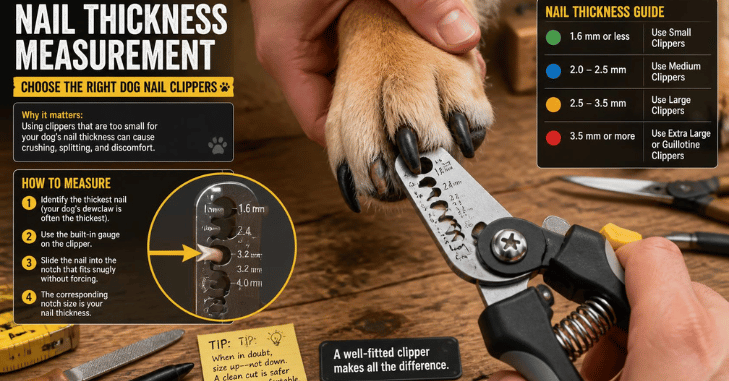
Nail thickness varies far more than shelf labels admit. Dogs bred to dig or work rough ground grow dense, oval nails with a wide base. Sighthounds, many toy breeds, and most puppies grow thin, flat ones. Weight barely predicts either.
Dog Nail Clippers Resco publishes the only sizing test worth repeating. Its guidance asks you to hold the nail next to a number 2 pencil. If it’s thinner than the pencil, the regular size fits, which the company pairs with dogs around 10 to 50 lbs. If it’s thicker than the pencil, you want the large.
Try That Comparison Even If You’re Buying a Different Brand
Check the dew claws separately. They sit off the ground, never wear down, and often stay thinner than the front nails on the same paw. Plenty of owners size a tool for the big front nails and then find the jaw too clumsy for a dew claw. Paw Care sits alongside feeding and behavior in our pet’s care hub, and the same rule applies across all of it: measure the thing you are working on.
The Four Mechanisms and What Each One Actually Does
Scissor and Plier Style
Two curved blades close past each other and shear the nail. You control the angle, which lets you take the tip at the natural slope rather than square across. This is what most groomers reach for.
- Pros: full-angle control, no loop to line up, strong leverage, sizes from toy to giant breed, cheap to own.
- Cons: Blades are rarely replaceable, so a dull pair becomes a landfill. Cheap ones flex under load.
Guillotine
You feed the nail through a metal loop and a single blade rises to slice it off. On a thin nail this works fine. On a thick one, the loop has to sit at an awkward angle to fit, so the nail gets pushed sideways as the blade climbs.
The result is a crush and a twist rather than a clean slice. Whole Dog Journal notes that the single blade can dull or separate from the loop over time and leave a jagged, irregular cut. That mechanism is a large part of why groomers moved away from guillotines for big dogs.
- Pros: genuinely easy on thin nails, and Resco’s models take replacement blades, which almost no plier-style tool does.
- Cons: poor on-thick nails, the loop limits your cutting angle, and the blade needs swapping to stay honest.
Grinders
The rotary head sands the nail down instead of cutting it. Nothing snaps, so brittle nails stop splitting, and you can take a hair off at a time on a black nail where you cannot read the cut face.
Two honest drawbacks get skipped in most roundups. First, noise and vibration: a real proportion of dogs never accept a grinder, however slowly you introduce it, and no technique fixes that for every dog. Second, friction makes heat. Hold the head on one nail too long, and the toe warms up fast, which is why owners work in short passes and move to the next nail.
- Pros: safest option on black nails, smooth finish with no sharp edge, forgiving of small mistakes.
- Cons: slow, noisy, dusty, needs charging, and some dogs refuse it.
LED Quick Sensor Clippers
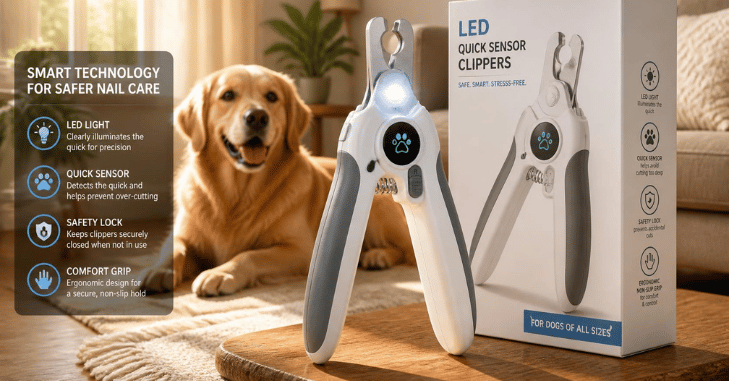
These are ordinary plier-style trimmers with a light in the jaw. Marketing calls it a quick sensor, which oversells it. There is no sensor. Instead, a bright light shines through the nail so the pink quick shows as a shadow.
On pale nails, that genuinely helps, and it is a good reason to buy one for a small dog. On a black nail, light barely passes through the keratin, so you get very little. Read the claims with that in mind and treat the light as a lamp, not a safety system.
- Pros: real help on pale nails, usually cheap, often includes a lock and a file.
- Cons: little use on black nails, batteries to replace, and most models are built for small pets.
Dog Nail Clippers Compared: Six Models Side By Side
The retailers named checked out at these prices on August 2, 2026, and they move around. Treat them as a band, not a quote.
| Model | Mechanism | Suits | Replaceable blade | Price band |
| Miller’s Forge Nail Clipper (orange handle) | Plier style | Thick, medium- and large-sized dogs | No | About $20 for the medium at Chewy |
| Safari Professional Nail Trimmer | Plier style with safety stop | Small and large, two sizes | No | $14.49 small/medium, $18.99 medium/large at Chewy |
| Boshel Dog Nail Clipper | Plier style with guard and lock | Small and medium nails | No | Around $12 to $16 |
| Resco Deluxe | Guillotine | Thin to medium nails, sized by the pencil test | Yes, patented blade swap | Roughly $15 to $25, blade packs sold separately |
| Dremel PawControl 7760-PGK | Grinder, 4V cordless | Black, brittle, or very thick nails | Sanding bands, sold in packs | $63.99 at Chewy |
| PETKIT LED Nail Clipper | Plier style with LED | Cats and small dogs, pale nails | No | $14.99 at Chewy |
Two details in that table do more work than the star ratings. Only Resco lists a blade you can swap, and only the Dremel comes with a graded paw guide, which Dremel specifies with three nail-length settings and four speeds.
The Verdict by Dog Size and Nail Type
There isn’t a single best pick here, because the nail decides. Take the line that describes your dog.
- Large dog, thick nails: the large Millers Forge orange handle. Its stainless jaw shears a dense nail without flexing, and Chewy prices the medium at $20.63.
- Large dog, black nails: the Dremel PawControl. You trade speed for the ability to stop the moment the cut face changes color.
- Medium dog, average nails: the Safari Professional. It costs less than the Millers Forge, and the safety stop is adjustable rather than fixed.
- Small dog or puppy: the PETKIT LED clipper or the small Boshel. Both are sized for a nail you can see through.
- Thin nails and a steady hand: the Resco Deluxe, and only here. Buy the blade pack with it.
- Brittle, splitting nails: a grinder, whichever brand fits your budget. Cutting makes splitting worse.
A Sharp Blade Beats Every Feature on the Box
Ask any groomer why a trimmer feels weak and the answer is rarely the design. It is the edge. A dull blade compresses the nail before it parts it, and the dog feels that pinch through the whole toe.
Three signs tell you the edge has gone:
- The nail whitens or flattens at the cut line before it separates.
- You need two squeezes where you used to need one.
- The cut face looks ragged and frayed instead of smooth.
That is the argument for Resco’s replaceable blade, and it is the strongest thing the guillotine design has going for it. Everywhere else, budget for a new tool every few years rather than sharpening a cheap one.
The Safety Guard Almost Nobody Adjusts
The guard is a small plate that stops the blade closing past a set point. It is genuinely useful on the first few trims, when you have no feel for how far to go.
The problem is what happens next. Owners set the guard once and leave it there for years. Meanwhile, the quick recedes as you trim regularly, so the safe cutting point moves further down the nail and the guard is now the thing stopping you from making progress. Some models fix the guard in place entirely, which suits nobody after month one.
Set it, use it while you learn, then move it or swing it out of the way. New care write-ups land on the Petistra blog as they publish, and grooming questions turn up there more often than any other kind.
Cutting the Quick and What to Keep on Hand
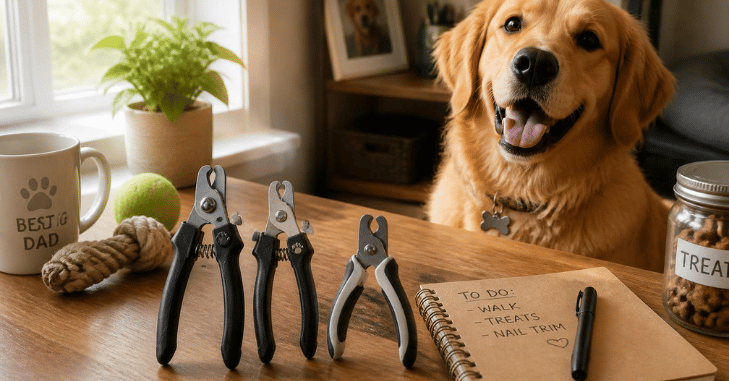
The quick is the bundle of blood vessels and nerves running inside the nail. Cut it, and the nail bleeds, and the dog hurts, which is the single outcome every buyer is trying to avoid.
Buy styptic powder at the same time as the trimmer, before you need it. Washington State University’s Veterinary Teaching Hospital recommends keeping some on hand for exactly this. Its 2026 nail clipping guidance notes that a nail cut too short can take about 5 minutes to stop bleeding on its own. Five minutes is a long time with a frightened dog on your lap.
Watch the cut face rather than the tip. As you get close, a gray to pink oval appears in the center of the pale nail, and that is your stop signal. On black nails, you cannot see it, which is the whole case for a grinder.
Your Next Step
Dog Nail Clippers: Hold your dog’s nail beside a number 2 pencil tonight and note which side of that line it falls on. Then buy the size that matches, plus a tub of styptic powder. That one comparison will save you more grief than any feature list on a box.
Frequently Asked Questions
A large plier-style trimmer, or a grinder. Both apply force along the nail rather than across it. Guillotines struggle because the loop pushes a thick nail sideways as the blade rises.
Bad is strong, but they are the wrong fit. The loop has to clear the nail, and on a 60 lb working dog, that means a poor angle and a crushing cut. Keep them for thin nails, and swap the blade when it dulls.
They work better on black, brittle, or very thick nails. They work worse on a dog that hates noise. Most homes end up owning both and using the grinder to smooth what the trimmer cut.
Every two to four weeks for most dogs. If you can hear nails tapping on a hard floor, you are overdue. Frequent small trims let the quick recede, which makes each session easier.
Yes, unless the blade swaps out. A stainless plier-style tool used at home stays usable for years, but the edge fades, and the cut gets rougher. When two squeezes replace one, replace the tool.
Use it while you’re learning, then adjust it. A guard set for a puppy’s nail will block a useful cut a year later, because the quick has receded and the safe point has moved.