
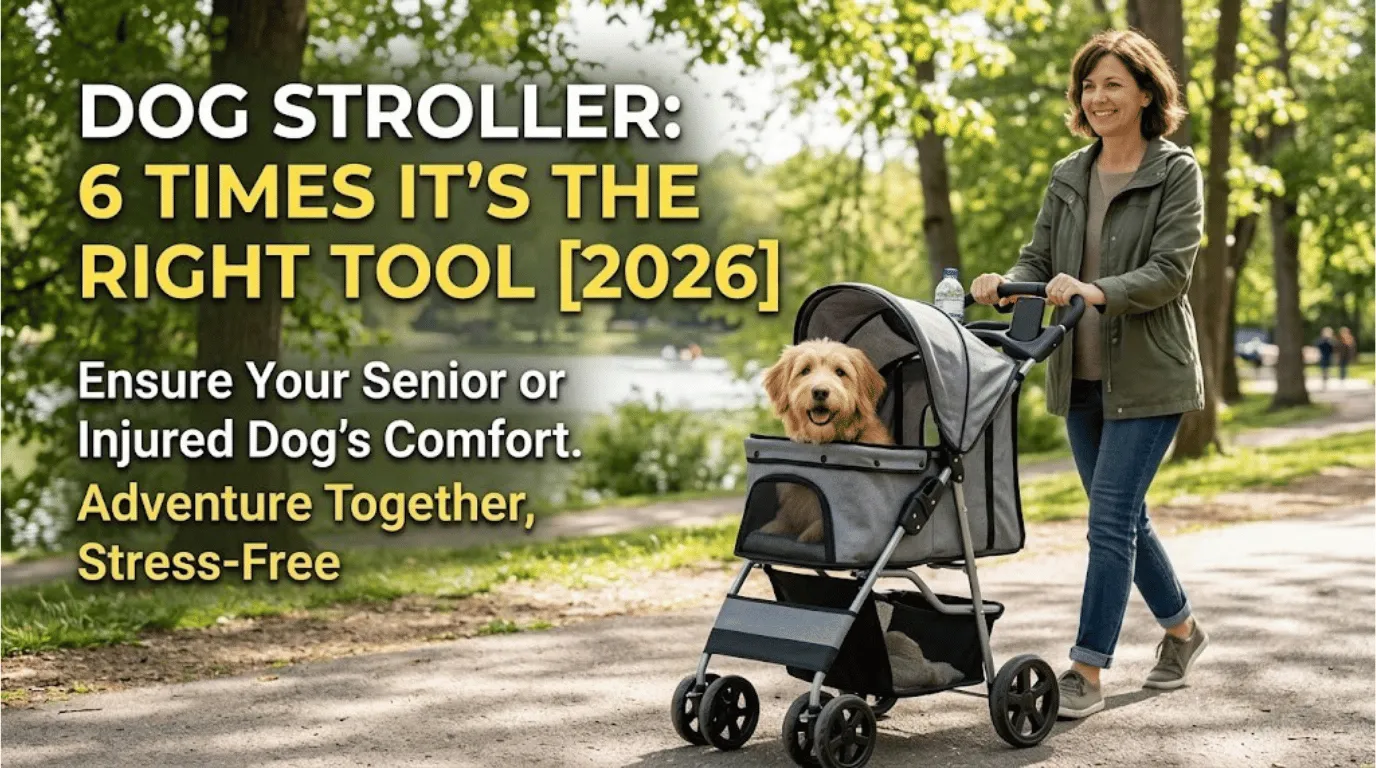
Buying a dog stroller feels ridiculous right up until the day your dog needs one. It replaces nothing about a normal walk, and it is not a costume. For a short list of dogs, it is the one bit of gear that keeps them getting outside. Here is who it suits, what the spec sheets hide, and which models hold up.
Short version: the purchase is worth it when a dog still wants the outing but cannot cover the distance. That covers seniors, dogs on restricted activity after surgery, and flat-faced breeds in summer. It also covers small dogs in crowds, dogs weakened by treatment, and puppies mid-socialization who are not fully vaccinated.
Match the case to the feature that solves it
| Your situation | What the ride has to do | The feature that decides it |
| Senior or arthritic dog | Carry the dog for the back half of a walk | Low step-in height, cabin long enough to lie down |
| Recovering from surgery or injury | Keep exertion near zero under vet orders | Rear entry so you do not lift, interior tether |
| Flat-faced breed in warm weather | Cut walking time without cutting the outing | Large mesh panels, roll-up canopy, top window |
| Small dog at a busy event | Keep paws out from under strangers’ feet | Enclosed sides, secure latch, rear brakes |
| Dog on treatment and tiring fast | Let the dog stop without ending the walk | Padded floor, easy one-hand fold |
| Puppy not yet fully vaccinated | Show the world without paws on the ground | Panoramic window, light frame you can lift |
Key takeaways
- The listed weight capacity and the usable cabin are different numbers. Check both.
- Hard plastic wheels are sidewalk only. Grass, gravel, and rough ground need something bigger.
- A swivel front wheel turns; a locked front wheel is what you want for jogging.
- Published folded dimensions tell you whether it fits your trunk. Measure first.
- Ventilation is the difference between a dog that rides happily and one that never gets in twice.
Six genuine cases, and the novelty test

Most buying guides open with product cards, which skips the question everyone has: are dog strollers silly? Here is the honest filter. If your dog matches one of these six, the purchase is sensible gear. If not, it is a novelty, and you can keep your money.
- The senior who still wants to go. Arthritic dogs often manage the first ten minutes and nothing after. Rolling the return leg keeps the sniffing without the limping.
- The post-op dog on restricted activity. When a vet says limit exertion for six weeks, a dog that still needs air has two options: the yard, or wheels.
- The flat-faced breed in July. Pugs, Bulldogs, and French Bulldogs overheat on walks other dogs shrug off.
- The small dog at a crowded event. A ten-pound dog at a street fair is at real risk of being stepped on.
- The dog partway through treatment. Chemotherapy and long medication courses leave good days and flat days, and the flat days still deserve an outing.
- The unvaccinated puppy. The socialization window closes early, and the vet has warned you off shared ground.
That last case gets almost no coverage, and it is the one I would argue hardest for. A puppy needs to see traffic, hear a leaf blower, and meet strangers well before its final shots clear it for dog parks. Riding lets it take all of that in with its feet off the ground.
Numbers back the heat case. A 2020 study in Scientific Reports, using UK primary care veterinary records, found brachycephalic dogs had 2.10 times the odds of heat-related illness. That comparison was against medium-muzzled dogs, and Bulldogs showed the highest incidence at 0.42%. Shade, mesh, and a shorter walk are not fussing over a flat-faced dog. They answer a doubled risk.
Mobility trouble rarely shows up on its own. The Petistra pets guides cover the everyday care that tends to arrive alongside it.
Weight capacity is the number that misleads
Every listing leads with a capacity figure, and it is the least useful spec on the page. Rated to 45 pounds means only that the wheels and joints will not fail. It says nothing about whether your 40-pound dog can turn around in there.
Look at Petco’s own listings. The Pet Gear Orchid Special Edition No-Zip is rated for 45 pounds, and its cabin measures 25.5 by 11 by 20.5 inches. Eleven inches is narrower than most 45-pound dogs are wide when they lie on their side. The Happy Trails Lite No-Zip is rated for 25 pounds with a cabin 11.5 inches across.
So run two checks before you buy a dog stroller. First, your dog’s weight against the rating. Second, your dog’s length from nose to tail base, and shoulder width lying down, against the published cabin. If the maker does not publish interior dimensions, treat the capacity claim as a frame rating and nothing more.
Wheels decide where you can push it.
Wheel size and material set the boundary of where this thing is usable at all. Small hard plastic wheels, standard on most budget models, are fine on smooth sidewalks and hopeless off them. Grass grabs them. Gravel stops them dead.
Rough ground and dirt trails need larger wheels, and air-filled tires roll over broken surfaces far better than solid ones do. The catch is punctures, so an air tire model means owning a pump. None of the widely stocked retail models below publish an air tire spec. If you want one, shop the jogger category and read the tire line carefully.
Front wheel choice is a separate decision. Swivel steering pivots through tight turns and crowded sidewalks. A locked front wheel tracks straight, which is what you need if you plan to jog. Petco lists the Gen7Pets Promenade with convertible front wheels, and the Pet Gear Orchid Special Edition with a front locking wheel plus front shock absorbers. Convertible is the safer buy if you are undecided.
Brakes, folded size and mesh
Rear brakes appear on nearly everything here, including the Pet Gear Travel Lite and the No-Zip Expedition. Test them on a slope in the shop or the driveway, because a parking brake that only holds on flat ground is not a brake.
Folded dimensions are published, and almost nobody reads them. The Happy Trails Lite No-Zip folds to 35.5 by 16.5 by 11 inches. Its Orchid Special Edition sibling folds to 33 by 21 by 11 inches. Measure your trunk opening, not the trunk floor, since the opening is what stops most of these.
Then there is airflow. One small window turns a canopy into a warm box by mid-afternoon. Look for mesh on at least two sides plus a top panel that unzips or rolls back. Fixed plastic windows are the wrong answer. Open every panel in the shop.
Five dog stroller picks compared
| Model | Listed capacity | Cabin (L x W x H) | Notable hardware | Petco price |
| Pet Gear Travel Lite | 15 lb | 15.5 x 11 x 23 in | Rear brakes, 8.5 lb frame | $94.99 |
| Pet Gear Happy Trails Lite No-Zip | 25 lb | 21.5 x 11.5 x 17 in | Plastic wheels, one-hand fold | $129.99 |
| Pet Gear Orchid Special Edition No-Zip | 45 lb | 25.5 x 11 x 20.5 in | Front locking wheel, shock absorbers, tether | $189.99 |
| Gen7Pets Promenade | 50 lb | Not published | Convertible front wheels, rear brakes, tether | $229.99 |
| Pet Gear No-Zip Expedition | Not published | Not published | Front and rear entry, two tethers, 600D nylon | $269.99 |
Prices and specs above come from Petco’s product pages, read on August 2, 2026. Retail pricing moves, so treat them as a street-price guide rather than a quote.
- Travel Lite. Pro: 8.5 pounds so that anyone can lift it into a car. Con: 15 pounds is a hard ceiling, and the cabin is short.
- Happy Trails Lite No-Zip. Pro: the clamp entry beats fighting a zipper one-handed—con: plastic wheels, sidewalks only.
- Orchid Special Edition No-Zip. Pro: shock absorbers and a lockable front wheel at a mid price. Con: that 11-inch width undercuts the 45-pound rating.
- Gen7Pets Promenade. Pro: convertible front wheels cover both jogging and crowds. Con: no published interior, so measure in person.
- No-Zip Expedition. Pro: rear entry means you slide a stiff dog in instead of lifting. Con: 32 inches long, and the heaviest to store.
The verdict, case by case
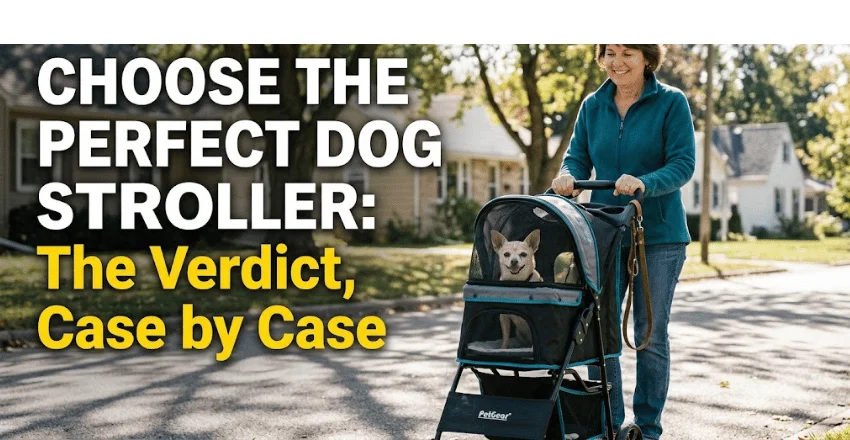
There is no single best pick here, because the six cases pull in different directions. Match yours.
- Small senior dog, daily neighborhood loops: Happy Trails Lite No-Zip, if your dog is under about 20 pounds.
- Occasional errands with a tiny dog: Travel Lite, purely on weight and price.
- Post-surgical medium dog that must be loaded without lifting: No-Zip Expedition for its rear entry.
- Medium dog, mixed sidewalks and park paths: Gen7Pets Promenade for the convertible front wheels.
- Flat-faced dog in a hot climate: whichever model gives you the most unzippable mesh, and go early in the morning.
- Jogging on trails: none of these five. Shop joggers with air-filled tires and a locking front wheel.
If your dog refuses to get in
Plenty of dogs balk the first time. Forcing it teaches the dog that it’s a trap, so work in this order.
- Park it open in the living room for two days and ignore it completely.
- Feed meals beside it, then in it, with the canopy off and the brakes on.
- Clip the tether and let the dog sit still inside for thirty seconds—release before it asks to leave.
- Push it three feet across a flat floor. Stop, treat, lift the dog out.
- Take it outside for one short block, then home.
Most dogs acclimate inside a week. If yours still refuses after that, the cabin is probably too small or too dark, which is a hardware problem rather than a training one. More dog care reading sits on the Petistra blog while you decide.
Safety rules that matter more than price
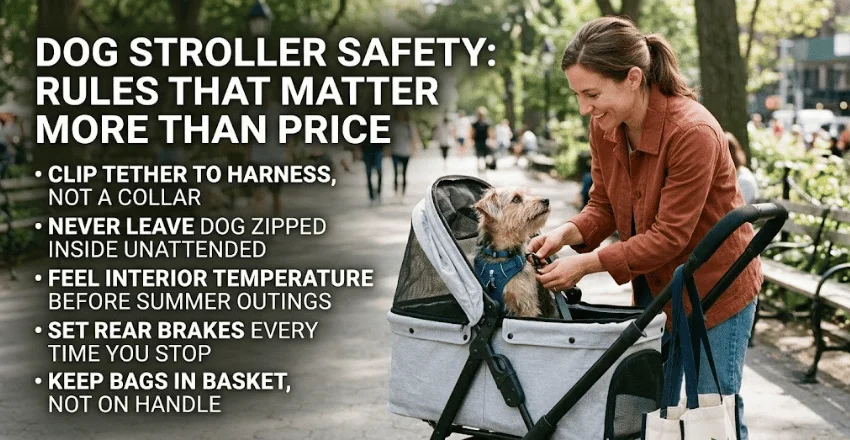
- Clip the interior tether to a harness, never to a collar.
- Never leave a dog zipped inside unattended, in a store or a car.
- Feel the interior with your hand before a summer outing. A shaded mesh enclosure can still sit well above the air temperature.
- Set the rear brakes every time you stop, even on ground that looks level.
- Keep bags in the basket, not hanging off the handle, or the whole thing tips backward.
What to do next
Weigh your dog, then measure it lying flat on its side. Take both numbers to a store that stocks these, open the cabin, and put your dog inside before paying. That five-minute check tells you more than any spec sheet, including this one.
If you want to know about Dog Leash Lengths Ranked, then visit our Accessories category.
FAQ
Only if you use it instead of walking, used as intended, it extends the outing for a dog that would otherwise turn back at the corner. Many owners walk out and roll home.
Only with a front wheel that locks straight. A free-swiveling front wheel wobbles at running pace and can fold under. Check the spec before you try it.
Common retail models run from 15 to 50 pounds. Bigger frames exist, but the cabin usually runs out before the frame does.
Folded, most of these sit around 33 to 36 inches long and 11 inches thick. Measure your trunk opening and compare it against the published folded size.
Usually not. A fit dog with no heat problem and no medical restriction gets nothing from riding, and you would be buying it for yourself.