


Most vegetable guides for dogs stop at the dinner plate. With this one, the plate is the least interesting part. Can dogs eat asparagus? Yes, plain cooked spears are fine in small amounts, but the plant they grow on is the real hazard.
Short answer: yes, but only the spear. Plain cooked spears, chopped small, are safe as an occasional treat for most dogs. Raw stalks are tough and can choke a gulper. The mature garden plant’s ferny foliage and red berries are toxic, and so is the houseplant sold as asparagus fern.
What each part of the plant does to a dog
| Part | Verdict | Why |
| Cooked spear tip, plain | Safe in small amounts | Soft enough to break down, low calorie, no toxic compounds |
| Raw spear | Risky | Stringy and hard to chew; whole pieces get swallowed |
| Woody bottom end | Throw it away | Roughly two and a half times the fiber of the tip, and indigestible |
| Mature foliage and red berries | Toxic | Vomiting, abdominal pain, diarrhea; skin reactions on contact |
| Asparagus fern houseplant | Toxic | Listed by the ASPCA as toxic to dogs and cats |
Key takeaways
- Cook it, chop it under half an inch, and keep it to a teaspoon or two for a small dog.
- The garden bed and the windowsill pot are the real hazards, not the vegetable drawer.
- Snap off the woody end. Your dog cannot digest it, and it can lodge in the gut.
- A sudden sulfur smell in the yard is the vegetable, not an infection.
- This is a low-value treat. It is fine, not medicinal.
The part of the plant that actually hurts dogs
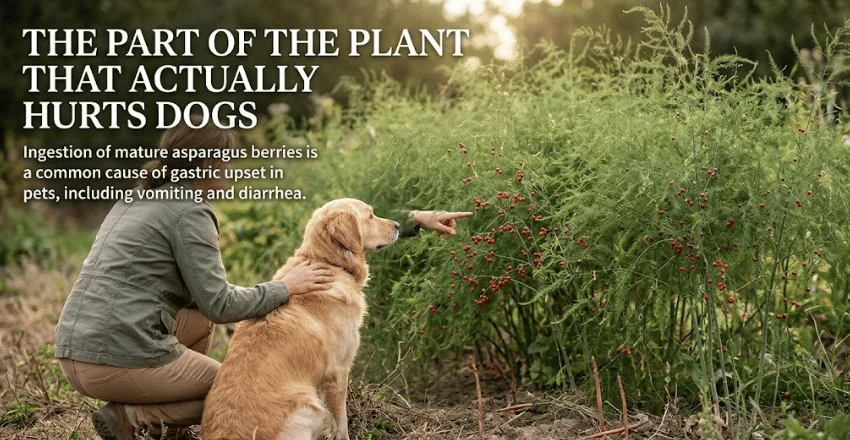
The spears you buy in March are the plant’s young shoots. Leave those shoots in the ground, and they open into a tall, feathery bush four to six feet high. By late summer, the female plants carry small red berries.
Those berries are the problem. The ASPCA’s toxic plant database lists berry ingestion as a cause of gastric upset in dogs, meaning vomiting, abdominal pain, or diarrhea. North Carolina State University’s Extension plant toolbox names the fruits and stems of Asparagus officinalis as its poisonous parts, and adds contact dermatitis from young raw shoots.
So a dog who noses through an unharvested asparagus patch in August is at more risk than a dog who licks your plate in April. That inversion is the thing almost no page tells you.
It’s the same pattern that trips owners up with stone fruit, where the flesh is harmless, and the seed is not. Our guide to the two pit risks in nectarines walks through the same edible-versus-inedible split in more detail.
Asparagus fern is a houseplant, not a vegetable.
The plant sold as asparagus fern, Asparagus densiflorus and its relatives, is not a fern and is not food. It is a decorative cousin of the vegetable, and it sits on a lot of shelves in hanging baskets.
Two things happen with it. A dog who chews the foliage or the berries gets stomach upset. A dog who brushes past it day after day can develop an itchy, inflamed muzzle or belly. The ASPCA calls that allergic dermatitis from repeated skin exposure.
Neither reaction usually kills a healthy dog. Both are miserable, and both are avoidable by moving the pot.
Can dogs eat asparagus raw, or does it need cooking?
Cook it. Raw stalks are one of the most fibrous vegetables in the average kitchen, and dogs are not built to grind them down. A dog with a gulping habit swallows a two-inch piece intact, and that piece arrives in the stomach exactly as it left the cutting board.
Bottom ends are worse than tips, and there is a measured gap between them. A 2024 study in the journal Foods found that total dietary fiber made up 57.7% of the dry matter in the woody by-product. In the edible portion of the spear, it was 22.9%. That is roughly two and a half times as much fiber, packed into the piece people hand over because they were not going to eat it.
Use the snap test. Hold a raw stalk at both ends, bend it, and it breaks where the tender part meets the woody part. Everything below that break goes in the bin.
Then cook what’s left until a fork slides in with no resistance, and chop it to pieces smaller than half an inch. Small breeds, flat-faced breeds,s and fast eaters need the smallest pieces you can be bothered to cut.
Cooking it softens most of the nutrition
Here is the honest part that the superfood write-ups skip.
Raw spears carry vitamin C, folate, and potassium. Vitamin C and folate are water soluble, so a long boil leaches them into the water you pour down the sink. The softer you cook it, the less is left. And soft is exactly what a dog’s gut needs.
Asparagus is also around 93% water by weight. Once you have boiled out the fragile vitamins, what reaches your dog is mostly water and fiber, plus a pleasant crunch that survives light steaming.
None of that is an argument against feeding it. It is an argument against believing it does anything. Treat it as a low-calorie snack, not a supplement. Want a green vegetable that holds more of its value through a quick cook? Our ranking of six pea types by safety covers better options.
How much is a safe portion

Treats of any kind should stay under 10% of your dog’s daily calories. Vegetables count. Start with less than you think, because the first serving is a test of tolerance rather than a meal.
| Dog weight | First serving | Regular portion |
| Under 20 lbs | 1/2 teaspoon, chopped | 1 teaspoon, twice a week |
| 20 to 50 lbs | 1 teaspoon | 1 to 2 teaspoons |
| 50 to 90 lbs | 2 teaspoons | 1 tablespoon |
| Over 90 lbs | 1 tablespoon | 2 tablespoons |
Gas and loose stools are the usual sign you went too far. Back off to half the amount and wait a few days.
What goes on the spears matters more than the spears. Butter, oil, salt, and cheese turn a low-calorie snack into a stomach ache, and the two seasonings people reach for most are the dangerous ones. Garlic and onion damage canine red blood cells, and the dose that does it is smaller than most owners expect. Our breakdown of the toxic garlic dose by weight sets out the numbers. Cook your dog’s portion separately, in plain water, before you season yours.
Why your dog’s pee suddenly smells
Asparagusic acid is a sulfur compound found in this vegetable and almost nowhere else. The body breaks it into small, volatile sulfur molecules that leave through urine, and the smell is sharp, cabbage-like, and hard to ignore.
It shows up fast. Many owners notice it on the very next trip outside, and it clears within a day.
This is where people call the vet. A strong, unfamiliar urine smell reads like a urinary tract infection, and the timing looks suspicious because dinner was hours ago. The difference is in the behavior, not the smell:
- Just the vegetable: smell only, normal squatting, normal volume, gone inside 24 hours.
- Call the vet: straining, frequent tiny puddles, blood, accidents indoors, licking at the area, or a smell that outlasts the day.
What to do if your dog ate the fern or the berries

Stay calm and work through it in order.
- Take the plant or a photo of it away from the dog, and note roughly how many berries are gone.
- Rinse the mouth and any red patches of skin with cool water.
- Call your vet or a pet poison line and describe the plant, the amount, and your dog’s weight.
- Do not make your dog vomit unless a vet tells you to.
- Offer water, skip the next meal if advised, and watch for the next 12 to 24 hours.
Get seen the same day for repeated vomiting, diarrhea that will not stop, drooling, wobbliness, a swollen face, or a puppy of any size that ate berries. Small dogs hit trouble on smaller quantities, so the threshold for calling is lower.
Then fix the access. Hanging baskets get moved, garden rows get fenced, and fallen berries get raked up in late summer.
The practical takeaway
Feed the tip, bin the stem, cook it plain, and keep the portion small. Then k at where the plant lives in your house and yard, because that is the risk this vegetable actually carries.
Tonight, snap one stalk at the break point, steam the top half, chop a teaspoon of it, and see how your dog handles it over the next day. If the answer is fine, you have a low-calorie training treat you already keep in the fridge. If the answer is gas, you have learned something and lost only one spear.
If you want to know about Can Dogs Have Pickles? then visit our Pet Food category.
Frequently asked questions
Better not to. Daily fiber at that level loosens stools in a lot of dogs and crowds out balanced food. Twice a week is plenty.
Yes. The ASPCA lists it as toxic to dogs and cats, with berry ingestion causing stomach upset and repeated skin contact causing allergic dermatitis.
Watch closely for 24 to 48 hours. Retching, refusing food, a hunched posture, or straining without producing stool means an obstruction, and that needs a vet immediately.
Skip both. Canned versions carry added sodium, and pickled ones bring vinegar, salt,, and often garlic. Frozen spears, thawed and steamed plain, are the easy substitute.
No. It is the sulfur compounds doing what they do in people to—onlyy the behavior signs listed above point to an infection.