

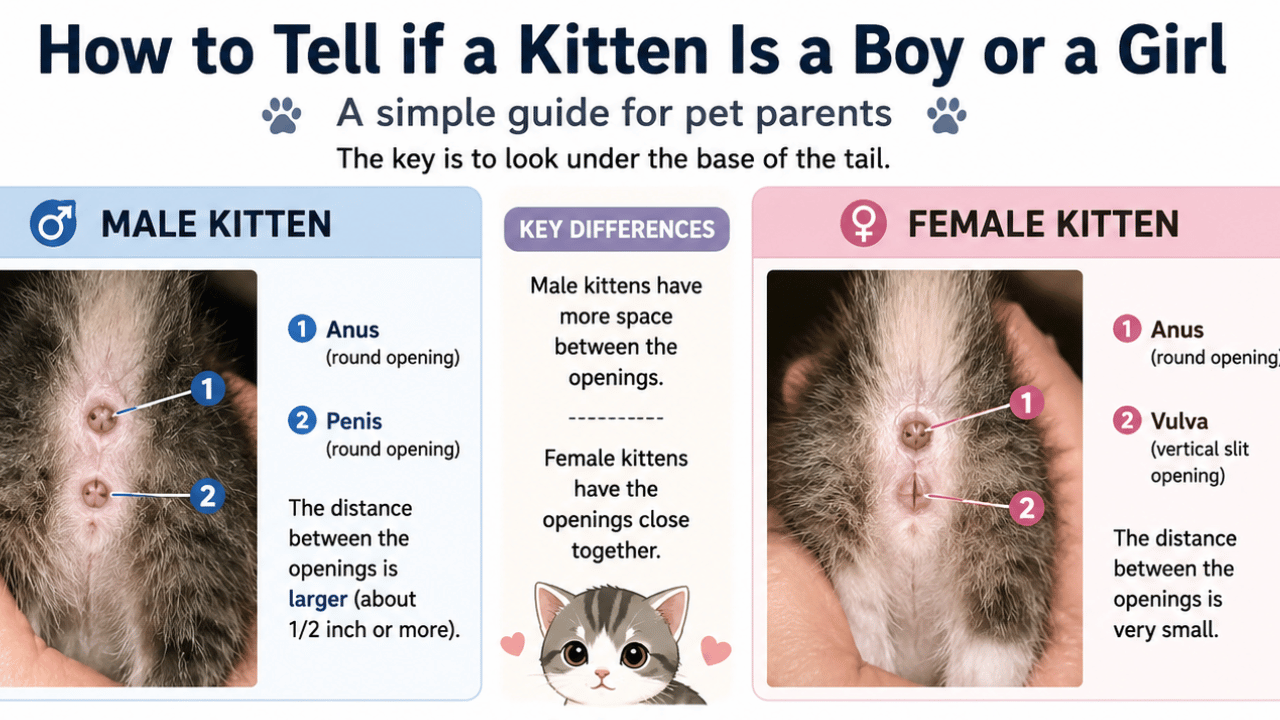
Lift the tail and read the spacing, not the shape. Knowing how to tell if a kitten is a boy or a girl comes down to one gap you can judge by eye in about ten seconds. Coat color adds a useful clue, and the age of the litter matters more than most guides admit.
Male and Female Signals at a Glance
| What do you check? | Male | Female |
| Gap between the two openings | About 1/2 inch on a young cat, over 1 inch on an adult | Under 1/4 inch, often almost touching |
| Lower opening | Small round dot | Narrow vertical slit |
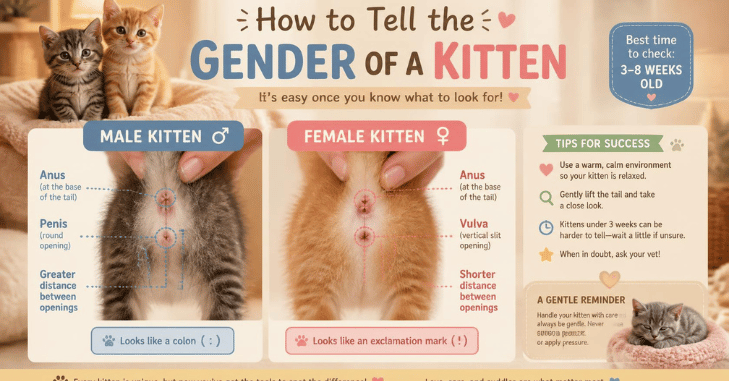
| Combined shape | Colon, two dots stacked apart | Upside-down exclamation mark, or a semicolon |
| Testicles | Often not visible until 6 to 8 weeks | None |
| Coat color odds | Orange-tabby lean male | Calico or tortoiseshell is almost always female. |
| Easiest age to check | 3 to 4 weeks and up |
Key Takeaways
- Spacing beats shape. Judge the gap first, then confirm with the outline of the lower opening.
- The first two weeks are the hardest window, so treat any early call as provisional.
- Testicles are a late signal and often stay hidden until six to eight weeks.
- Color is a probability, not proof. A calico is nearly always female, but rare males exist.
- A neonate chills fast, so keep the check under a minute and put her straight back.
The Short Answer: Read the Gap Under the Tail
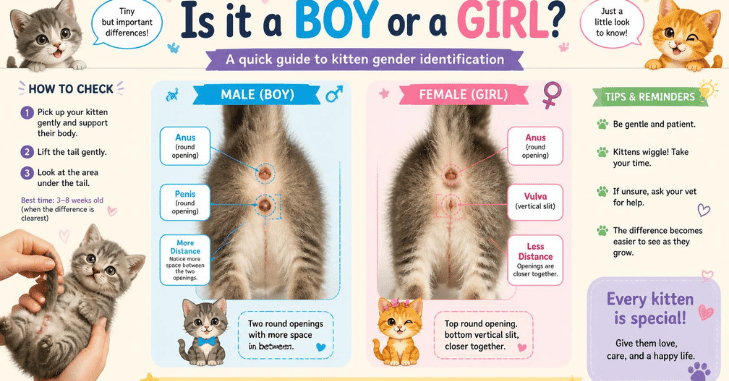
A male shows two openings set clearly apart, roughly half an inch, with a round opening sitting below the anus. That pair reads like a colon. A female shows a vertical slit tucked right under the anus, closer to an upside-down exclamation mark. The distance decides it, not the shape on its own.
How to Tell if a Kitten Is a Boy or a Girl Vets and shelter fosterers call that gap the anogenital distance. It is the whole method. Everything else on this page supports it.
What You’ll Need
Not much, and that is the point. Grab these before you pick anyone up.
- Clean, warm hands. Cold fingers make a newborn squirm and lose heat.
- A soft towel or fleece to rest her on.
- Good light. A phone flashlight held to the side works better than an overhead bulb.
- A phone camera, so you can zoom in later instead of staring longer.
- Ideally a littermate, because two bottoms side by side make the difference obvious.
How to Tell if a Kitten Is a Boy or a Girl: The Five Steps
- Wait for a calm moment. Pick a time when the litter has fed and settled. A hungry, wriggling baby tells you nothing.
- Support the whole body. Scoop her up with one hand under the chest and belly, keeping her upright. Never dangle a young cat by the scruff or the legs.
- Lift the tail straight up. Use one finger. You want a clear view of the two openings, not a wrestling match.
- Measure the gap by eye. Anus on top, second opening below. Half an inch of fur between them points male. A slit that starts almost immediately points to female.
- Check the outline, then put her back. A round dot means male, and a vertical slit means female. Return her to the nest within a minute and write down what you saw.
Compare two siblings if you can. One bottom in isolation is genuinely ambiguous, while two side by side are rarely close.
Why Age Changes the Answer
This is the part of page one that tends to be buried. Sexing is hardest in the first two weeks, when everything is tiny, swollen from birth, and covered in fine fur. Guesses made at three days old get corrected all the time, and shelters expect it.
By three to four weeks, the gap has opened up, and the difference is much easier to see. That is why experienced fosterers record a sex at intake and then recheck it before adoption paperwork goes out. If you named her at day two, be ready to change the name. You can find more cat- and dog-care reading across the pet care hub on Petistra while you wait for the litter to grow.
Testicles are the last piece to arrive. They are often not plainly visible until six to eight weeks, and sometimes later on in a small or slow-growing baby. Their absence at four weeks proves nothing.
Male vs. Female Kitten by Age
Most guides describe one snapshot. Below is the comparison broken down by age band, male versus female, with a column for how much weight to put on your call.
| Age | Male | Female | How confident should you be? |
| 0 to 2 weeks | Faint gap, no scrotal swelling | Openings nearly touching | Low. Recheck later. |
| 3 to 4 weeks | Clear gap, round opening | Slit sits tight under the anus. | Good. This is the sweet spot. |
| 6 to 8 weeks | Scrotum visible or easy to feel | No swelling, slit unchanged | High |
| 10 weeks and up | Gap over an inch, testicles obvious | Gap stays narrow. | Near certain |
Coat Color: A Real Clue With One Exception
Color is not folklore. The gene that makes a cat orange sits on the X chromosome, which is why the odds skew so hard by pattern. Roughly three in four orange tabbies are male, and a calico or tortoiseshell coat is almost always female.
The genetics behind that were pinned down recently. Researchers at Stanford University School of Medicine published a 2025 study in Current Biology on sex-linked orange. The team, led by Christopher Kaelin, traced it to a 5 kilobase deletion at the ARHGAP36 gene. They describe the patchwork coats of calico and tortoiseshell cats as a defining signature of random X-inactivation in females.
Here is the exception that matters. A male can carry two X chromosomes plus a Y, an XXY pattern, and that cat can wear a calico or tortoiseshell coat. These males turn up rarely and are usually sterile. So color moves the odds, and the gap under the tail settles the question.
Handling a Newborn Without Chilling Her

A very young cat cannot hold her own body heat. She cannot constrict the blood vessels in her skin, so warmth comes from her mother and her littermates. Alley Cat Allies puts the normal rectal temperature of a one-day-old at 92 to 97 degrees F. From two to twenty-one days, it sits between 96 and 100 degrees F. Room air at 70 degrees F pulls heat out of her fast.
Keep the whole check under a minute. Hold her against your body rather than out in the air, work over a towel, and return her to the nest the moment you have your answer. Watch the mother too. Mothers stressed by handling may move the litter or, at worst, reject a baby that smells wrong: short visits, clean hands, and low voices. For a closer look at this, see How to Cut Dog Nails Safely.
Cold is the emergency to know. Chilled newborns go limp and quiet, stop nursing, and need slow warming plus a vet call, not food.
Still Not Sure? Do This
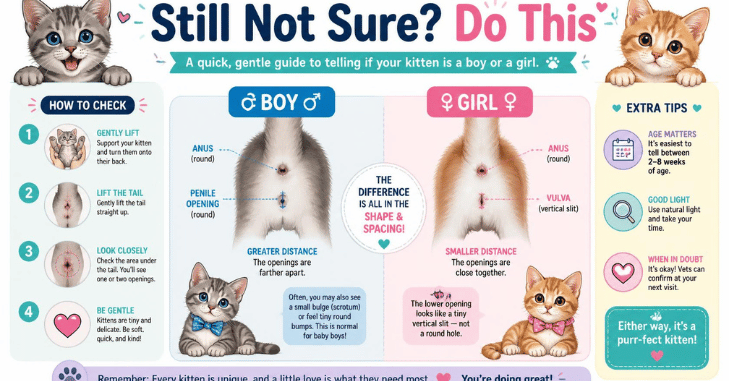
Photograph the area with the tail lifted and zoom in on the screen. Still images beat a wriggling target every time, and you can compare siblings frame by frame without holding anyone.
If two photos a week apart still leave you guessing, book a vet check. A vet can palpate for testicles that have not dropped and will settle them in seconds, usually during the first vaccination visit you were booking anyway. That timing folds the answer into an appointment you already need.
For more litter care reading, the Petistra blog archive covers the day-to-day side of raising pets. Whatever the answer turns out to be, plan the neuter or spay conversation for around four to six months.
Your Next Step
How to Tell if a Kitten Is a Boy or a Girl: Pick a quiet moment after the next feed, take one clear photo of each baby with the tail lifted, and compare the gaps side by side on a big screen. That single habit turns a coin flip into a reliable answer. Then set a reminder to recheck the week they turn four weeks old.
FAQs
From about three to four weeks, you can be reasonably confident. Before that, how to tell if a kitten is a boy or a girl is mostly guesswork, and vets often recheck at the six-to eight-week visit.
No. Around three-quarters are male, so an orange coat shifts the odds without proving anything. Check the gap.
Almost always. Rare XXY males exist, roughly one in several thousand, and they are typically sterile.
Not on a baby. Broad jowls and a heavier head come with adult male hormones, long after adoption age.
Under a minute. She loses heat quickly, so look, decide, and put her back with her mother.
No, and plenty of fosterers wait. Names get swapped after a three-week recheck more often than you would think.