

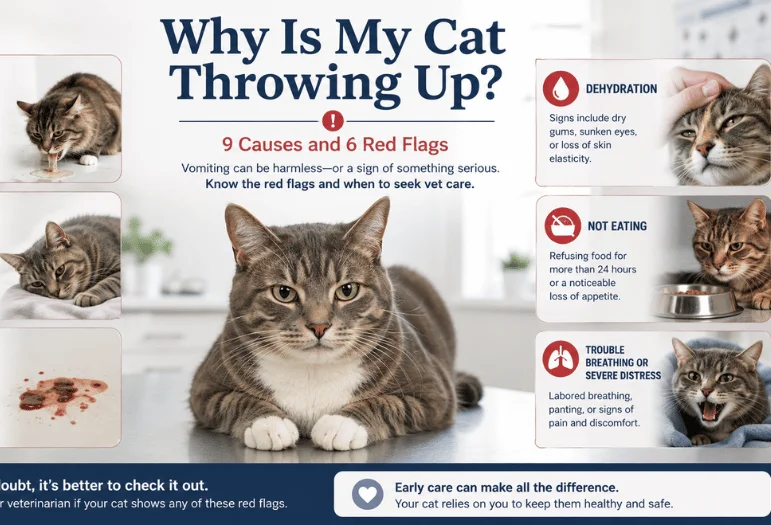
Cats are not naturally sick animals. If somebody told you that bringing food back up is just part of the deal, that belief is quietly costing cats diagnoses. So why is my cat throwing up, and where does normal end? Vomiting is a clinical sign, not a personality trait, and a pet who does it regularly usually has something a vet can name. We cover this in more depth in Cat Sneezing a Lot.
The short answer: occasional vomiting, roughly once every month or two, with steady weight and a normal appetite, sits inside the normal range. Anything more frequent points to a cause. That could be over-grooming, a food problem, a swallowed object, a toxin, or a chronic disease such as enteropathy, hyperthyroidism, or kidney trouble. Blood, repeated retching, or lethargy means a vet today.
What the vomit is telling you
| What you see | What it usually points to | How fast to act |
| Clear liquid or white foam | Gastric irritation or bile on an empty stomach | This week if it repeats |
| Whole food, tube-shaped, minutes after a meal | Regurgitation, not true vomiting | This week, sooner if every meal |
| Partly digested food, hours after a meal | True vomiting, from the stomach or gut | This week if twice a month or more |
| One hairball every month or two | Ordinary grooming | Nothing needed |
| Hairballs most weeks | Over-grooming, or slowed gut motility | Book an appointment |
| Yellow or green bile | Empty stomach, or a blockage lower down | Same day if it repeats |
| Fresh red blood or coffee-ground flecks | Bleeding or ulceration | Emergency |
| Retching that brings up nothing | Possible obstruction | Emergency |
Key takeaways
- Frequent vomiting is a clinical sign. Treat it as a symptom with a cause, not a quirk.
- Vomiting is active and involves retching. Regurgitation is passive and points to the esophagus.
- An occasional hairball is normal. Weekly hairballs usually mean over-grooming or a motility problem.
- Any part of a true lily, pollen included, is a same-hour emergency for cats.
- String is the household hazard owners underestimate most.
Frequent vomiting is a clinical sign, not a quirk

Veterinary thinking has moved on from “Some cats just do that.” Any pet who vomits every week or two is now treated as a patient with something to find. The evidence is not vague. A 2015 study in the Journal of the American Veterinary Medical Association took full-thickness biopsy samples from 300 cats investigated for chronic vomiting, diarrhea, or weight loss.
Chronic enteritis was the diagnosis in 150 of them and intestinal lymphoma in 124. Together, those two conditions accounted for more than 90 percent of the group. So how often is too often? Once every month or two, an animal holding its weight and eating well is not a red flag on its own. Twice a month or more earns a workup. Anything building over several weeks earns one sooner, even if everything else looks fine.
Vomiting or regurgitation? Get this right first
This distinction changes everything downstream, and search results blur it constantly. Vomiting is active. Watch for a heaving abdomen, retching, and warning behavior beforehand: drooling, lip-licking, pacing, and a low crouch.
Regurgitation is passive. Food simply arrives, with little or no warning, often tube-shaped, usually within minutes of eating. It never reached the stomach, so it points to the esophagus. Call one the other, and the whole investigation heads the wrong way.
| Feature | Vomiting | Regurgitation |
| Effort | Active, with retching and abdominal heaving | Passively, the food falls out |
| Warning | Drooling, lip licking, pacing, crouching | Little or none |
| Timing | Any time, often hours after a meal | Usually within minutes of eating |
| What comes up | Partly digested, sometimes with bile | Undigested, often tube-shaped |
| Where it starts | Stomach and intestines | Esophagus |
| First tests | Bloodwork, fecal panel, imaging | Chest imaging, swallow study |
The hairball myth, and what frequent hairballs really mean
Hairballs get blamed for far more than they cause. One every month or two is ordinary. Producing them most weeks is a different story, because that volume of swallowed hair has to come from somewhere. Usually it comes from over-grooming, and over-grooming has causes.
Itch arrives with fleas, food allergies, or mites. Pain arrives with arthritis, dental disease, or a sore bladder. Stress arrives with a new pet, a house move, or a disliked litter box. Impaired gut motility is the other explanation, where hair that should pass through simply does not. Either way, the hairball is a symptom, not the diagnosis.
Grooming changes rarely arrive alone, so read up on skin, litter box, and behavior signs in our other cat and dog care articles while you watch.
Acute causes and chronic causes are different problems
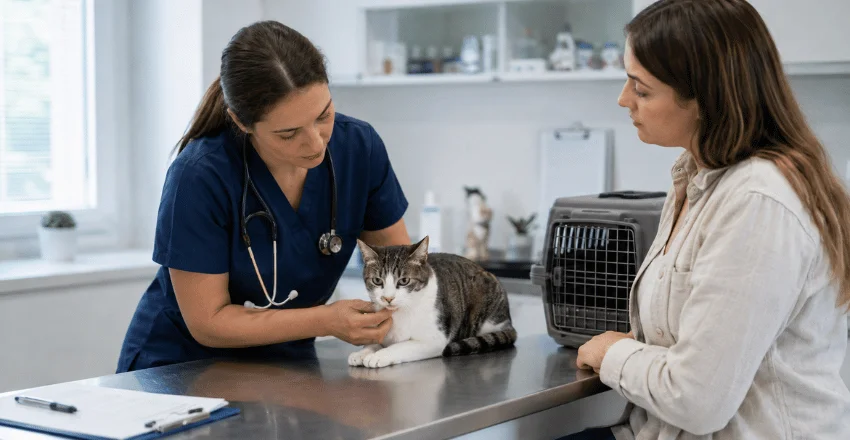
Splitting the list this way tells you which appointment to book. Sudden onset and slow build point at different diseases.
| Acute (hours to a day) | Chronic (weeks to months) | |
| Usual causes | Dietary indiscretion, a plant or chemical toxin, a swallowed object, string | Chronic enteropathy, small cell lymphoma, hyperthyroidism, chronic kidney disease, pancreatitis, food sensitivity |
| Other signs | Drooling, straining, sudden lethargy | Slow weight loss, dull coat, drifting appetite |
| Which vet visit | Same day, sometimes same hour | A booked workup, bloodwork and imaging |
Acute causes worth knowing
Dietary indiscretion covers spoiled food, a raided trash can, or a sudden switch of brand. It settles within a day. Toxins do not, and neither do foreign bodies. String is the emergency owners underestimate. Thread, dental floss, tinsel, and ribbon behave differently from a swallowed toy. One end catches, often under the tongue, while the gut keeps trying to move the rest along.
The intestine bunches up along the thread like a curtain on a rail, and that thread can saw through the wall. Never pull a visible thread from either end. Look under the tongue if she will let you, then drive to the clinic.
Chronic causes worth knowing
- Chronic enteropathy and small cell lymphoma. These two top the list and look almost identical from outside. Telling them apart usually needs a biopsy.
- Hyperthyroidism. The Cornell Feline Health Center describes it as common in middle-aged and older cats and lists vomiting alongside weight loss and a big appetite.
- Chronic kidney disease. Look for extra thirst, more urine in the box, and weight sliding off.
- Pancreatitis. Often vague in cats. Lethargy and a poor appetite may be the only company.
- Food sensitivity. Suspect it when the vomiting tracks a particular protein or a recent diet change.
One caution on appetite. Any pet who stops eating for more than a day needs a vet regardless of the vomiting, because prolonged fasting carries its own risk in this species. More from us: Can Cats Get Hiccups.
Poisons that matter most for cats, starting with lilies
Cats are not small dogs, and their toxin list reflects that. Lilies top it. Any part of a true lily (genus Lilium) or a daylily (genus Hemerocallis) can cause acute kidney injury. That includes petals, leaves, pollen brushed off onto a coat, and water from the vase.
According to the UC Davis School of Veterinary Medicine, kidney failure can kill within 36 to 72 hours without treatment. Its guidance reports that care delayed by more than 18 hours after ingestion generally leads to irreversible kidney failure. Vomiting is often the first sign, and it arrives while the kidneys are still saveable. Do not wait for the second episode.
Other household poisons that reach the emergency room:
- Antifreeze, sweet and lethal in tiny amounts.
- Dog flea products containing permethrin, which cats cannot process.
- Human painkillers, especially acetaminophen and ibuprofen.
- The onion family. Onion, leek, and chive damage feline red blood cells, and cats are more sensitive to them than dogs are. That makes the toxic dose of garlic for dogs a floor rather than a safe level.
- Sago palm and lily of the valley are heart toxins rather than kidney ones.
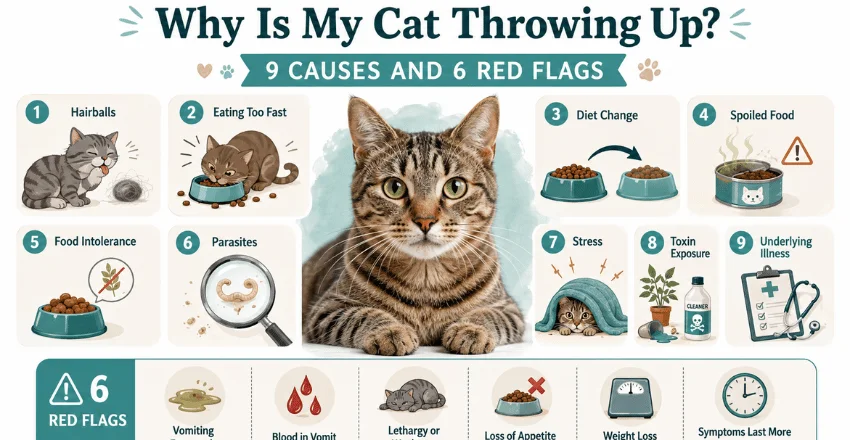
Six red flags that mean call the vet today:
- Vomiting more than twice in one day, or retching that will not stop.
- Blood, either fresh red or dark coffee-ground flecks.
- An inability to keep water down.
- Lethargy, hiding, or a hunched posture over the water bowl.
- Straining in the litter box or an empty box for a whole day.
- Any suspicion of a string, a pill, antifreeze, or a dropped pill.
Two or more of these together move the trip from today to now.
What to do in the first 24 hours
- Lift the food for four to six hours. Leave water down.
- Photograph what came up and note the time. Vets read that better than words.
- Search the house for a chewed plant, a missing hair tie, or an open pill bottle.
- Offer a small portion of the usual food after six hours, not a new food.
- Skip human medicine entirely. Acetaminophen kills cats at doses a person would not notice.
- If it happens again, book the appointment.
What the vet will test for, and what it costs
Expect a staged workup, not one big bill. Physical examination comes first, and it often finds the string, the thyroid nodule, or the painful belly on its own. Bloodwork and urine come next, checking kidney values, thyroid hormone, blood sugar, and pancreatic markers.
Fecal testing rules out parasites. X-rays or ultrasound follow if an obstruction or a thickened intestine is in question. Endoscopy or a full-thickness biopsy sits at the end, and only for chronic cases. Cost climbs with each stage. Ask your clinic for a written estimate before each one, and ask which result would actually change the plan.
For scale, the American Veterinary Medical Association reported that cat-owning households in the US spent an average of $433 on veterinary care in 2024. One chronic workup can eat that in an afternoon. Most US practices price the exam, the lab panel, and the imaging separately.
Why is my cat throwing up but acting completely normal?
This pattern gets ignored the longest. An animal with early chronic enteropathy, early kidney disease, or an overactive thyroid can still play, purr, and greet you at the door. Bodies compensate for months. Weight is the honest witness.
Put your pet on a kitchen scale once a month and write the number down in pounds and ounces. Losing half a pound steadily is a real finding in a small animal, and it turns a vague complaint into something the vet can chase.
Your next step
Start a log today: date, time, what came up, and what your pet ate beforehand. Three weeks of that turns “she is sick sometimes” into a pattern a vet can work with, and it is the most useful thing you can carry into the appointment. For more feline and canine health reading, browse the full Petistra pet health library.
Frequently asked questions
More than twice a month is too often, and once a week is a clear signal. A single episode in an otherwise bright animal that eats normally afterward can wait for the next routine visit.
White foam usually means an empty, irritated stomach. Yellow or green is bile. Brown can be food or digested blood. Fresh red is bleeding, and coffee-ground flecks mean older blood. Those last two are emergencies.
Four to six hours without food is reasonable for an adult. Never fast a kitten, and never fast anyone for a day or more.
Yes, usually indirectly. Stress drives over-grooming and changes gut motility, so a house move can produce a run of hairballs and vomiting. Have your vet rule out disease first.
Yes. Nonstop retching with nothing produced, blood, a swallowed thread, a chewed lily, or a pet too flat to lift her head all justify the overnight clinic visit. Waiting until morning is where lily cases are lost.