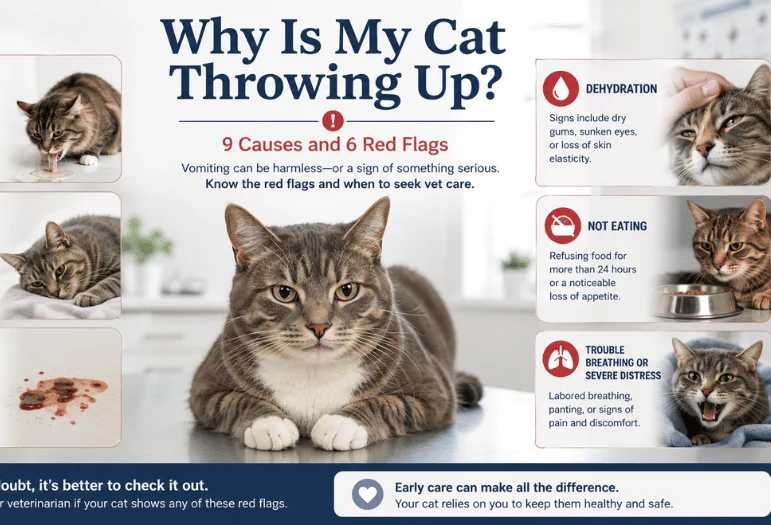


Search How Long Can Cats Go Without Food and page one hands you a survival window of one to two weeks. The number is technically true, and it is the wrong thing to know. A cat that stops eating can get into serious trouble long before starvation becomes the problem because of a liver condition called hepatic lipidosis. So, the honest answer to How Long Can Cats Go Without Food is measured in hours, not weeks. Our related guide, Panleukopenia in Cats, goes further into this.
The short version: A healthy adult cat should not go a full day with an empty stomach. Liver damage can start within two to three days of a food strike, and overweight cats are hit hardest of all. Treat 24 hours with nothing eaten as the point where you stop watching and call your veterinarian. Elsewhere on the site: Cats in Heat.
What is happening inside your cat, hour by hour
| Time with no food | What is going on internally | What you should do |
| 0 to 12 hours | Stored liver sugar covers energy needs. Nothing is wrong yet. | Watch. Note the exact time of the last meal. |
| 12 to 24 hours | Sugar stores run down. The body starts pulling fat out of storage. | Try tempting food. Check for drooling, hiding, or vomiting. |
| 24 to 48 hours | Fat is arriving at the liver faster than the liver can burn it. | Book a veterinary appointment. Do not wait for day three. |
| 48 to 72 hours | Fat is building inside liver cells. Jaundice and drooling can appear. | Same-day veterinary care. This is hepatic lipidosis territory. |
| Beyond 72 hours | Liver function drops. Vomiting, weakness and collapse follow. | Emergency clinic, now. |
| Kitten under 6 weeks | Almost no reserves. Blood sugar crashes quickly. | 12 hours without food is already an emergency. |
TL;DR: the six things that matter
- 24 hours without food is the line where a healthy adult cat needs a vet, not more patience.
- Hepatic lipidosis, fatty liver disease, can begin within days of a food strike.
- Overweight cats carry the highest risk, which is the reverse of what most owners assume.
- No water at all is dangerous within roughly three days, faster than no food.
- A cat refusing food is showing you a symptom, not making a decision.
- Warming food and hand feeding are safe. Forcing food into the mouth is not.
Why “one to two weeks” is the wrong answer
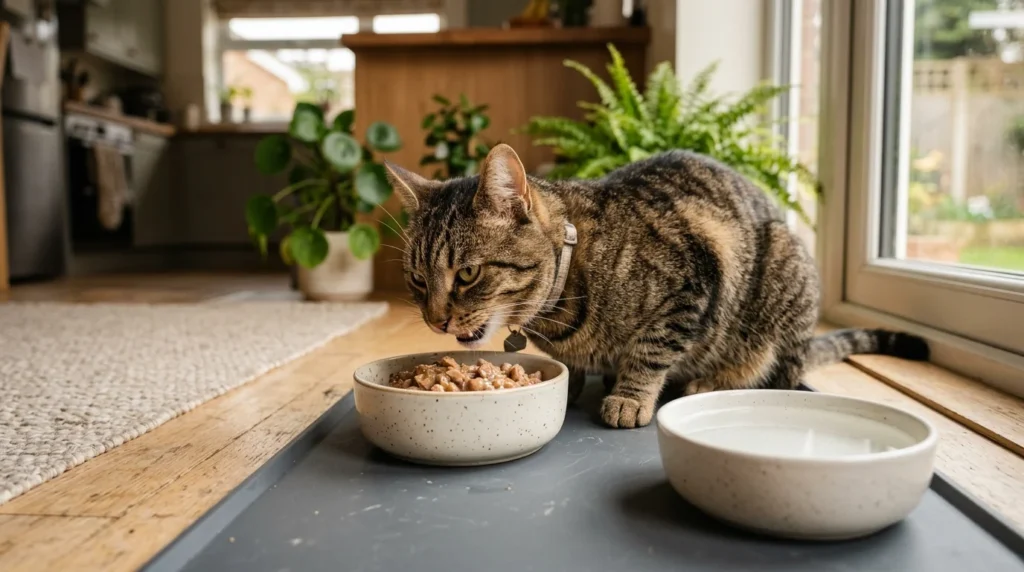
That survival figure comes from body reserves. A cat with water and some fat on board can technically hang on for a while. Surviving and being fine are not the same state.
The Cornell Feline Health Center draws the line at a single day. Its guidance states that loss of appetite can have a severe impact on a mature cat’s health if it persists for as little as 24 hours. For a kitten younger than six weeks, the same page says food avoidance for only 12 hours can pose a lethal threat.
So the question worth asking is not how long your cat could survive. It is how quickly a cat that stops eating gets into danger.
Hepatic lipidosis, explained without the jargon
Cats are obligate carnivores. Their whole metabolism is built around a steady supply of animal protein, and their liver handles a sudden flood of fat badly. When the food stops, the body does the obvious thing. It ships stored fat to the liver to be turned into energy. In a cat, that fat arrives faster than the liver can process it.
The fat then piles up inside the liver cells themselves. Cells swell, bile stops moving properly, and liver function starts to fail. Vets call this hepatic lipidosis, or fatty liver disease. It can start within a few days. Not weeks.
Why a chubby cat is at more risk, not less
Most owners assume a heavy cat has a buffer and can afford to skip a couple of meals. The truth runs the other way.
More body fat means more fat mobilized at once, and a bigger flood hitting a liver that already cannot keep up. The classic hepatic lipidosis patient is an overweight indoor cat that went off its food for a few days. A cat on a crash diet is at risk for exactly the same reason, which is why feline weight loss has to be slow and supervised.
Steady, unexciting daily care is what prevents most of this, and our pets and animal wellness archive covers that side of things.
How long can cats go without food before the liver is at risk?
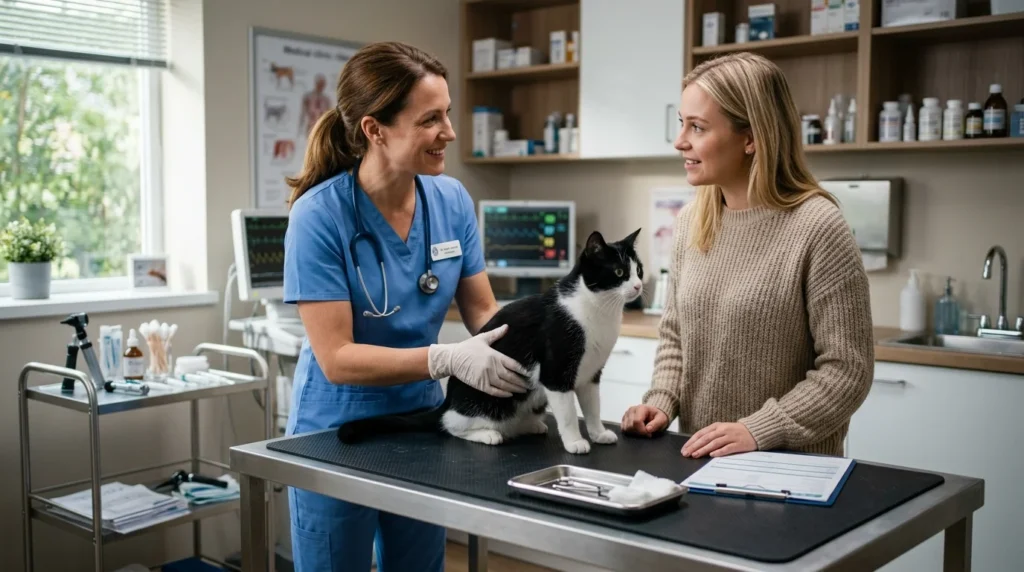
Two to three days is the window most veterinarians treat as the danger zone for a normal adult. That is the general rule. Several cats get much less rope than that:
- Kittens: 12 hours for a young kitten, because they have almost no fat reserve and their blood sugar drops fast.
- Diabetic cats: a skipped meal after an insulin dose can drop blood sugar dangerously low. Call the same day.
- Senior cats and cats with kidney disease: less reserve, more nausea, faster decline.
- Pregnant or nursing cats: the energy demand is already high, so the margin is thin.
- Cats recovering from surgery: report any refusal to eat to the clinic that treated them.
Water is the faster clock
Dehydration does damage more quickly than hunger. Go three days with no water at all, and your cat is in real trouble, and kidney function suffers well before that point.
Here is the part owners miss. A cat on wet food gets most of its daily water from the food itself, since a typical can is roughly three-quarters water. A cat that quits eating wet food loses its main water supply in the same moment. That is two problems arriving together, not one.
Pinch the skin between the shoulder blades. If it stays tented instead of springing back, your cat is already dehydrated.
A cat that won’t eat is showing you a symptom
Refusing food is almost never a preference or a mood. Cornell’s hepatic lipidosis overview reports that in more than 90 percent of cases the condition is a secondary consequence of some other underlying problem. Something else came first. Here is the real differential, in plain terms.
- Dental and mouth pain. A fractured tooth, a resorptive lesion, or inflamed gums. The giveaway is a hungry cat who walks to the bowl, starts, then flinches and backs away.
- Kidney disease. Very common in older cats. It causes nausea, so food starts to feel unpleasant.
- Pancreatitis. Painful and vague, with nothing to see beyond a quiet cat who has stopped eating.
- Gastrointestinal disease. Inflammatory bowel disease, parasites, or a food intolerance.
- An obstruction. String, hair ties, and pieces of toys. No appetite plus repeated vomiting is an emergency.
- Upper respiratory infection. A blocked nose means no sense of smell, and a cat that cannot smell its dinner will not eat it. Clearing the nose often restores the appetite.
- Stress and recent change. A house move, a new pet, building work, a relocated bowl, or a switched brand of food.
Your vet needs the timeline, so write it down first: last meal, last drink, last urine or stool, and anything that changed at home this month.
Safe ways to tempt your cat to eat
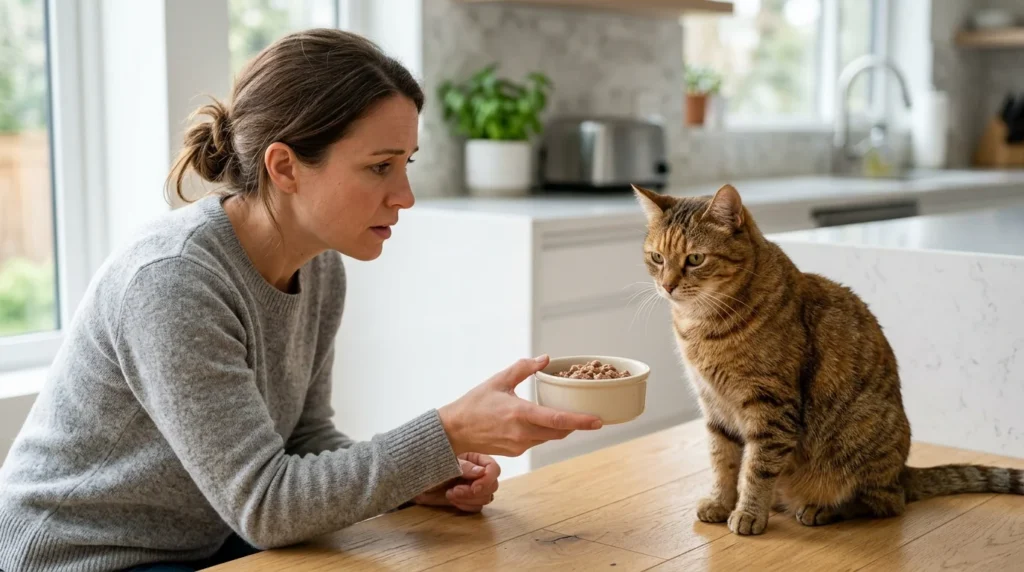
These buy you a little time while you arrange care. None of them replaces a veterinary appointment.
- Warm the food. Twenty seconds at body temperature lifts the smell enormously. Test it on your wrist first, and never serve it hot.
- Switch to something strong smelling. Fish-based pate beats a mild chicken chunk for a cat with a dull nose.
- Offer it by hand. A smear on your fingertip, or on the roof of the mouth if she licks it away willingly.
- Move the bowl. A quiet spot, away from the litter box and other pets.
- Use a clean, wide, shallow dish. Deep bowls press on the whiskers and put some cats off entirely.
- Add a spoonful of tuna water. From a can packed in spring water, not oil and not brine.
If these work and your cat eats a real meal, you still ring the clinic in the morning. For more everyday feeding and care reading, browse the latest posts on the Petistra blog.
What not to do
- Do not force food into the mouth. Syringing food into an unwilling cat risks aspiration pneumonia, and it can create a lasting food aversion that makes recovery harder.
- Do not give it another day to see. Day three is where this stops being cheap to fix.
- Never give human painkillers. Acetaminophen and ibuprofen are toxic to cats, and a single tablet can be fatal.
- Do not withhold food to reset the appetite. That advice exists for dogs. It is dangerous for a cat.
- Do not write it off as fussiness when your cat has always eaten well.
Red flags: go now, not tomorrow
- Nothing eaten for 24 hours, in any adult cat
- Vomiting more than once, especially with no appetite
- Yellow tint in the gums, the eyes, or the ear flaps
- Drooling, pawing at the mouth, or a smell from the mouth
- Hiding, hunching, or crying when picked up
- No urine in the litter box for a day
- A kitten that skips a single feeding
- Any diabetic cat that refuses a meal
Frequently asked questions
Twenty-four hours for a healthy adult, and 12 hours for a young kitten. Past two to three days, you are looking at possible liver damage rather than a missed meal.
A cat can be alive at three days and still be very unwell. That is the window where hepatic lipidosis takes hold, and it needs treatment, not more time.
Yes. Nibbling still leaves your cat in an energy deficit, and partial appetite loss over several days carries the same liver risk. Measure what goes down, rather than judging by the bowl.
Some will hold out for a long time over a sudden diet change, which is why any switch should be gradual over a week. Assume illness first, fussiness second.
Roughly three days at the outside, and damage begins well before that. Dehydration is the faster of the two clocks, so a cat that has stopped drinking as well as eating needs care today.