
Panleukopenia is a feline parvovirus that destroys white blood cells and the lining of the gut, and unvaccinated kittens die from it more than any other group. The virus can stay infectious on floors, carpet, and furniture for up to a year. So a house where a sick cat lived stays dangerous long after that cat is gone.
Two facts shape every decision you make. This is a parvovirus, a close relative of the canine parvo that dog owners already fear. And it shrugs off most of the cleaners under your sink.
Quick facts
| Item | Detail |
| Other names | Feline distemper, feline infectious enteritis, cat parvo, FPV |
| Virus type | Non-enveloped parvovirus, closely related to canine parvovirus |
| Incubation | Roughly 2 to 10 days from exposure to signs |
| Highest risk | Unvaccinated kittens, shelter and foster cats, outdoor strays |
| Survives in a home | Months, and up to about a year on untreated surfaces |
| Killed by | Dilute bleach, accelerated hydrogen peroxide, potassium peroxymonosulfate |
| Not killed by | Alcohol, quaternary ammonium cleaners, most scented wipes and sprays |
| Treatment | Supportive hospital care. No drug kills the virus |
| Prevention | FVRCP kitten series finishing at 16 weeks or later |
Key takeaways
- The virus attacks fast-dividing cells, which is why it wrecks bone marrow and gut lining at the same time.
- Most cats that die are killed by dehydration and blood infection, not by the virus itself.
- Bleach and accelerated hydrogen peroxide work. Alcohol gels and quat cleaners do not.
- Carpet, cat trees, and soft bedding usually cannot be saved and should go in the trash.
- The vaccine is one of the most reliable in veterinary medicine, but one kitten shot is not enough.
What the virus does inside a cat
It hunts cells that divide quickly. Bone marrow, the intestinal lining and, in an unborn kitten, the developing cerebellum all fit that description. The name says the rest: pan for all, leuko for white cells, penia for shortage.
Once the marrow stops producing, the white cell count can fall to a few hundred per microliter instead of several thousand. At the same time, the gut lining sloughs away. Fluid pours out, nothing stays down, and bacteria that normally live in the intestine cross into the bloodstream.
That combination kills. A cat with almost no white cells has nothing left to fight the bacteria that escaped from its own gut, and sepsis can follow within hours.
A pregnant queen who catches the infection can pass the damage to her kittens’ developing brains, which shows up weeks later as the wobbly, tremoring gait of cerebellar hypoplasia.
Warning signs, and how fast they move
- Sudden dullness, hiding, or refusing to move from one spot
- No interest in food or water
- Fever above 103°F early on, often dropping below normal as the cat crashes
- Repeated vomiting, sometimes with nothing left to bring up
- Watery diarrhea, which may turn bloody
- Sitting hunched over the water bowl without drinking
- Sudden death in very young kittens, sometimes before diarrhea ever appears
Signs usually start 2 to 10 days after exposure. Then they move fast. A kitten can go from bright to critical inside 24 hours, so treat this as a same-day emergency rather than a wait-and-see problem.
Fever is the sign owners miss most, because a hiding cat reads as a sulking cat. If you’re still learning what normal looks like for a new arrival, the everyday care guides in our pets section are a reasonable starting point.
How panleukopenia spreads between cats

Feces carry the most virus. Vomit, saliva, and urine carry it too, and an infected cat sheds heavily for a few days before tailing off over roughly six weeks.
Direct cat-to-cat contact is only part of the story. Shoes matter. So do hands, food bowls, litter scoops, bedding and carriers, and fleas can move the virus between animals without ever being infected themselves. An indoor-only cat that never meets another cat can still catch it from whatever you tracked in. We cover this in more depth in How Long Can Cats Go Without Food.
People cannot catch it. Human parvovirus B19, the one behind fifth disease, is a separate virus with no link to this one. Dogs can pick FPV up in their lymph tissue without getting sick or shedding it, so your dog is not a danger to your cat. The reverse is less comforting: several canine parvovirus strains can infect cats and cause the same illness.
How long the virus survives, and what kills it
Here is where most advice stops short. The virus has no fatty envelope, and that envelope is what soap, alcohol, and quaternary ammonium cleaners are built to break apart. Without one, those products leave it intact. They clean. They do not kill.
| Surface or item | How long it stays infectious | What to do |
| Sealed floors, tile, metal, glass | Up to about a year | Bleach solution or accelerated hydrogen peroxide, kept wet 10 minutes |
| Litter boxes, bowls, unscratched crates | Months | Scrub off all waste first, then soak in the same solution |
| Scratched plastic, bare wood, unsealed concrete | Months to a year | Accelerated hydrogen peroxide, or replace the item |
| Carpet, rugs, upholstery, cat trees, soft beds | Months to a year | Discard. Disinfection here is unreliable |
| Soil, gravel, patio cracks | Months, longer in shade | Keep unvaccinated cats off it. Time and sunlight only |
For the numbers, go to a public health body rather than a cleaning brand. Public Health, Seattle & King County tells pet businesses to mix half a cup of 5.25% household bleach into one gallon of cold water. It then says to allow that solution to contact the surface for at least 10 minutes. The same guidance rates quaternary ammonium compounds and alcohols as not effective against non-enveloped viruses.
Cleaning a home after an infected cat
Work in this order. Skipping the first step is the usual reason a careful cleanup still fails.
- Scrub away every trace of feces, vomit, litter, and food. Organic matter inactivates bleach on contact.
- Mix your bleach solution fresh that day. Diluted bleach loses strength within about 24 hours.
- Apply it and leave the surface visibly wet for a full 10 minutes. A quick wipe does nothing.
- Rinse food and water bowls with clean water afterward, then air dry them.
- Bag and bin the porous items: beds, blankets, scratching posts, cardboard, cat trees, litter mats.
- Wash any fabric you keep on the hottest cycle it survives, then run the machine empty with bleach.
- Change your clothes and shoes before visiting anyone else’s cat.
The everyday kitchen routine is far too weak for this job. Around one tablespoon of bleach per quart of water suits the salmonella risk we cover in our guide to dogs eating raw chicken. As a panleukopenia disinfectant, it does nothing.
Accelerated hydrogen peroxide products handle wood, scratched plastic, and unsealed concrete better, since bleach performs poorly there and strips the finish. Shelters rely on them for that reason.
When is it safe to bring another cat home?
A fully vaccinated adult cat can move in once you’ve cleaned properly, because the vaccine holds up well against real-world exposure. Kittens are a different question. So is any adult cat with an unknown history.
Plan on a minimum of one month after a thorough bleach or peroxide clean of every hard surface, with the porous items already thrown out. If you couldn’t treat the carpet, the wood floors, or the sofa, be honest about it and treat that room as contaminated for a year. The safer route is simple: wait until the new cat has finished its kitten series and had its booster.
Vaccination, and why one kitten shot is not enough
The FPV component of the FVRCP vaccine is among the most dependable products in small animal medicine. It fails for one predictable reason: timing.
Kittens absorb antibodies from their mother’s first milk. Those maternal antibodies protect them early, then fade at an age nobody can predict from the outside, anywhere from about 8 weeks to past 16. While they’re still circulating, they neutralize the vaccine before the kitten’s own immune system ever sees it. The 2020 AAHA/AAFP feline vaccination guidelines call that persistence one of the most common reasons a vaccine fails.
So the series isn’t repetition for its own sake. Each dose is another attempt to land in the window after her antibodies fade and before the kitten meets the virus. Timing, not dosage.
| Age | What happens |
| 6 to 8 weeks | First FVRCP dose. Shelters often start earlier, from 4 weeks |
| Every 3 to 4 weeks after | Repeat doses through the kitten period |
| 16 weeks at the earliest | Final kitten dose. This is the one that decides protection |
| 6 months to 1 year | Booster |
| Every 3 years | Adult booster for most indoor cats |
A kitten that had one shot at 8 weeks and nothing since is not protected. That gap is where most preventable cases come from.
Diagnosis and treatment
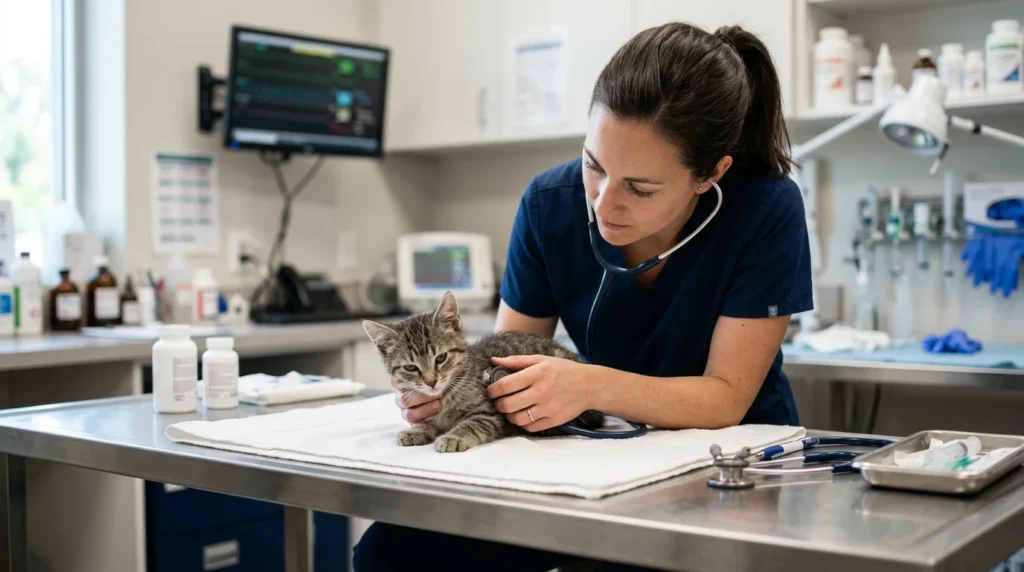
Vets usually reach for the in-clinic fecal antigen test made for canine parvo, which cross-reacts with the feline virus. A blood count showing a collapsed white cell line supports it. PCR at a lab is more sensitive and sorts out the confusing cases, including the weak false positive a recent vaccine can produce.
Nothing on the shelf kills the virus. Treatment buys the cat time while its own marrow recovers, and it looks like this:
- Intravenous fluids, replacing what the gut is losing
- Anti-nausea drugs so food and water stay down
- Broad-spectrum antibiotics against the bacteria crossing out of the intestine
- Early nutrition, often through a feeding tube
- Warmth, glucose, and strict isolation from other patients
Outcomes are sobering but not hopeless. A series of 244 cats from Europe, published in Canine and Feline Infectious Diseases, recorded a survival rate of 51.1% among treated animals. Cats that make it through the first five days usually recover.
What treatment costs
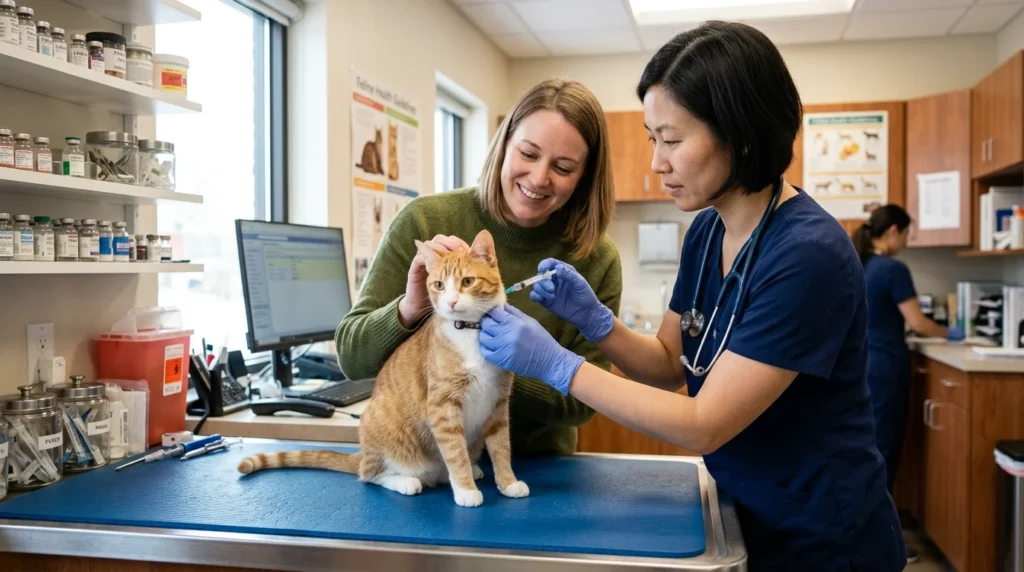
Almost no ranking page will give you a dollar range, so here is an honest one. Ask for a written estimate before you agree to anything. A mild case treated as an outpatient can land in the low hundreds of dollars. Five to seven days of hospital care with fluids, tube feeding and nursing commonly runs past $2,000. Emergency clinics charge more than day practices, and a litter of sick fosters multiplies all of it.
What to do next
Is your cat vomiting, refusing water and hiding? Call a vet today and say you suspect a parvovirus, so the clinic can prepare an isolation room. Bringing a kitten home instead? Book the full FVRCP series now and put the 16-week date in your calendar. New cat health guides go up on the Petistra blog every week.
FAQs
Rarely. Breakthrough cases happen in cats whose kitten series ended too early, in cats with weakened immune systems, and occasionally in older cats overdue for a booster. A completed series plus a booster is close to reliable protection.
No. There are no reported human infections with this virus. Wash your hands anyway, because you can carry it to somebody else’s cat on your skin and clothing.
Your dog will not get sick from the feline virus and will not shed it. Canine parvo is the one to worry about in the other direction, since some strains do infect cats.
Shedding tails off within a few days of recovery, though it can continue for up to six weeks. Keep a recovered cat away from unvaccinated cats for at least that long.
Yes, in soil, gravel, and shaded corners, for months. There’s no practical way to disinfect open ground, so keep unvaccinated cats off it and vaccinate before letting a cat outside.