


Do Female Cats Spray? Yes, female cats spray. The belief that only intact toms mark is a myth, and it’s why this page needs to exist. Owners who trust that myth lose months treating the wrong problem.
Most people searching for “female cats spray are standing over a wet patch, guessing. Ask a sharper question first. Is this spraying, or is your cat urinating outside the box? Those are two behaviors, with different causes and different fixes. For the full picture, read Why Is My Cat Meowing So Much.
Short answer: Yes. Females spray, spayed ones included, though far less often than intact males. Spraying is territorial marking. She stands, backs up to a vertical surface, treads with her back feet, and leaves a small amount of urine at nose height. A squatting cat leaving a normal puddle is doing something else.
Female cat spraying at a glance
| Question | What owners need to know |
| What is it called | Urine marking, or spraying |
| Which cats do it | Intact males most of all, then intact females, plus a minority of neutered and spayed cats |
| Posture | Standing, back feet treading, tail upright and quivering |
| Where it lands | Vertical surfaces at roughly nose height: walls, door frames, sofa backs, speakers, bags |
| How much | A small volume, often streaks rather than a pool |
| Usual driver | Territory and social stress, not a full bladder |
| First move | Book a vet exam to rule out a urinary problem |
| What clears the smell | An enzymatic cleaner, never anything ammonia-based |
Key takeaways
- Spaying cuts marking sharply. It does not switch it off, and it does nothing at all when the trigger is social stress.
- Posture and surface tell you which behavior you have. Read those before you buy a single product.
- A cat squatting and leaving puddles needs a vet exam first, because bladder disease looks exactly like a behavior problem.
- Straining with nothing coming out is an emergency, especially in a male cat.
- Ordinary detergent leaves the scent mark in place, so the same spot keeps getting hit.
Spraying or a litter box problem? Read the posture, not the puddle.
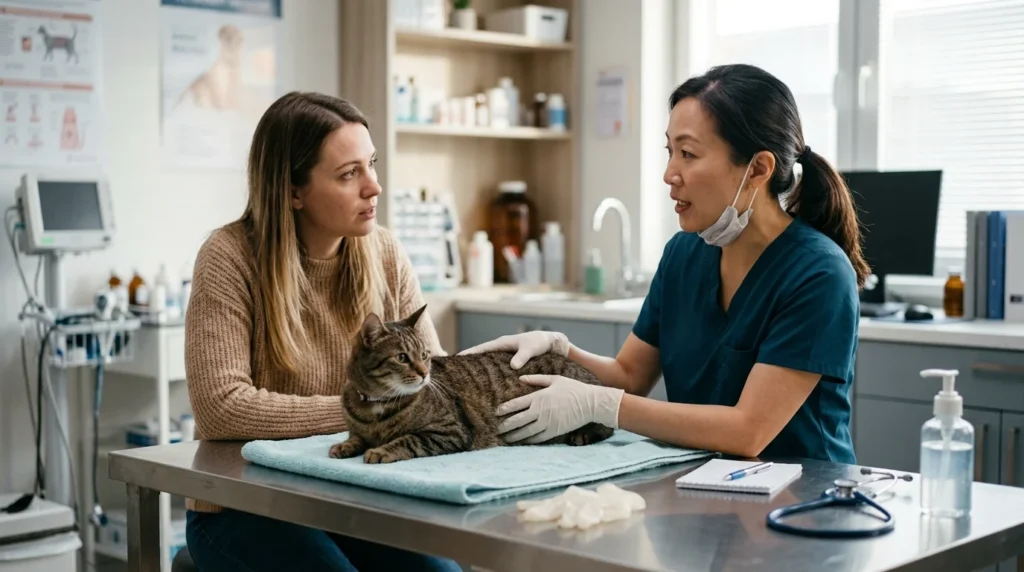
This is the split almost every article blurs, and getting it wrong sends you down the wrong path for months. A spraying cat is communicating. A cat urinating outside the box is either sick or unhappy with her toilet.
Watch her, or read the evidence she left. The two look nothing alike once you know the tells.
| Clue | Spraying (marking) | Urinating outside the box |
| Body position | Standing, back to the target | Squatting |
| Back feet | Treading or paddling in place | Still |
| Tail | Straight up and quivering | Down or relaxed |
| Surface | Vertical: wall, door frame, furniture side | Horizontal: rug, bath mat, bed, tile |
| Height of the mark | Around nose height, drips running down | Floor level |
| Volume | Small | A normal sized puddle |
| Litter box use | Still using it normally | Often avoiding it |
| Where to start | Find the trigger | Vet exam first |
One caution. A cat can do both, and a cat in pain sometimes marks as well. If the evidence is mixed, treat it as a medical case until your vet says otherwise. More cat and dog behavior write-ups sit in the pets section on Petistra.
Rule out the medical causes before you treat behavior
Do Female Cats Spray? Urinating outside the box is one of the main ways feline lower urinary tract disease shows up. No amount of stress management fixes an inflamed bladder.
According to the UC Davis School of Veterinary Medicine, feline idiopathic cystitis is the diagnosis in roughly two in three cats with lower urinary tract signs. Most are aged between 1 and 10 years. Those signs include urinating outside the litter box, straining, and blood in the urine. Bacterial urinary tract infection and bladder stones look the same.
So a vet visit is urgent rather than optional when you see any of this:
- Straining in the box with little or nothing coming out
- Crying or yowling while trying to go
- Pink or red urine
- Repeated trips to the box within an hour
- Licking hard at the genital area
- Hiding, off food, or vomiting alongside any of the above
A male cat straining with nothing coming out may have a urethral obstruction. That blocks the kidneys and can kill within a day or two, so it needs a vet the same day, out of hours if necessary. Females block far less often, but they are not immune.
Why female cats spray, and why it is not about mating
Marking is a social signal. Cats leave urine where other cats will read it. The message is about territory and confidence rather than romance. A spayed girl with no hormonal drive at all can still have plenty to say.
Three things she may be signaling:
- This space is claimed. A cat outside the window, or a new cat indoors, gets answered on the nearest wall.
- I am not comfortable here. Marking rises when a cat feels crowded, watched, or unable to avoid a housemate.
- Something changed. New smells and new furniture disturb a scent map she spent months building.
Sexual signaling is real in intact females, and it does spike around heat. It is simply not the common story in a spayed household pet.
7 triggers to check in your home
Sudden marking in a house that was fine before almost always has a cause you can name. Work through these in order, because the first two account for most cases.
- A strange cat visible through a window. Look at where the marks are. If they cluster near a patio door or a low window, the trigger is outside, not inside.
- Conflict between resident cats. Blocked doorways, staring, and one cat guarding the food bowl all count as conflict, even with no fighting.
- A new arrival. Another cat, a dog, a baby, a housemate, or a partner moving in.
- A move or a renovation. Fresh paint and rearranged furniture wipe out familiar scent.
- A change in your routine. A new work schedule, a long trip, or a house sitter she does not know.
- Litter box competition. Too few boxes, or boxes lined up in one room, force cats to share a single resource.
- An imported smell. Another animal’s scent on a visitor’s coat, a delivery box, or your shoes.
Fix the trigger and the marking usually fades. Block the window view. Add feeding stations in separate rooms, and give each cat a route to her food and litter box that does not cross another cat’s path.
Do Female Cats Spray When They Are in Heat?
An intact female in heat may spray, and she may also roll, call loudly, and rub against everything at ankle height. The marking is part of an advertisement. Heat cycles repeat every two to three weeks through the breeding season, so the pattern comes and goes.
If your cat is intact and the marking tracks her cycle, spaying is the obvious next step. Talk to your vet about timing.
Does spaying stop it? The honest answer
Spaying reduces marking a great deal. It does not reliably end it.
The Cornell Feline Health Center reports that 10% of neutered males and 5% of neutered females still spray. Cornell also notes that in households with more than seven cats, one or more of them will probably spray. That second figure is the useful one, because it points to the real driver: crowding and social pressure, not hormones.
So the honest framing is this. Spaying removes the hormonal reason to mark. If your cat is marking because a tomcat sits on the deck every night, or because two cats in the house cannot share a hallway, surgery changes nothing about that.
Cleaning: why your detergent is not working
Cat urine contains proteins and fatty compounds that ordinary soap breaks up but does not remove. Your nose stops noticing. Hers does not, and the scent mark stays exactly where she left it, which is an invitation to top it up.
Worse, ammonia is one of the breakdown products of urine. Cleaning with an ammonia-based product leaves a smell a cat reads as another cat’s mark, so the same spot gets hit again.
What works:
- Find every mark first. An ultraviolet flashlight in a dark room shows dried urine that is invisible by daylight.
- Blot, do not rub, then soak the spot with an enzymatic cleaner made for pet urine. The enzymes digest the odor compounds instead of masking them.
- Let it stay wet for as long as the label says, then air dry.
- Skip ammonia and bleach. Skip steam too, because heat can set the proteins into fabric.
- Change what the spot means. Feed her there, or put a scratching post against it. A synthetic feline pheromone diffuser nearby can help as well.
Your next steps this week
Do these in order. Skipping the first one is how owners buy products for a bladder problem.
- Call your vet and book a urinalysis, especially if you are seeing puddles rather than wall marks.
- Photograph the marks and note the height and the room. That map tells your vet more than a description.
- Clean every spot properly with an enzymatic product.
- Work down the seven triggers and change the one you can change first.
- Give it two to four weeks, then ask your vet about a referral to a veterinary behaviorist if nothing shifts.
Punishment belongs nowhere in this list. Scolding or squirting her with water raises the stress that drives marking, and she will not connect it to the mark. For more pet care reading, browse the Petistra blog.
Frequently asked questions
Some do. Cornell puts it at around 5% of spayed females. Spaying is still the right call, and it remains the single most effective change you can make, but it is not a guarantee.
Marking usually begins around sexual maturity, which arrives between four and ten months in most cats. Stress-driven marking can start at any age, including in a senior cat facing a new housemate.
Sharper and more pungent than normal urine. Marking urine carries extra scent compounds, and many owners describe it as musky. It clings to fabric and drywall for weeks without proper cleaning.
No. Cats do not mark to punish you. Marking is a response to something in her environment, which is good news, because environments can be changed.
It helps litter box avoidance more than it helps marking, and it is easy to test. The usual guidance is one box per cat plus one spare, placed in separate rooms rather than side by side.
Sometimes. Where environmental changes are not enough, vets do prescribe anti-anxiety medication alongside behavior work. It is not a shortcut around the trigger.