


Adult cats barely meow at each other. They hiss, chirp, growl, and yowl, but the plain meow is mostly aimed at people, and it survives from kittenhood because we respond to it. So, when you ask why is my cat meowing so much, the answer usually splits two ways: your cat is either talking to you because talking works, or telling you that something has changed.
The short version: kittens call to be fed and to find you. An adult cat usually starts after something in her world shifts. A senior cat who begins yowling needs a medical workup before a training plan. Age is the strongest clue you have, so sort the cause by age first.
Likely causes at a glance, by age
| Age | What usually drives the noise | First move |
| Under 6 months | Hunger, cold, looking for you or littermates | Fixed meals, a warm bed, hard play before bed |
| 6 months to 7 years | Learned demands, boredom, a change at home, heat cycles | Fix the routine, spay or neuter |
| 7 to 10 years | A new stressor, early pain, dental disease | Vet check if the noise is new |
| 10 years and older | Overactive thyroid, high blood pressure, arthritis, failing senses, cognitive decline | Blood work, blood pressure, thyroid test |
Key takeaways
- Any shift in how much your cat talks matters more than the raw volume.
- New noise plus any change in eating, drinking, litter box habits or weight is a vet question.
- Night yowling in a cat over ten earns a workup, not a spray bottle.
- Giving in some of the time makes demand meowing stronger, not weaker.
- Siamese and the oriental breeds really are louder, but breed explains a baseline, never a sudden change.
The meow is a message for you, not for other cats
Kittens meow at their mother. Once they grow up, cats mostly drop the sound with each other and switch to scent, posture, hisses, and chirps. The meow survives in one relationship: the one with humans. That is one reason why is my cat meowing so much can have more to do with communication and learned behavior than with a problem.
Your cat is pushing a request through the channel she knows you answer. It might be food, a door, company, a clean tray, or relief from pain. The cat and dog care guides in our Pets section cover the day-to-day end of that list. What follows sorts the causes by age, because age changes the answer more than anything else.
Why is my cat meowing so much all of a sudden?
The change matters more than the decibels. A cat who has always been chatty is probably just chatty. A quiet cat who starts calling this week has told you something is different. It is usually one of four things.
- The routine moved. A new work schedule, a later dinner, a bedroom door that used to stay open.
- The household changed. A new pet, a baby, a house guest, a move, building work next door.
- The body changed. Pain, nausea, hunger driven by illness, fading sight or hearing.
- The hormones changed. An intact female in season, or an intact male who can smell one.
Here is the rule to keep. If the new noise arrives alongside any change in eating, drinking, litter box habits, weight or grooming, treat it as a medical question first. If nothing else changed at all, treat it as a behavior question.
Kittens: noise that means feed me and find me
Kittens under six months are supposed to be loud. The meow is their distress call, and it works on their mother the same way it works on you. Hunger, cold, loneliness, and a dirty tray all produce it.
Most kitten noise settles with three fixes: predictable meals, a warm sleeping spot out of drafts, and a real play session before bed.
One kitten pattern is not normal. A kitten who cries while straining in the litter box needs a vet that day.
Adult cats: routine, change, and hormones
Between about six months and seven years, most extra noise is learned or situational. Cats are excellent at spotting what gets a response. If the 5 am wail once produced breakfast, the wail is now a tool.
Stress is the other common driver. New cats indoors, a resident cat guarding the stairs, a neighborhood tom at the window after dark, or a tray in a busy hallway can all raise vocalizing. Cats hide worry well, so noise is often the first signal you get.
Is she in heat?
An unspayed female in season yowls, rolls, treads with her back legs, and may spray. She can cycle every two to three weeks through spring and summer. Intact males answer from outside. Spaying or neutering removes this cause outright.
Senior cats: the branch where meowing turns medical
Past ten years old, a new yowl deserves a genuine workup rather than a training plan. Several of the conditions behind it respond well to treatment. A vet can pick up most of them with blood work, a blood pressure reading, and a hands-on exam.
An overactive thyroid sits at the top of the list. The American Association of Feline Practitioners puts the prevalence of feline hyperthyroidism at up to 10% of US cats older than 10 years in its 2016 management guidelines. That makes it the most common hormone disorder in that age group. Watch for weight loss with a big appetite, extra thirst and a wired manner.
The rest of the senior list is short:
- High blood pressure, often riding along with kidney disease, and a cause of sudden blindness.
- Arthritis, which turns a jump off the bed into something that hurts.
- Hearing loss, which leaves a cat unable to judge her own volume.
- Sight loss, which makes a dark hallway feel unsafe.
- Feline cognitive dysfunction, the cat version of dementia.
That last one gets written off as old age far too often. A 2022 survey of senior cats appeared in the Journal of Feline Medicine and Surgery. It found inappropriate vocalizing was the most common sign in affected cats, reported in 32 of 80 animals, or 40%. Disorientation and litter box accidents travel with it.
Night yowling has its own short list
Cats are crepuscular. Dawn and dusk are their hunting windows, so a cat with nothing to do at 4 am invents something. In a young cat, night noise is nearly always boredom, hunger, or a wasted afternoon of sleep.
In an older cat, the list changes. Night calling shows up often with high blood pressure or an overactive thyroid, and it is one of the first cognitive signs owners notice. A senior howling into an empty hallway at 3 am is not being difficult. She may be lost in a room she has lived in for a decade.
The trap: giving in sometimes makes it worse
Most owners hold out, then cave at the twentieth meow because they want to sleep. That pattern has a name in behavior science: intermittent reinforcement. Rewards that arrive unpredictably build a far more stubborn habit than rewards that arrive every time.
Slot machines run on exactly this principle.
So when you feed at the twentieth wail, you have taught your cat that twenty is the number. Next week she tries thirty. Expect the noise to spike before it fades once you stop responding, a jump behaviorists call an extinction burst. That spike is the moment most people quit. Two weeks of consistency does more than any collar or scolding.
Red flags that mean call the vet
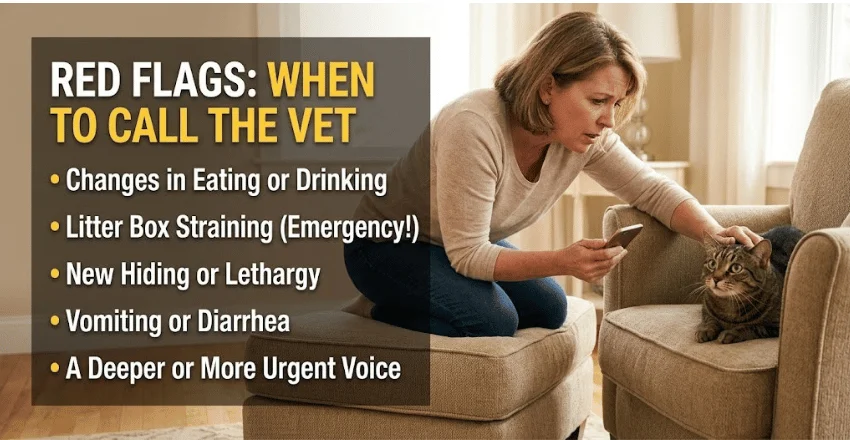
Book an appointment instead of waiting it out if the new noise comes with any of these.
- Straining or crying in the litter box, especially in a male cat. A blocked bladder is an emergency.
- Weight loss, a sharp rise in appetite, or heavy drinking.
- Vomiting, diarrhea, or food left untouched.
- Hiding, flinching at your touch, or hesitating before a jump.
- The sound itself changing: deeper, hoarser, or more urgent than normal.
- Any new yowling in a cat over ten, particularly after dark.
- Staring at walls, wandering, or missing the box.
How to bring the noise down without ignoring your cat
Blanket advice to ignore a cat is poor advice. Plenty of those meows are accurate reports: an empty water bowl, a shut door, a filthy tray. Answer those fast, and stop rewarding the negotiation.
- Rule out disease first, always in a cat over seven.
- Feed on a fixed schedule, pushing the last meal as late as you can.
- Add a timed feeder, so breakfast stops arriving from you.
- Play hard for ten to fifteen minutes before bed, then feed, then lights out.
- Give her the room she wants: a window perch, a high shelf, a quiet box.
- Reward quiet. Attention goes to the silent cat, never to the loud one.
- Hold the line for two weeks, and expect the burst early.
Enrichment does the heavy lifting for a young cat with energy to burn. Climbing space, a puzzle feeder and short hunting games shift more behavior than any correction. For the rest of our animal care coverage, browse the pet care articles on the Petistra blog.
Do talkative breeds exist?

They do, and it is not something owners imagine. Siamese cats and the oriental breeds built from them, including the Oriental Shorthair, Balinese and Tonkinese, are known for loud, insistent, almost conversational voices. Bengals and plenty of Maine Coons chat more than average.
Breed sets a baseline, not a trend. A Siamese who has held long conversations since kittenhood is normal. One who doubles her output this month still needs every check above.
Your next step
Write down when the noise happens, what stops it, and anything that changed in the two weeks before it started. If your cat is over seven, or another new symptom came with it, book the vet and bring those notes. If she is young and healthy, start with the feeding schedule and the bedtime play.
If you want to know about Why Does My Cat Bite Me, then visit our Pet Care category.
Frequently asked questions
In a young cat, look at the day first: too much sleep, too little play, dinner served early. In a cat over ten, treat night calling as a medical flag until a vet rules out thyroid disease, high blood pressure, pain, and cognitive decline.
Ignore the demands, never the reports. Check the water bowl, the tray and the doors, then give attention only during quiet moments.
It stops the hormonal kind. Yowling tied to a heat cycle, or to a female nearby, usually fades within weeks of surgery. Learned demand meowing carries on regardless.
There is no set number. Your cat’s own baseline is the measure, and doubling it inside two weeks counts as too much even in a talkative breed.
Yes, and so can an illness that causes hunger. Begging around the clock while losing weight points to an overactive thyroid, diabetes, or a gut problem.