


Biting is not one behavior. The cat who nips your hand after two minutes of stroking is doing something completely different from the one who ambushes your ankles at 6 am. One piece of advice will never solve both, and that is the real reason so many owners fail to fix this. So the useful version of the question Why does my cat bite me is simpler: which of the six causes am I looking at?
Short answer: almost every bite comes from one of six causes. Petting overstimulation, play aggression, redirected aggression, quiet grooming nibbles, fear, and pain. Each has a different fix. Bites also come with warning signals you can learn to read, and a puncture on your hand needs a doctor the same day, not next week.
The six causes, and what actually fixes each one
| Cause | What it looks like | What fixes it |
| Petting overstimulation | Enjoys the contact, then flips. Usually the belly, base of the tail, or a long session | Shorter sessions, stop before she asks you to, stick to head and cheeks |
| Play aggression | Stalking, ambushing ankles, grabbing your hand with both paws and kicking | Wand toys twice a day, never hands as toys, end the game when teeth land |
| Redirected aggression | Stares out a window, then bites whoever is nearest for no clear reason | Block the view, separate the cat, leave him alone until he settles |
| Grooming nibbles | Soft, repeated, no pressure, often with licking and purring | Nothing. Move your hand if it bothers you |
| Fear and defense | Crouched, ears flat and out, hissing, backed into a corner | Give space and an exit; never reach into the hiding spot |
| Pain | New behavior in a cat who never bit before, or bites in one body area | A vet exam, not a training plan |
Key takeaways
- Match the fix to the cause. A play biter and a pain biter need opposite responses.
- Bites are rarely unpredictable. What people read as random is missed body language.
- The single best petting rule: stop early, while she still wants more.
- Punishment makes feline aggression worse, because it adds fear to the situation.
- A cat bite that breaks skin on the hand is a same-day medical question.
The warning signs that come before a bite
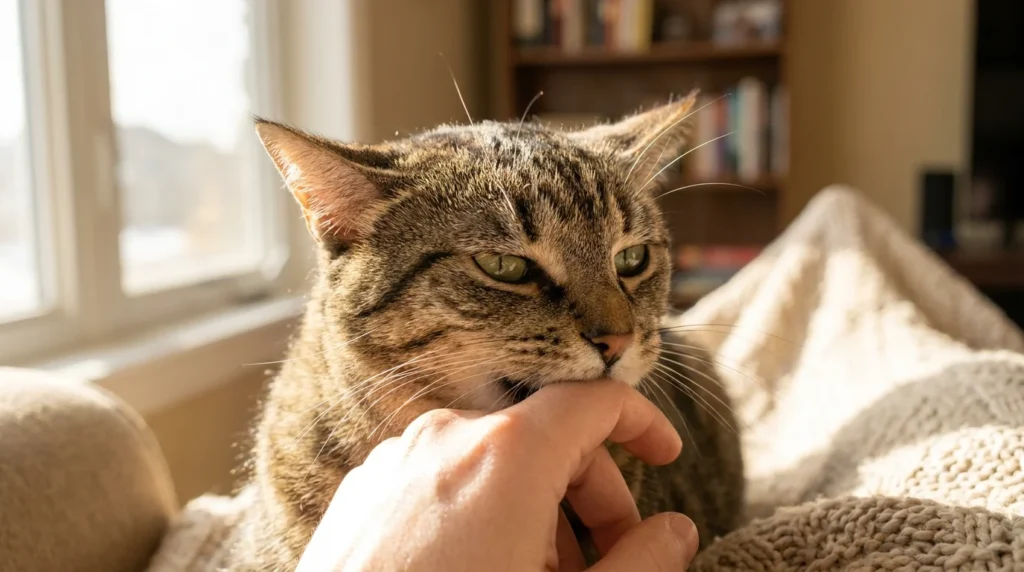
Owners describe cat bites as coming out of nowhere. They almost never do. Cats broadcast discomfort for several seconds before teeth get involved, and the signals are small enough to miss if you are watching television instead of the cat.
Watch for these, in roughly the order they appear:
- The tail. Lashing, thumping the couch, or a fast flick at the tip.
- The ears. Rotating backward, or flattening down against the head.
- The skin. A ripple or twitch running along the back.
- The eyes. Pupils widening, or a hard stare at your hand.
- The body. Muscles going stiff under your palm, weight shifting away.
- The sound. A low mutter or growl, or a purr that stops mid-breath.
Any one of those means stop now. Reading a cat this way pays off far beyond biting, and the same skill sits behind most of the advice in the pets and animal care hub. Once you can spot the tail change, the whole problem stops feeling random.
Petting overstimulation, the most common cause
Your cat jumps into your lap, purrs, leans into your hand, then bites it. Nothing changed except the number of strokes. This is petting-induced aggression, and it is not spite. Repetitive touch builds up until a pleasant sensation tips over into an irritating one, and the bite is how the cat ends the conversation.
Three things help, and the first matters most.
- Stop before she asks you to. Count roughly ten strokes, then lift your hand. Let her ask for more. Short sessions that end well beat long ones that end in teeth.
- Change where you touch. Most cats like the cheeks, chin, and the base of the ears. Far fewer enjoy the belly, the flank, or the base of the tail.
- Freeze rather than jerk away. Pulling your hand back fast drags the skin across the teeth and turns a warning into a puncture.
Play aggression, usually a kitten problem that grew up
This one traces back to how the cat was raised. Kittens learn bite inhibition from littermates, who yelp and quit the game when a bite lands too hard. A kitten raised alone never gets that lesson. Neither does one whose people used bare hands as a toy, which teaches a literal rule: hands are prey.
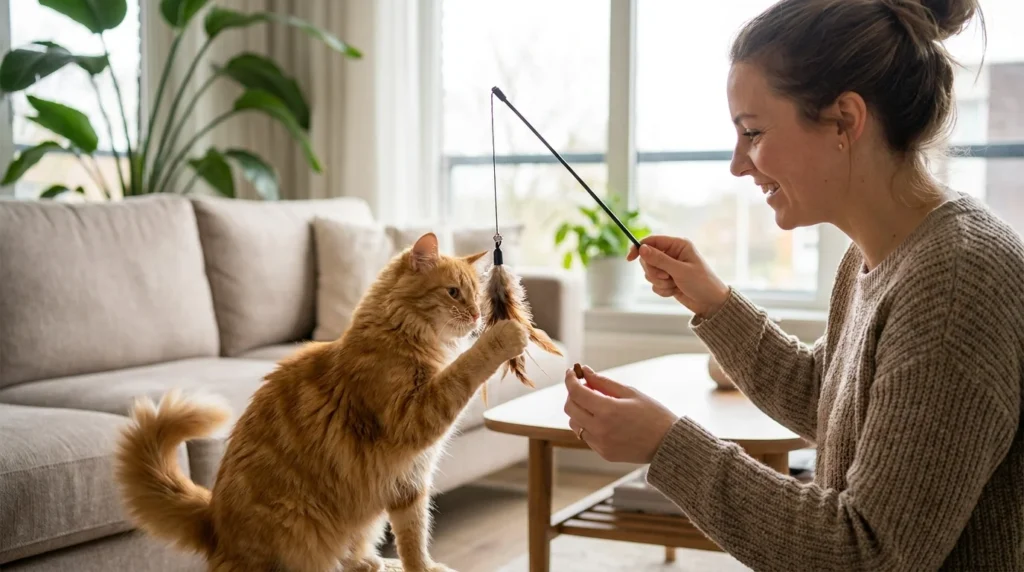
The fix is redirection, not correction. Give the hunting sequence a proper target with a wand toy for ten minutes twice a day, ideally before meals and before bed. Keep hands out of the game entirely. When teeth do land, stand up and walk away without a word, because ending the fun is the consequence a cat understands.
Redirected aggression, when the bite has nothing to do with you
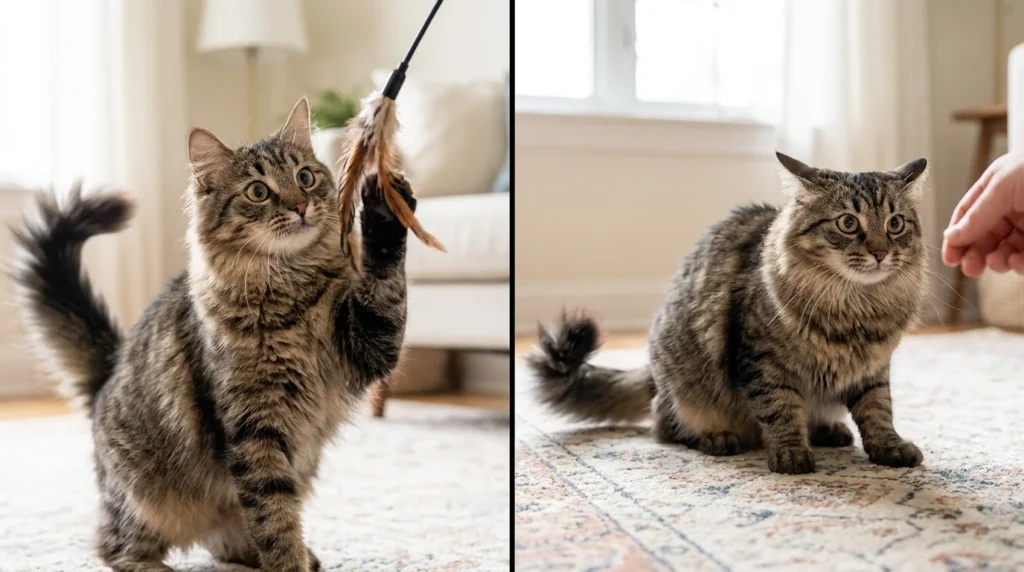
A neighborhood cat walks past the window. Your cat cannot reach it, winds up anyway, and bites the person sitting next to her. It feels like a betrayal. It is closer to a misfire.
Block the view with window film or move the cat’s perch. If it has already happened, do not try to soothe her. Leave the room, let her cool down for a few hours, and reintroduce yourself calmly. Cornell University’s Feline Health Center advises removing or avoiding the trigger as the main prevention here, and warns against touching a cat during these episodes at all.
Grooming nibbles are not aggression
Soft, repeated, no real pressure, often mixed with licking and a running purr. These are social grooming behaviors, the same thing cats do to each other. Nothing needs fixing. If the sandpaper tongue and the tiny teeth bother you, move your hand somewhere else and carry on.
Fear biting, the one that looks the most dramatic
A frightened cat wants distance, not a fight. Biting is what happens when you take the option to flee away from him. The posture gives it away: crouched low, ears flat and turned out, tail tucked, hissing, backed into a corner or under the bed.
Give him an exit and stop reaching. Never pull a cat out of a hiding place by hand, especially at the vet or after a move. A carrier left open in the room, a towel to hide under, and quiet patience will do more in ten minutes than any amount of coaxing.
Why does my cat bite me now when he never used to?
When a friendly cat suddenly starts biting and never did before, take it seriously. Pain is the most common explanation, and cats hide it well. Arthritis, dental disease, an abscess, an ear infection, and hyperthyroidism all show up as a shorter fuse rather than an obvious limp. We cover this in more depth in Do Female Cats Spray.
Two patterns point to pain. The behavior is new, and the bites cluster around one body area: the hindquarters, the mouth, an ear, a paw. Book a vet exam before you start any training plan. Treating a sore cat as a behavior problem wastes months and lets the underlying cause get worse.
Punishment makes it worse, every time
Shouting, scruffing, a tap on the nose, a spray bottle. All of it backfires. Cornell’s Feline Health Center is direct about this: physical punishment increases a cat’s fear and anxiety, and worsens aggression. You have not taught your cat that biting is wrong. You have taught her that hands are unpredictable, which is exactly the belief that produces more biting.
Do this instead. Go still, disengage, and end the interaction. No eye contact, no talking, no picking her up.
When a cat bite needs a doctor
This part deserves more attention than most articles give it. Cat teeth are narrow and sharp, so they behave like hypodermic needles. They drive bacteria deep into tissue, and the small entry wound seals over quickly, which traps the bacteria under the skin. A puncture that looks trivial on the surface can be the one that turns serious.
A 2024 study in Archives of Orthopaedic and Trauma Surgery reviewed 102 adults treated for cat bites to the hand and forearm. Pasteurella multocida accounted for 53% of the positive cultures, and the average hospital stay across the group ran 3.1 days. The same paper notes that a Pasteurella multocida infection usually produces local inflammation and cellulitis within 3 to 6 hours of the bite. That timescale is the point. Waiting to see how it looks tomorrow is how a small wound becomes an operation.
Call a doctor the same day if any of these apply:
- The bite broke skin on your hand, wrist, or over any joint.
- Redness, swelling, heat, or throbbing pain starts within hours.
- You are pregnant, diabetic, over 65, or on medication that suppresses your immune system.
- Your last tetanus shot was more than five years ago.
- The cat’s vaccination history is unknown, or it was a stray.
First, wash it. Hold the wound under running water for five minutes, wash with soap, and cover it with a clean dressing. Then make the call. Doctors often prescribe antibiotics for cat bites even when the wound looks fine, and that is a reasonable decision rather than an over-cautious one.
What to do this week
Pick one cause from the table that matches what you see at home, and change just that. For most households it will be the petting rule: ten strokes, then stop. Give it two weeks and watch the tail rather than the clock. For more on living with a cat who has opinions, browse Petistra’s newest pet articles and start with the behavior pieces.
Frequently asked questions
That combination usually means the interaction went slightly too far and then reset. The bite is a stop signal, and the licking is social grooming afterward. Shorten your petting sessions, and it tends to disappear.
Real, in the sense that gentle mouthing with no pressure is a social behavior rather than an attack. The test is force. If it never breaks skin and comes with purring and kneading, treat it as affection.
Play is silent, bouncy, and comes with a wiggling rear end and dilated pupils. Aggression comes with sound, hissing, growling, a stiff body, and flattened ears. Play still hurts. It is not hostile, though.
Moving shapes under fabric look exactly like prey. Your feet are not being judged. Keep them still, and burn off the hunting drive with a wand toy before bed.
Kitten mouthing usually fades by about a year if hands were never used as toys. Biting that continues in an adult cat is a habit with a cause, and it needs the cause identified rather than time.
![The Ultimate Pooper Scooper Guide: Best Options for Grass, Gravel, and Turf [2026]](https://petistra.com/wp-content/uploads/2026/08/Pooper-Scooper.webp)