
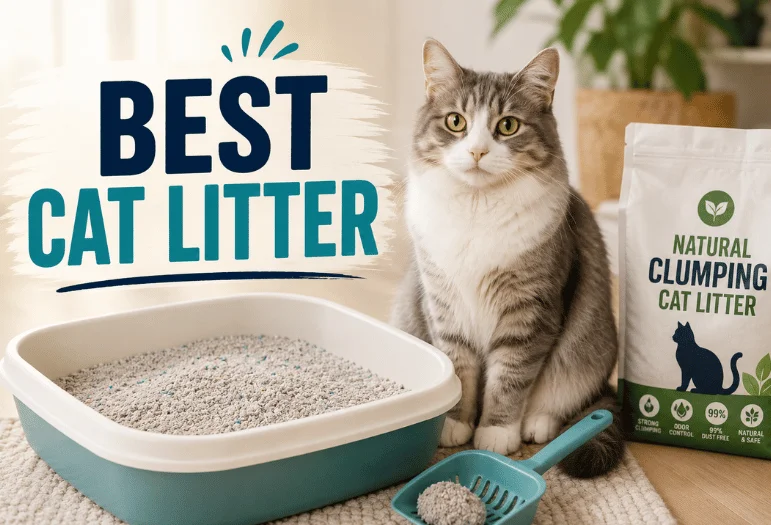
Most roundups rank litter by how well it hides odor from you. Your cat ranks it by texture, and if the texture is wrong, she stops using the box. That one fact reorders everything, so this guide picks the best cat litter by what cats will use first, then by dust, clumping, odor control, tracking, and cost. We cover this in more depth in Cat Carrier Types Ranked.
Short answer: for most homes, the best cat litter is an unscented, fine-grained clumping clay, and Dr. Elsey’s Ultra is the easiest one to buy at roughly $0.57 a pound. Go plant-based with walnut or corn if disposal matters to you. Choose silica crystals only when daily scooping is never going to happen. Elsewhere on the site: Crystal Litter for Cats.
Seven litters compared at a glance
| Litter | Type | Clumps | Scent | Maker’s dust claim | Bag | Price seen | Per pound |
| Dr. Elsey’s Ultra Premium | Sodium bentonite clay | Yes, hard | Unscented | 99.9% dust-free | 40 lb | $22.99 | $0.57 |
| Tidy Cats Free & Clean | Clay plus activated charcoal | Yes | Unscented | Low-dust formula | 35 lb | $18.99 | $0.54 |
| Arm & Hammer Clump & Seal Slide | Bentonite, limestone, baking soda | Yes | Unscented version | 99.9% dust-free | 38 lb | $26.79 | $0.71 |
| World’s Best Multi-Cat | Whole-kernel corn | Yes | Unscented | 99% dust free | 28 lb | $34.95 | $1.25 |
| Naturally Fresh Multi-Cat | Walnut shell | Yes | Unscented | Virtually dust-free | 26 lb | $32.99 | $1.27 |
| Okocat Original Premium | Wood fiber | Yes | Unscented | 99% dust-free | 18.8 lb | $22.99 | $1.22 |
| PrettyLitter | Silica gel crystals | No | Unscented | Low dust | 8 lb | $27.48 | $3.44 |
Prices are US retailer listings read on August 2, 2026, and they move. Dust wording is quoted from each maker or its retail listing. We ran no tests of our own.
Key takeaways
- Buy unscented. Perfume is a leading reason a cat quietly abandons the box.
- Fine, sandy grains beat coarse pellets on acceptance almost every time.
- Price per pound is the only fair comparison, because bag sizes run from 8 lb to 40 lb.
- Clay wins on cost and clumping. Plant-based wins on weight and disposal. Crystals win on effort.
- Switch slowly over ten days, or expect a puddle on the rug.
Why your cat picks the best cat litter, not the reviewer

Cats show a consistent texture preference, and it is not subtle. The 2014 AAFP and ISFM house-soiling guidelines in the Journal of Feline Medicine and Surgery name one substrate first: a fine, sand-like, non-scented, clumping material. Depth matters too. Those guidelines set a floor of 1.25 inches and warn that cats often find aromatic litter and deodorizers offensive.
So the perfumed, coarse-pelleted bag that smells clean to you is the one most likely to send your cat behind the couch.
Cornell University’s Feline Health Center arrives at the same conclusion from the clinic. Its house-soiling page reports that roughly 10% of neutered males and 5% of neutered females spray, and calls house soiling the behavior problem cat owners report most. It recommends unscented, finer-textured material one to two inches deep.
Acceptance therefore sits above odor control in the ranking below. Dust comes next, then clumping strength, then odor, and only then tracking and price. For the wider groundwork on feline health and behavior, the Petistra pets section covers it.
Dust is the spec nobody regulates
Read five bags, and you will see five versions of the same promise. Nobody checks. No US regulator defines dust-free for pet products, and no published industry test sits behind those percentages. Each figure comes from the brand’s own protocol, so two products quoting 99% may have measured different things.
That matters because your cat digs with her face inches from the surface, twice a day, for years. Fine clay powder is respirable. Nobody has proved that ordinary household litter causes feline airway disease. Keeping the exposure small is still sensible, especially if a cat has asthma or someone in the house does.
Two checks beat any label. Pour a fresh bag in low, angled light and watch the cloud. A week later, run a finger along the top rim of the box and look at what comes off.
The five litter types, with pros and cons

- Clumping sodium bentonite clay. Pros: the fine grain cats prefer, hard clumps that lift whole, and the lowest cost per pound. Cons: heavy bags, real tracking, never flushable, and strip-mined.
- Non-clumping clay. Pros: cheap, and it holds a lot of liquid. Cons: urine pools at the bottom, so the whole box needs dumping every few days, and ammonia builds fast. Skip it unless a vet asked for it after surgery.
- Silica gel crystals. Pros: excellent moisture and odor capture, light bags, and one fill can run weeks. Cons: expensive per pound, crunchy underfoot, no clumps to scoop, and some cats refuse the texture outright.
- Plant-based clumping (corn, wheat, walnut shell, wood, paper, tofu, grass). Pros: light, biodegradable, often flushable in small amounts, and low tracking in the finer grinds. Cons: roughly double the price per pound, softer clumps, and corn or wheat can grow mold if the box stays damp.
- Pelleted paper or pine. Pros: near-zero dust, so it is the usual pick after eye or airway surgery. Cons: pellets are the texture cats reject most, and they do not clump at all.
The seven picks, ranked
- Dr. Elsey’s Ultra Premium. Dr. Elsey’s lists it as 100% bentonite clay in a medium grain, hypoallergenic, and 99.9% dust-free. At $22.99 for 40 lb, it is also the cheapest serious clumping option here. Good: acceptance, clump hardness, price. Bad: 40 lb of bag to carry, and it tracks.
- Tidy Cats Free & Clean Unscented. Purina builds this on clay with activated charcoal and no fragrance or dye. At $0.54 a pound, it is the cheapest in the table. Good: value, odor control without perfume. Bad: recent buyer reviews report weaker clumping than older batches.
- Naturally Fresh Multi-Cat. Crushed walnut shell, unscented, sold as virtually dust-free and hard-clumping within about 15 minutes. Good: dark grains hide soil, strong odor control, renewable. Bad: $1.27 a pound, and reviewers report batch-to-batch dust swings.
- World’s Best Multi-Cat Unscented. Whole-kernel corn, 99% dust-free by the maker’s account, flushable and septic-safe. Good: light bags, quick clumps, low tracking. Bad: $1.25 a pound, and corn can mold in a damp box.
- Arm & Hammer Clump & Seal Slide. Bentonite, limestone, and baking soda, claimed 99.9% dust-free with a non-stick base so waste slides out. Good: nothing cements to the box floor. Bad: $0.71 a pound, and the baking soda load is heavier than some cats like.
- Okocat Original Premium. Reclaimed softwood fiber, unscented, claimed 99% dust-free, flushable in small amounts on municipal sewer. Good: lightest full-size bag, faint woody smell. Bad: 18.8 lb for $22.99, and several 2026 reviews call the current batches dusty.
- PrettyLitter. Silica gel crystals that change color against urine pH and blood, roughly two months per 8 lb bag for one cat. Good: minimal effort, an early flag on urinary trouble. Bad: $3.44 a pound, no clumping, and the color signal is a prompt to call a vet, not a diagnosis.
How to switch litters without accidents
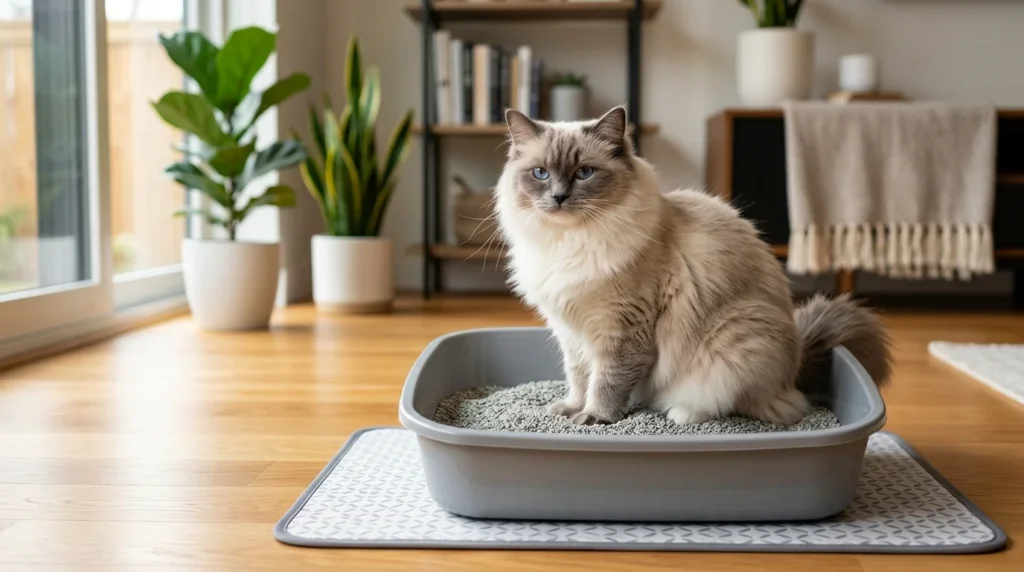
Abrupt swaps cause more house soiling than bad litter does. Give the change ten days.
- Days 1 to 3: fill the box with three parts old material and one part new.
- Days 4 to 7: move to half and half.
- Days 8 to 10: three parts new, one part old.
- Day 11: all new, filled to a depth of one to two inches.
- Any hesitation at the box, and you drop back one step for three days.
With two or more cats, a second box holding only the new material lets each cat vote instead of forcing the issue. Scoop both twice a day during the switch. A dirty box will otherwise get blamed on the new texture. More owner guides sit on the Petistra articles index if you want box setup covered too.
The verdict for your household
- Multi-cat home: Dr. Elsey’s Ultra, in the largest bag you can lift. Hard clumps survive being walked on by a second cat.
- Kitten under four months: a pelleted paper litter such as Fresh News. Kittens taste everything, and clumping clay is the one texture worth keeping away from a mouth that young.
- Senior or arthritic cat: soft, fine grain and a shallow two-inch fill. Naturally Fresh or Dr. Elsey’s both work; pellets hurt sore toes.
- Asthma in the house: Okocat or a paper pellet, poured slowly and low. Skip any lightweight clay, which is the dustiest format on the shelf.
- Flushing and disposal: World’s Best, and only in small scoops on municipal sewer. Never flush clay.
- Tightest budget: Tidy Cats Free & Clean at $0.54 a pound, or Dr. Elsey’s at $0.57.
Buy one bag, not a pallet. Watch what your cat does with it for two weeks. If she starts avoiding the box on any litter, book a vet visit before you try another brand. Straining, frequent small urinations, and puddles just outside the box are signs of urinary disease. A male cat who cannot pass urine is an emergency.
Frequently asked questions
Clumping clay with activated charcoal or baking soda, scooped daily. Silica crystals hold odor longer between changes, then let ammonia build once saturated. Perfume masks nothing. It adds a second smell.
Clumping, by a wide margin, as long as the grain is fine. The clumping action is not the appeal. That sand-like texture is.
It is not toxic. Veterinary house-soiling guidance does treat fragrance as a common trigger for box refusal. Unscented is the first change to make once a cat starts eliminating outside the box.
An unscented paper pellet or a fine plant-based litter until about four months old. After that, move her to whatever the adults use. Young kittens mouth their bedding, and clumping clay is the wrong thing to swallow.
One to two inches, topped up as you scoop. Deeper feels unstable to some cats. Shallower leaves urine sitting on plastic.