

Most indoor cats take two or three car rides a year, and nearly all of them end at a clinic. That single fact should decide which cat carrier you buy. Whether it matches your hallway is not the question. It is how much easier it makes the ten minutes your cat spends on an exam table.
Short answer: pick a hard-sided model whose top half lifts away. Your vet can then work with your cat sitting in the base instead of pulling a scared animal out through a narrow front door. Check that it belts into the car, compare its published inches against your airline’s, and keep it out of the house all year.
| What matters: Cat Carrier | What to look for |
| Vet handling | A top half that lifts off in seconds, no tools |
| Car safety | A seat belt path, plus a crash test you can look up |
| Air travel | Published exterior inches you can check against the airline |
| Cleaning | Smooth plastic base with no fabric seams |
| Typical price | $39.99 to $224.99 across the models checked here |
| Weight limits | Cat-sized models are usually rated for 10 lb to 18 lb |
TL;DR
- A removable top is the one feature that changes the vet visit, and page one rarely leads with it.
- Soft-sided bags win on airline fit and lose on cleaning and structure.
- Very few carriers have any independent crash test, so belt yours down regardless.
- The cardboard box from the shelter is a container for one ride home, not a carrier.
- Leave it out as furniture, or your cat learns to vanish when it appears.
Why the vet visit should decide the whole purchase
Owners skip appointments because the trip is awful, and the trip is awful because loading goes badly. A cat that has to be tipped, shoved, or poured through a small opening arrives already frightened. Handling then gets harder for everyone in the room.
Search results for this query are mostly retailer category grids and roundups. They rank by price and looks. Not one of them says which design a veterinarian actually prefers to work with. Nobody ranks by the thing that matters.
This is a documented gap in advice, not a hunch. The 2022 AAFP/ISFM Cat-Friendly Veterinary Interaction Guidelines appeared in the Journal of Feline Medicine and Surgery. They report that over 75% of caregivers say they have never been given travel advice. The same guidelines tell clinicians to remove the top half and then examine the cat in the base.
So the ranking criterion writes itself. Whatever makes that removal quick and calm wins, and the rest is decoration. If you want more on feline behavior generally, our cat and dog care hub covers the wider picture.
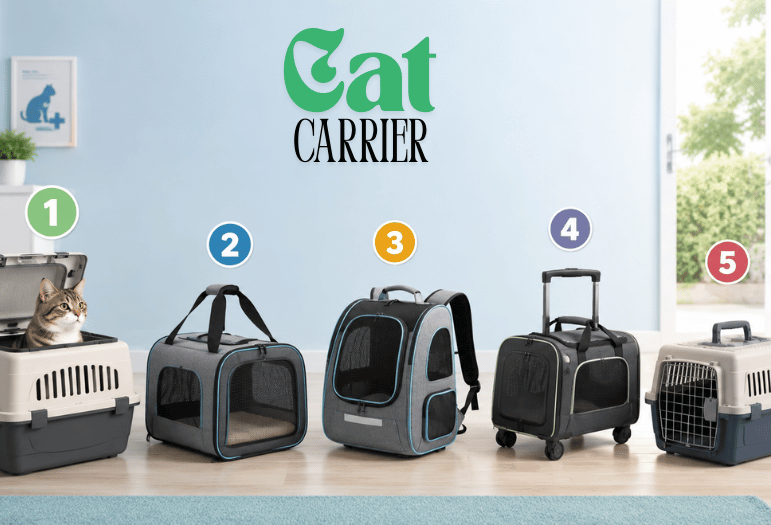
Five cat carrier designs, ranked by vet-day ease

1. Hard-sided with a removable top
Clips or wing nuts hold the shell together, and the lid comes away in seconds. Your cat never has to be extracted. She sits in a familiar place, often on her own blanket, while the vet works around her.
- Pros: best handling on the table, wipes clean, holds its shape in a crash, and the front door is available as a backup.
- Cons: bulky in a closet, heavier to carry, rarely fits under an airline seat.
2. Hard-sided, front door only
Same tough shell, one way in. Loading a nervous cat means aiming her head first through a gap the size of a shoebox end, which she can brace herself against. Getting her out again is worse.
- Pros: cheap, secure, easy to clean, widely stocked.
- Cons: the hardest design to load and unload, and vets often end up tilting it upright.
3. Soft-sided
Fabric over a light frame, usually with a top zip and a front zip. These fold flat and fit under seats, which is why they dominate airline advice. Structure is the trade.
- Pros: slight, packable, best chance of meeting an under-seat rule.
- Cons: fabric absorbs urine and odor; zips can be forced open by a determined cat; walls collapse under load.
4. Top-entry only
Lowering a cat feet first is genuinely kinder than pushing her forward. The problem shows up later. With no front door and no separable shell, the vet has to reach down into a deep box and lift a frightened animal out.
- Pros: easy loading, good for cats that plant their feet.
- Cons: awkward unloading at the clinic and no way to leave your cat sitting in the base.
5. The cardboard box from the shelter
It is a temporary container, not equipment. Handles tear, the base softens if anything is spilled, and a determined cat can push the flaps apart at a red light. Use it for the ride home and buy something real that week.
- Pros: free, flat-packed, fine once.
- Cons: no security, no structure in a crash, ruined by one accident.
How the five designs compare
| Design | Vet-friendly | Cleaning | Security | Car safety |
| Hard, removable top | Excellent | Excellent | Excellent | Good, some certified |
| Hard, front door only | Poor | Excellent | Excellent | Good |
| Soft-sided | Fair | Poor | Fair | Mixed, a few certified |
| Top-entry only | Fair | Good | Good | Fair |
| Cardboard box | Poor | None | None | None |
Real models, with the numbers their makers publish

Every figure below comes from the manufacturer’s own product page, checked on August 2, 2026. We have not put these through a hands-on test, so treat the specs as verified and the ranking above as the judgment.
| Model | Type | Size and limit | Price |
| Petmate All-Purpose Vari Kennel, 19 in | Hard, two halves joined by wing nuts | Interior: 16.2 x 12 x 9 in, up to 10 lb | $39.99 |
| Petmate E-Z Load Top-Load Cat Kennel | Hard, top lid plus front door | 19.4 x 12.8 x 10 in., up to 10 lb | $44.99 |
| Sleepypod Air | Soft, built for in-cabin flights | 16 to 22 x 10.5 x 10.5 in., up to 18 lb | $214.99 |
| Sleepypod Mobile Pet Bed | Soft dome that unzips and lifts off | Dimensions not published, rated to 15 lb | $224.99 |
Two things stand out. Cheap hard shells cap out around 10 lb, which rules them out for a 14 lb cat. And the models with real crash data cost roughly five times the plain plastic ones.
Check the weight rating before the price.
Car safety and the crash test have almost nothing in common
Loose luggage becomes a projectile in a collision, and a 12 lb cat inside a plastic box behaves the same way. Belting the thing down protects your passengers as much as your cat. Physics does not care that she is family. Independent testing barely exists here. In the United States, the Center for Pet Safety runs the only certification program of its kind, and its certified list is short.
Sleepypod states that its Air model is certified by that program and tested to the child seat standards FMVSS 213 and FMVSS 213b. The company rates its mobile pet bed for 15 lb. Almost everything else on the shelf carries no independent crash test, whatever the packaging implies.
Until that changes, do this every trip. Route the seat belt through the strap slots, and set the box on the back seat or the floor behind a front seat. Never let it ride loose in a footwell or on a lap.
Flying: check the airline’s own inches, not a label
“Airline approved” is marketing. Under-seat space changes by carrier and by aircraft, so the only number that counts is the one your airline publishes. Delta, for example, recommends a soft-sided kennel no larger than 18 x 11 x 11 inches, because that size fits most of its fleet.
Fees matter too. Delta charges $150 each way for an in-cabin pet within the US, Canada, Puerto Rico, and the US Virgin Islands and $200 on international routes. Measure your chosen bag against the rule before you buy, not at the gate.
Make it furniture, so it stops being a warning sign
Here is the part that changes daily life. A cat who sees the box twice a year, always right before a car ride, learns the pattern fast and hides under the bed. Fixing it costs nothing. The 2022 ISFM/AAFP environment guidelines put it plainly: carriers are best kept as a permanent feature of the cat’s daily environment, in a place she already likes. Practically, that means:
- Park it in a room she uses, door off or tied open, with her own blanket inside.
- Drop a few treats in it each day and walk away. No coaxing.
- Once she naps in it, start feeding her dinner in the base.
- Close the door for thirty seconds, then open it and feed her again
- Carry her around the house, then take one short drive that ends back at home.
Work at her pace and skip a step if she balks. For more short reads on living with cats, browse the Petistra pet blog.
The verdict, by case

Match the case, not the brand.
- Best overall, and best for a nervous cat: a hard shell whose top lifts off. The Petmate E-Z Load Top Load Cat Kennel does this at $44.99 for cats up to 10 lb.
- Tightest budget: the Vari Kennel style at $39.99. The halves separate, though wing nuts are slower than clips.
- Flying: the Sleepypod Air, at $214.99 and rated to 18 lb, then confirm the inches against your airline.
- Car miles with a big cat: a certified soft model such as the Mobile Pet Bed, rated to 15 lb.
- Never use the shelter’s cardboard box as your only option.
Pick one this week, take the door off, and put it in the living room tonight. That one move does more for the next appointment than any upgrade you can buy.
FAQ
For the ride home, yes. After that, it fails: the handle tears, the base gives way, and a determined cat pushes out through the flaps. Replace it before the first booster appointment.
Plain hard shells start near $39.99. Crash-tested soft models run $214.99 to $224.99. Expect to pay in the middle unless you fly or drive long distances often.
Hard-sided, if the top comes off. A nervous cat gets examined in the base and never has to be dragged out. Soft bags earn their place mainly in the air.
Stop it being an event. Leave it out, feed her in it, and practice with the door closed for seconds at a time. If she still hides, put the box in her hiding spot rather than chasing her.
Only if it is restrained, and only a handful have been tested independently. Belt it in every time and treat any untested model as unproven.
Around 18 x 11 x 11 inches suits most aircraft, but each airline publishes its own limit. Check that page, then check the maker’s exterior dimensions.