

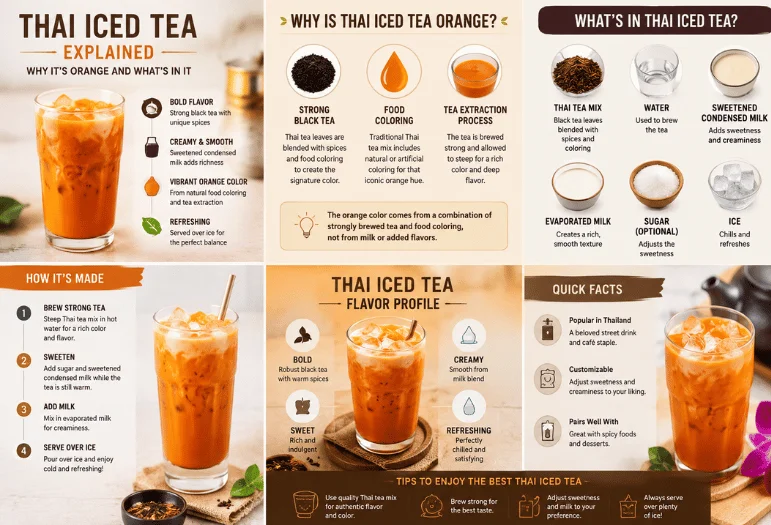
Order Thai iced tea at a Thai restaurant, and a tall orange glass arrives, sweet and creamy and nothing like the tea in your kitchen. The color is the first surprise. Its richness is the second, for a drink built on tea leaves and ice. Thai iced tea is less a flavor of black tea than a formula.
Strong spiced tea, sugar, and a heavy pour of milk each do a job. Get one of them wrong and the whole glass falls flat. Thai tea is strongly brewed black tea, usually Assam, sweetened with sugar and sweetened condensed milk, then poured over ice and topped with evaporated milk.
Its bright orange color comes from added food coloring rather than from the leaves. One glass sits closer to a dessert than to plain iced tea, carrying real caffeine and heavy sugar.
What This Drink Actually Is
“Cha yen” is the Thai name, and it translates as “cold tea.” Street vendors in Bangkok brew a black tea blend, make it hot and sweet, and then finish it in the glass with milk. The base is usually Assam or Ceylon, ground fine and steeped strong enough to stand up to all that dairy.
Spices belong to the tradition too. Star anise, cardamom, and crushed tamarind seed show up in older blends and in some modern mixes. Commercial powders often swap them for an artificial vanilla flavoring, which is why a supermarket version tastes rounder and sweeter than a blend you build yourself.
Why the Orange Color Is Not Natural
Brewed black tea is brown. That glowing orange arrives from dye stirred into the tea mix long before it meets hot water.
Popular Thai tea mixes list the coloring plainly. Read the back of a ChaTraMue bag, and you will find FD&C Yellow No. 6, the same sunset yellow used in boxed macaroni and cheese.
- Dye does the visual work only. It carries no flavor and changes nothing about strength.
- Naturally colored blends exist, and they brew a deep reddish brown instead of orange.
- The color also separates the drink from iced coffee, which vendors sell off the same cart.
What Goes Into a Glass
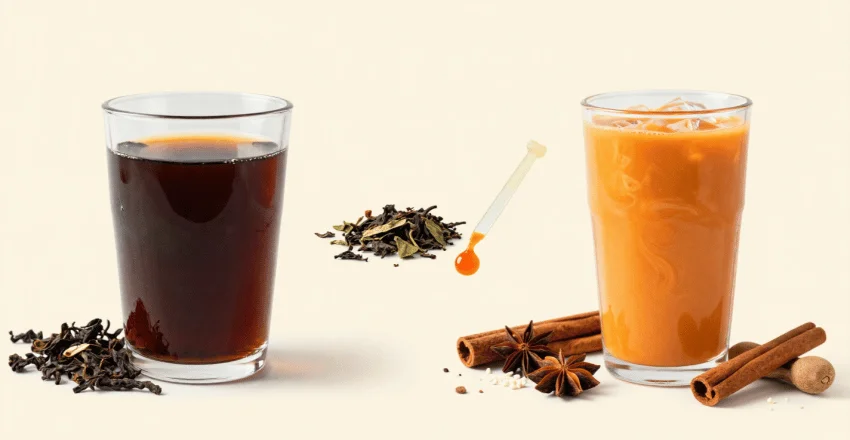
Five things do all the work, and the milk does most of it.
| Component | What it does | Typical form |
|---|---|---|
| Black tea base | Bitterness and body | Assam or Ceylon, brewed double strength |
| Sugar | Balances the tannins | Stirred into the hot tea |
| Sweetened condensed milk | Sweetness and thick texture | 2 to 3 tablespoons per glass |
| Evaporated milk | The pale swirl on top | Floated over the ice |
| Ice | Chill and dilution | Filled to the rim |
Condensed milk is why the drink coats your mouth. It is also a large pour of straight dairy, which is worth a thought before a curious pet gets near your glass. Our guide to whether dogs can drink milk covers the lactose side of that.
Thai Iced Tea vs Regular Iced Tea
Both start with black tea and ice. Everything after that point splits apart.
| Feature | Thai style | Regular iced tea |
|---|---|---|
| Tea strength | Brewed very strong | Brewed light |
| Milk | Condensed plus evaporated | None |
| Sweetness | Built in and heavy | Optional |
| Color | Orange, usually dyed | Amber brown |
| Calories per glass | Roughly 150 to 250 | Near zero unsweetened |
| Best moment | After a spicy meal | All afternoon |
Key takeaways
- The base is Assam or Ceylon black tea, brewed far stronger than you would drink it plain.
- The orange is food coloring, most often FD&C Yellow No. 6.
- Sweetened condensed milk supplies both the sweetness and the texture.
- One glass carries real caffeine plus about as much sugar as a soda.
- Dogs and cats should not have any of it, not even the melted ice.
Caffeine and Sugar in One Glass
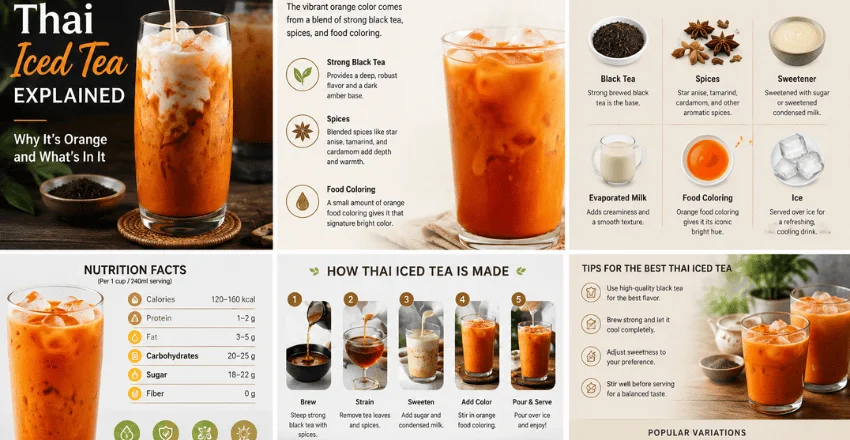
The Food and Drug Administration puts 400 mg of caffeine a day as the amount not generally tied to dangerous effects in healthy adults. That guidance, current as of August 28, 2024, lists black tea at about 71 mg per 12 fluid ounces. Thai tea gets brewed at roughly double normal strength. One large glass therefore lands near a strong cup of coffee, which matters if you already drink coffee at breakfast.
Sugar is the bigger story. Sweetener goes into the hot tea, then condensed milk goes on top. A restaurant glass of wine usually lands in the 150 to 250 calorie range, nearly all of it sugar and milk fat.
- A smaller glass with less condensed milk cuts the sugar sharply.
- Unsweetened evaporated milk on its own gives creaminess without the syrup.
- Boba versions add tapioca pearls, cooked in sugar syrup, which pushes the total higher still.
Can Dogs or Cats Drink Any of It?
Short answer: no. Not a sip, and not the leftover ice.
Three parts of the glass work against a pet. Caffeine is the serious one, since dogs and cats react to it far more sharply than people do. A lick off a spill is rarely an emergency, but a knocked-over glass that a small dog laps up deserves a call to your vet.
Dairy is the second problem. Most adult dogs make little lactase, so a big dose of condensed milk tends to mean loose stools within a few hours. Sugar and milk fat come third, and fat is what can tip a sensitive dog toward pancreatitis.
Cats fare no better, and they gain nothing from it either. Water and shade beat any drink in your hand on a hot afternoon. Panting is how a dog sheds heat, so why dogs pant in warm weather is useful reading before summer.
Sharing food off your plate carries the same trap in other forms. Plenty of ordinary kitchen items are risky, and why garlic is bad for dogs makes the point clearly.
Dairy-Free and Dye-Free Versions
You can rebuild the whole drink without either of the parts people ask about. Full-fat coconut milk lands closest to the original texture, and oat milk with a spoonful of sugar runs a close second. For color, skip the packaged mix entirely. Brew a strong Assam with star anise and a little cardamom instead, and it will pour reddish brown and taste much more like tea.
How It Shows Up on US Menus
Restaurants pour it from a pitcher of pre-brewed sweetened base and float the evaporated milk at the table. Boba shops treat it as a flavor rather than a drink, so you pick your ice, your sweetness level, and your toppings. Bottled versions sold in grocery stores are milder and thinner, because shelf-stable milk behaves differently from a fresh pour. Expect to pay around $4 to $6 at a sit-down Thai restaurant, and $6 to $8 at a boba shop once pearls go in.
Names on menus wander. Thai tea, Thai milk tea, and cha yen usually point to the same orange glass. Thai green tea, or cha yen keow, is a separate drink with a jade color and a grassier taste.
Worth Ordering, Worth Understanding
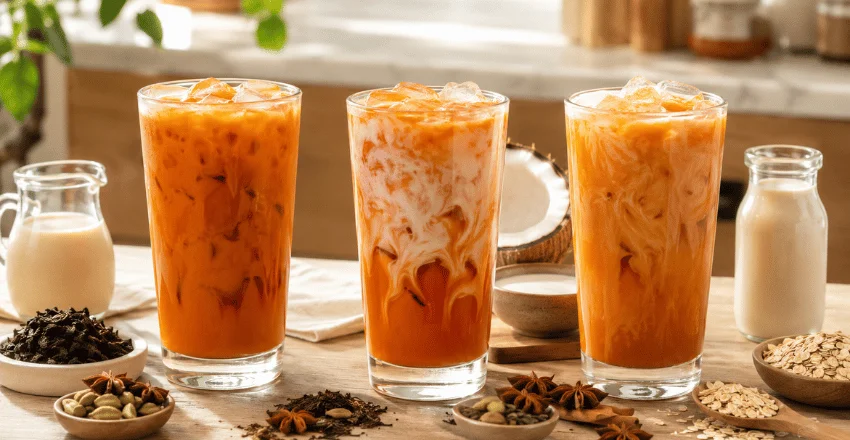
This drink earns its reputation. Strong tea, heavy milk, and a lot of sugar make something no plain glass of iced tea can copy, which is exactly why a small one goes a long way. Treat it as what it is: a sweet, caffeinated dessert in a glass, meant for you and never for the animal watching you drink it.
Frequently Asked Questions
Black tea, brewed strong. Assam is the usual pick in Thailand, with Ceylon a common stand-in. Most bagged mixes sold in the US start from a finely ground Assam already blended with sugar, flavoring, and dye.
Added food coloring. FD&C Yellow No. 6 sits on the ingredient list of the mixes stocked in most Asian groceries, and it is there for looks alone.
Yes. Real black tea, brewed at double strength, means a glass often carries more caffeine than a plain cup of black tea. Decaf versions exist but rarely reach restaurant menus.
Close enough that many menus use the two names for one drink. Some shops reserve Thai milk tea for a milkier, less sweet pour. Ask if the distinction matters to you.
No. Caffeine and dairy both count against it, and the sugar does a pet no good either. Offer cool fresh water instead.
Brewed and unsweetened, it holds about a week in a sealed jar in the fridge. Add the milk only as you pour, because dairy shortens that window to a day or two.