

The cereal bowl sat on the coffee table for about four seconds. Your lab got there first. Now she’s licking her chops, and you’re standing in the kitchen doing math.
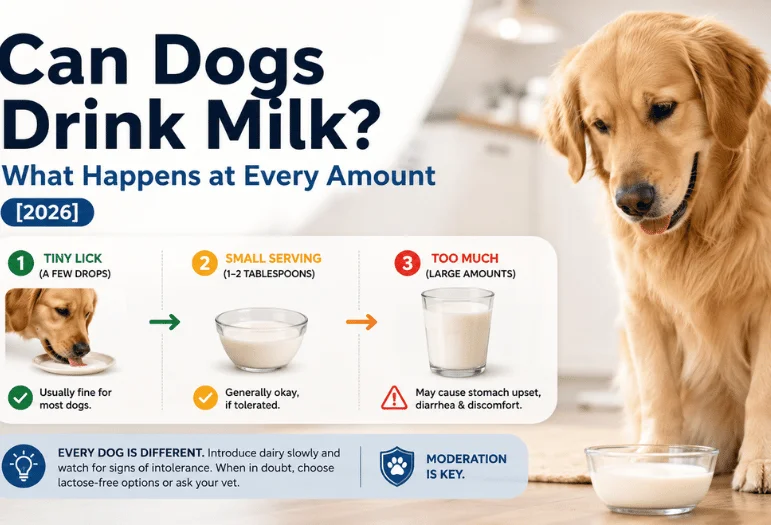
So can dogs drink milk? A lick or a tablespoon will pass through most healthy adults with nothing to show for it. Anything near a full bowl usually won’t. Milk isn’t poison. It’s a poor match for a gut that stopped making much lactase at weaning, and the amount is what decides how rough the next twelve hours get. For the full picture, read How Long Can Dogs Hold Their Pee.
How Much Went Down, and What It Does
Start here, because this is what matters tonight. The honest answer to “Can dogs drink milk?” is a dose, not a yes or a no. The figures below assume whole cow’s milk and a roughly 40-pound dog with no history of dairy trouble.
| Can Dogs Drink Milk? Amount Consumed | Roughly | What Usually Happens | Your Move |
|---|---|---|---|
| A lick or two from a plate | Under 1 teaspoon | Usually nothing at all | Carry on as normal. |
| One to two tablespoons | About 1 oz | Usually nothing, although mild gas is possible | Make a note of it and avoid offering more. |
| A quarter cup | 2 oz | Sensitive dogs may develop soft stool within 12 hours | Provide fresh water and skip the evening treat. |
| Half a cup to one cup | 4–8 oz | Many dogs may experience stomach gurgling, gas, or loose stool | Provide water, offer a small plain meal, and monitor your dog overnight. |
| A whole bowl | 8 oz or more | Diarrhea is likely, and vomiting may also occur | Monitor closely and contact your veterinarian if symptoms continue for more than 24 hours. |
| Flavored or sweetened milk | Any amount | The reaction depends on the ingredients | Contact a veterinarian immediately if it contains xylitol or chocolate, as both can cause emergencies. |
Body weight scales all of it. That 10-pound terrier hits the loose stool row on a quarter of what a 70-pound shepherd shrugs off. Halve the amounts for a small breed and double them for a giant one, then still expect surprises.
Key Takeaways
- Small amounts are a tolerance question, not a poisoning question.
- Most adult dogs make little lactase, so mild dairy trouble is normal rather than rare.
- Signs start 30 minutes to 12 hours later and usually clear inside a day.
- Whole milk carries fat as well as sugar, and the fat is the part that can turn serious.
- Puppies need a milk replacer formula, never a carton from the fridge.
- Lactose-free milk holds up in testing. Goat milk does not.
Lactose Trouble Is the Default, Not the Exception
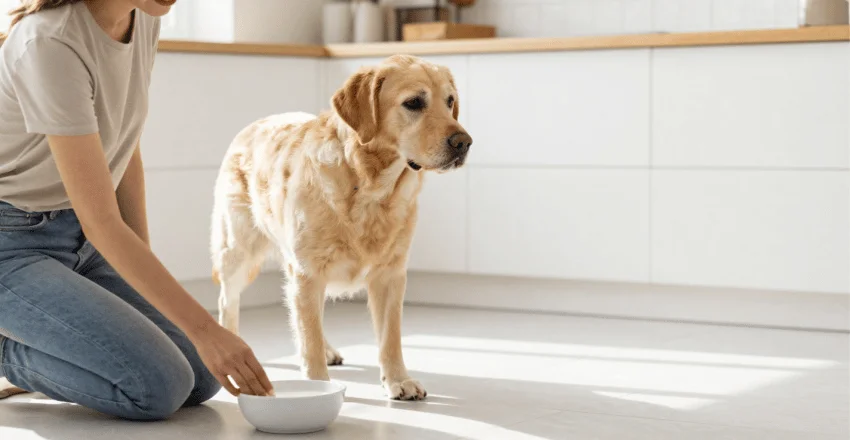
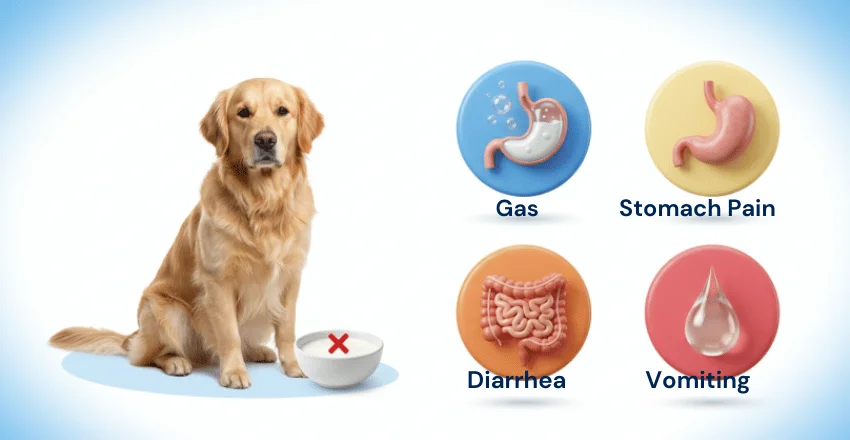
Every puppy is born able to digest milk. That’s the whole point of milk. Newborns make plenty of lactase, the enzyme that splits lactose into sugars small enough for the small intestine to absorb. Then they wean, and production falls away. That decline is ordinary mammal biology, not a defect. Undigested lactose travels on to the colon, pulls water in behind it, and gets fermented by bacteria. Gas and a soupy stool are the result.
Which makes “lactose intolerant” an odd label to hang on an adult dog. It describes the majority of them. The useful question isn’t whether yours is intolerant. It’s where her personal line sits. A 2018 feeding trial published in the Italian Journal of Animal Science went looking for that line.
Researchers fed 14 healthy adult dogs rising daily doses of lactose across three 20-day periods. Four refused the food outright at the lowest dose. Two more developed acute diarrhea once the dose was doubled. Only 8 of the 14 finished with no digestive signs at all.
Close to half of an ordinary, healthy group hit a wall before the study reached its top dose. Keep that ratio in mind before you pour. Dairy behaves differently in a canine gut than it does in yours. So do plenty of other things from your fridge, and our pet food and feeding guides work through them one at a time.
The fat problem is a separate problem
Lactose gets all the attention. Fat deserves some. One cup of whole milk carries close to two teaspoons of fat, delivered in one go to an animal that eats the same measured kibble daily. Sudden fat loads are one recognized trigger for pancreatitis, and that is a genuinely serious illness. Watch for repeated vomiting, a hunched posture, a hard belly, and refusing food. Those signs together mean a vet today, not a night of waiting.
She Already Drank It. Here’s tonight.
Nothing here is dramatic. Do it in order.
- Don’t make her vomit. Milk isn’t a toxin, and forcing it back up creates a second problem where you had one.
- Take the bowl away and put fresh water down. Loose stool costs fluid, and that’s the actual risk.
- Write down the time and your best guess at the amount. It’s the first thing a vet will ask.
- Hold the next meal if she’s small, then offer something plain. Boiled chicken and white rice are the standard fallback.
- Take her out more often than usual for the next twelve hours.
Timing runs roughly like this. Gurgling and gas show up first, often within an hour. Soft or loose stool follows somewhere between 2 and 12 hours. Most dogs are back to normal stools within 24 hours of the last dairy, because once the lactose has cleared the colon, there’s nothing left to ferment.
When to stop waiting
- Diarrhea running past 24 hours, or any blood in it
- Vomiting more than twice
- Puppies, seniors, and any dog under 10 pounds, since they dehydrate quickly
- Pale or tacky gums, or skin that stays tented when you lift it
- Flat, unwilling to move, or crying when you touch the belly
- The milk was chocolate, sweetened, or flavored with anything
Dehydration, not dairy, is what puts a small dog in a clinic. Knowing the animal health warning signs before you need them turns a panicked evening into a manageable one.
Puppies Are a Different Question Entirely
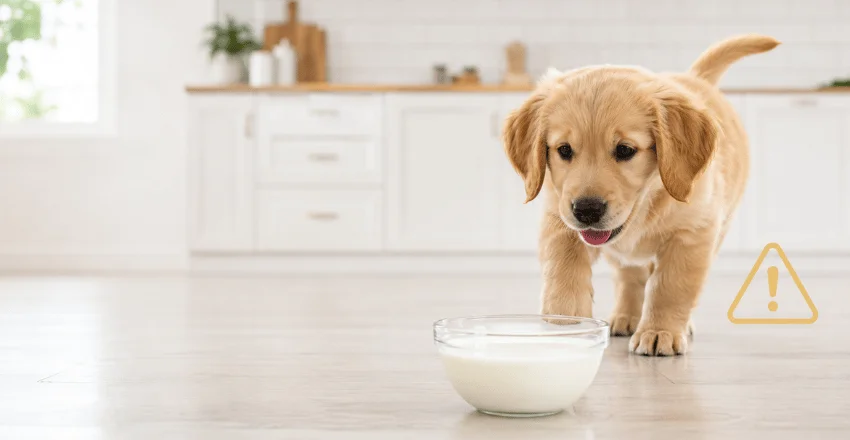
Nursing puppies live on milk, but not on this milk. Canine milk is a much richer fluid than the stuff in a carton: far more protein and fat per ounce, and proportionally less sugar. Cow’s milk is thin by comparison. Feed it to a young puppy, and you get the worst of both. Too watery to grow on and too much lactose to digest comfortably. Weaning diarrhea in a litter is miserable to deal with and easy to cause.
An orphaned litter needs a commercial puppy milk replacer, mixed and warmed to the label. Most pet stores and clinics sell it for around $15 to $25 a can. That’s the answer. Not cow’s milk, not goat’s milk, not an almond or oat drink.
By eight to twelve weeks, the weaning is finished, and lactase output is already falling. From that point, a puppy has no nutritional need for milk of any kind from any species.
What to Put in the Bowl Instead
Plain water. That’s the honest first answer, and it isn’t a dodge. Any dog drinking well from a clean bowl needs nothing else poured in.
If you want a small dairy treat anyway, here’s how the usual options really behave.
- Lactose-free cow’s milk. The only one of the three with a trial behind it. A 2022 study in the Journal of Applied Animal Nutrition split 40 adult Springer Spaniels across cow milk powder, goat milk powder, lactose-free powder, and water for 21 days. Intolerance signs appeared in the cow and goat groups. They didn’t appear in the lactose-free or water groups.
- Goat milk. Marketed as the gentle one. It holds slightly less lactose than cow’s milk (not zero), and in that same trial it produced the same trouble. Treat it as milk, because it is milk.
- Plain unsweetened yogurt or kefir. Fermentation consumes some of the lactose, so tolerance is often better. A spoonful, not a serving, and read the label for xylitol first.
Fussy drinker? A second wide, shallow bowl in a different room moves the needle more than any additive. There’s more on bowls and feeding accessories if hydration is the real thing you’re solving.
Can Dogs Drink Milk as a Regular Treat?
No. Not as a routine. An occasional tablespoon for a dog who has proven she handles it is fine, and there’s no reason to feel bad about it. Daily saucers are different. It adds calories she doesn’t need, fat she doesn’t need, and sugar her gut can’t fully process.
Complete dog food already supplies the calcium and protein people imagine milk is adding. It isn’t adding them. It’s adding a variable. Has your dog had a bad stomach more than once after dairy? Keep a short written log of what she ate and when, then bring it to your next vet appointment. A pattern on paper is worth far more to them than a description from memory.
Frequently Asked Questions
Warming changes nothing about the lactose. Diluting helps a little, because you’re serving less sugar per mouthful, but a diluted cup is still a cup. Serve less instead.
Usually under 24 hours from the last dairy. Anything running longer than a day, or containing blood, needs a call rather than more waiting.
A pup cup is whipped cream or soft serve, so it’s dairy plus sugar plus fat in one small container. Most medium and large dogs handle a small one. Small breeds and dogs with any history of pancreatitis should skip it.
Possibly, or she’s one of the tolerant ones. Either way, it isn’t proof of anything, and tolerance can shift with age. Don’t read one quiet evening as permission.
They can, but the fat and calories still count against her daily total. A few tablespoons a couple of times a week is a sensible ceiling for a medium dog