


How long can dogs hold their pee? Most healthy adults manage 6 to 8 hours, and plenty stretch past that without an accident. That figure is a ceiling, not a schedule. What a bladder survives once and what is fair to ask of it every weekday are different numbers, and page one rarely says so. There is more on this in Great Pyrenees Behavior.
Quick answer: a healthy adult dog holds urine for 6 to 8 hours during the day, and often 8 to 10 overnight. Aim for a potty break every 4 to 6 hours instead. Puppies manage roughly one hour per month of age. Seniors, and any dog on a diuretic, need shorter gaps of about 3 to 4 hours.
Safe holding limits at a glance
| Dog | How Long Can Dogs Hold Their Pee? (Physical Maximum) | Recommended interval | Why the gap |
| Puppy, 8 to 16 weeks | 2 to 3 hours | Every 1 to 2 hours | Bladder control is still developing |
| Puppy, 4 to 6 months | 4 to 6 hours | Every 3 to 4 hours | Roughly one hour per month of age |
| Adult under 20 lbs | About 6 hours | Every 4 hours | Small bladder, thin margin for error |
| Adult 20 to 90 lbs | 8 hours | Every 4 to 6 hours | Capacity is fine, contact time is not |
| Adult, asleep overnight | 8 to 10 hours | One last trip before bed | Urine output drops during sleep |
| Senior, 8 years and up | 4 to 6 hours | Every 3 to 4 hours | Muscle tone and signaling both fade |
| On diuretics, or with kidney disease, diabetes or Cushing’s | 2 to 4 hours | Whenever asked | Urine volume runs far above normal |
Key takeaways
- The maximum and the healthy interval are separate numbers. Plan around the interval.
- Harm from long holds builds up slowly. One late evening is not the problem; a routine is.
- Concentrated urine sitting still is what raises infection and stone risk.
- A dog straining with nothing coming out needs a vet the same day.
- Never limit water to buy yourself extra hours. It makes the underlying problem worse.
How Long Can Dogs Hold Their Pee? Know the Difference
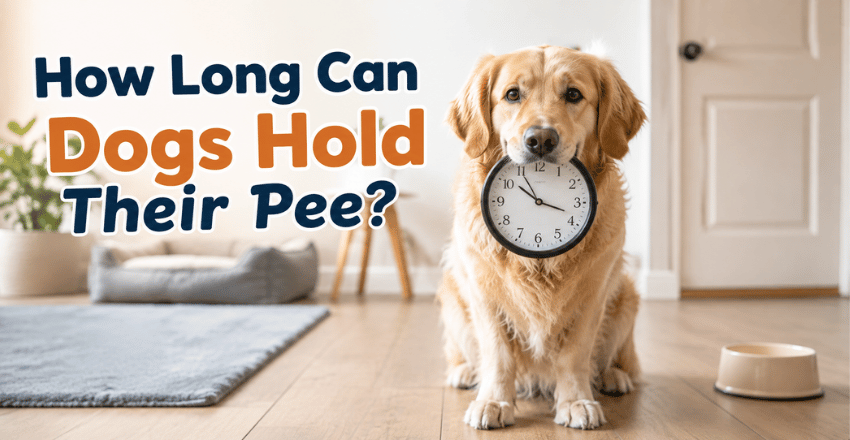
Ask a room of owners, how long can dogs hold their pee? and you’ll get a wide range of honest answers. Most of them are true. Plenty of well-house-trained retrievers can go ten hours on a bad Tuesday without an accident, making owners believe that’s normal. However, just because a dog can hold its bladder that long doesn’t mean it should. You might also like Black Labradoodle.
That is the trap. The cost of a long hold does not arrive as a puddle or a whimper, so nothing tells you the line was crossed. It accumulates quietly across months of the same workday. Treat the maximum as your emergency reserve and build the week around the shorter interval instead.
What a long hold does inside the bladder
Two things happen while the urine sits. The first is contact time. Bacteria that travel up the urethra get more hours against the bladder wall before the next flush moves them out. Bladders that are often empty are poor places to set up an infection.
The second is chemistry. Minerals stay dissolved while urine is dilute and moving, and they start dropping out of solution when it is not. Cornell University’s veterinary school reports that struvite crystals form when urine turns alkaline and concentrated. Dissolving the stones they build on a therapeutic diet takes 8 to 12 weeks. Crystals are how bladder stones begin.
The water bowl problem nobody mentions
Here is the part page one skips. Dogs who learn that relief is hours away often drink less, because drinking less is the only control they have. Owners read the emptier bowl as a dog that needs less water.
Less water means darker, denser urine. Denser urine means more mineral load per hour of contact, which is exactly the condition you were trying to avoid. The holding and the drinking feed each other, and the bladder pays for both.
Salt pushes the same system the other way. One cured snack can carry a startling load of salt. Our breakdown of the sodium in a single pickle spear shows how fast a small treat drives thirst. Extra thirst on a long shift ends in an accident, or an uncomfortable afternoon.
How long can dogs hold their pee at each life stage
Puppies
The standard rule is one hour per month of age, plus one. Three months old works out at roughly four hours. It is a reasonable starting point, and it has two limits people rarely repeat.
First, it stops scaling somewhere around eight hours. An eight-month-old puppy is not a nine-hour dog, and an adult ceiling still applies. Second, bladder control is a physical skill that finishes developing over several months, so a young puppy who has an accident at hour three has not disobeyed anything.
Adults
Dogs between one and seven years old are the group the 6-to-8-hour figure was written for. Aim for four breaks a day: first thing, midday, early evening, and last thing before bed. That pattern keeps the longest daytime gap in nearly five hours.
Seniors
Holding gets harder with age, not easier. Bladder muscle tone drops, kidneys concentrate urine less efficiently, and arthritis makes the trip to the door slower. Spayed females can also develop urethral sphincter weakness, which shows up as leaking during sleep rather than as a full accident.
An older dog who suddenly cannot last the night is telling you something has changed. That is a vet conversation, not a training problem.
Size changes the math
Bladder capacity scales with body size, so a 12 lb terrier holds less than a 70 lb shepherd and needs a shorter cycle. Toy breeds also have less warning between comfortable and urgent, which is why small dogs get labeled hard to house-train when the real issue is the clock.
Coat, sex, and neuter status matter far less than most owners expect. Frequency of access is the variable that changes outcomes.
Conditions and medications that shrink the limit
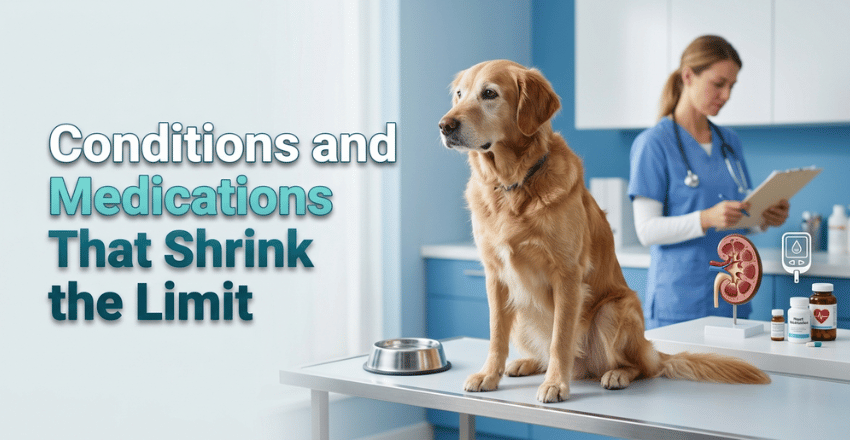
Some dogs cannot do a standard workday at all, and no amount of training fixes that. Urine volume is driven by the underlying condition.
- Diuretics such as furosemide, prescribed for heart failure, can more than double output within an hour or two of the doses.
- Chronic kidney disease leaves the kidneys unable to concentrate urine, so volume climbs even when thirst looks normal.
- Diabetes mellitus pulls water into the urine along with glucose.
- Cushing’s disease raises cortisol, which drives both drinking and urinating.
- Steroids and some seizure medications do the same on a shorter timescale.
Diet interacts with several of these. A dog prone to stones may be on a prescription formula, and our guide to peas, purines and urate stone formers covers why the ingredient list matters for that group. Ask the vet who wrote the plan before you change anything.
Overnight is not the same as a workday
Sleep lowers urine production, so an 8- to 10-hour night is genuinely easier on the bladder than an 8-hour afternoon alone. That is why a dog who sails through the night can still struggle with a long shift.
Move the last water top-up to roughly two hours before bed and take a proper walk rather than a quick trip to the yard. A full empty at 11 p.m. buys more than a hopeful one at 9 p.m.
What to do about a long shift
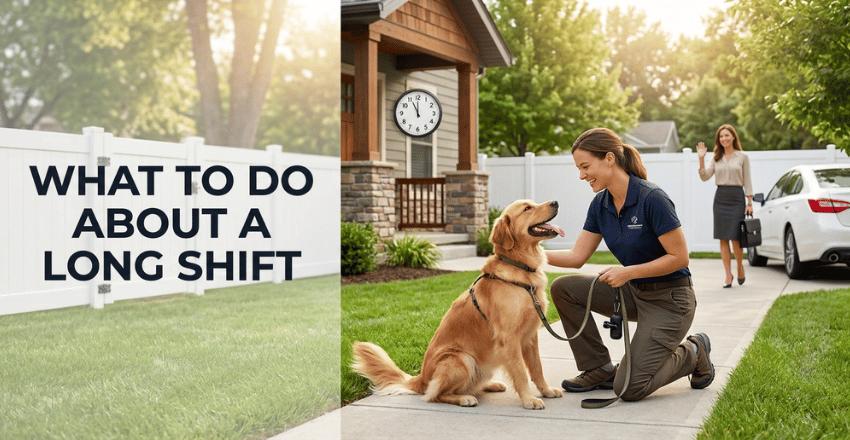
Not every option solves the same problem. Ranked by what they actually fix:
- A midday visit from a walker, neighbor, or family member. This is the only fix that empties the bladder in the middle of the gap, which is the whole point. Rates vary by city, and $16 to $25 for a 30-minute walk is a common US band.
- Doggy daycare. Excellent for a sociable dog, and it handles boredom too. Expect to pay more than a single walk, and some temperaments hate it.
- A dog door to a secure yard. Unbeatable if you own the space and the yard is safe.
- Staggering two people’s schedules. Free, and often overlooked. A partner coming home for lunch three days a week changes the whole picture.
- Indoor pads or grass trays. A genuine last resort. It protects the bladder, which matters, while teaching a house-trained dog that indoors is an option.
One thing never belongs on that list. Restricting water to shorten the gap trades a full bladder for concentrated urine and mild dehydration, and it makes infection and stones more likely, not less.
Red flags that need a vet today
- Straining in position with little or nothing coming out
- Repeated small squats within a few minutes
- Blood, or a pink tinge, in the urine
- Crying, hunching or persistent licking at the genitals
- Accidents from a reliably house-trained adult
- A sharp rise in drinking, or in the volume produced
- No urine at all for more than 12 hours
Read the first and last of those together. A dog that cannot pass urine is a medical emergency, and Cornell’s veterinary school describes urinary obstruction as potentially life-threatening. Pressure backs up toward the kidneys within hours. Go now, not in the morning.
Where to go from here
Pick the interval from the table that matches your dog, then look at your actual week and find the one day that misses it. That single day is where the risk lives, and fixing it is usually a phone call. For more on hydration, diet and the small habits that keep a bladder healthy, browse the Petistra pets guides.
Frequently asked questions
A healthy adult manages 8 to 10 hours of sleep. Puppies under six months rarely last that long and usually need one night trip.
For a healthy adult, once in a while, it is more uncomfortable than dangerous. As a weekday routine, it is too long, and it is well past the point where risk starts climbing.
Usually, though the signals are quiet: pacing, circling, sitting by the door, sudden restlessness. Stoic dogs and dogs who have learned that asking gets no response often stop asking.
No direct link is established. Long holds are tied to infections and stones, while age-related incontinence has separate causes, mainly hormonal and muscular.