

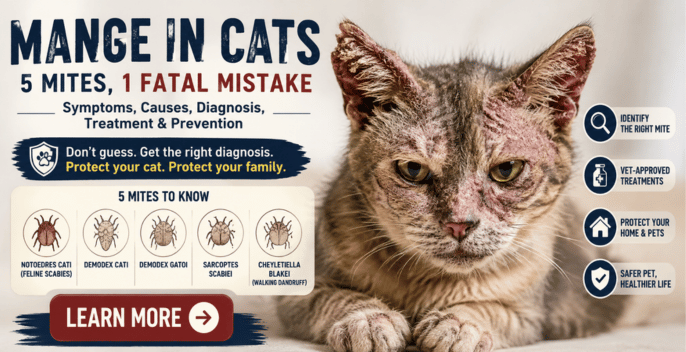
Mange in cats is not one disease. The word covers several unrelated mites that itch differently, spread differently, and respond to different drugs. Owners lose weeks treating the wrong parasite while the cat keeps scratching. Getting the species right is the whole job.
Short answer: five mites cause what people call mange, and only a vet skin scraping tells them apart. Notoedres cati crusts the ear margins and face. Demodex gatoi itches and spreads. Demodex cati signals a hidden illness. Cheyletiella flakes visibly. Never treat a cat with a dog product.
The five mites at a glance
| Mange in Cats Mite | What you see | Spreads cat to cat | Risk to people | How a vet finds it |
| Notoedres cati (feline scabies) | Thick gray crusts at the ear margins, then face, head and neck. Fierce itch | Yes, readily | Yes, a rash that settles after treatment | Skin scraping. Mites are usually easy to find |
| Demodex cati | Patchy hair loss and crusting around the head and chin. Mild itch | No | No | Deep scraping, plus bloodwork |
| Demodex gatoi | Broken hair and bald strips on the belly and legs from overgrooming. Itchy | Yes | No | Wide superficial scrapings, tape strips, sometimes fecal flotation |
| Sarcoptes scabiei | Crusts and scratching on ear edges and belly. Usually from a dog | Yes | Yes, a temporary rash | Scraping, or a treatment trial |
| Cheyletiella blakei (walking dandruff) | Big flakes along the spine that appear to move | Yes | Yes, itchy bumps on arms and waist | Tape strip or flea comb. Often visible unaided |
Key takeaways
- Four parasites, one word. The treatment, the contagion risk and the follow-up all change with the species.
- You cannot identify the mite by looking at the cat. Neither can your vet, which is why scrapings exist.
- Demodex gatoi breaks the usual rule: it spreads between cats, and it itches hard.
- Finding Demodex cati is a reason to test for FIV, FeLV, diabetes, or recent steroid use.
- A dog flea product can kill your cat. Permethrin causes seizures and death in cats.
Before Anything Else: The Mange in Cats Mistake That Kills Cats
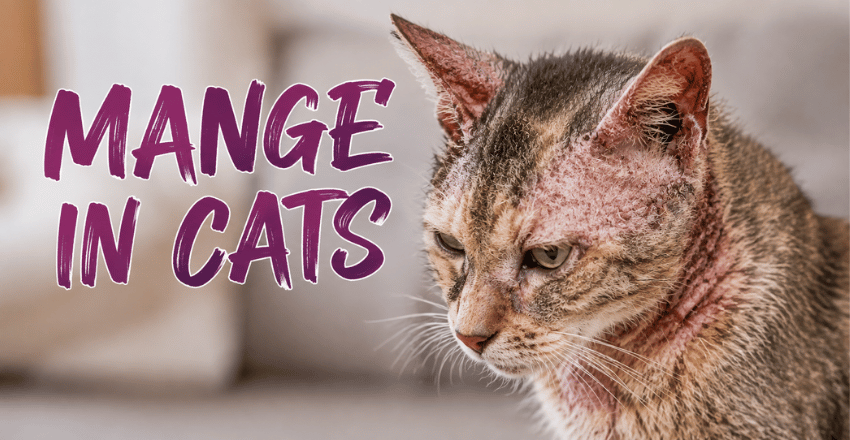
A cat with mange may scratch raw skin, tempting owners to use a dog spot-on product. Many contain permethrin, which is highly toxic to cats and can cause tremors, seizures, and even death without emergency treatment. Always use a vet-approved cat treatment, as the wrong product can turn a treatable skin condition into a life-threatening emergency.
Never apply a dog flea, tick, or mange product to a cat, and keep treated dogs away from cats for at least 48 hours. If a dog product has already been applied, bathe the cat in warm water with plain dish soap and call an emergency vet immediately. Do not wait for symptoms.
Home remedies are the other trap. Sulfur soap, tea tree oil, motor oil, undiluted vinegar, and borax all appear in forum threads, and none of them clear a mite infestation. Garlic gets pushed hardest of all, and it is worth reading why garlic fails as a natural flea remedy before you dose any animal with it. Tea tree oil is separately toxic to cats.
Notoedric mange in cats: the ear margins go first
Notoedres cati is the one most people picture. It starts at the upper edges of the ears and works down over the face and neck in a pattern experienced vets recognize across the room. The whole head can end up being involved. The skin thickens into gray or yellow crusts, and the itch is relentless.
Left alone, it spreads to the paws and tail base, carried there while the cat grooms. Secondary bacterial infection follows the self-trauma. Cats stop eating and lose weight. It is highly contagious among cats.
One infested stray in a colony or a shelter room can seed every other cat in days, so isolation matters as much as the drug does. The University of Minnesota’s veterinary dermatology text notes that mites are easy to find on scrapings here, unlike canine scabies.
The demodex split almost every article gets wrong.
Most pages treat demodectic mange as one condition. Cats carry two species, and they behave like opposites.
Demodex cati: a passenger that got loose
Demodex cati lives in hair follicles on healthy cats as normal skin flora. It only overgrows when the immune system stops holding it down. So, a generalized case is not really a parasite problem. It is a symptom.
The Merck Veterinary Manual links generalized D. cati to feline leukemia virus, feline immunodeficiency virus, diabetes mellitus, and cancer. Long-term steroids or cyclosporine do the same thing.
If your vet finds this mite, the next step is a workup, not just a miticide, and you should expect blood tests. Owners managing a cat with a suppressed immune system will find the everyday warning signs covered across other cat health articles on Petistra.
Demodex gatoi: contagious and itchy
Demodex gatoi reverses both assumptions. It lives in the surface layer of skin rather than the follicle; it passes between cats in the same household, and it causes real pruritus. Affected cats overgroom the belly and inner legs until the hair snaps off short. Owners often report the cat’s licking constantly.
Here is the catch that costs months. Cats groom the evidence away, so scrapings frequently come back negative even when the mite is present. A 2009 report in Acta Veterinaria Scandinavica describing six Finnish households found the heaviest mite load on a cat showing no signs at all. Quiet carriers reinfest the treated ones.
Sarcoptic mange and walking dandruff

Sarcoptes scabiei is a dog parasite. It does infest cats, but rarely, and usually the cat lives with an infested dog. Signs mirror notoedric disease: crusted ear edges, elbows and hocks, plus scratching that never stops.
Cheyletiella blakei gets lumped in with mange even though it lives on the skin surface under scale rather than burrowing. Its nickname is Enjoy. The mites are large enough to see, and the “dandruff” along a cat’s back appears to crawl. They spread fast in catteries and multi-pet homes, and they bite people readily.
Ear mites, Otodectes cynotis, are a separate parasite. They stay inside the ear canal and produce dark, crumbly debris rather than facial crusting.
How a vet works out which mite it is
Looks alone, settle nothing. Ringworm, flea allergy, food allergy and atopic skin disease all produce crusting and hair loss in the same places. Diagnosis runs through a few practical steps.
- Deep skin scrapings to capillary bleeding, taken from several sites, which is how follicular species such as Demodex cati are recovered.
- Broad superficial scrapings over a wide area for surface dwellers, since Demodex gatoi sits in the stratum corneum and is missed by a single small sample.
- Acetate tape strips and flea combing for Cheyletiella and its eggs.
- Fecal flotation, because a cat that overgrooms swallows mites, and Demodex gatoi has been recovered from feces when skin samples failed.
- A treatment trial when everything comes back clear, and the clinical picture still fits, treating all in-contact cats for six to eight weeks.
Ask which test was run. A negative scraping is not a clean bill of health, and vets know it.
Treatment: what works and how fast
Modern prescription parasiticides have made lime sulfur dips largely optional. Selamectin, moxidectin, fluralaner, or sarolaner products applied to the skin clear most mite species, and several are approved for cats in the United States.
A single dose produced a 100% reduction in live Notoedres cati mites relative to placebo within 30 days, while every placebo cat still carried mites at day 60.
Expect the following alongside the miticide:
- Antibiotics for infected, self-traumatized skin, often for two weeks.
- Pain relief or a short anti-inflammatory course, because the itch itself is miserable.
- A recheck scraping for two and four weeks rather than a guess.
- A second dose roughly 30 days after the first for most spot-on protocols.
Demodex gatoi is the slow one. Plan on six to eight weeks of treating every cat in the house, and do not stop at the first sign of regrowth.
Treat every animal, then clean the house

Half of all relapses come from an untreated housemate. Notoedres, Sarcoptes, Cheyletiella and Demodex gatoi all move between animals, so every cat, dog or rabbit in the home needs the vet’s protocol on the same schedule. A cat that looks fine can still be shedding mites.
Environmental work is simpler than the internet suggests. These mites die within days off the host.
- Wash bedding, blankets, soft toys and washable furniture covers weekly in hot water for a month.
- Vacuum floors and cat trees, then throw the bag or empty the canister outside.
- Discard or deep clean every brush and groom glove.
- Keep the treated cat off fabric you cannot wash until the recheck comes back clear.
Year-round parasite prevention is what stops the next round, and it covers fleas and ear mites at the same time. There are more pet care posts on the blog covering the rest of a cat’s routine health calendar.
Frequently asked questions
Some of it is. Notoedres and Sarcoptes will bite people, and so will Cheyletiella, raising an itchy red rash on the forearms and waist. They cannot complete their life cycle on human skin, so the rash fades on its own once the animal is treated. Demodex species do not transfer to people. See a doctor about any rash rather than self-treating.
No. A healthy adult cat may hold a mild demodex population in check, but notoedric disease progresses to widespread crusting, then skin infection and weight loss. Waiting is how a treatable skin problem turns into a hospital stay.
Budget roughly $60 to $120 for the exam and scrapings, plus $25 to $60 per dose of a prescription spot-on. Multi-cat homes pay per animal. Bloodwork adds more when Demodex cati turns up.
Most cats are visibly more comfortable inside a week and look normal by four to six weeks. Regrowth on a badly damaged coat takes two to three months.
Yes. Mites arrive on a new kitten, a foster, a visiting dog, or on your own clothes after you handle an infested animal. Indoor cats catch Cheyletiella and Demodex gatoi regularly.