


Dark, crumbly debris in a cat’s ear gets blamed on ear mites in cats far more often than it deserves. Mites are genuinely common in kittens, shelter cats, and cats who go outside. In a healthy adult indoor cat, that same brown gunk is more often a yeast or bacterial infection. The two look almost identical to the naked eye, and they need completely different medicine. For a closer look at this, see Mange in Cats.
Short answer: ear mites are tiny parasites that live in the ear canal and cause fierce itching, head shaking, and dark waxy debris. A vet confirms them with an otoscope or by checking a swab under a microscope. Prescription treatment kills most mites within days, and a repeat dose about three weeks later is common.
Ear mites at a glance
| Question about ear mites in cats | The short version |
| What is it | Otodectes cynotis, a surface mite about the size of a pinhead |
| Who gets it most | Kittens, shelter and rescue cats, outdoor cats, multi-pet homes |
| Classic signs | Head shaking, frantic scratching, dry dark crumbly discharge |
| Looks exactly like | Yeast or bacterial ear infection, heavy wax, allergy flare |
| Confirmed by | Otoscope exam, or ear swab under a microscope |
| Treated with | Prescription spot-on or ear medication containing selamectin, moxidectin, ivermectin or an isoxazoline |
| Time to clear | Mites die within days, debris and itching settle over two to four weeks |
| Spreads to | Other cats, dogs and ferrets by close contact; people only rarely |
Key takeaways
- The coffee-ground look is a clue, not a diagnosis. Plenty of infected ears look the same.
- Get the ear checked before you buy anything. Treating yeast with a mite product loses weeks.
- Nothing kills them instantly. Modern prescription products work through one application in many cases.
- Treat every cat and dog in the house, even the ones who seem fine.
- Violent head shaking can burst a blood vessel in the ear flap, which is a separate vet problem.
What Are Ear Mites in Cats? Understanding the Parasite

These ear mites in cats are tiny eight-legged parasites that live on the surface of the ear canal, feeding on skin debris and tissue fluid. They don’t burrow; they crawl across the skin, causing intense irritation that can make a cat scratch so aggressively the skin behind the ears becomes raw.
Egg to egg, the whole cycle runs about three weeks. Companion Animal Parasite Council guidance puts it at 18 to 28 days. Eggs hatch within a few days, and the young mites pass through two nymph stages before they can breed. That timeline matters more than it sounds, and the treatment section below explains why.
Signs owners notice first:
- Head shaking, sometimes constant
- Scratching at one or both ears, often hard enough to break the skin
- Dry, dark brown or black debris that crumbles rather than smears
- A tilted head, or ears held flat
- Scabs and hair loss on the neck and around the ear
Why that black gunk might not be mites
Here’s the part page one skips. Ear mites are a leading cause of ear disease in cats as a group, but kittens and free-roaming cats carry that number. Your six-year-old indoor cat sits in a different risk pool. In that cat, yeast, bacteria, allergies, or a plain wax buildup are all likelier explanations for the same mess.
Look at the two side by side, and the overlap is obvious.
| Feature | Mite infestation | Yeast or bacterial infection |
| Discharge | Dry, dark, crumbly, often described as coffee grounds | Waxy or gooey, brown to yellow, sometimes moist |
| Smell | Usually mild | Often sweet, musty or foul |
| Itch level | Severe and sudden | Ranges from mild to severe |
| Typical patient | Kitten, shelter cat, cat with outdoor access | Adult indoor cat, allergy history, recurring episodes |
| Usually affects | Both ears | Often one ear only |
| Right treatment | Antiparasitic | Antifungal or antibiotic, plus finding the underlying cause |
| Wrong treatment costs | Weeks of continued itching and damage | Weeks of continued itching and damage |
Neither column is diagnostic on its own. A cat can also have both at once, since mite damage invites secondary infection with organisms like Malassezia and staph bacteria. That’s another reason a guess at the counter goes wrong. Browsing our wider pet health and care archive is fine for background, but an actively sore ear needs eyes on it.
How a vet confirms it
Two methods settle the question, and both take minutes.
- Otoscope exam. The vet looks down at the canal with a lighted scope. Live mites show up as small white specks moving against the dark debris.
- Microscope check. A cotton swab of debris goes onto a slide with mineral oil. Mites and their eggs are unmistakable at low magnification.
Swabs are the most reliable of the two. Debris can block the view down a sore, swollen canal, so a clean otoscope exam does not rule mites out. Ask for the slide if your cat has been treated once already and the ear still looks wrong.
What kills ear mites in cats, and how fast
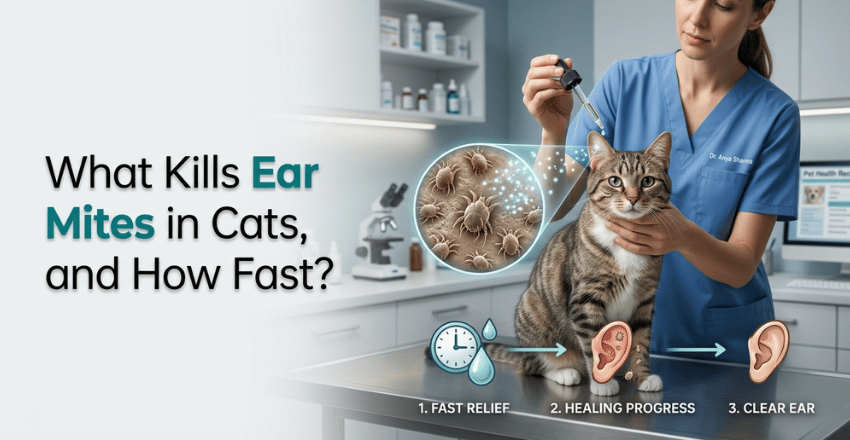
Nothing works instantly. That search phrase exists because pet store packaging promises it, and the promise is marketing. What modern prescription products do offer is close. A single spot-on dose containing selamectin, moxidectin, or an isoxazoline reaches the ear through the bloodstream or the skin and stays active for weeks.
Here’s the realistic timeline your cat is on.
| Stage | Roughly when | What you’ll see |
| Adult mites start dying | Hours to a few days | Nothing visible yet |
| Scratching eases | 2 to 5 days | Calmer cat, less head shaking |
| Debris clears | 1 to 3 weeks | Ear looks normal again as the canal sheds |
| Eggs hatch and are killed | Around 3 weeks | Why a second dose or recheck is often scheduled |
| Recheck | 3 to 4 weeks after day one | Vet confirms the ear is clear |
That follow-up exists because of the egg stage. Most products kill the mites crawling in the canal today, and some do not reliably kill eggs already laid. Newly hatched mites arrive two weeks later to restart the whole problem if nothing is scheduled to meet them.
Home remedies and pet store drops
Owners try oil, hydrogen peroxide, vinegar, tea tree oil, and garlic. None of these are treatments, and two of them cause harm.
- Oil. Smothering mites with baby or olive oil is old advice. It needs daily dosing for a month; it rarely finishes the job, and the greasy residue feeds secondary infection.
- Hydrogen peroxide. It stings inflamed skin, damages healing tissue, and can reach the middle ear through a ruptured eardrum you can’t see.
- Tea tree oil. Toxic to cats even in small amounts on the skin.
- Garlic. The same folklore that sells it as a flea cure, and our guide to why garlic is unsafe for pets covers how thin the evidence behind it always was.
- Over-the-counter mite drops. Usually, pyrethrin is the basis. They may knock down some adults, but they don’t cover the life cycle, and they buy weeks of delay on a cat that never had mites.
Cleaning is a different matter. A vet may flush or clean the canal with a proper ear cleaner before medicating, which helps the drug reach the skin. That is a step in a plan, not a substitute for one.
The part owners skip, then wonder why mites come back
Reinfestation is nearly always a household problem rather than a treatment failure. Treat every cat, dog and ferret in the home on the same day, whether they’re scratching. Mites move between animals during ordinary contact, sleeping together, grooming, sharing a sunny windowsill, and a quiet carrier can reinfest the one you treated.
Ask your vet for the right product per animal, because dog and cat formulations are not interchangeable. Then deal with the shared spaces. These mites don’t survive long away from a host, so you’re not fumigating the house. Wash bedding, blankets, and soft carrier liners on a hot cycle, vacuum the spots your pets sleep in, and clean grooming tools.
When head shaking becomes an injury

Persistent shaking is not only noise. Shaking hard enough can rupture a blood vessel inside the ear flap, and blood pools between the skin and the cartilage. You get an aural hematoma: a soft, swollen, pillow-like ear that appears within hours.
It needs veterinary treatment. Left alone, it may reabsorb, but the flap often scars into a shrunken, crumpled shape. Untreated infection carries its own price too, with chronic inflammation thickening the canal and, at worst, reaching the middle and inner ear to affect hearing and balance.
Can you catch them from your cat?
Rarely, and the honest answer is not a flat no. The Western College of Veterinary Medicine at the University of Saskatchewan describes human infestation as a rare, transient event, established experimentally but very unlikely in normal life.
Case reports describe itchy rashes or ear irritation in people in close contact with infested pets. Wash your hands after cleaning your cat’s ears and don’t lose sleep over it. Other animals in your home are the ones at real risk.
What to do next
Book the exam before you buy anything. Ask the clinic to confirm mites on a slide, then treat every pet in the house on the same day. Put the recheck in your calendar for three weeks out, and wash the bedding while you wait. For more cat and dog care reading, browse the Petistra pet care blog.
Frequently asked questions
Nothing does. Prescription products begin killing within hours and clear the canal over days, and no product on sale acts on contact in the way the packaging suggests.
Yes, though it’s less likely. They usually arrive with a new kitten, a boarding stay, a foster animal, or a dog that goes out. An adult indoor cat with no new arrivals in the house is a poor candidate for a mite diagnosis.
US clinics generally quote a routine feline office visit somewhere between $53 and $124, with a small extra charge for the swab and slide. Prices vary by city and clinic type. Either way, it beats a month of guesswork, and it tells you which drug your cat needs.
Only if your vet asks you to, and only with the cleaner they recommend. Cotton swabs pushed into the canal can pack debris deeper and damage the eardrum.
Go back. Either a secondary infection is still running, the original diagnosis was wrong, or an allergy is driving the itch. Repeating the same mite product a third time is the usual mistake.