

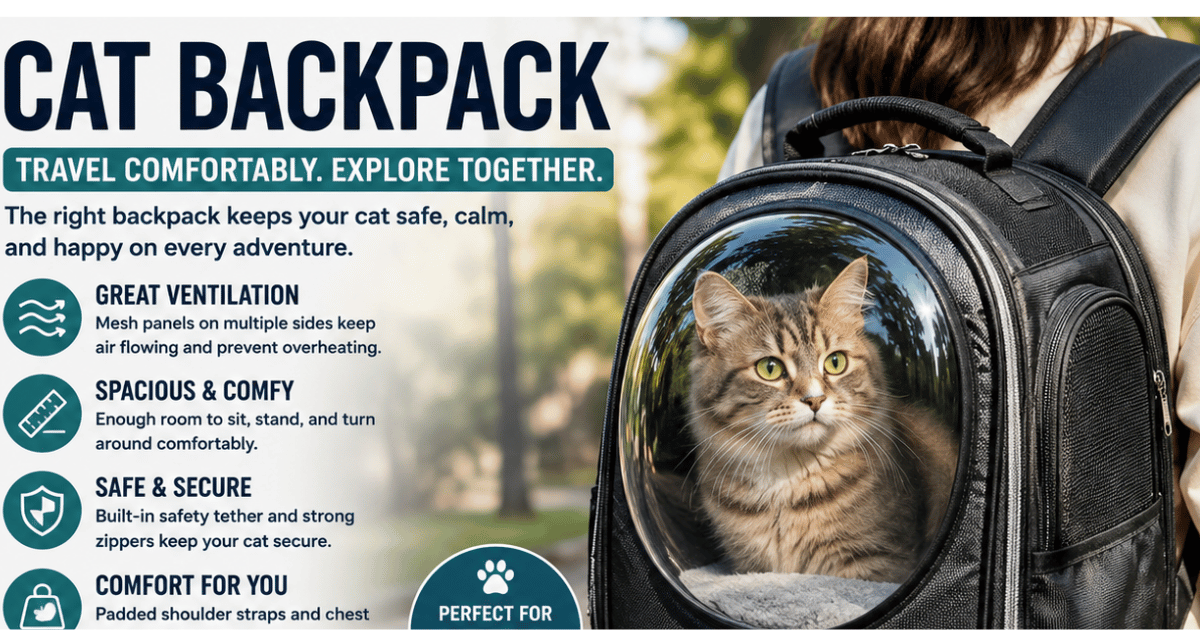
Almost every cat backpack you scroll past is sold on one photograph: a calm cat framed in a clear dome, chin on its paws, apparently delighted. That photo is the product. What the pack does to a cat is a separate question, and listings rarely raise it.
Short answer: these packs suit a confident, harness-trained cat on short, quiet trips, and they fail almost every other cat. Judge one on the mesh area, the interior height, and a firm floor, not on the bubble. For a shy or elderly cat, the right purchase is nothing at all.
The Key Facts Before You Spend Anything
| Question | The honest answer |
| Who it suits | Confident cats are already used to a harness and to going outside. |
| Who it doesn’t | Shy, fearful, elderly, or unwell cats, and most of whom never leave the house |
| Interior height | Your cat has to sit up fully and turn around inside it. |
| Ventilation | Mesh on three or more sides beats a rigid dome every time. |
| Outing length | No maker publishes a limit. Keep first trips to 10 or 15 minutes. |
| Price range | $27.99 to $53.99 on maker sites, checked 2 August 2026 |
| Never | Leave the loaded pack in a parked car or in direct sun. |
Key Takeaways
- Small enclosed spaces, unpredictable movement, and novel sights all stress cats. A pack delivers three at once.
- Some cats enjoy short outings. Most do not, and pushing a frightened cat is a welfare problem, not a training gap.
- Ventilation is the safety feature. The bubble window is styled.
- Measure your cat, then the interior. Label sizes describe the shell, not the usable space.
- Stop at the first sign of distress rather than finishing the walk.
Does Your Cat Want To Be Carried At All?
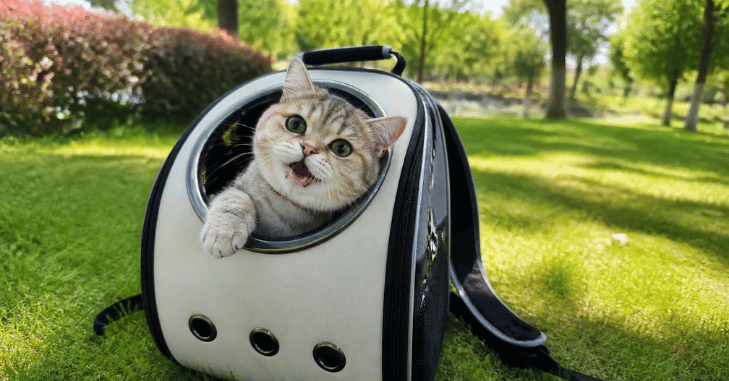
Cat Backpack: Start here, because the answer decides whether the rest of this matters. Being lifted off the ground, sealed in a capsule and moved in a direction it cannot predict is close to a shortlist of what a cat dislikes. Add strangers, dogs, unfamiliar smells, and traffic noise arriving through a window it cannot get away from.
None of that makes the product cruel. It makes it narrow. A cat who already walks in a harness, rides calmly in the car and greets visitors instead of hiding may treat a trip out as enrichment. Our cat care and behavior guides cover the groundwork that has to come first.
Cats that often cope well
- Young to middle-aged, healthy, used to handling
- Harness-trained, with weeks of outdoor practice
- Curious rather than flighty around new things
- Happy to walk into the pack on their own at home
Cats That Almost Certainly Won’t
- Shy, fearful, or newly adopted cats
- Senior or arthritic cats, or any cat with breathing trouble
- Cats who hide from the doorbell or flatten near a carrier
- Cats who have never worn a harness
The Body Language That Means Stop
Cats rarely protest loudly. They go quiet and small, and owners read that as calm. Learn the difference before the first trip.
End the outing at the first of these, without finishing the walk:
- Ears flattened sideways or pinned back
- Crouched low, tucked into the back corner, weight off the floor
- Pupils wide and round in ordinary daylight
- Panting, open-mouth breathing, or heavy drooling
- Yowling, growling, or continuous meowing
- Frantic scrabbling at the mesh or the zip
Panting and drooling need a response in seconds, not minutes. Get the cat into cool air, then out of the pack somewhere enclosed.
Five Things the Marketing Skips

1. Ventilation, not the view. A clear acrylic dome facing the sun behaves like a small greenhouse, and a cat cannot sweat its way out. Cats shed heat by finding shade and by grooming, both impossible in a sealed shell. Count mesh panels first, and treat a single rigid front as a warm-weather liability.
2. Interior size, measured against your cat. Measure your cat sitting down, from the floor to the top of the head. The cat needs to sit upright without pressing the roof and turn around without folding in half. Outside dimensions tell you almost nothing about that.
3. Floor rigidity. Soft-bottomed packs sag under a cat, which tips the animal backwards against the panel that sits on your spine. Look for a wire frame, support rods, or a firm insert to keep the floor flat.
4. An internal tether. One clip inside, attached to the harness, stops a startled cat bolting through an open lid. Most listings never mention it. Petsfit publishes an anti-loss leash; several Texsens listings publish none.
5. The half of the load that is yours. A 12 lb cat plus the pack sits high on your back, and it shifts every time the cat moves. Wide padded straps and a chest strap decide whether you can carry that for 20 minutes. Thin webbing digs in long before your cat runs out of patience.
Bubble window or mesh panel: which design wins
| Rigid bubble front | Mesh panel front | |
| Airflow | Sealed. Air moves only through side panels. | Air passes through the panel itself. |
| Heat in the sun | Traps heat like a car windshield | Vent heat continuously. |
| What the cat sees | A wide view it cannot avoid. | Softer and coverable with a curtain |
| Bulk and weight | Rigid parts add both | Lighter, packs flatter |
| Honest use case | Photos, indoor use, cool days | Nearly every real outing |
Bubbles are not useless. The dome adds headroom, and Texsens sells its semi-sphere window separately for $9.99, so it comes off. Airflow is the trade-off, and no maker page found publishes a ventilation figure for the dome.
Bubble pros: headroom, a clear view, and easy to wipe clean. Bubble cons: heat build-up, extra weight, and glare, plus no escape from the view.
Mesh pros: real airflow, lighter, cheaper, and curtains dim the world. Mesh cons: claws catch it, and cheap mesh frays.
Five packs you can buy now, and what they cost
Every price and spec below comes from the maker’s own product page, read on 2 August 2026. Nobody here has carried a cat in one, so this is a specification comparison, not a road test.
| Pack | Price | Outside size (inches) | Cat weight limit | Ventilation | Internal tether |
| Texsens Super Breathable Pet Backpack Carrier | $27.99 | 12.6 x 11.4 x 16.5 | Up to 18 lbs. | PVC mesh on three sides | Not published |
| Texsens Pet Backpack Carrier with Roller Blind & Curtains | $39.99 | 13 x 10.63 x 16.54 | Up to 17 lbs. | PVC mesh three sides, roll-up front | Not published |
| Texsens Cat Backpack Expandable Pet Carrier | $39.99 | 13.4 x 11 x 16.6 | Not published | Mesh three sides, expanding tunnel | Not published |
| Texsens Large-Size Pet Backpack Carrier (Black) | $53.99 | 15.75 x 9.84 x 17.32 | Up to 22 lbs. | Mesh three sides, roll-up curtain | Not published |
| Petsfit Backpack Pet Carrier Airline | $43.69 | 18 x 11 x 11 | Up to 15 lbs. | Mesh on all four sides | Yes, anti-loss leash. |
Texsens is the only maker here publishing weight limits across the range, and its tallest option gives a big-cat headroom at 17.32 inches. The Petsfit pack is the only one publishing both a tether and a wire frame. Its 11-inch height suits a cat that travels lying down rather than sitting up.
Buying the cheapest option first is often sensible. If your cat refuses to settle at home, you found out for $27.99 rather than $53.99.
Using one safely
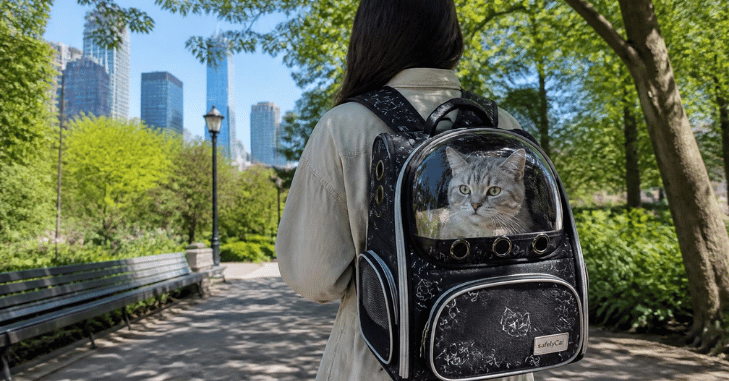
Heat is the risk that turns a bad trip into an emergency. According to the Cornell Feline Health Center, the signs of heat stroke in cats are weakness or collapse, excessive panting, drooling, vomiting, and diarrhea. Its feline heat safety guidance was last updated in June 2025. Cornell also advises keeping cats in a cool, air-conditioned space during extreme heat.
Parked cars deserve their own rule. A 2005 study in the journal Pediatrics by McLaren, Null, and Quinn measured parked cars on clear days. Interiors rose about 3.2 degrees Fahrenheit every five minutes, with 80% of the total rise inside the first half hour. Cracking the windows barely helped. That was a car, not a carrier, but a small sealed space in the sun behaves the same way.
The rest of the safe use is short and non-negotiable
- Harness and leash go on indoors before the pack opens outside.
- Clip the harness to an internal tether if the pack has one.
- Keep first outings to 10 or 15 minutes, under an hour after that
- Carry water, and stay in shade above roughly 75 degrees Fahrenheit.
- Never leave it in a car, on a sunny porch, or on hot asphalt.
- Skip it entirely if your cat has heart, breathing, or mobility problems.
Verdict: Who Should Buy a Cat Backpack

Here is the bottom line. If your cat already walks in a harness and shows curiosity rather than fear outdoors, a mesh-sided pack with a firm base is a reasonable buy. Based on published specs, I would recommend the Petsfit carrier for its tether and four-sided mesh. If you want maximum headroom for a large cat, the Texsens Large Size pack is the stronger pick.
If your cat hides from visitors, has never worn a harness, or is over about 12 years old, buy nothing. That is not a failure of training, and it is not fixable with a better pack. Spend the money on window perches and play instead, and read more of our pet care and pet food posts for indoor enrichment ideas.
Still keen? Measure your cat this week, get a harness on first, and leave the empty pack open in the living room for two weeks before it goes anywhere.
Conclusion
A cat backpack can be a practical way to travel with your pet, but it is only suitable for the right cat and the right situation. Instead of choosing a carrier because it looks stylish, focus on the features that matter most—excellent ventilation, enough interior space, a firm base, and a secure internal tether.
A confident, harness-trained cat may enjoy short outdoor adventures, while shy, elderly, or anxious cats are usually happier staying in familiar surroundings. Always introduce the backpack gradually, keep trips short, avoid hot weather, and watch for any signs of stress. When your cat’s comfort and safety come first, a well-designed cat backpack can become a useful travel accessory rather than an unnecessary purchase. There is more on this in Cat Harness.
FAQs
A confident, harness-trained cat can find short outings interesting. Most show stress instead. The honest test is whether your cat walks in voluntarily at home.
No maker publishes a limit. Ten to fifteen minutes suits a first trip, and under an hour after that. End it sooner at any sign of distress.
A rigid, clear panel in direct sun heats faster than mesh and vents nothing. Use the dome on cool days or in shade, or take it off and run the mesh cover.
Yes, outdoors. Fit the harness before you open the lid, and clip it to an internal tether if there is one. Startled cats are through a gap in under a second.