


Can dogs eat cauliflower? Yes, if it is plain, unseasoned, and portioned far smaller than most owners assume. Toxicity is not a problem here. Gas is, and in a deep-chested dog that distinction matters before you hand over the first floret. For a closer look at this, see Can Dogs Eat Zucchini.
Quick answer: plain cauliflower is safe for dogs and contains nothing poisonous. Serve it cooked and unseasoned, chopped into pieces your dog cannot inhale whole. Keep it under 10 percent of daily calories. Raw florets produce the most gas, steamed florets the least, and anything cooked with butter, salt, garlic, or onion should stay on your plate.
The short version, at a glance
| Question About Can Dogs Eat Cauliflower | Answer |
| Safe for dogs? | Yes. Not toxic; no compound that harms dogs specifically |
| Main risk | Gas, bloating, loose stool from fermentable fiber |
| Best preparation | Steamed 5 to 7 minutes, plain, chopped small |
| Worst preparation | Roasted in oil with garlic, or a big pile served raw |
| Daily ceiling | Under 10 percent of total daily calories |
| Stems and leaves | Edible, but cook them and cut them small |
| Stop and call your vet if | Hard swollen belly, retching that brings nothing up, pacing |
Key takeaways
- Gas here is chemistry, not an allergy. Cruciferous vegetables carry sulfur compounds, and a sugar called raffinose that dogs cannot break down.
- Cooking changes the outcome more than portion size does. A short steam is the single biggest improvement you can make.
- Portion discipline matters most for large, deep-chested breeds, because their baseline bloat risk is already high.
- Riced versions are fine plain. Frozen bags with a seasoning packet are not.
- Introduce it once, in a small amount, on a day you are home to watch.
Why Can Dogs Eat Cauliflower but Still Get Gassy?

Can dogs eat cauliflower? Yes, but it may cause gas. Cauliflower belongs to the brassica family and contains glucosinolates. When chopped or chewed, these compounds produce isothiocyanates, which are harmless but can contribute to gas and digestive discomfort, especially when served raw.
Then there is raffinose. Dogs lack the enzyme that splits this sugar, so it travels intact to the large intestine, where gut bacteria ferment it and release hydrogen and methane. That fermentation is the bloating, the gurgling, and the smell. None of them are dangerous on their own. It is uncomfortable, and discomfort usually shows up as pacing or an unhappy evening.
The bloat question, and why portions matter more here
Gastric dilatation volvulus, usually shortened to GDV or bloat, is the emergency every large breed owner has heard about. A dog’s stomach fills with gas and then twists itself, cutting off its own blood supply. Without surgery, it kills.
Feeding a gassy vegetable does not cause GDV. No study shows that link, and it would be dishonest to imply one. What the research does establish is that some dogs start from a much higher baseline. Gas volume plus a deep chest makes a combination of respect rather than test.
So, the practical rule is split by building. A beagle that eats a few extra florets has a windy night. A Great Dane, a standard poodle, a weimaraner, or a boxer is a dog where you measure the portion and skip the second helping. That same portion-by-weight logic applies to other fermentable vegetables, as covered in our breakdown of pea types and safe amounts.
Raw vs steamed vs roasted vs riced
Most guides say, “cooking is better” and stop. Here is what each method does to the gas load and texture.
| Preparation | Gas load | Choking risk | Verdict |
| Raw florets | Highest | Moderate, hard round pieces | Fine in tiny amounts. Chop; never serve a whole floret |
| Steamed 5 to 7 minutes | Lowest | Low, soft enough to squash | Best option. Softens fiber without leaching everything out |
| Boiled | Low | Low | Good, though more vitamin C ends up in the water |
| Roasted plain | Moderate | Low | Acceptable only if no oil, salt, garlic or onion touched it |
| Riced, plain | Moderate | Very low | Easy to portion. Check frozen bags for seasoning |
| Frozen chunks | Moderate | High for tooth damage | Skip. Rock hard pieces crack teeth |
Steaming wins on both counts at once. Heat breaks down cell walls that would otherwise reach the colon intact. It also softens the florets enough that a dog crushes it instead of swallowing it whole.
Roasting is where things go wrong in real kitchens. Nobody roasts a tray plain. There is oil, and there is usually garlic, which is a genuine toxin for dogs rather than an inconvenience. Our guide to the garlic toxic dose by body weight covers how little it takes to matter.
What about the stem and the leaves?
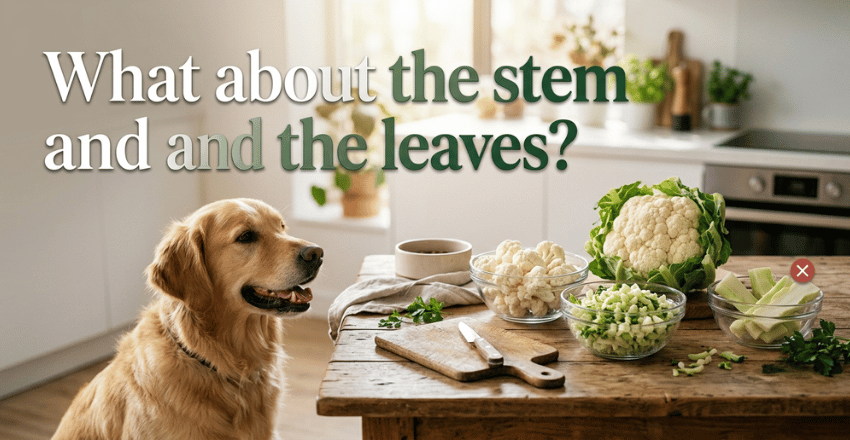
Page one contradicts itself on this. Some guides tell you to discard the stalk; others say serve it. Both are half right, and the deciding factor is size rather than the part of the plant. Every part of the head is edible, from the outer leaves down to the core.
Stalk and leaves are far more fibrous than the florets, which means more fermentation and a tougher texture to chew. A raw chunk of stalk is roughly the shape and hardness of a wine cork, and that is exactly the profile that lodges in a windpipe.
Cook them until a fork goes through easily, then dice them to a quarter inch for a small dog or half an inch for a large one. Handled that way, the stalk is genuinely useful, since it holds more fiber per bite than the flower’s head.
How much is safe for your dog’s weight?
Treats and extras should stay under 10 percent of daily calories. That is the standard veterinary rule, and it keeps a balanced diet balanced. A cup of raw florets carries under 30 calories, so the limit here is digestive comfort long before it is calories.
Start at half these amounts on the first try.
- Under 10 lbs: one small floret, roughly a teaspoon chopped
- 10 to 25 lbs: one to two florets, roughly a tablespoon
- 25 to 50 lbs: two to three florets, roughly two tablespoons
- 50 to 90 lbs: three to four florets, roughly a quarter cup
- Over 90 lbs: up to a third of a cup, split across the day
Can dogs eat cauliflower every day?
You can, but there is little reason to. Two or three servings a week gives your dog the fiber and the vitamin C without keeping a constant fermentation load in the gut.
Daily feeding also makes it harder to spot a problem. If your dog’s stool softens over two weeks, you want to know which new item caused it, and a food that appears every day hides its own effects.
Kitchen versions to skip
Plain florets are safe. What humans do to them usually is not.
- Cauliflower cheese: dairy and butter, plus onion powder in most recipes. High fat and pancreatitis risk in small dogs.
- Buffalo bites: hot sauce, breading, and fryer oil. No.
- Pickled florets: vinegar brine loaded with sodium, and garlic cloves are standard in the jar. Our sodium math on pickles and their salt content applies here too.
- Pizza crust made from it: usually bound with cheese and egg, then topped with things dogs should not have.
- Seasoned frozen bags: read the panel. Many include garlic or onion powder in the sauce sachet.
Dogs that should skip it entirely
Some dogs get nothing useful out of this and suffer it in discomfort.
- Dogs with a diagnosed hypothyroid condition, since brassicas contain goitrogens that can interfere with iodine uptake. Ask your vet first.
- Dogs with inflammatory bowel disease or chronic soft stool.
- Dogs recovering from surgery or an episode of pancreatitis.
- Puppies under about four months, whose digestion is still settling.
- Any dog on a prescription therapeutic diet, where extras undo the formulation.
How to introduce it over 48 hours?

- Steam a few plain florets for five to seven minutes and let them cool.
- Chop one floret into pieces smaller than your dog’s throat opening.
- Offer half the portion of your dog’s weight on a day you will be home.
- Watch for six hours. Gurgling and a little gas are normal; straining is not.
- Check the next two stools. Soft and formed means you are clear.
- If all is well, move to the full portion at the next serving, two or three days later.
Stop immediately and call your veterinarian for a hard, distended abdomen, unproductive retching, or a dog that will not settle. Those three signs together are the classic bloat picture, and they are a same-day emergency, not a wait-and-see.
The bottom line
Plain, steamed, and portioned to your dog’s weight, cauliflower is a low-calorie, high-fiber addition that most dogs handle without trouble. Raw and unlimited is where owners run into gas, and deep-chested breeds are the ones who deserve the strictest measuring cup.
Start with half a portion this week and watch what happens. Then browse our pet food guides before you add the next new item to the bowl.
Frequently asked questions
Plain riced brassica is one of the easier ways to serve it, since the pieces are already small and mix into food without effort. Buy the plain frozen or fresh version and cook it without oil. Skip anything sold as a seasoned or flavored blend.
Not as a chew. Frozen chunks are hard enough to fracture a tooth, and slab fractures on the upper carnassials are a common repair. Thaw and cook it instead.
In a normal portion, no. Beyond that, expect gas first, then loose stool. Symptoms usually clear within a day once you stop feeding it.
Slightly, for gas purposes. Broccoli carries the same sulfur compounds in a higher concentration, plus isothiocyanates that irritate some dogs’ stomachs. White heads are milder on both fronts.
Wait until about four months, then use a quarter of the adult portion for their expected size. Growing dogs need complete puppy food to do the heavy lifting.