

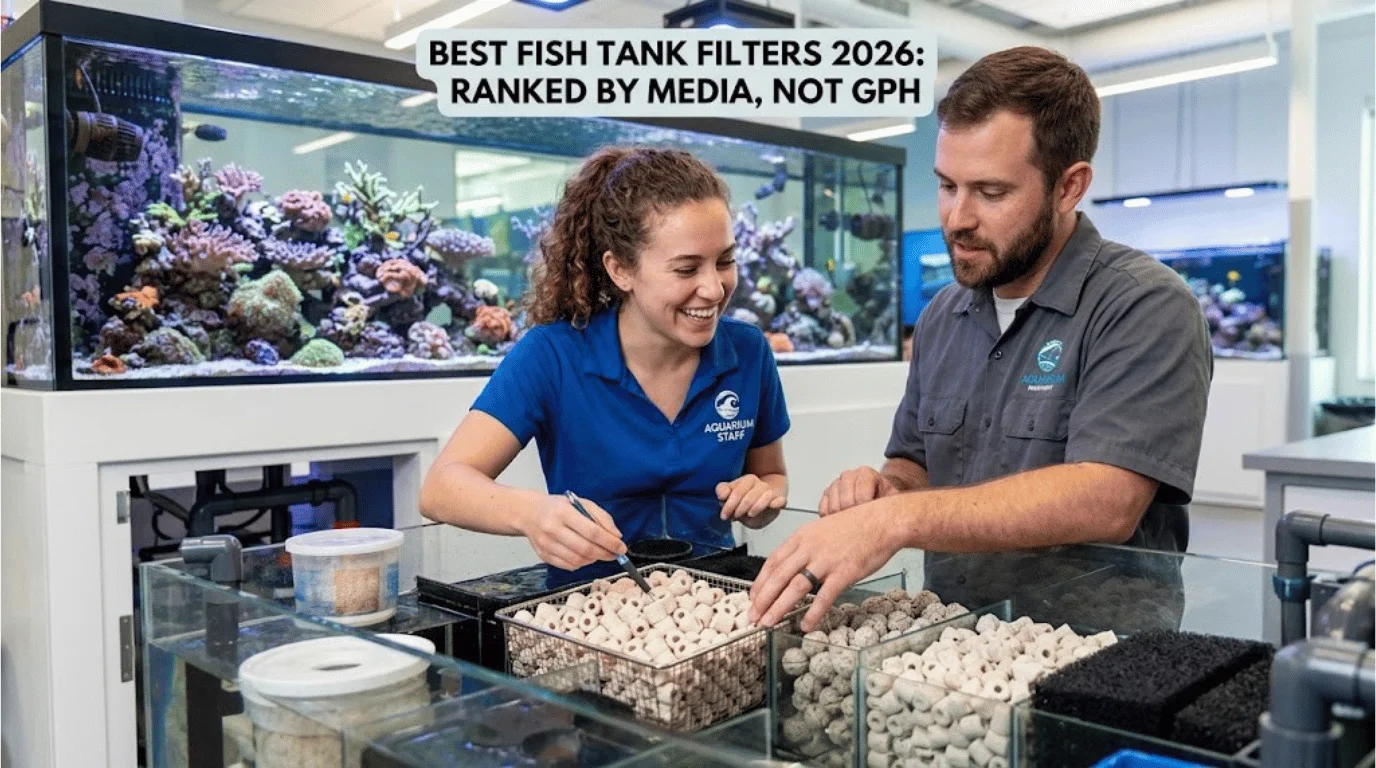
Buy for media volume first and flow rate second. For most home aquariums, the best fish tank filters are a canister above 40 gallons, a hang-on-back from 10 to 40, or a plain air-driven sponge. Media volume decides how big a bacteria colony your setup can host. That colony keeps ammonia near zero, and the gallons per hour figure on the box says little about it.
Quick picks by setup
| Your setup | Type to buy | Why | A unit that fits |
| 5 to 10 gallon nano | Sponge, air-driven | Silent, gentle, cheap biological surface | Top Fin sponge, $9.99 to $19.99 |
| 10 to 30 gallon community | Hang-on-back with an open basket | You choose the media; upkeep is easy | AquaClear 50, rated 20 to 50 gallons |
| 30 to 55 gallon planted | Large hang-on-back or small canister | Quiet running, more media room | Seachem Tidal 55, 250 GPH |
| 55 gallons and up | Canister | Most media, longest gaps between services | Fluval 307, 303 GPH |
| Fry, shrimp, hospital tank | Sponge | Nothing small gets pulled in | Any air-driven sponge |
Key takeaways
- Biological media keeps fish alive. Mechanical work only keeps water looking clear.
- Chemical media is optional. Run carbon for a set reason, then take it out.
- Rated flow is measured with an empty chamber, so buy a size above your tank volume.
- Never rinse or swap all the media on the same day.
- Sponge units beat every fancy alternative for fry, shrimp and quarantine tanks.
Three jobs, and only one of them keeps fish alive
Mechanical, biological and chemical filtration are three separate jobs. Shops sell them as one feature, which is where buyers go wrong. The difference between them decides what you should pay for.
| Job | What it handles | Where the work happens | Do you need it? |
| Mechanical | Solid particles, uneaten food, plant debris | Foam pads, floss, sponge | Yes, for clear water |
| Biological | Ammonia and nitrite from fish waste | Porous ceramic, sintered glass, sponge | Yes, this is the one that keeps fish alive |
| Chemical | Dissolved organics, tannins, medication residue | Activated carbon, resin | Rarely, and only for a set reason |
Fish give off ammonia constantly, and it turns dangerous long before the water looks bad. University of Florida IFAS Extension puts real numbers on that risk. Its guidance on ammonia in aquatic systems, revised in 2023, says damage to fish tissue can occur once un-ionized ammonia passes 0.05 mg/L. At 2.0 mg/L, sensitive fish typically die.
Bacteria living on your media are the only thing holding that number down. A more porous surface means a bigger colony, so media room matters more than a pump spec. For the wider husbandry picture, our pets care hub covers the daily side of keeping animals well.
The gallons per hour rating on the box is not what you get
Makers measure flow with an empty chamber and the outlet sitting at pump level. Pack that same unit with foam, ceramic, and carbon, then lift the outlet up to the tank rim. Head height costs you throughput. Media resistance costs you more.
That gap is the whole point. It is the honest reason experienced keepers buy above their tank volume, and nobody prints it on the packaging. Fluval rates the 107 at 145 US GPH for tanks of 10 to 30 gallons. Loaded and installed, treat it as a comfortable 20-gallon canister rather than a 30.
How much flow your tank needs
The working rule is four to six times the tank volume every hour for a lightly stocked community. Push that to eight or ten times for messy fish such as goldfish and cichlids. Since the rated figure is optimistic, read the table below as a floor rather than a target.
| Tank volume | Lightly stocked target | Heavily stocked target |
| 10 gallons | 40 to 60 GPH | 80 to 100 GPH |
| 20 gallons | 80 to 120 GPH | 160 to 200 GPH |
| 40 gallons | 160 to 240 GPH | 320 to 400 GPH |
| 55 gallons | 220 to 330 GPH | 440 to 550 GPH |
| 75 gallons | 300 to 450 GPH | 600 to 750 GPH |
Shrimp and betta tanks are the exception. Those animals hate current. Aim low, then break up the outflow with a spray bar or a sponge.
Best fish tank filters by type: five real options
| Type | Media capacity | Upkeep | Noise | Footprint | Suits |
| Hang-on-back | Moderate, one basket | Monthly rinse | Slight trickle | Hangs off the rim | 10 to 70 gallon community tanks |
| Canister | Largest, stacked trays | Every 6 to 8 weeks | Near silent in a cabinet | Cabinet space plus hoses | 40 gallons and up |
| Sponge | Strong biological, weak mechanical | Squeeze monthly | Air pump hum | One inside corner | Fry, shrimp, quarantine, nano |
| Internal | Small | Frequent | Pump vibration | Takes up tank space | Small tanks, turtles, low water |
| Undergravel | The gravel bed itself | Awkward, needs deep vacuuming | Quiet | Hidden under the substrate | Legacy setups only |
Hang-on-back units
The safe default under 55 gallons. An open basket model lets you pack your own sponge and ceramic instead of buying replacement cartridges forever, which is the cheaper road over five years.
Pros: cheap, easy to reach, no hoses to hide. Cons: a trickling sound, limited media room, faster evaporation.
Canisters
Sealed, sit in the cabinet, plumbed with two hoses. They hold the most media by a wide margin and run for weeks between services. They are not cheap.
Pros: quiet, large capacity, adjustable outflow. Cons: price, a fiddly first setup, leaks if a seal gets dirty.
Sponge units
An air pump pushes bubbles up a lift tube and drags water through a sponge. That sponge becomes a large bacteria bed, and nothing tiny gets sucked into it. Reviewers skip them. They look unglamorous next to a chrome canister. For fry, shrimp, and quarantine tanks, they remain the right pick, and two of them still cost less than one pack of cartridges.
Pros: silent apart from the pump, cheap, safe for tiny livestock. Cons: visible in the tank, poor at trapping fine debris.
Internal units
A submerged box holding a small pump. Handy for turtle tanks and shallow water, where a hang-on-back cannot prime.
Pros: works at any water level. Cons: eats tank space, small media volume.
Undergravel plates
A legacy design. The gravel bed does the biological work while an air lift or powerhead pulls water down through it. Planted tanks suffer badly. Servicing one means taking the aquarium apart, so skip it in 2026 unless you inherited the setup.
Running something over 100 gallons? A sump under the cabinet gives you far more media room than any sealed canister, plus somewhere to hide heaters. It costs more and needs either a drilled tank or an overflow box.
Named units and what the makers publish
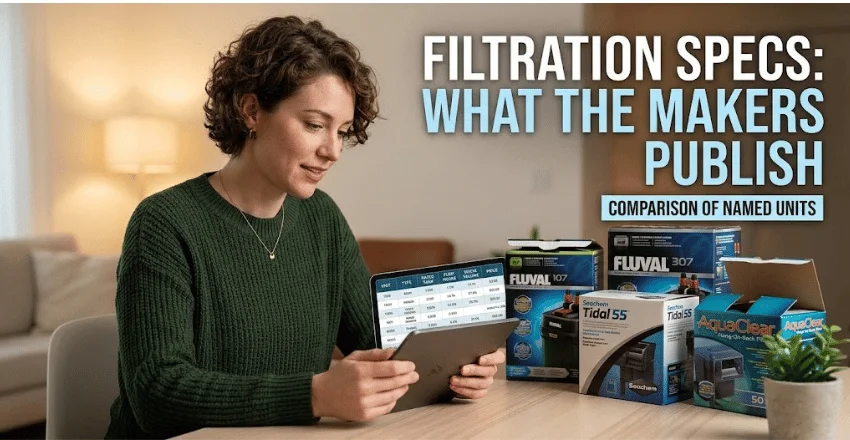
Every spec below names its source and says “not published” where a maker publishes none.
| Unit | Type | Rated tank | Maker’s flow figure | Media volume | Price seen |
| Fluval 107 | Canister | 10 to 30 gallons | 145 US GPH | About 0.53 gallons of chamber | Not published by Fluval |
| Fluval 307 | Canister | 40 to 70 gallons | 303 US GPH | About 1.2 gallons of chamber | $217.99 at PetSmart |
| Seachem Tidal 55 | Hang-on-back | Up to 55 gallons | 250 US GPH | 0.32 gallons, Seachem’s own figure | Not published by Seachem |
| AquaClear 50 | Hang-on-back | 20 to 50 gallons | Not published on the product page | Foam, carbon and BIOMAX included | $49.99 to $112.99 across the range at PetSmart |
| Top Fin sponge | Sponge | 20 to 75 gallons | Not published | Sponge body only | $9.99 to $19.99 at PetSmart |
Fluval rates the 107 at 145 gallons per hour and the 307 at 303. Seachem lists the Tidal 55 at 250 gallons per hour with 0.32 gallons of media space. Prices come from PetSmart listings checked on August 2, 2026, and retail figures move.
The media mistake that restarts your cycle
Rinsing everything at once under the tap is how beginners crash a healthy tank. Chlorine kills the colony. So does a hard scrub. So does swapping every cartridge on the same day, which is exactly what the packaging tells you to do.
Do this instead:
- Rinse mechanical foam in a bucket of old tank water you just siphoned out, then put it straight back.
- Replace biological media in stages, roughly a third at a time, several weeks apart.
- Leave ceramic and sintered glass alone until flow really drops off.
- Treat carbon as a short course after medication, then pull it out.
Monthly cartridge swaps are the advice that strips the bacteria colony, and they persist because cartridges are a subscription. More care routines like this one sit on the Petistra blog.
The verdict, by setup
Most lists of the best fish tank filters crown one winner. There is no single best overall pick, so take the separate verdict that matches your tank.
Nano and betta tanks: a sponge on a low air setting, and nothing more.
A 20 to 40 gallon community: a hang-on-back with an open media basket, such as the AquaClear 50.
A 55 gallon or larger display: a canister, bought a size above the tank. The Fluval 307 covers 40 to 70 gallons on Fluval’s own rating.
Breeding, shrimp and hospital tanks: sponge again, with a spare one kept running in the main tank, so it is already colonised when you need it.
Bedroom or office tanks: a canister is the quietest option, because the motor sits inside a closed cabinet. A good sponge setup comes close if the air pump sits on a foam mat.
Work out your tank volume, multiply it by five, then shortlist units rated above that number. Check the media volume before you check the price, and you will not have to shop twice.
If you want to know about Best Cat Litter of 2026 then visit our Accessories category.
FAQ
Yes, and the rating method is why. The unit was measured empty, so a model rated to your exact tank volume will run short once media and head height are in play. One size up is the safe call.
In a fry, shrimp, or quarantine tank, yes. In a stocked community tank, they handle the biological load well but leave fine debris drifting, so most keepers pair one with a hang-on-back.
Rinse mechanical foam monthly in old tank water. Biological media only gets replaced when it crumbles, and never all at once.
A hang-on-back suits most 30-gallon setups and costs less to run. Go with a canister if the tank is heavily stocked, densely planted, or standing somewhere you want silence.
No. Bacteria convert ammonia to nitrite and then to nitrate, and nitrate leaves with a water change. No standard unit does that job for you.