

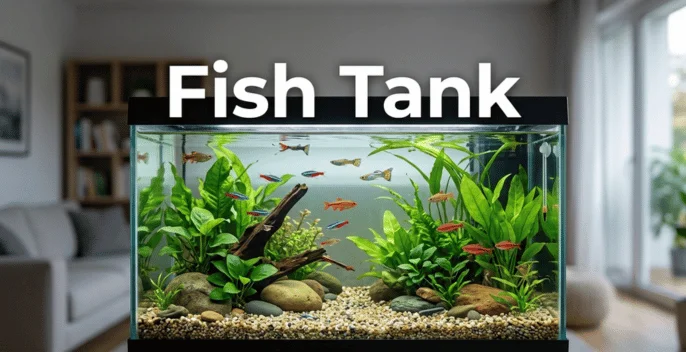
Before you buy a fish tank, learn the process that decides whether the fish live: the nitrogen cycle. A brand-new aquarium holds no bacteria to handle waste, so ammonia builds up and poisons the occupants. Cycle the water first, which takes weeks, then stock it.
Every other choice on the shopping list sits below that one. Size, weight, glass or acrylic, what comes in the box: none of it saves fish put into raw water. So the chemistry comes first here, then the buying.
The five numbers that matter
| Number | What it refers to in a fish tank | Why it decides the outcome |
| 0 ppm | Ammonia in a finished cycle | Anything above zero is burning gills and skin |
| 0 ppm | Nitrite in a finished cycle | Nitrite blocks the blood from carrying oxygen |
| 3 to 8 weeks | Time for the bacteria to establish | The window when new setups kill fish |
| 20 gallons | Volume we suggest for a first setup | More water dilutes every mistake you make |
| 8.34 lbs | Weight of one gallon of water | A loaded 55-gallon setup passes 600 lbs |
Key takeaways
- Cycle the aquarium with an ammonia source and a liquid test kit before any fish arrive.
- Bigger is easier. A 20-gallon setup forgives errors that wreck a 3-gallon desktop kit.
- Check what the furniture can hold before you fill anything over 10 gallons.
- Most starter kits leave out the heater and the test kit, the two things you need most.
The nitrogen cycle, and why new fish tank setups kill fish

Fish waste and uneaten food break down into ammonia inside a fish tank. Ammonia is toxic. One group of bacteria feeds on it and converts it into nitrite, which is also toxic. A second group converts nitrite into nitrate, which is far less harmful and comes out with your weekly water change.
That bacterial workforce does not come in the box. It has to grow on the filter media and the gravel, and it grows slowly. Until both colonies are large enough, the water is poisoning whatever swims in it.
University of Florida IFAS Extension puts figures on the danger. Its 2023 guide Ammonia in Aquatic Systems reports that fish tissue starts taking damage above 0.05 mg/L of un-ionized ammonia. Sensitive fish typically die at 2.0 mg/L. That same source names nitrite as toxic from 0.10 mg/L.
Here is how that plays out in a living room. Someone buys a setup on Saturday, fills it, adds six fish on Sunday, and by the second week most are dead. They conclude they are bad at this and quit. Raw water killed the fish, not the owner.
How to cycle a new aquarium before the fish arrive
A fishless cycle grows the bacteria without an animal in the water. You need two things: an ammonia source and a liquid test kit that reads ammonia, nitrite, and nitrate. Strips are cheap and vague. Buy the liquid kit.
- Set the aquarium up completely, with the filter running and the heater on, and hold the water at roughly 78 F.
- Dose ammonia to about 2 ppm, using bottled ammonium chloride or a pinch of fish food left to rot.
- Test every two or three days. Ammonia falls, then nitrite appears and climbs.
- Keep topping the ammonia back to 2 ppm each time it drops to zero.
- Watch for nitrite to fall to zero and nitrate to appear.
Shops imply days. UF IFAS Extension guidance on recirculating aquaculture systems states that nitrifying bacteria need 3 to 8 weeks to establish at 77 F to 81 F. Cooler water takes longer. Home aquariums behave the same way.
You are finished when a 2 ppm ammonia dose reads zero ammonia and zero nitrite within 24 hours, with nitrate clearly present. Those readings are the whole test. Do a large water change to drop the nitrate, then stock slowly. Getting the environment right before the animal arrives is the principle behind our pets section on animal care.
Why a bigger fish tank is easier for a beginner
Retailers point beginners at tiny desktop kits because they are cheap and easy to carry home. The chemistry works the other way round. A larger volume of water is more stable, so it is more forgiving.
Overfeed a 30-gallon setup, and the extra ammonia spreads through 30 gallons. Do the same in a 3-gallon kit, and the concentration is ten times higher, in water that also swings in temperature with the room. One mistake in a small volume changes the chemistry fast enough to kill.
Twenty gallons is the sweet spot. Light enough for sturdy furniture, cheap to stock, and big enough that a missed water change is not fatal.
What size to buy, by species and experience
| Capacity | Who it suits | Realistic stocking |
| 5 gallons | One betta, planted, patient owner | 1 betta plus snails |
| 10 gallons | Tight budget or tight shelf | 6 small tetras, or 1 betta |
| 20 gallons | First-timers, our recommendation | 8 to 10 small community fish |
| 29 to 40 gallons | Confident beginner, bigger species | 1 fancy goldfish, or a pair of angelfish |
| 55 gallons and up | Goldfish keepers, cichlid keepers | 2 to 3 fancy goldfish |
Two species deserve honesty, because shops still sell them short. A single betta wants 5 gallons of heated, filtered water as a floor, not a 3-gallon cube and certainly not an unheated jar. Fancy goldfish are messy and grow past six inches. So 20 gallons is a minimum for one, and 55 gallons is a fairer home for a pair.
Goldfish bowls show the gap between what shops sell and what the animal needs. No bowl holds enough water to stay stable, and none carry a filter. Species minimums mean little while shops still sell gear below the line.
How much a filled setup weighs
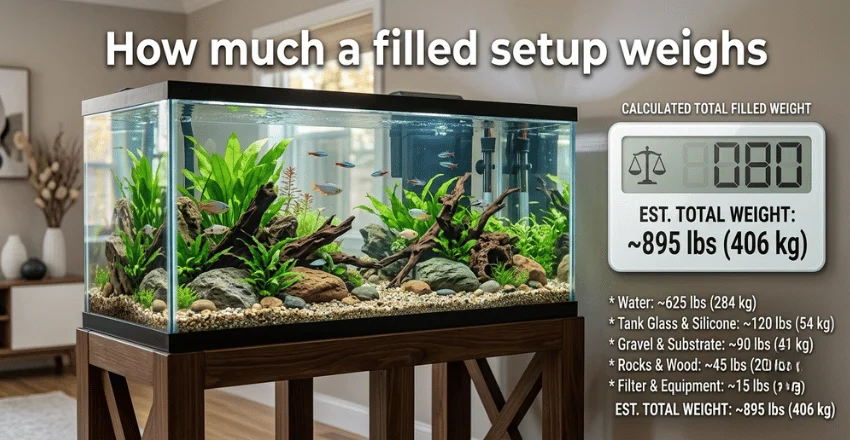
This is the number almost nobody checks, and it damages houses. Water weighs about 8.34 pounds per gallon before you add glass, gravel, and rock.
| Capacity | Water alone | Estimated filled total |
| 5 gallons | 42 lbs | about 60 lbs |
| 10 gallons | 83 lbs | about 110 lbs |
| 20 gallons | 167 lbs | about 225 lbs |
| 29 gallons | 242 lbs | about 320 lbs |
| 55 gallons | 459 lbs | about 600 lbs |
The filled totals above are our estimates: water at 8.34 lbs per gallon plus an allowance for glass, substrate, and hardscape.
Now compare that with your furniture. A flat-pack sideboard is rated to hold a television, not 600 pounds on a footprint the size of a doormat. Anything over 10 gallons belongs on a purpose-built aquarium stand—past 55 gallons, the floor underneath matters too.
Glass or acrylic
Glass wins for most homes. It scratches far less and costs less at the sizes beginners buy.
- Glass: scratch-resistant, cheap, heavy, and it will shatter if you drop something hard into it.
- Acrylic: roughly half the weight and far harder to break. It scratches if you look at it wrong, even from a gravel grain under a cleaning magnet.
Pick acrylic when weight rules the decision, such as an upstairs room. Pick glass everywhere else. Acrylic scratches polish out, but only after you drain the whole thing.
What starter kits include, and what they leave out

| Kit | Size | Listed contents | Price |
| Fluval Flex | 15 gal, 16 x 15 x 15 in | Integrated filter with foam, carbon, and BIOMAX, dual-output pump, remote LED. Heater sold separately | Not published on the maker page |
| Fluval Flex 2.0 | 9 gal, 14 x 13 x 13 in | Multi-stage filtration, adjustable pump, RGB and white LED, spray bar. Heater not included | Not published on the maker page |
| Top Fin Essentials Starter Kit | 5 to 55 gal, six sizes | Full starter kit range at PetSmart | $63.99 to $199.99 |
| Top Fin Captivate Starter Kit | 20 gal | Starter kit, one size | $118.39, reduced from $147.99 |
| Top Fin All-In-One Betta Kit | 3 gal | Betta starter kit | $43.99, reduced from $54.99 |
| Aqueon Standard Glass Rectangle | Six sizes | Bare glass, no equipment | $11.99 to $99.99 |
Prices above are what PetSmart displayed on August 2, 2026. Contents are what each maker or retailer lists, and we have not tested these products. Fluval publishes dimensions and kit contents but no price.
Notice the pattern. Both Fluval kits state plainly that the heater is sold separately, and no kit here ships with a liquid test kit. Those two purchases keep fish alive. Buying guides describe what is in the box and stay quiet about the gaps.
The equipment worth owning on day one is short:
- Heater sized to the volume, roughly 3 to 5 watts per gallon, for any tropical species.
- Lighting on a timer, eight hours a day, which keeps algae down.
- Substrate, one to two inches, which also houses bacteria.
- Liquid test kit covering ammonia, nitrite, nitrate, and pH.
- Gravel siphon for weekly water changes, the most useful tool you will own.
Filtration matters too, and a kit filter is usually adequate for the volume it ships with. We publish separate pieces on individual pieces of gear, so browse the Petistra blog index when you are ready to compare specific models.
Our verdict, by case
- First fish ever: we recommend a 20-gallon glass setup with a heater and a liquid test kit. The Top Fin Captivate at $118.39 covers the hardware.
- One betta, small space: 5 gallons minimum with a heater. Skip the 3-gallon kits.
- Goldfish: 29 gallons for one, 55 for a pair. Never a bowl.
- Design-led desk build: the Fluval Flex 15 at 16 by 15 by 15 inches, plus a separate 50-watt heater.
- Lowest cost: a bare Aqueon glass aquarium from $11.99, and buy each component yourself.
FAQ
Three to eight weeks if you cycle it properly. Adding fish sooner means they sit in ammonia and nitrite while the bacteria catch up.
Yes. Squeeze media from an established filter, or add a bottled bacteria starter, and hold the water near 78 F. Test before stocking anyway.
Yes, for tropical species. Room temperature drifts several degrees overnight, and that swing stresses fish badly.
Around 25 percent weekly, using the siphon to pull waste out of the gravel at the same time. That is how nitrate leaves the system.