


A litter box enclosure solves your problem and can quietly create your cat’s. Cabinets hide the tray, the scattered litter, and the view your guests would rather not have. It also shrinks the floor space your cat must turn in, and that is where tidy furniture turns into a cat peeing on the rug. So, buy for the inside, not the finish.
Short answer: pick the unit by its interior dimensions. A cat’s tray should measure roughly 1.5 times its body length, nose to the base of the tail. An average 18-inch cat therefore wants a tray near 27 inches long. Plenty of cabinets on page one fit nothing bigger than 19 inches. Measure your cat first.
The six numbers to check before you buy
Most roundups quote exterior dimensions and stop there. Those numbers tell you whether the unit fits your hallway. They say nothing about whether your cat fits inside it. Six things do.
| What to check in a litter box enclosure | The number that matters | Why it decides the buy |
| Interior length | About 1.5x your cat’s nose-to-tail base length | A cat that cannot turn around starts going elsewhere |
| Entry hole | Roughly 8 inches square, and how high off the floor it sits | Kittens and arthritic seniors cannot hop a high sill |
| Ventilation | Vents or filter slots on at least two sides | Odor and ammonia concentrate fast in a sealed wooden box |
| Exits | Two, in any home with more than one cat | A single doorway can be blocked by another cat |
| Cleaning access | A full height door or a lift off top | Scooping through an 8 inch hole gets old in a week |
| Price band | $66 to $310 across the units named below | Thin panel board swells once urine soaks the seams |
Key takeaways
- Interior dimensions decide everything. Exterior dimensions decide nothing.
- An enclosed tray concentrates odor, so scoop daily and buy vents.
- Two cats need two exits, or the box becomes an ambush point.
- Check the entry hole height against your oldest, stiffest cat.
- You will clean this thing 365 times a year. Buy the easy door.
The sizing rule that decides everything for a litter box enclosure

Measure your cat before choosing a litter box enclosure. Measure from the tip of the nose to the base of the tail, not the tail tip, then multiply that length by 1.5. That is the tray length your cat wants inside a litter box enclosure. Most adult domestic cats need a tray measuring between 24 and 30 inches once you do the math.
Cats are not subtle about the difference. Over 28 days, the large boxes took 5,031 urine and fecal deposits against 3,239 in the standard ones. Given a free choice, the cats used the bigger tray about 61% of the time.
Now look at what page one recommends. Cabinets with an interior of 21 by 15.5 inches hold a standard tray and nothing larger. That suits a small cat of roughly 14 inches. Put an 18-inch cat in it, and you have bought an undersized box with a nice oak veneer on the outside.
The habit of measuring the animal before buying the product runs through Petistra’s pets section, and it saves more money here than anywhere else in the house.
Ventilation, odor, and what builds up inside a closed cabinet
Put a lid on a litter tray and the air stops moving. Urine breaks down into ammonia. The ammonia has nowhere to go, and your cat stands in it for ninety seconds it takes to dig, squat and cover.
Ohio State University’s Indoor Pet Initiative runs out of its College of Veterinary Medicine. Its guidance sets 2 hard numbers for an enclosed setup: scoop at least once every 24 hours and wash the box every 7 days with mild dish detergent. It also warns that covered boxes concentrate odors more than uncovered ones, and that a cat may refuse a covered box that is not kept spotless.
Ammonia is a respiratory irritant. A cat that starts holding urine because the air inside stinks is a cat heading toward urinary trouble. That is a vet visit, not a decor problem.
Three things fix most of it:
- Buy a unit with vent slots or a carbon filter housing, not a sealed box with one hole in the side.
- Scoop every single day. An enclosed tray has no margin for a skipped morning.
- Leave the door open for an hour after a full litter change so the wood dries out.
The ambush problem, and why a second exit matters
No top result explains this part. A cat shut in a cabinet with one doorway has exactly one way out, and every other cat in the house knows it too.
In a multi-cat home, the cat waiting outside that doorway controls the situation. The cat inside learns that squatting there means getting cornered. It does not have to be aggression. A young cat who thinks pouncing is a game will do the same damage to the habitat.
So in any home with more than one cat, look for a unit with two openings, or cut a second hole yourself. Several furniture-style cabinets let you move the entry wall to either side, which helps with placement but still leaves a single exit. Two doorways on opposite ends is the arrangement you want.
Entry height for kittens, seniors and arthritic cats
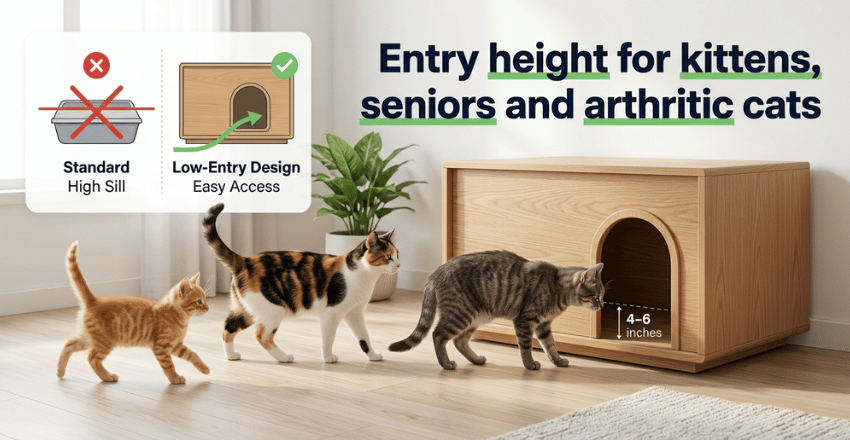
Entry holes on most cabinets sit a few inches off the floor. Base panels and tray rims both add height. That step is invisible on a spec sheet. It is painfully obvious to a twelve-year-old cat with sore hips and stiff joints.
Feline arthritis is common in senior cats. Your cat will avoid a painful climb long before it complains about anything. Kittens have the opposite problem: short legs and no reach.
Skip top entry designs entirely if your cat is old, young, or unsteady. Pick a front opening within about four inches of the floor instead. For a borderline case, a cheap ramp or a folded towel outside the hole fixes it.
Cleaning access, the part you live with every day
You will open this cabinet roughly 365 times a year. Human ergonomics matter as much as the cat’s side, and it is the thing nobody checks in the store.
Ask three questions. Does the door open wide enough to lift a full tray without dismantling half the cabinet? Is there scoop clearance above the litter, or does the roof stop your wrist? Can you reach the back corners, where cats put the thing you most want to remove?
Pick a drop-down front or a lift-off top. Both beat a narrow-hinged door.
The 5 litter box enclosure types compared
Here are the five formats people actually buy, with a named, currently available example for each. Prices were checked in August 2026 and move with sales. For a closer look at this, see Pooper Scooper.
| Type | Named example and price | Interior | Entry | Cleaning access |
| Furniture style cabinet | The Refined Feline Refined Cat Litter Box Deluxe, xLarge, $235 to $310 | 31 x 21 x 20.5 in | Side hole, wall fits either side | Removable front panels plus a sliding drawer |
| Top entry box | Modkat XL, $189.99 | 21 x 16.3 x 17 in exterior | Top, front or both | Swiveling lid lifts away |
| Bench or side table | Frisco Drop Down Door Bench, $65.69 | 22.25 x 17.5 x 17.75 in | 8.25 in square hole | Hinged drop-down door |
| DIY IKEA conversion | IKEA BESTA shelf unit with doors, 47.25 in wide, $205 | About 46 x 15.5 in usable | Whatever you cut | Full width doors |
| Pet specific enclosure | New Age Pet ecoFLEX Litter Loo, Jumbo, $199.99 | 28.4 x 22.4 x 25.2 in | 7.9 in square hole | Lift off top |
Furniture style cabinets
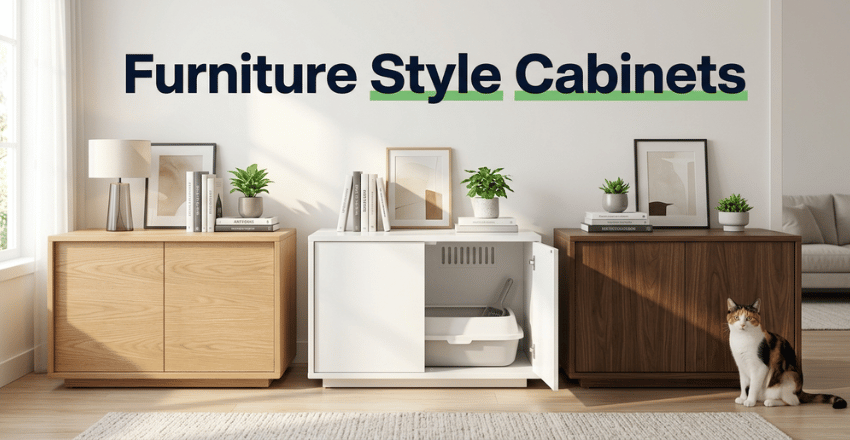
The Refined Feline lists the xLarge Deluxe interior at 31 by 21 inches, with ventilation slots sized for carbon filters and front panels that come off for cleaning. That is one of the few cabinets whose inside genuinely clears the 1.5x rule for a full-grown cat.
Pros: real furniture looks, the largest interiors on the market, proper venting.
Cons: the price, the footprint, and one exit unless you modify it.
Top entry boxes
Modkat’s XL measures 21 by 16.3 by 17 inches and configures as top entry, front entry, or both. It is a box rather than a cabinet, so nothing is hidden, but litter tracking drops sharply.
Pros: excellent scatter control, no cabinet to clean, a front entry mode for older cats.
Cons: the interior suits cats under roughly 13 inches, and top entry alone rules out kittens and arthritic seniors.
Bench and side table styles
Chewy lists the Frisco Drop Down Door Bench with an interior of 22.25 by 17.5 inches and an 8.25-inch square opening, at $65.69. The whole side hinges down, which is the easiest cleaning access at this price.
Pros: cheap, easy to clean, doubles as seating.
Cons: the interior only suits a cat up to about 15 inches, and there is no ventilation to speak of.
DIY IKEA conversions
A stock cabinet with a hole cut in one end gives you the most interior per dollar. IKEA lists a BESTA shelf unit with doors at 47.25 inches wide for $205, which swallows a 30-inch tray lengthwise with room to spare.
The trap is depth. That unit is only 16.5 inches from front to back, so a wide jumbo pan will not sit crosswise. Orient the tray along the length, seal the base with vinyl or a plastic liner, and cut two holes rather than one.
Pros: the largest usable interior for the money, two exits if you want them, replaceable parts.
Cons: a saw, an afternoon, and raw chipboard edges that need sealing against urine.
The verdict, by household type
Each roundup names one of the best overall picks. That is the wrong shape of an answer, because the right unit depends on who lives in your house.
- One average adult cat, and the room matters: we recommend the Refined Cat Litter Box Deluxe in large. The interior clears the sizing rule, and the venting is real.
- Two or more cats: the BESTA conversion, cut with two openings at opposite ends. Nothing off the shelf solves the ambush problem this cheaply.
- A senior or arthritic cat: the Frisco bench, with the tray swapped for a low-sided pan. Front entry, low sill, easy door.
- A litter scatterer in a small apartment: the Modkat XL and skip the cabinet idea. Hiding the box matters less than living with the mess.
Measure your cat this week, write the number on your phone, and take it shopping. More cat and dog buying guides land on the Petistra blog every week.
Litter box enclosure FAQ
Many do, provided the inside is big enough and the air is clean. Cornell’s Feline Health Center notes that most cats prefer an open box that lets odors escape and gives a 360-degree view. Treat an enclosed setup as the compromise it is and compensate for size and daily scooping.
Scoop daily, wash the tray weekly, and pick up a unit with vent slots or a carbon filter. Odor sitting in a closed cabinet is a cleaning frequency problem before it is a product problem.
A 20-inch Maine Coon wants a tray about 30 inches long, which means an interior of at least 31 by 21 inches. Two units on this list reach that. Most cabinets sold as large do not.
Yes, on interior space per dollar, and yes if you need two exits. No, if you would rather not seal, cut the chipboard against urine. Buy ready-made and pay for the interior instead.