
![The Ultimate Pooper Scooper Guide: Best Options for Grass, Gravel, and Turf [2026]](https://petistra.com/wp-content/uploads/2026/08/Pooper-Scooper.webp)
Most buying guides hand you one winner and stop there. That advice breaks down the moment your yard isn’t a flat lawn, because a pooper scooper is a mechanism first and a product second. Jaws that close cleanly on grass will grab a fistful of pea gravel. A rake and pan that glides across concrete will bury itself in bark mulch.
Short answer: pick the mechanism to match the ground. Jaw scoops and spring claws suit grass, mulch, and gravel because they close around waste instead of sliding under it. Rake and pan sets need a firm, flat surface. Bag holder scoops are the cleanest choice for concrete, sidewalks, and travel.
Quick reference: Which mechanism suits which surface
Read it before you shop. Match your ground to the mechanism, and most of the shortlist rules itself out before you have looked at a single brand name.
| Surface. | Mechanism that works. | What fails, and why. |
| Grass and lawn. | Jaw scoop or spring claw. | Flat spades push waste into the thatch. |
| Gravel and rock. | Jaw scoop with serrated edges. | A rake and pan lift more stone than waste. |
| Concrete and patio. | Rake and pan, or a bag holder scoop. | Toothed jaws skid and smear on hard flat ground. |
| Mulch and garden beds. | Spring claw. | Any pan drags bark chips along with the load. |
| Artificial turf. | Smooth-edged jaw scoop. | Serrated tines snag and pull the turf fibers. |
| Snow and frozen ground. | Metal spade or flat rake. | Plastic jaws cannot break a frozen bond. |
Key takeaways
- There is no single best overall pick. There is a verdict per surface, and yours may need two tools.
- Handle length beats brand. A 32- to 37-inch handle keeps most adults upright.
- Gravel is the hardest surface, and only a serrated jaw handles it well.
- Cleaning and storage decide whether the tool survives its first month.
- Same-day pickup is the real hygiene control, not a weekend sweep.
Pooper scooper mechanisms, and what each one really does
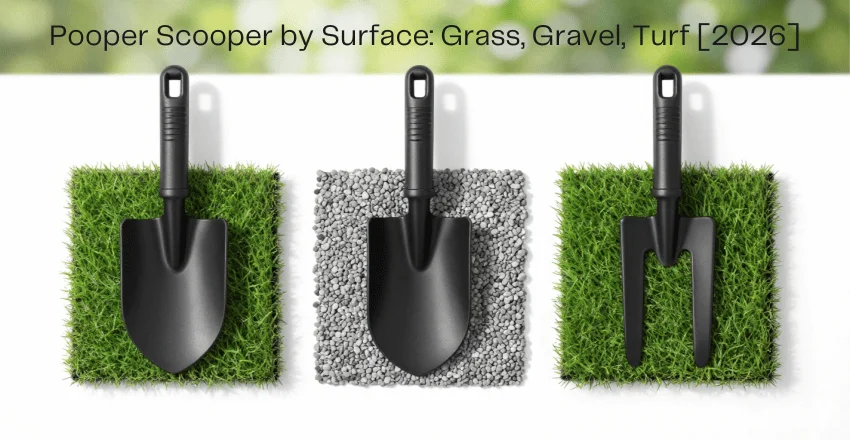
Four mechanisms cover almost everything sold in the United States. Each solves a different problem. Each also has a surface it quietly hates, which is the part the packaging never mentions.
Jaw scoops
Two hinged halves close around the waste, usually with serrated or toothed edges. Squeeze the grip, the jaws bite, and the load lifts clear of whatever it was sitting on. Dogit’s Clean Jawz model is built this way, with two calibrated springs and edges the maker describes as “serrated” for grass and gravel.
- Pros: lifts loose material, works one-handed, and has no separate pan to chase around.
- Cons: teeth smear on smooth concrete, and the jaws need rinsing after every use.
Spring action claws
A claw is a jaw scoop with a spring that holds it open until you press. Chewy’s Frisco Spring Action Foldable Scooper in Large is the common example, listed at 26 inches, molded in plastic, with jagged teeth, and one-handed operation.
- Pros: fast, light, folds for storage, and forgiving on mulch and long grass.
- Cons: plastic teeth wear, and a weak spring gets sloppy after a season.
Rake and pan sets
The pan sits flat; the rake drags the waste in. Classic two-handed setup. If you are clearing a week of mess from a big yard, nothing else moves volume this fast, and nothing else is this cheap to replace when it wears out.
- Pros: high capacity, nothing touches your hands, cheap to replace.
- Cons: a rake and pan need a firm surface and fail on loose gravel, where the pan scoops up stones.
Bag holder scoops
Here the bag clips inside the scoop head, so waste drops straight into it, and the tool itself never gets dirty. Pooch Approved Products builds the GoGo Stik line around that idea.
- Pros: almost no cleanup, ideal for sidewalks, apartments, and travel.
- Cons: bag cost adds up, and a windy day makes loading fiddly.
Six real models compared
Every figure below comes from the maker’s or the retailer’s own listing. Price bands are typical street prices in USD and shift with promotions, so treat them as a range rather than a quote.
| Model. | Mechanism. | Handle. | Suits. | Hands. | Price band. |
| Arm & Hammer Swivel Bin & Rake. | Rake and bin. | 32 assembled. | Grass, dirt, sidewalks. | Two. | $20 to $30. |
| GoGo Stik XP. | Bag holder scoop. | 37 are fixed. | Grass, concrete, gravel, dirt. | Two. | $20 to $45. |
| GoGo Stik Catch-N-Go. | Bag holder catcher. | 25 to 36 in. telescoping. | Walks, sidewalks, travel. | One. | $30 to $42. |
| Frisco Spring Action Foldable, Large. | Spring claw. | 26 in. | Grass, mulch. | One. | Under $20. |
| Dogit Clean Jawz for Grass & Gravel. | Serrated jaw scoop. | 25.5 in. | Grass, gravel. | One. | $20 to $30. |
| Four Paws Wee-Wee Rake, Spade & Pan. | Rake, spade, and pan. | 33.5 in. listed height. | Concrete, packed dirt, snow. | Two. | $20 to $35. |
Two prices were listed openly when this guide was written. Petmate shows the Arm & Hammer bin and rake at $23.99. Chewy shows the large Frisco claw at $18.99. The rest move around too much to pin down. Working out what else your routine needs? The pets section on Petistra covers general dog care and wellness alongside this kind of yard chore.
The verdict for each surface
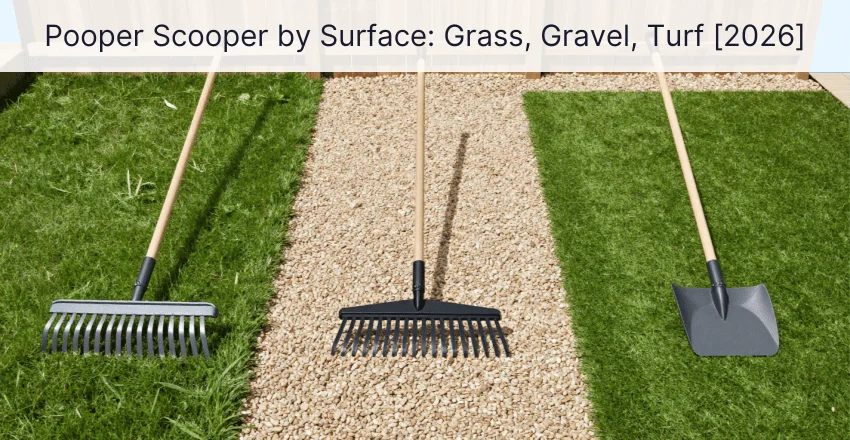
Grass and lawn
Grass hides waste down in the thatch, so you want something that closes around it rather than something that slides underneath and pushes it deeper. Serrated jaws and spring claws both do that. For a large dog, Dogit’s Clean Jawz is the safer pick, because its jaw opening is wider than a folding claw.
Gravel and rock
Gravel defeats most tools. Pea gravel and lava rock shift under any flat edge, so a pan fills with stone. Serrated jaws are the answer. They close above the stone line and pinch the waste out. The Dogit model names gravel on the package, and the GoGo Stik XP lists gravel among its surfaces too. Expect to lose a few pebbles either way.
Concrete, patio and sidewalk
Hard flat ground is where jaws struggle, and pans shine. A rake pushes the load cleanly into the pan without the teeth skidding and smearing. For a sidewalk or a walk around the block, a bag holder scoop is tidier still, because nothing you carry home needs washing.
Mulch and garden beds
Bark chips travel with anything you drag. Lift vertically with a spring claw instead, and you take the waste while leaving the bed roughly where the landscaper put it. Shake the claw once before bagging. Most of the chips drop straight back.
Artificial turf
Synthetic grass is the surface page one forgets. Serrated tines snag the turf fibers and can pull loops free of the backing, which is expensive to repair. Use a smooth-edged jaw scoop, or lift a firm stool with a bagged hand and then rinse the spot. Save the toothed tools for real grass.
Snow and frozen ground
Frozen waste bonds to whatever it froze against, and plastic jaws will crack before it lets go. Metal wins here. A steel spade or a flat steel rake breaks the bond, which is why the Four Paws Wee-Wee set earns its place on a snowy yard.
Handle length and grip decide whether you keep using it
Owners rarely abandon a tool because it failed. They abandon it because their backs hurt. Match the handle to your height and to how far you can comfortably bend. As a rough guide, a handle should reach somewhere between your hip and your lower ribs when the head is on the ground. For most adults between 5 feet 4 inches and 6 feet, that lands at 32 to 37 inches. For the full picture, read Yorkie Haircuts.
Long-handled models exist specifically for people who cannot bend at all after a hip replacement or with arthritic knees. The GoGo Stik XP is fixed at 37 inches for that reason. Telescoping handles like the 25- to 36-inch Catch-N-Go trade a little rigidity for a shorter storage length.
Grip matters almost as much. A bare plastic loop gets slippery in the rain, and a squeeze mechanism that needs real hand strength will beat up weak wrists. Rubber padding and a wrist strap are worth more than an extra inch of reach.
Cleaning and storage are the second reason tools get abandoned
Something that lives dirty in the garage stops getting used within a month. Cleaning takes under two minutes.
- Rinse the head with a hose right after the job, before anything dries on.
- Scrub the teeth or tines with an old dish brush kept only for this.
- Disinfect with a diluted bleach solution, roughly one part bleach to thirty parts water, and leave it wet for five minutes.
- Rinse again, then stand it head up so water drains out of the hinge.
- Store it under cover. The sun makes plastic brittle, and rain rusts spring steel.
Bag holder designs skip most of this, which is their real selling point. Hang the tool on a nail rather than leaving it on the ground, and the spring lasts far longer. Owners who want more routine care reading will find recent posts on Petistra useful alongside this one.
Why same-day pickup matters
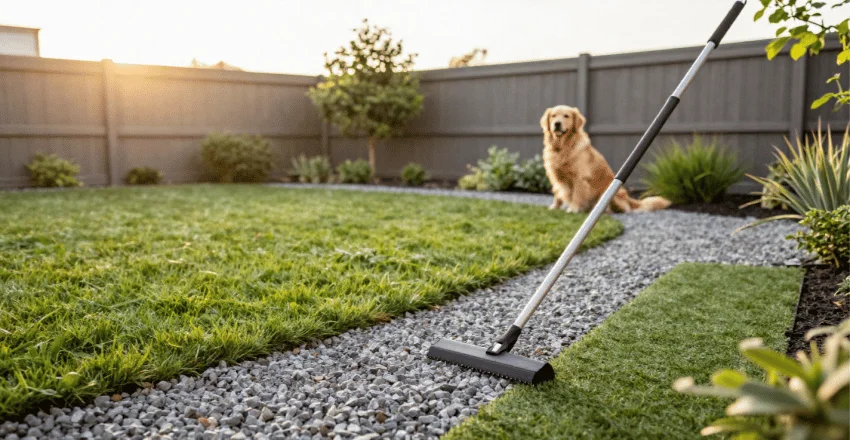
Dog feces can carry roundworm and hookworm eggs, which is why speed matters more than thoroughness. Freshly passed roundworm eggs are not yet infectious to people. According to the CDC, Toxocara eggs need 2 to 4 weeks in the environment before they develop enough to cause infection. Once they mature, the protective shell lets them survive in soil for months or years.
So the control point is time, not scrubbing. Clear the yard the same day, and the eggs never reach the stage where contaminated soil becomes a risk to children playing on it. Leave the yard for a fortnight, and you have created the exact conditions the parasite needs.
Wash your hands afterwards, every time, no matter what tool you used.
How often to scoop, and what to do next
Daily. That is the target for one or two dogs in a normal yard, and twice daily suits either a small yard or a large breed. For the past three days you have been managing a problem rather than preventing one. Pick your surface off the table above, buy the mechanism that matches it, and check the handle length against your own height before you order.
If your yard mixes lawn and gravel, budget for two tools rather than hoping one covers both.
Frequently asked questions
A jaw scoop with serrated edges. The teeth close above the stone line and pinch the waste out, while any flat pan simply fills with gravel. The Dogit Clean Jawz and the GoGo Stik XP both name gravel on their listings.
It depends entirely on the ground. The rake and pan win on concrete, packed dirt, and snow and move more volume per trip. Jaw scoops win on grass, mulch, and gravel because they lift rather than slide.
Yes, but only a smooth-edged one. Toothed models catch the fibers and can tear loops out of the backing.
Rinse, scrub, then soak the head in roughly one part bleach to thirty parts water for five minutes. Rinse it again and let it dry head up.
It stops the deep bend, which is where most of the strain comes from. A 32- to 37-inch handle keeps a typical adult standing nearly upright through the whole motion.
It becomes dangerous with time rather than immediately, because roundworm eggs need weeks in soil before they can infect anyone. Same-day pickup removes that window.