
Two claims lead almost every article on this subject. Your dog is short of a nutrient, or you got the house training wrong. Neither claim survives the largest survey of the behavior. You might also like Cadaver Dogs.
Why do dogs eat their own poop? Usually because the habit is normal and inherited, not because something is missing. Survey data ties it to greedy eaters and to fresh stool, not to diet, age, or house training. A sudden start in a previously clean adult dog is the exception, and that dog needs a veterinary exam. We cover this in more depth in Can Dogs Eat Lettuce.
The evidence at a glance
| Questions owners ask about why dogs eat their own poop | What the research shows |
| How common is it? | 16% of surveyed dogs had been seen eating stool at least six times |
| Is it caused by diet? | No link found |
| Is it a house-training failure? | No. Stool eaters were house-trained about as easily as other dogs |
| Strongest associations | Greedy eaters, and homes with more than one dog |
| Which stool gets eaten | Fresh stool, under two days old |
| Do deterrent additives work? | Reported success across 11 products was close to zero |
| What does work | Immediate pickup, leash control, a trained “leave it” |
| When to call a vet | The habit starts suddenly in an adult dog |
Key takeaway
- This is a common behavior in healthy dogs, not a symptom in most cases
- No survey evidence backs the nutrient-deficiency story.
- Products sold to stop it almost never stop it.
- Management beats correction. Remove the stool before your dog reaches it.
- A new onset in an adult dog is the version worth a vet visit.
What the largest survey actually found
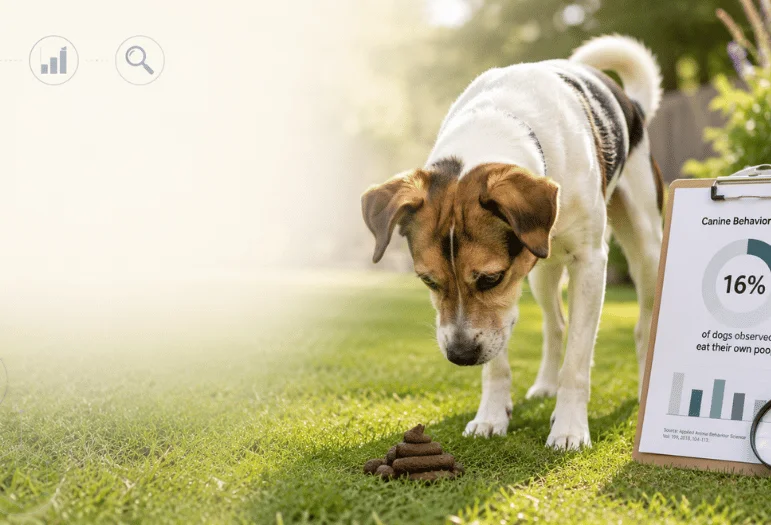
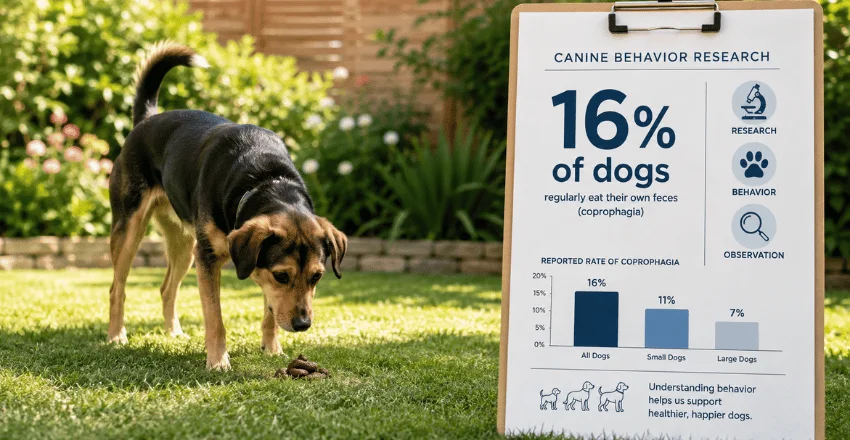
Benjamin Hart and colleagues at the UC Davis School of Veterinary Medicine ran two web surveys of dog owners, gathering 1,552 and 1,475 usable returns. Their 2018 paper in Veterinary Medicine and Science reported that 16% of the sampled dogs were frequent stool eaters, meaning owners had watched it happen at least six times. The same paper found no evidence linking the behavior to diet or to the dog’s age.
Two of the negative findings matter more than the headline number. Owners house-trained the stool eaters about as easily as everyone else’s dogs, which points to a normal aversion to feces rather than a training failure. Owners were also more likely to describe those dogs as greedy eaters.
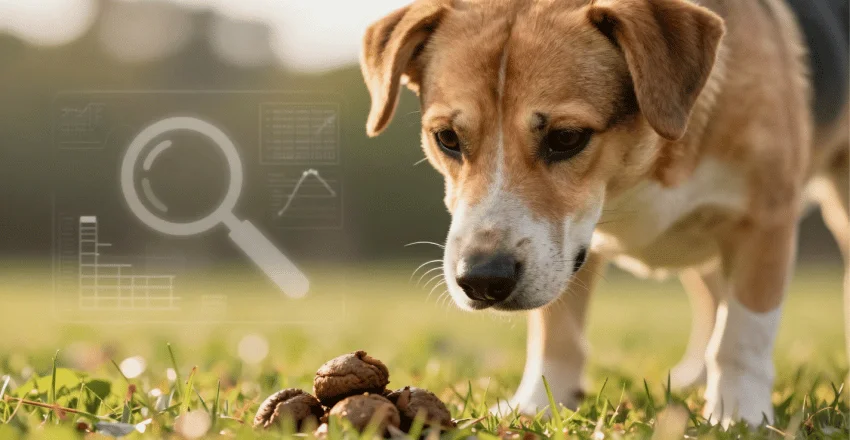
One more detail is easy to miss. The behavior aimed almost entirely at fresh stool, which the researchers defined as no more than two days old. Old, dried stool in the corner of the yard mostly gets ignored.
Myth versus evidence
| What you have probably read | What the evidence says |
| Your dog is missing a nutrient | The 2018 survey found no relationship with diet, and no deficiency has been shown to cause the habit |
| You failed at house training | Stool eaters were house-trained about as easily as non-stool eaters. |
| It always means the dog is ill | Usually not. A sudden change in an adult dog is the version that needs checking |
| A powder in the food will fix it | Reported success across 11 marketed products was close to zero |
| Scolding the dog afterward teaches it | Correction after the event teaches nothing about the act, and can make a dog swallow faster next time |
| Only badly kept dogs do it | One in six dogs in a large owner survey did it repeatedly |
The deficiency story survives because it feels fixable. Changing food gives an owner something to do this evening. If your dog’s food is worth improving for other reasons, read the ingredient panel properly instead of trusting the front of the bag. Our guide to peas in dog food shows how one legume can appear four separate times on a single list.
The wolf den theory, and why it stays a theory
Hart’s team offered an explanation for the two-day pattern. Wolves rest in a den, intestinal parasite eggs land there in fresh stool, and those eggs are not infective at once. Larvae develop later. A wolf that swallowed fresh stool near the resting area removed the eggs before they turned dangerous.
It is a tidy fit with the freshness data. It is also a hypothesis, and the authors present it as one. Nobody has run the experiment in wild canids, and inherited behavior is difficult to prove after thousands of years of domestication. Treat it as the leading current explanation rather than a settled fact, and be skeptical of any article that states it flatly.
Causes that are real
A mother cleaning her litter
A nursing female licks her puppies to stimulate them and swallows what comes out. That keeps the whelping box clean for the first few weeks. It is normal, it stops on its own, and it needs no intervention.
Puppies working out what food is
Puppies mouth everything. Stool is warm, it smells of the diet that produced it, and a puppy has no cultural objection to it. Most grow out of it somewhere between six and twelve months, especially if nobody makes a scene about it. Chasing a puppy across the yard turns the whole thing into a game worth repeating.
Another animal’s droppings are a different habit
Eating cat litter box deposits, horse manure, goose droppings, or deer pellets is a separate behavior with separate risks. Cat feces is rich in undigested protein and fat, which is why so many dogs raid the box. Livestock manure can carry dewormer residue. Wildlife droppings carry parasites your dog’s monthly preventative may not cover. Ask your vet about the ones common in your area before you assume they are harmless.
Why do dogs eat their own poop suddenly in adulthood?
This is the version worth taking seriously. A dog that ignored stool for six years and then starts eating it has changed, and something usually changed it. Book an exam rather than buying a supplement.
Here is the short list your vet will work through:
- Intestinal parasites. Roundworm, hookworm, whipworm, and Giardia all steal nutrients and can drive appetite up.
- Exocrine pancreatic insufficiency. The pancreas stops producing enough digestive enzymes, so food passes through barely digested. Stool that still smells of dinner is worth eating.
- Diabetes or Cushing’s disease. Both raise hunger sharply, and both show other signs such as heavy drinking and urinating.
- Appetite-raising medication. Steroids like prednisone are the usual culprit. So are some anticonvulsants.
- Chronic gut disease. Inflammatory conditions that block absorption leave a hungry dog with a normal-looking meal plan.
A workup is not exotic. Expect a fecal test, a blood panel, and a urine sample. If your vet suspects the pancreas, a TLI blood test settles it. Bring a note of when the habit started, what has changed in the household, and every medication your dog takes.
What actually works, ranked
| Approach | Does it work? |
| Pick up every stool the moment it lands | Yes. This is the whole fix for most households |
| Leash in the yard until the habit fades | Yes, while you are consistent |
| Train a reliable “leave it” and pay well for it | Yes, with several weeks of practice |
| Feed a greedy eater smaller meals, more often | Sometimes. Worth trying, cheap to test |
| Basket muzzle for walks past a known hotspot | Yes, as a short-term tool |
| Deterrent additives and stool-taste powders | Close to zero reported success |
| Scolding, rubbing the nose in it, punishment | No. It teaches your dog to hide and gulp |
The ranking has an uncomfortable implication. Your fix is a rake and a routine, not a purchase. Deterrent chews and powders sell for roughly $7 to $40 a tub at US pet retailers, and the 2018 survey put their reported success close to zero. That is money spent because the alternative sounds like more work.
Practical version for a fenced yard: walk out with your dog, take a bag, and clear the stool while it is still fresh. Two weeks of that breaks the loop for most dogs, because the opportunity disappears before the interest does.
Health risks, told honestly
A healthy adult dog eating its own fresh stool is at low risk. Those bacteria already lived in that dog’s gut. The genuine problems sit slightly to the side of the behavior itself.
- Reinfection. A dog with worms that eats its own stool can re-dose itself with eggs, which makes treatment harder to finish.
- Other dogs’ stool. Dog parks and shared yards are where giardia, whipworm, and parvovirus move between animals.
- Your household. Roundworm and giardia are transmissible to people, and a dog that eats stool then licks a face is a short path for them.
The last one is the same fecal-oral route that makes raw chicken and household hygiene such a persistent issue for families with babies, elderly relatives, or anyone immunocompromised. Wash hands, keep faces out of muzzles, and stay current on parasite prevention. That covers most of the real risk.
What to do this week?
Start with the boring fix. Clear the yard after every trip outside, keep your dog on a leash in high-risk spots, and practice “leave it” with treats your dog genuinely wants. Give it two weeks before you judge it.
Then book the vet if the habit is new, if your dog is losing weight, or if the stool itself looks wrong. Everything else on your shopping list can wait. For more on behavior, feeding, and everyday care, browse the rest of our pet guides.
FAQs
Probably not. That 2018 survey compared diets across more than 3,000 dogs and found no relationship. Change the food if the food deserves changing, not as a treatment for this.
Most do, usually before their first birthday. Keep the yard clear, avoid making it a chase game, and reward your puppy for coming to you instead.
No reliable evidence supports it. Pineapple sits in the same category as the commercial additives, which reported success close to zero. It is harmless in small amounts, so it costs little beyond disappointment.
You can catch parasites such as roundworms and giardia from dog feces, and the route is usually hands or face contact rather than the dog itself. Regular deworming and ordinary hand washing handle it.
Freshness explains much of it. Your dog is present the moment its own stool lands, and the two-day window matters more than whose stool it is. Many dogs will happily eat another dog’s stool when it is fresh enough.
Only if your vet has a reason to suspect a digestive problem. Given as a guess, these products belong in the same group as the additives that failed in the survey.