
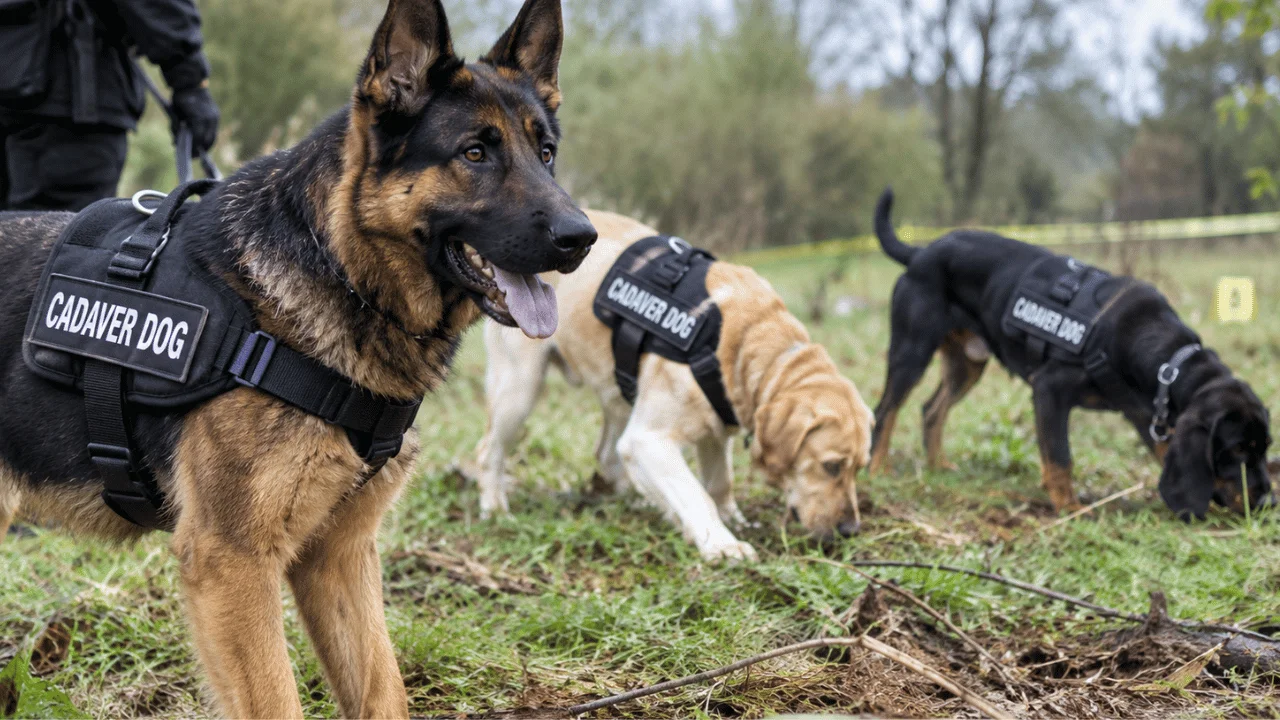
Cadaver dogs are specially trained working canines that locate the scent associated with human remains. Professionals usually call them human remains detection, or HRD, dogs. They assist law enforcement, forensic investigators, and search teams during recovery operations.
These dogs do not simply search for a visible body. They can work with odors associated with tissue, blood, bone, and decomposition fluids. Their effectiveness depends heavily on training, environmental conditions, handlers, and the odor sources used during training.
Direct answer: Human remains detection dogs learn to recognize odors associated with decomposing human material. They search an assigned area and give a trained response near the detected odor. Their work can support investigations, disaster recovery, missing-person cases, and searches involving buried or concealed remains.
Human Remains Detection at a Glance
| Question | Practical answer |
|---|---|
| Formal name | Human remains detection dog, or HRD dog |
| Primary job | Locate odor associated with human remains. |
| Common users | Law enforcement, forensic teams, and search organizations |
| Search environments | Land, structures, disaster sites, and specialized water searches |
| Common target material | Tissue, blood, bone, decomposition fluids, and other human remains |
| Training approach | Repeated target-odor searches paired with a reward |
| Typical response | A trained behavior identifying the odor location |
| Major limitation | Performance depends on the dog, handler, training, and search conditions. |
Key Takeaways
- HRD dogs search for human decomposition odor rather than a specific living person.
- Training must teach the animal to distinguish target odor from distracting smells.
- Dogs and handlers operate as teams, so handler behavior can influence search performance.
- Human remains create changing odor profiles as decomposition progresses.
- Buried, concealed, and weather-exposed material can present different search challenges.
- The United States now has a published 2026 standard for land-based HRD training and certification.
How Cadaver Dogs Detect Human Remains
Human decomposition releases a complex mixture of volatile organic compounds, commonly called VOCs. That odor mixture changes with decomposition stage and environmental conditions. Scientists still do not know every chemical cue that trained dogs use.
The dog’s task is therefore more complicated than recognizing one chemical. Training exposes the animal to relevant odor sources under controlled conditions. The dog learns that finding the target odor produces a valued reward.
Dogs can then search areas containing many competing smells. Soil, plants, animals, buildings, people, and weather can all add background odor. Successful detection requires discrimination rather than simple sensitivity.
A canine also needs to communicate a find clearly. Teams train a specific response that tells the handler where target odor appears strongest. That response becomes useful only when it remains dependable across different search conditions.
This learning process shares principles with everyday canine training. Consistent cues and rewards help dogs connect particular information with expected behavior. Petistra’s guide to how dogs understand words and cues explains how those learned associations develop.
What Exactly Are HRD Dogs Smelling?
Human decomposition does not produce one permanent scent. Chemical profiles change as tissues break down and environmental conditions change. Temperature, humidity, burial conditions, storage, and sample age can affect available odor.
Research also shows why varied training material matters. A 2025 review found substantial differences among human remains training aids. The authors recommended exposure to varied, relevant odor profiles when legally and ethically possible.
That point helps explain why simplistic descriptions can be misleading. A dog is not necessarily searching for one famous “death chemical.” It learns a broader odor concept through repeated and carefully controlled training.
Human Remains Detection vs. Search-and-Rescue Dogs
HRD and live-person search teams may work at the same incident, but their target odors differ. Live-search dogs generally seek people who may still be alive. HRD teams focus on odors associated with deceased humans.
| Feature | Human remains detection | Live-person search |
|---|---|---|
| Main target | Human decomposition odor | Living human scent |
| Common mission | Recovery and forensic searches | Rescue and missing-person searches |
| Search method | Often area or odor-source searching | Tracking, trailing, or air scenting |
| Desired outcome | Locate possible human remains. | Locate a living missing person. |
| Training focus | Human remains odor discrimination | Live human scent detection |
The distinction matters during real deployments. Search managers need teams trained for the specific mission. Specialized training also reduces uncertainty about what a dog’s response represents.
How Human Remains Detection Dogs Are Trained
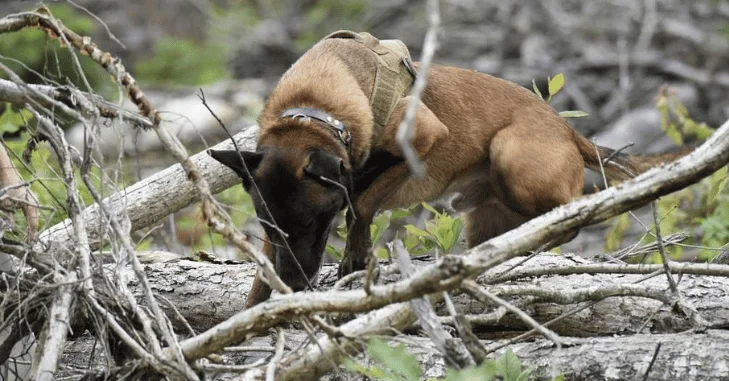
Training usually begins with dogs that have strong motivation, physical capability, and willingness to search. Breed alone does not determine success. Individual temperament, health, drive, and handler compatibility also matter.
Handlers introduce target odor and pair successful identification with a reward. Rewards may include food, toys, or play, depending on the animal. Research surveys have found reward-based methods common among HRD handlers.
Training then becomes progressively harder. Teams work around distracting odors and changing terrain. They may also practice with different source quantities and decomposition stages.
Documentation matters because successful searches cannot depend on occasional impressive performances. Teams need repeated training that reveals strengths, errors, and changing performance. Certification provides another structured assessment of the dog-and-handler team.
The dog’s relationship with its handler remains central throughout this process. Working breeds can differ greatly in independence and responsiveness. Petistra’s Great Pyrenees behavior guide shows how strongly a dog’s original working purpose can shape behavior.
U.S. Training and Certification Standards in 2026
A major U.S. development arrived in 2026. NIST’s forensic standards library lists ANSI/ASB Standard 076-26 for human remains detection on land. The Academy Standards Board owns the published standard.
The standard addresses training and certification for land-based canine detection of human remains. It belongs to the Dogs and Sensors area within forensic science standards. Its publication gives U.S. organizations a newer framework for evaluating land HRD programs.
Certification organizations and operational requirements can still differ among agencies. A 2025 handler survey identified several certification bodies used by participating teams. These included FEMA, NASAR, IPWDA, and NAPWDA among the reported organizations.
How Accurate Are HRD Search Teams?
There is no responsible universal accuracy percentage for every dog and every search. Performance changes with training, target material, environmental conditions, and handler behavior. Different studies also use different testing methods.
Controlled research has demonstrated impressive scent discrimination under specific conditions. One study found two trained dogs detected highly diluted human cadaveric blood. They also distinguished the target from competing substances in that experiment.
Field searches introduce more variables than laboratory tests. An older U.S. field study tested teams searching for buried remains in Alabama. Success varied with conditions, and researchers noted that handlers affected reliability.
That makes an alert different from laboratory confirmation. Investigators may use a canine response to guide further searching or evidence collection. The response should be interpreted within the broader investigation rather than treated as automatic proof.
Can They Find Buried or Concealed Remains?
Burial does not necessarily prevent odor from reaching a trained dog. Odor can move through soil and reach locations where a canine can encounter it. Search success still depends on depth, soil, weather, decomposition, and other conditions.
Research in the southeastern United States demonstrated that trained teams could locate some buried human remains. The tested remains included material at different decomposition stages and depths. Results varied between searches and teams.
Water searches are another specialized discipline. Some working dogs receive separate water-HRD training and certification. Indiana’s Department of Homeland Security, for example, describes teams certified for land, water, and disaster HRD work.
Which Dog Breeds Can Do This Work?
There is no single required HRD breed. Working programs use dogs selected for useful behavioral and physical characteristics. Search motivation and the ability to work with a handler matter more than appearance alone.
Labrador Retrievers and German Shepherd Dogs are familiar examples in working programs. Indiana’s state program currently describes both Labrador and German Shepherd detection dogs. Breed selection still varies between organizations and individual teams.
Mixed breeds can also possess useful working traits. Coat color or fashionable breed labels do not create scent-detection ability. Petistra’s Black Labradoodle guide explains why individual traits can vary considerably even within familiar breed mixes.
Physical structure also affects how any dog moves during demanding work. Dogs are digitigrade animals, meaning they carry weight mainly through their toes and paw pads. Petistra’s guide to digitigrade anatomy explains that canine movement pattern in detail.
Why the Handler Matters
A detection dog never works as an isolated biological sensor. The handler directs the search, observes behavior, and interprets the trained response. Poor handling can therefore weaken otherwise strong canine performance.
Scientific literature has repeatedly emphasized the dog-and-handler team rather than the animal alone. Field research has also observed handler effects during buried-remains searches. Training must prepare both partners for realistic conditions.
Handlers also need knowledge beyond canine behavior. Search procedures can involve scene protection, documentation, safety, and coordination with investigators. Professional deployment is therefore far more demanding than ordinary scent games with a pet.
Could a Pet Dog Become an HRD Dog?
A pet may have an excellent nose, but scent ability alone does not create an operational working dog. Professional work requires stable behavior, search motivation, physical fitness, and extensive training. The handler needs substantial education as well.
Owners interested in scent work can still give pets safer nose-based activities. Structured scent games provide mental exercise without entering forensic work. They also let owners see how naturally dogs use smell to investigate their surroundings.
Professional human-remains training is different because target materials raise legal, ethical, and safety issues. Training aids must be obtained, handled, stored, and used appropriately. This work belongs with qualified programs rather than casual home experiments.
Frequently Asked Questions
How accurate are cadaver dogs?
Accuracy cannot be reduced to one percentage covering every team and environment. Controlled studies show strong detection abilities under defined conditions. Real searches add variables involving weather, terrain, handlers, training history, and available odor.
Can an HRD dog smell remains through concrete?
Odor can sometimes escape concealed locations and become available to a trained canine. Success depends on construction, airflow, decomposition, and other environmental conditions. A dog’s response identifies odor interest rather than proving what lies behind a barrier.
Can these dogs find old bones?
Specialized teams can train on skeletal material and other older human remains. Research and operational programs include bone among relevant HRD training materials. Performance depends on training history, available odor, conditions, and the individual team.
Are human remains detection dogs used only by police?
No. Law enforcement agencies use them, but search organizations and specialized recovery teams also operate HRD programs. Government emergency-response programs can maintain trained teams for searches and investigations.
Do the dogs understand what they are finding?
Training teaches a dog to recognize a target odor and perform a learned response. That does not show human-like understanding of death or forensic investigations. The animal performs a carefully reinforced scent-detection task.
What to Remember About Human Remains Detection Dogs
HRD teams combine canine scent ability with specialized training, careful handling, and structured search procedures. Their work can help investigators narrow large or difficult search areas. Their responses still need appropriate interpretation alongside other evidence.
Scientific research continues to improve knowledge about decomposition odor and training materials. The 2026 U.S. land standard also reflects growing attention to consistent training and certification. Better standardization can make performance easier to document and evaluate.
For everyday dog owners, the larger lesson is simpler. A dog’s nose supports abilities far beyond ordinary household sniffing. Responsible training can turn that natural ability into remarkably specialized work.