
Choosing between Yorkie haircuts looks like a style question. In practice, it is a scheduling question. Whatever photo you hand your groomer decides how many minutes you spend brushing every week for the next two months.
Six cuts cover almost every Yorkshire Terrier in a salon. They are the puppy cut, the teddy bear, the schnauzer trim, the kennel or summer cut, the full show coat, and the top knot worn over any of them. What separates them is the length left behind, and that length sets both your brushing time and your salon schedule.
Start with the coat, not the photo
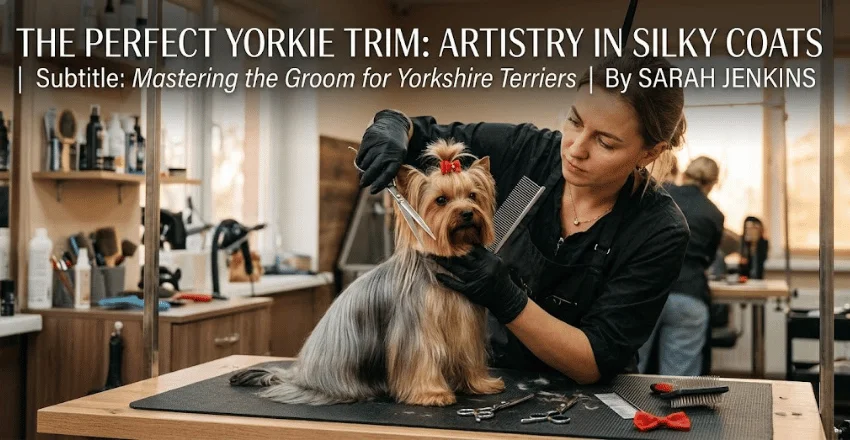
A Yorkshire Terrier carries a single coat. There is no woolly undercoat beneath it, and the hair itself is fine, glossy, and silky, which the AKC breed standard describes as moderately long and perfectly straight. That structure sits closer to human hair than to typical dog fur.
Three consequences follow. This coat barely sheds. It also keeps growing rather than reaching a set length and stopping. And when it tangles, it mats into felt against the skin instead of blowing out in clumps the way a double coat does.
So this breed needs cutting, not only brushing. Every style below is a decision about how much constantly growing hair you are willing to manage. Grooming routines differ sharply between breeds and species, and our other pets guides cover the rest of the household.
Yorkie haircuts at a glance
Brushing times below are working estimates based on how much hair each length leaves. Cottony coats tangle faster than true silk coats, so shift them up if yours mats easily.
| Style | Length left | Brushing per week | Weeks between grooms | Suits |
| Puppy cut | 1 to 2 inches all over | about 15 minutes | 6 to 8 | most pet homes |
| Teddy bear | 2 to 3 inches, rounded head | 25 to 30 minutes | 6 to 8 | owners who want a plush face |
| Schnauzer or Westie trim | 1/2 inch body, long legs and skirt | 20 to 25 minutes | 5 to 6 | fans of the terrier outline |
| Kennel or summer cut | 1/2 inch to 1 inch everywhere | 5 to 10 minutes | 8 to 10 | busy homes, hot states, senior dogs |
| Show or floor length coat | down to the floor | 60 minutes plus, daily | 4 to 6, tidy trims only | show homes |
| Top knot | worn over any cut | 2 minutes a day | with each groom | any dog with hair near the eyes |
Key takeaways
- Silky hair that never stops growing makes cutting a maintenance job, not vanity.
- Shorter cuts buy back brushing minutes. That trade is the whole comparison.
- Most owners land on the puppy cut, which sits in the middle of both columns.
- Never ask for a shave to the skin. Leave an inch.
- Bring a photo and name a number, since “puppy cut” means different lengths to different groomers.
The six yorkie haircuts, style by style

The puppy cut
One broad length, roughly 1 to 2 inches, across the body, legs, and head. Groomers trim the face round and keep it short enough to hold hair clear of the eyes. Owners request it more than any other pet trim, for a plain reason: it looks tidy at four weeks and still looks deliberate at eight.
Brushing stays near a quarter of an hour a week, split into two or three short sessions.
The teddy bear cut
Think of this as a longer, softer variation of the same idea. Body length runs 2 to 3 inches, and your groomer scissors the head into a rounded shape with full cheeks. That extra length is what makes the face look plush, and it is also what tangles.
Budget closer to half an hour of brushing a week, with real attention behind the ears and under the front legs.
The schnauzer or Westie trim
Body clipped short, around half an inch, with the leg furnishings and belly skirt left long. Beard and eyebrows stay on the muzzle. You end up with a terrier outline rather than a soft one, which suits owners who like the working look the breed was built on.
Clipping the back is easy. Furnishings are not, so the legs want combing out twice a week.
The kennel or summer cut
This is the shortest sensible option: half an inch to an inch everywhere, face included. Groomers reach for it with dogs who hate brushing and with seniors who find long table sessions hard. It also suits homes in hot states, where a long skirt collects grit and burrs.
Weekly brushing drops to a few minutes. In exchange, you get a generic silhouette and more exposed skin, so shade matters on bright afternoons.
The show or floor-length coat
The AKC breed standard calls for a glossy, fine, silky coat, trimmed only to floor length for ease of movement. Owners part the fall on the head and tie it in one or two bows. Keeping that means daily line brushing, oiling, wrapping, and weekly baths.
Plenty of owners try it for a year and go back to a pet trim. That is not a failure. It is an honest read of the hours.
The top knot
Strictly a hairstyle rather than a cut, and it works over any style above once the head hair passes about two inches. Gather the fall from the outer corners of the eyes, secure it with a soft latex band, then add a bow if you want one.
Three things owners get wrong
Shaving to the skin is the big one. A single-coated dog has no undercoat to lose, so a bare clip leaves thin skin exposed to sun and insects. The AKC advises leaving at least an inch of hair on single-coated breeds, and it notes that shaving has little effect on cooling a dog. Heat leaves through panting, not through a haircut.
Waiting for tangles is the second. A mat pulls on the skin every time the dog moves, and a comb cannot pass through felt without tearing. A severely matted coat removes the choice entirely, because the groomer’s only safe option is to shave beneath the mats and start over. That phone call is why the brushing minutes in the table are the real decision.
Third, the top knot is function first, not decoration. Hair falling over the eyes rubs the surface of the eye and blocks vision. A Yorkie whose fringe is tied back blinks less and walks into less.
Signals that a cut is not working for you:
- your dog scratches the same spot after every groom
- felted patches turn up behind the ears or in the armpits
- the fringe reaches the muzzle between visits
- brushing has quietly become a weekly argument
How to ask for the cut you want
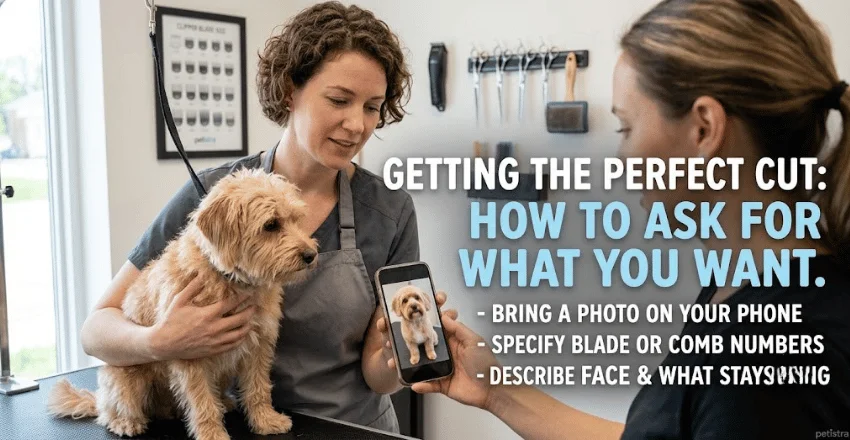
The phrase “puppy cut” has no fixed length. One salon reads it as an inch, another as half that, and the gap between them is six weeks of your life. Remove the ambiguity at the groomer counter.
- Bring a photo on your phone, ideally of this breed rather than a poodle.
- Name a number: the body length in inches, or the blade or guard you want used.
- Say what stays long, whether that is ears, tail, leg furnishings, or the fall on the head.
- Describe the face separately. Round and short, or beard and eyebrows.
- Book the next appointment before you leave, six to eight weeks out for most cuts.
Groomer blade charts map to fairly consistent lengths, so a number travels better than an adjective.
| What you ask for | Blade or comb | Roughly leaves |
| Short pet body clip | #5F | 1/4 inch |
| Standard short trim | #4F | 3/8 inch |
| Half inch body | #3F | 1/2 inch |
| Puppy cut length | 1 inch snap-on comb | 1 inch |
| Pads and sanitary work only | #10 | 1/16 inch |
Keep the #10 off the back. That blade belongs on pads and sanitary areas, where a close finish is the point.
A full groom for a small dog typically costs somewhere between $40 and $100 in the United States, and published price guides put the realistic average near $60. Silky coats sit at the higher end, since they take longer to dry and finish. Prices vary by region, and a city salon quotes more than a rural one. For more everyday pet care reading, the Petistra blog is a good place to browse next.
Pick the cut, then book it
Decide by the brushing minutes you will genuinely spend, not by the cutest photo on the wall. Fifteen minutes a week buys the puppy cut. Five buys the kennel cut. An hour a day buys the show coat. Pick the honest number, book your groomer, and bring the photo with you.
If you want to know about Dog Toothpaste Explained then visit our Pet Care category.
Frequently asked questions
Most pet trims hold their shape for six to eight weeks. AKC grooming guidance suggests a trim every four to six weeks for a consistently neat finish, and longer styles need that shorter interval.
Barely. Its single silky coat drops hair the way human hair does, a few strands at a time, mostly into the brush. That same trait is why it needs cutting.
Clipping short is fine, and half an inch to an inch works well in heat. Going to bare skin is not, because there is no undercoat protecting the skin and the cooling benefit owners expect does not arrive.
Around half an inch a month is a fair working estimate, so an inch of regrowth takes roughly two months. Puppies and adolescents tend to run faster than that.
No. Both leave one broad length, but the teddy bear runs longer and puts a rounded, scissored shape on the head. It costs about twice as much brushing.
Whichever one the groomer can reach safely, which usually means a kennel cut. Once mats sit tight against the skin, a shorter clip is the humane answer and the coat grows back within a few months.