

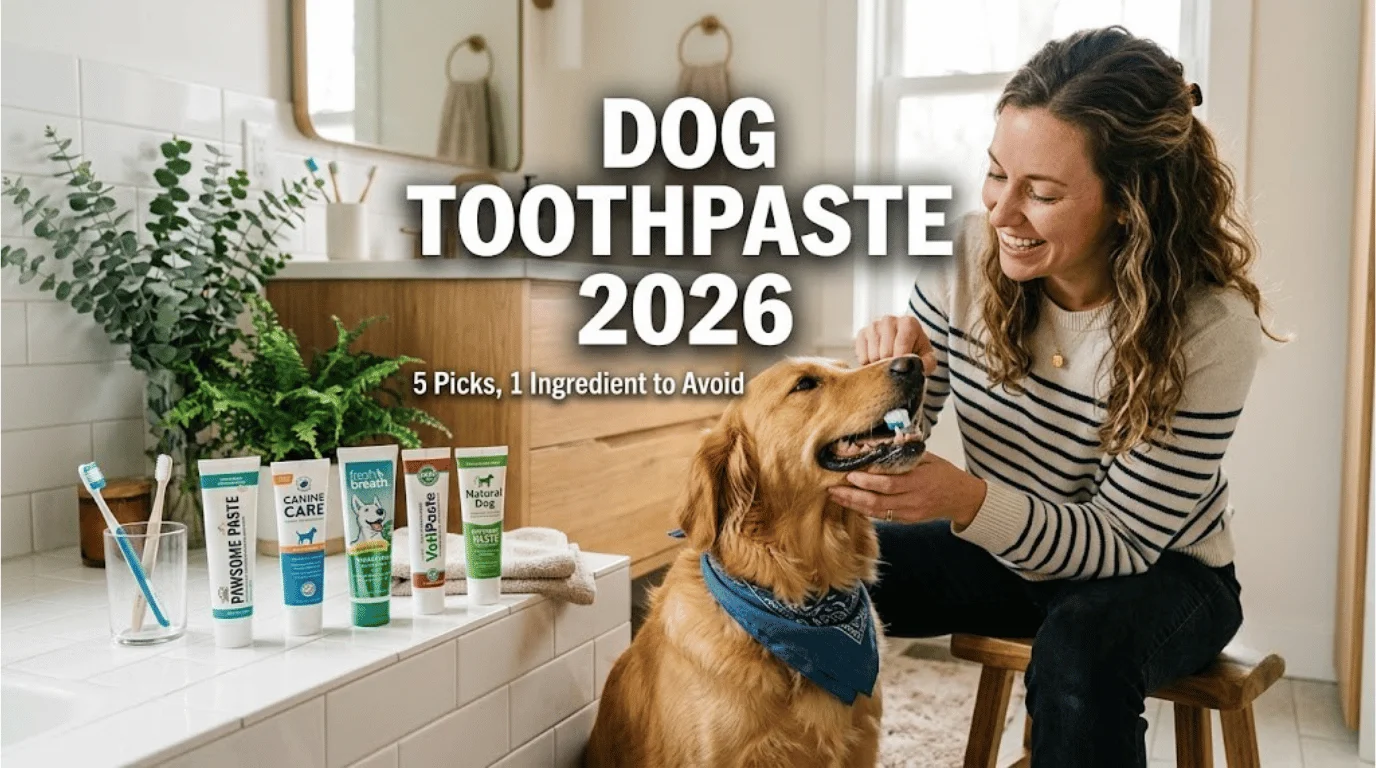
Buy a dog toothpaste, never a human one. That is not brand snobbery. Human paste can contain xylitol, which poisons dogs, and your dog swallows every bit of what you put on the brush. Five real products are compared below on type, flavor, active ingredients, price, and the one seal that carries independent weight. For the full picture, read Thai Iced Tea.
Short answer: pick a paste your dog will let you use every day, and check the label for no xylitol, no fluoride, and no foaming detergent. Only two pastes hold the Veterinary Oral Health Council Seal of Acceptance: Petsmile and Tartar Shield PRO CARE. Everything else competes on flavor and price.
Dog toothpaste at a glance
| Question | Straight answer |
| What does it do? | Carries mild abrasives or zinc and makes the brush taste good enough that your dog tolerates it |
| What can it not do? | Dissolve hardened tartar or replace the mechanical scrub of a brush |
| Ingredients to avoid | Xylitol, added fluoride, sodium lauryl sulfate, heavy baking soda, any “human safe” framing |
| Independent seal | VOHC Seal of Acceptance, held by 2 of the 56 accepted canine products as of November 2025 |
| How often | Daily is the target; three times a week is the realistic floor |
| Typical US price | $7 to $25 per tube, roughly two to four months of daily use |
| When paste is not enough | Brown calculus, red gums or bad breath that will not shift means a veterinary cleaning |
Key takeaways
- Human paste is the real hazard here, and xylitol is the reason.
- Brushing does the work. The paste mostly buys your dog’s cooperation.
- The VOHC seal proves a measured reduction in plaque or tartar. Nothing on a label matches it.
- “Vet recommended” and “vet formulated” are marketing phrases with no independent test behind them.
- Flavor acceptance beats ingredient marketing every time, because a refused tube cleans nothing.
Why is human toothpaste dangerous for dogs?
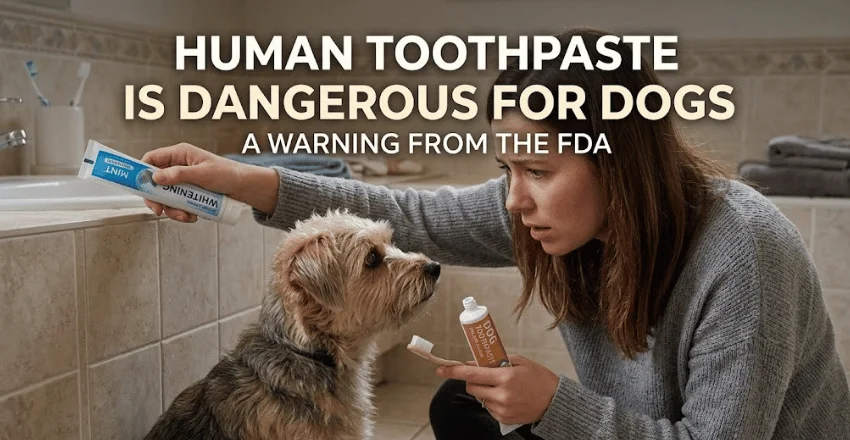
Xylitol is a sugar alcohol used to sweeten sugar-free gum, mints, and a growing number of whitening pastes. In people, it is harmless. In dogs, it triggers a fast, large insulin release, and blood sugar falls off a cliff.
The US Food and Drug Administration is direct about the timing. Its consumer update on xylitol was last updated in December 2025. The FDA reports that a dog’s blood sugar can crash within 10 to 60 minutes of eating xylitol. Serious effects can develop over the next 12 to 24 hours. Vomiting, weakness, staggering, collapse, and seizures are the signs it lists. Larger doses can also injure the liver. Its instruction to owners is one line: only use pet toothpaste for pets.
Xylitol sits alongside other everyday items that are fine for you and dangerous for your dog, much like the toxic dose of garlic by body weight.
Two more reasons apply even to a xylitol-free tube from your bathroom. Fluoride is meant to be spat out, and a dog cannot spit. Detergents such as sodium lauryl sulfate create the foam you expect from your own brushing. All of it lands in a stomach that never asked for it, which brings drooling and loose stools.
What the VOHC seal actually proves
The Veterinary Oral Health Council reviews trial data submitted by manufacturers and awards its Seal of Acceptance to products that hit a preset standard for slowing plaque or tartar. Its accepted-product list is public and updated regularly.
Here is the part no roundup tells you. The November 2025 canine list runs to 56 products. Only two of them are brushing pastes: Petsmile Professional, accepted for plaque in 2011, and Tartar Shield PRO CARE, accepted for tartar in 2025. Chews, water additives, and dental diets fill the rest.
What the seal does not prove matters just as much. It is not a promise that gum disease will be prevented. Nor is it a safety approval or a ranking. A product without it is not automatically weak, since testing is voluntary and expensive. But the seal is the only marker on a shelf that was checked by someone other than the company selling the tube.
Enzymes versus zinc: what really removes plaque
Dental disease is close to universal in dogs. Cornell University’s Riney Canine Health Center reports that 80 to 90% of dogs over the age of 3 carry some component of periodontal disease. Cornell names daily brushing with a veterinary paste as the mainstay of home care.
Read that order carefully. Brushing is the intervention. The paste is the reason your dog sits still for it.
Enzymatic formulas are the most heavily marketed type. Virbac lists the active pair in C.E.T. as glucose oxidase and lactoperoxidase, an enzyme system that produces antibacterial compounds in the mouth. The company also says the paste has no foaming agents, so a dog can swallow it safely. Vet’s Best uses glucose oxidase with aloe, neem oil and a little baking soda.
Non-enzymatic pastes take a different route. Tartar Shield PRO CARE leans on zinc citrate, kaolin clay and aspen bark extract. Petsmile uses a proprietary ingredient it calls Calprox and states a 62% greater plaque reduction than a control paste in its testing.
Baking soda deserves a caution of its own. Small amounts are fine and common. Build a paste mainly on it and the taste turns salty and bitter to a dog. Refusal is the single most expensive failure in home dental care.
5 dog toothpastes compared
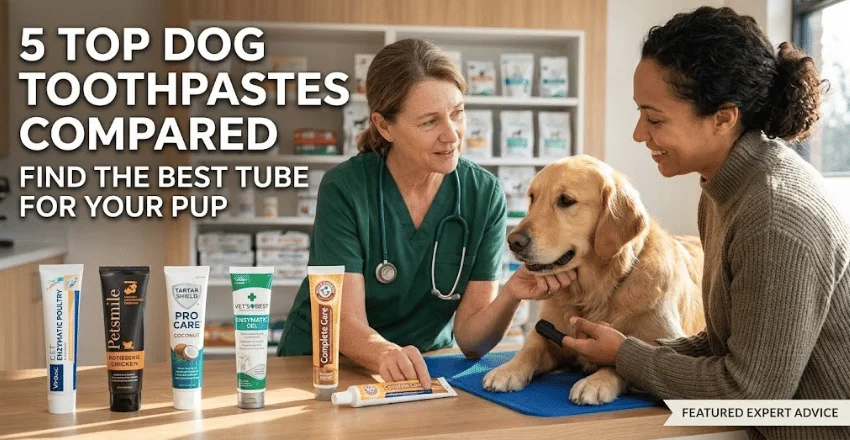
| Product | Type | Flavor | Key actives | VOHC | Price (verified) |
| Virbac C.E.T. Enzymatic | Enzymatic paste | Poultry, malt, vanilla mint, beef, seafood | Glucose oxidase, lactoperoxidase | No | $12.29 / 2.5 oz |
| Petsmile Professional | Non-enzymatic, brush optional | Rotisserie chicken, London broil, cheese | Calprox | Yes, plaque, 2011 | $20.00 / 2.5 oz |
| Tartar Shield PRO CARE | Non-enzymatic paste | Coconut | Zinc citrate, kaolin, aspen bark | Yes, tartar, 2025 | $20.99 / 3 oz |
| Vet’s Best Enzymatic | Enzymatic gel | Mild natural flavor | Glucose oxidase, neem, aloe, baking soda | No | $9.53 / 3.5 oz |
| Arm & Hammer Complete Care | Baking soda paste | Chicken, peanut butter | Sodium bicarbonate, calcium, protease, zinc gluconate | No | $6.99 / 6.2 oz |
Virbac C.E.T. Enzymatic. Most veterinary practices stock this tube, and it carries the widest flavor range here.
- Pro: no foaming agents, five flavors, so a fussy dog usually accepts one of them
- Con: no VOHC seal, and the small tube runs out faster than the price suggests
Petsmile Professional. The only paste accepted by the VOHC for plaque, and the brand says a pea-sized drop works without a brush.
- Pro: independent seal, plus a genuine option for dogs that refuse a brush entirely
- Con: the highest price per ounce here, and the no-brush route skips the scrubbing that does most of the work
Tartar Shield PRO CARE. Newest holder of the seal, awarded in 2025 for tartar control.
- Pro: independent tartar claim, human-grade ingredient list, no enzymes needed
- Con: one flavor only, so a dog that dislikes coconut leaves you stuck
Vet’s Best Enzymatic. Mid-price gel, stocked in most pet aisles.
- Pro: cheap per ounce, mild taste, easy to find in stores and online
- Con: no seal, and the mild flavor is less persuasive than a meat flavor for a reluctant dog
Arm & Hammer Complete Care. A budget pick at 6.2 oz for under seven dollars.
- Pro: fluoride-free, huge tube, chicken and peanut butter flavors dogs take readily
- Con: no seal, and baking soda leads a formula that divides dogs sharply
Which one to buy for your dog
Your choice depends on where your dog sits today, not on which formula reads best.
- New to brushing: Virbac C.E.T. in poultry. Flavor acceptance is the whole battle in week one, and this one wins it most often.
- Refuses the brush: Petsmile applied with a finger. Accept that you are getting partial coverage, and keep working toward a brush.
- Small breed with crowded teeth: Tartar Shield PRO CARE with a small soft brush. Crowding means calculus forms fast, so the tartar claim earns its price.
- Big dog, tight budget: Arm & Hammer Complete Care. A 6.2 oz tube at $6.99 removes the excuse to skip nights.
- Already has brown tartar: no paste at all. Book a veterinary cleaning under anesthesia first, then start brushing on clean teeth.
That last case is the one page-one roundups keep quiet about. Calculus is mineralized and bonded to enamel. Scraping it off is a clinical procedure, and no tube on any shelf softens it. More practical guidance for owners sits on Petistra’s pet care hub.
How to brush so the paste earns its keep

Technique is worth more than the brand on the tube.
- Let your dog lick the paste off your finger for three or four days. No brush yet.
- Rub a finger along the outer gum line for a few seconds, then stop and reward.
- Swap in a soft brush at a 45-degree angle to the gum line.
- Work the outer surfaces only, about 30 seconds per side. Dogs handle the inner surfaces reasonably well themselves.
- Finish before your dog decides to leave, not after.
Aim for daily. Three sessions a week still slows plaque, though the mineral clock never stops between them. Plaque hardens into calculus in roughly two to three days, which is why a Sunday-only routine achieves so little. You’ll find more owner guides on the Petistra blog.
The next step
Pick the flavor your dog will accept and buy a soft brush with it. Start tonight with your finger. Then look inside your dog’s mouth. If you see brown deposits at the gum line, book a veterinary dental exam before you buy anything at all.
If you want to know about Litter Box Enclosure Guide 2026 then visit our Pet Care category.
FAQ
Yes, that is the design. Pet formulas skip fluoride and foaming detergents precisely because dogs swallow instead of rinsing. Check the label anyway, since a few novelty brands add sweeteners.
Verified US prices run from $6.99 for a 6.2 oz Arm & Hammer tube to $20.99 for 3 oz of Tartar Shield PRO CARE. If you brush a medium dog nightly, you’ll get two to four months from a mid-size tube.
Read the ingredient panel immediately. If xylitol appears, call your vet or an animal poison line now, before symptoms start. A fluoride-only paste in a small lick usually causes nothing worse than drooling or a loose stool.
Coconut oil tastes pleasant and does nothing measurable to plaque. Baking soda in quantity tastes salty and is a poor idea for any dog on a sodium-restricted diet. Neither has been through the testing behind the VOHC seal.
Not reliably. Enzymes add antibacterial action, but the brush removes the biofilm. A plain paste used nightly beats a premium enzymatic tube used twice a month.