

Can dogs eat spinach? Yes, and the oxalate warning you have read on every other page is real chemistry attached to a portion nobody feeds. What almost none of those pages give you is a number. Here is that number, and the arithmetic that follows from it.
The short answer, in milligrams
A cup of raw spinach carries roughly 235 mg of oxalate. The half teaspoon a 30-pound dog usually gets carries under 3 mg. For healthy kidneys, that is nothing. So can dogs eat spinach? Yes, at those portions. A dog that already forms calcium oxalate stones is the exception, and for that dog the answer is no.
Preparation, oxalate retained, verdict
How you cook the leaf moves the number further than how much you serve. Below is the table no pet page prints.
| How you prepare it | Soluble oxalate left | Verdict |
| Raw, chopped fine | Effectively all of it | Fine at a teaspoon for a healthy animal. Skip it for a stone former. |
| Steamed, then served | 47% to 95% | The advice every pet site gives. It barely moves the number. |
| Boiled 5 minutes, water poured away | 13% to 70% | The only method that cuts oxalate meaningfully. Best choice if you are worried. |
| Boiled, cooking water served over the food | Effectively all of it | Self-defeating. The oxalate is sitting in that water. |
| Frozen chopped leaf, thawed | Probably below raw | Blanched at the plant, so some soluble oxalate is already gone. Unmeasured, so treat it as a guess. |
| Canned, creamed, or spinach dip | All of it, plus salt | Never. Sodium, dairy, onion and garlic outrank the oxalate as problems. |
Key takeaways
- Can dogs eat spinach? Yes, at a teaspoon. No for a dog that forms calcium oxalate stones.
- Fresh leaves run about 785 mg of oxalate per 3.5 ounces, so a cup holds roughly 235 mg and a teaspoon holds about 5 mg.
- Boiling and throwing the water away strips far more soluble oxalate than steaming does.
- Miniature Schnauzers, Bichons Frises and other stone-prone breeds should have none.
- Iron and calcium, the two nutrients spinach is credited with, are the two oxalate blocks.
Can Dogs Eat Spinach? Where 785 mg comes from
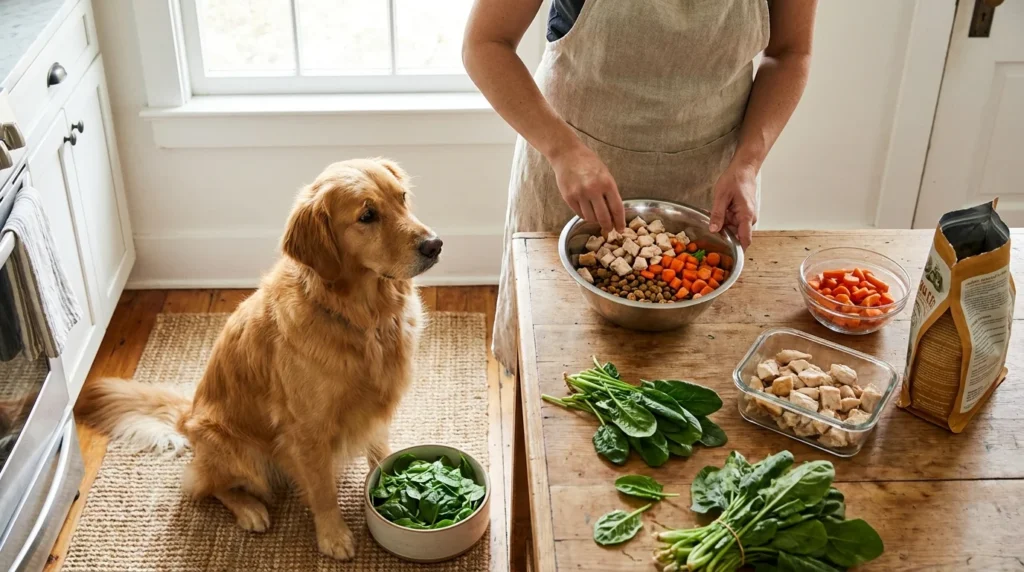
Spinach is a champion oxalate accumulator, and plant scientists have measured how much. A 2021 study in the International Journal of Molecular Sciences reported 785.5 mg of oxalate in every 3.5 ounces of fresh leaf from Bloomsdale, an ordinary garden cultivar. Its high-accumulating comparison line reached 1,312.9 mg. Call it 220 mg per ounce.
Not all of that behaves the same way in the gut. Roughly half the oxalate in raw spinach is soluble, which means it dissolves and crosses the gut wall. The rest is already locked to calcium as insoluble crystals, and most of that passes straight through. That split is what decides absorption, and only the soluble half matters here.
Convert the figure to kitchen units, and it stops sounding frightening. One cup of raw spinach weighs about an ounce, so a cup holds close to 235 mg. Chop a tablespoon, and you have roughly 15 mg. Down to a teaspoon, you have about 5 mg.
Doing the math for a 30-pound Beagle
Start with the portion veterinary sites recommend. For a 30-pound dog, that is half a teaspoon of chopped leaf, which works out at under 3 mg of oxalate. A generous full teaspoon lands near 5 mg.
Now find the ceiling. That Beagle burns roughly 750 calories a day, and the standard rule caps treats at 10% of the total, so 75 calories. Raw spinach runs about 7 calories a cup. Filling her whole treat allowance with spinach alone would take about 11 cups.
Eleven cups carries around 2,500 mg of oxalate. It is also an absurd volume of salad for a Beagle, and about 500 times the teaspoon anyone recommends. That gap, between the dose that might matter and the dose people give, is what a vague “feed in moderation” leaves out. More portion arithmetic like this sits in our dog food and feeding guides.
One caveat, stated plainly. No controlled trial has established the amount of dietary oxalate that harms a healthy dog. Stone risk builds from urinary oxalate over months, never from a single serving. So the arithmetic above sizes the exposure. It does not name a poisoning threshold, because none exists.
The dogs that should have none
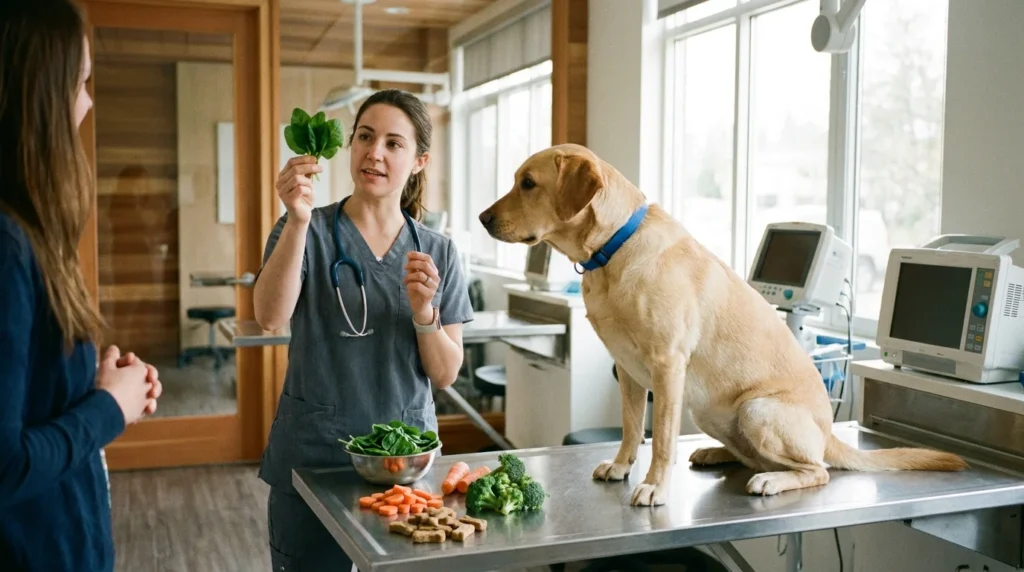
For one group, the moderation advice is simply wrong, and the honest answer is zero. If your dog has passed a calcium oxalate stone, has one now, or eats a prescription urinary diet, the leaf is off the menu. Diagnosed kidney disease and high blood calcium put an animal in the same group.
Breed matters more than most pet pages admit. Researchers at the University of Minnesota College of Veterinary Medicine have published the numbers. Miniature Schnauzers and Bichons Frises carry more than 20 times the risk of calcium oxalate stones compared with mixed breed dogs. Several other small breeds turn up repeatedly in the same lab’s caseload.
- Shih Tzu and Lhasa Apso
- Miniature and toy Poodles
- Yorkshire Terrier, Cairn Terrier and Jack Russell Terrier
- Pomeranian and Dachshund
Owning one of those breeds does not ban the vegetable outright. It shifts the calculation, and it makes the question one to raise with your vet before you start. Stone disease also clusters in middle-aged small breeds, so a nine-year-old Schnauzer deserves more caution than a young Labrador. Symptom guides for urinary trouble live in our animal health section.
Why steaming is the popular answer and the wrong one
Every page on the first results screen recommends steaming. Published chemistry points at boiling.
Weiwen Chai and Michael Liebman, writing in the Journal of Agricultural and Food Chemistry in 2005, tested nine vegetables and found that boiling cut soluble oxalate by 30% to 87%. Steaming reduced soluble oxalate by only 5% to 53%. They also traced where the oxalate went, recovering close to 100% of it in the cooking water. Their full study record sits on PubMed.
That last detail is the one no pet page mentions. Boiling only helps if the cooking water is discarded, so pour it down the sink rather than over the kibble. Steam the leaf instead, and you strip a sliver. Boil it and drain it and you remove a large share of the soluble fraction.
Boiling does strip some vitamin C and folate, which is why the pet sites warn against it. Your dog synthesizes her own vitamin C. That loss is free.
What spinach actually delivers
Pet pages credit the leaf with iron and calcium. Oxalate binds both. Those two minerals are the ones it delivers worst, because the compound everyone warns you about is also the one locking them up in the gut.
What survives is the set of vitamins oxalate ignores.
- Vitamin K1, at 483 mcg per 3.5 ounces, which puts it among the richest food sources anywhere
- Folate, beta carotene, and lutein
- A little fiber, around 2% of the leaf by weight
Then scale it to the portion. One teaspoon of chopped raw leaf supplies 0.02 mg of iron, 0.6 mg of calcium, and roughly 3 mcg of vitamin K. Any complete food already meets those requirements several times over. So the honest case is that spinach is a green, low-calorie treat your dog may enjoy, rather than a supplement. Everyday feeding questions like this one belong with our day-to-day pet care articles.
Feeding it without making things worse
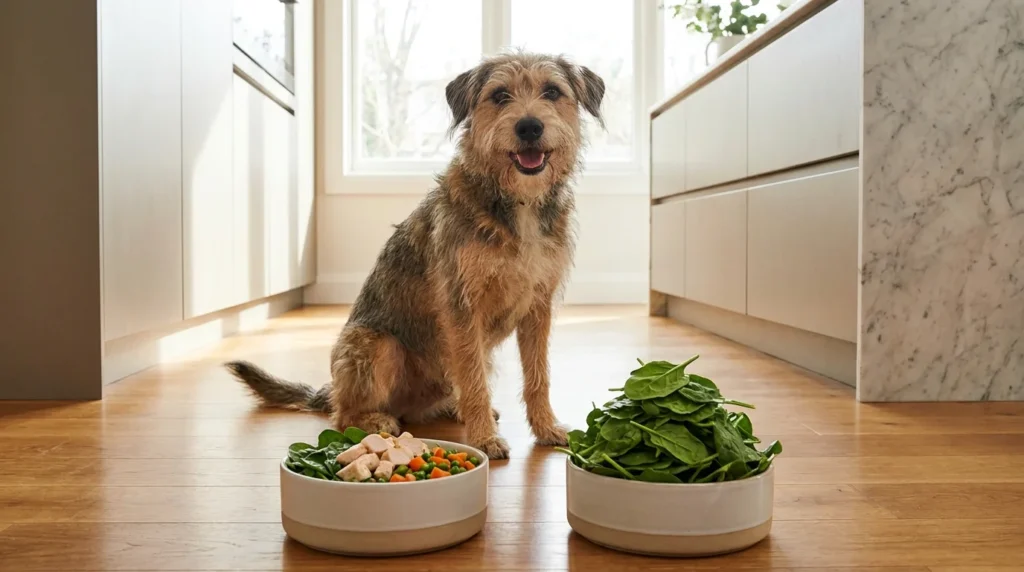
- Weigh your dog, then pick the portion: a quarter teaspoon under 20 lbs, half a teaspoon to 30 lbs, one teaspoon to 50 lbs, half a tablespoon above that.
- Rinse the leaves and chop them fine, because whole leaves pass through undigested.
- Boil for five minutes, then drain and discard the water.
- Serve it plain: no butter, no salt, no oil, and never onion or garlic.
- Offer it twice a week at most, not daily.
Begin at a quarter of that portion and watch for loose stool over the next day. If your dog forms stones, carries a kidney diagnosis, or belongs to one of the breeds above, ask your vet first and hold off until you have an answer.
Spinach FAQ
No. Twice a week is plenty. A daily green adds up in a way a weekly treat does not, and no nutritional argument makes it routine. Green beans and cucumber carry far less oxalate if you want something daily.
Boiled and drained, if oxalate is your concern. Raw suits a healthy animal in tiny amounts, though it digests poorly and keeps its full soluble load. Steaming is the popular answer and the weakest one.
Not at teaspoon portions in a healthy animal. Stone formation tracks genetics, urine concentration and pH far more closely than any one vegetable. In an animal already prone to stones, a repeated oxalate load is a genuinely bad idea, which is why vets tell those owners to avoid it.
Plain frozen leaf is fine, and blanching at the plant probably removes some oxalates before the bag is sealed. Nobody has measured retail bags, so treat that as reasoning rather than a figure. Canned and creamed versions are out on sodium alone.
Call your vet, then breathe. A 5-ounce bag carries roughly 1,100 mg of oxalate. In a healthy adult, the usual result is gas and a soft stool by morning. For a stone former, or an animal with kidney disease, make that call the same day.