
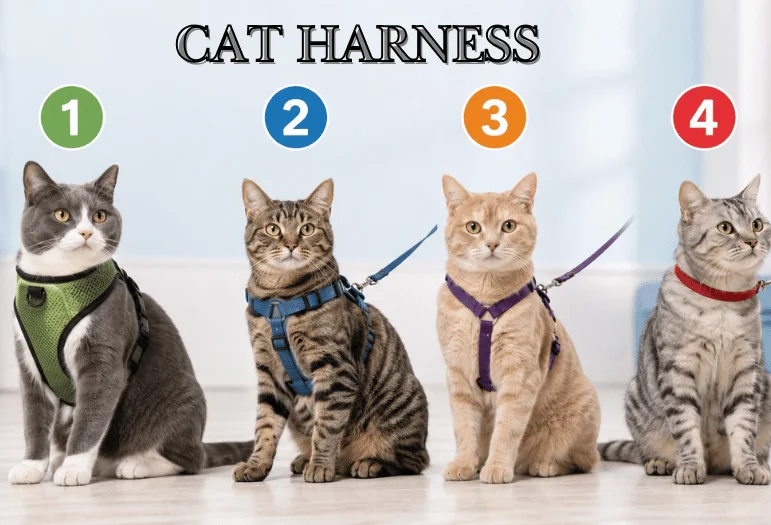
Buying a cat harness comes down to one question: can your cat reverse out of it on a bad day? Feline shoulders rotate far more freely than a dog’s, so a scared cat drops its weight, pulls backward, and slips the whole rig in seconds. That happens outdoors, which is how a pleasant plan turns into a lost pet.
Short answer: vest and jacket designs are the hardest to back out of because they spread pressure across the chest and shoulders instead of two thin straps. Mesh step-ins sit close behind. H-style straps escape most often, and figure-8 designs tighten on the neck under pull, so they suit cats least of all.
Cat harness styles at a glance
Rank these designs by the failure that matters. Color, weight, and reflective trim sit below comfort, and comfort sits below whether the thing holds when your cat panics.
| Style | Escape resistance | Adjustability | Ease of putting on | Best for |
| Vest or jacket | Highest | Moderate, 2 to 4 points | Slowest, needs a settled cat | Escape artists and nervous cats |
| Mesh step-in | High | Good, 4 sliders plus buckles | Easy once trained | Kittens and slim, small cats |
| H-style (figure-H) | Low | Excellent, and the lightest | Fast | Calm, deep-chested cats |
| Figure-8 | Lowest | Limited | Fast | Brief supervised handling only |
Key takeaways
- Nothing on sale today is truly escape-proof on a determined, panicking cat.
- Most escapes are fit failures rather than design failures.
- Two fingers should slide under the neck and chest straps. Three means trouble.
- Acclimation runs in weeks. Plan on three to six weeks before a first outdoor walk.
- Never clip the leash to a fence, post, or table leg and walk away.
Why cats back out, and what stops them
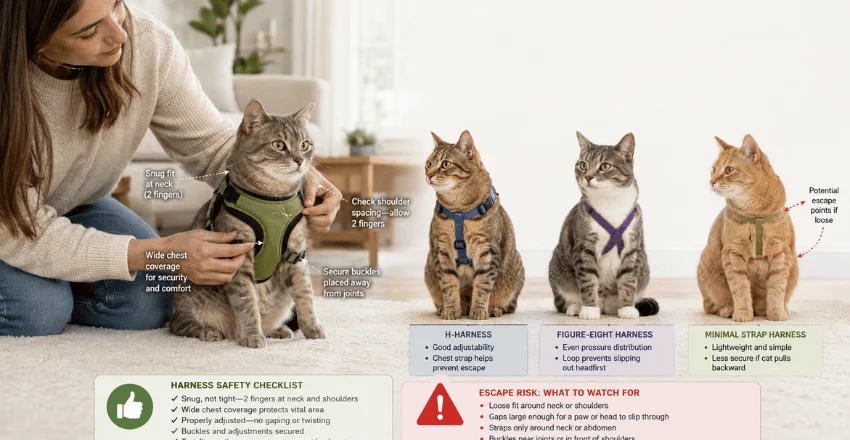
A dog’s shoulder blade sits against a broad, muscled chest. A cat’s forelegs float, and the whole front end tapers, so the skull is often no wider than the ribcage behind it. Pull a cat backward, and those shoulders fold inward. A harness relying on one narrow chest strap then slides forward over the head and off.
That mechanism sits behind nearly every escape story you will read. Surface area is the fix. Vests spread the load across inches of fabric instead of a strap that can travel. Strap designs hold too, but only inside a tight band of correct tension.
Fit is the bigger variable. The owner sizes it up so it “isn’t too tight”; the cat backs out on walk three, and the design takes the blame. Sizing deserves real care here. Our cat care and behavior articles cover the training half that equipment alone cannot fix.
The four styles compared
Vest or jacket: hardest to escape
A panel of fabric wraps the chest and shoulders, then fastens along the back or the belly. The Kitty Holster is the classic example, a cotton harness with hook-and-loop closures at the neck and abdomen.
- Pros: widest pressure spread, no thin strap to slip, calming for many cats
- Cons: warmer in summer, slower to put on, fewer adjustment points
Mesh step-in: a close second
Your cat steps in with the front legs and then buckles close over the back. Air mesh keeps things cool, and four sliders set neck and chest separately.
- Pros: light, breathable, genuinely adjustable, cheap enough to replace
- Cons: thin mesh frays, and one sloppy neck setting undoes the whole design
H-style: light, adjustable, easiest to lose a cat in
Two loops, one at the neck and one behind the front legs, sit joined by a strap along the spine. It weighs almost nothing and adjusts at four points, which is why plenty of cats tolerate it. It is also the shape cats back out of most.
- Pros: minimal contact, quick to fit, works on cats that hate fabric
- Cons: two narrow straps and a lot of open gap, unforgiving of loose sizing
Figure 8: Skip it for walking
One continuous loop crosses between the shoulder blades, so pulling tightens the neck opening. On a cat that lunges, that puts pressure on the throat instead of the chest. Retailers still recommend these, usually without that warning.
- Pros: cheap, packs flat, fine for a brief supervised lift indoors
- Cons: tightens under pull, barely adjustable, poor escape record
Getting the fit right: the two-finger check
Measure first. Wrap a soft tape around the chest right behind the front legs, note the neck too, and buy into the chest number rather than your cat’s weight. Two cats, each at 10 lbs, can be measured two inches apart. Then use the two-finger rule. You should slide two fingers flat under the neck strap and two under the chest strap, snug against the coat, and no further.
Three fingers means your cat has room to twist and reverse. One honest complication: the makers disagree with each other. Kitty Holster tells owners the vest should fit “like a glove,” with not even one finger’s width of slack for cats that have escaped before. Supakit advises sizing down when a cat falls between two sizes. Follow the chart for the harness you bought, then verify with your fingers.
Test indoors first. Hold the leash, let your cat walk away, and apply gentle backward pressure for a second. If the neck opening travels toward the ears, tighten it and try again.
Named picks and what the makers list
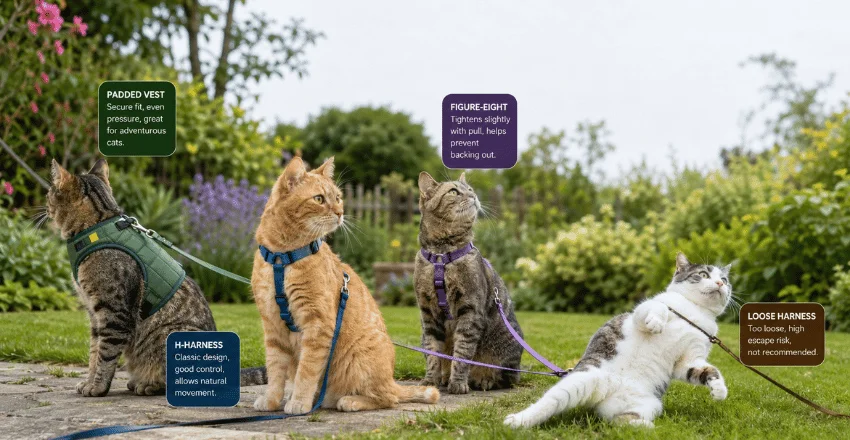
Each model below is current, with sizing published on the maker’s own site. Listed prices are the makers’ US figures in August 2026 and move with sales.
| Product | Style | Maker’s listed chest ranges | Listed price |
| Kitty Holster | Cotton vest, hook-and-loop | XS 10-14 in, S/M 13-17 in, M/L 16-20 in, XL 19-23 in | Varies by retailer |
| Sleepypod Martingale | Mesh vest with a martingale cinch | S, M, and L chart on the maker’s site | $49.99 |
| rabbitgoo Classic | Y-shape air mesh, 4 sliders | XXS 11.2-13 in chest, neck 6.5-8.8 in, up to M | $21.98 |
| PetSafe Come With Me, Kitty! | Strap design with a belly strap | S 9-11 in, M 10.5-14 in, L 13-18 in girth | $16.95 |
| Supakit | Leather or cork, cut snug | S 10-12.5 in, M 11.5-15 in, L 14.5-18 in | Varies by retailer |
Read the claims carefully. Sleepypod says its cinch stops “even the cleverest cats from backing out,” and Rabbitgoo says “once they’re in, they’re safe. Those are marketing lines, not published test results.
Acclimation takes weeks, not minutes
This step decides whether the purchase works at all, and most roundups hand it a quick five-line list with no timeline given. Rushing it is how owners end up with an expensive vest in a drawer.
- Leave the harness on the floor by the food bowl for several days. Let your cat sniff it, sit on it, or ignore it.
- Drape it over your cat’s back for ten seconds, then feed a treat. Repeat daily.
- Fasten it for two or three minutes indoors, always paired with food or play. Build up to twenty minutes of wearing it over a week or two.
- Clip the leash on indoors, let it drag under supervision, then hold it loosely and follow your cat.
- Move to a quiet, enclosed outdoor space with no dogs and no road noise. Ten minutes is a full first outing.
Three to six weeks is normal. Some cats need longer, and some never accept the gear at all.
Watch the body language, because it tells you before your cat does. Freezing, flattening to the floor, belly-crawling, a low tail, or flicking ears are all signs your cat is not ready. Back up a step, shorten the sessions, and add food. Pushing past those signals is what creates a cat that bolts on the first walk outside.
Outdoor safety that gets skipped
Going outside changes your cat’s health risks, and there is hard evidence behind that. A 2019 meta-analysis in Biology Letters covered 19 pathogens. It found cats with outdoor access were 2.77 times more likely to be infected with parasites than indoor-only cats. So the vet appointment should come before the first walk, not after.
The US Centers for Disease Control and Prevention tells owners to ask a veterinarian about preventive treatment for fleas, heartworms, ticks, and worms. It also says to keep cats current on rabies and feline distemper vaccination. Cats are sensitive to many chemicals, so never apply a tick product without veterinary advice.
Three more rules that owners break:
- Never tether your cat to a post, fence, or table leg and step away. A tangled cat can choke, and one left alone outside is a target for loose dogs.
- Press your palm to the sidewalk on hot days. If you cannot hold it there for five seconds, it will burn paw pads.
- Stay away from busy roads. Engine noise, not the cars themselves, is what triggers the backward bolt.
Update your microchip details before you go out, and fit an ID tag too. For the routine prevention side, the wider pet care articles on Petistra go into more depth.
The verdict, by case
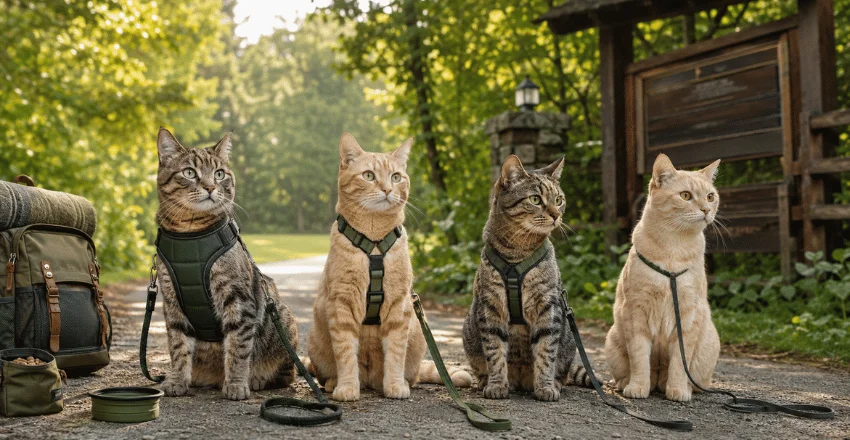
There is no single best buy here. The right pick depends on your cat, not on a star rating.
- Cat has escaped before: a vest or jacket, sized snug, with a martingale cinch if your budget stretches to the Sleepypod.
- First-time buyer, average adult cat: an adjustable mesh step-in like the Rabbitgoo Classic, cheap enough to replace once you learn your cat’s shape.
- Kitten or slim cat under 10 lbs: the smallest mesh size you can find, re-measured monthly while it grows.
- Cat that hates fabric: the PetSafe Come With Me Kitty, accepted only if you commit to the two-finger check every single time.
- Anyone eyeing a figure 8: don’t, at least not for walking.
Where to start tonight
Measure your cat’s chest, write the number down, and shop to it rather than to a weight class. Give the training four weeks before the front door opens. Measure, train, then walk: that order separates the cats who enjoy this from the ones who bolt.
FAQs
Tighten two fingers at the neck and the chest, then test indoors with gentle backward pressure. If your cat still slips it, move to a vest with more surface area.
No. That phrase is marketing. A well-fitted vest makes escape unlikely, though a terrified cat can defeat anything, which is why you never let go of the leash.
Two flat fingers under each, no more. Check again after five minutes, since coats compress and buckles creep loose.
Three to six weeks of indoor practice suits most cats. Judge by behavior, not by the calendar.
No. Tethering an unattended cat risks strangulation and leaves them defenseless if a dog arrives.
The middle size in most ranges: Kitty Holster S/M, PetSafe large, and Supakit medium. Check the chart for the model in your basket.