

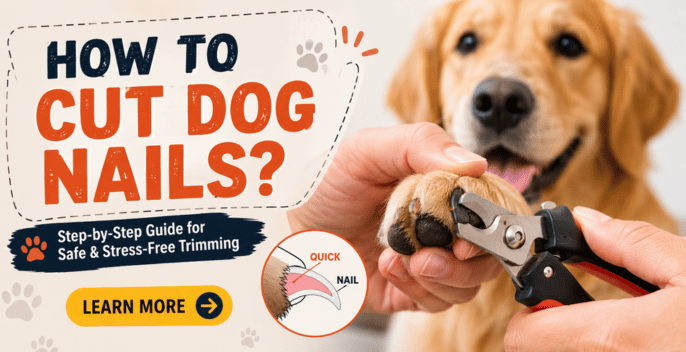
Almost nobody gives up on trimming because the clippers are hard to hold. They give up because they cannot tell where to stop. How to Cut Dog Nails? It all comes down to knowing where the quick ends. That one question is what this guide is built around, helping you trim your dog’s nails with confidence while avoiding painful cuts and unnecessary bleeding. tell if a kitten is a boy or a girl is a useful companion read here.
The short version: learning how to cut dog nails comes down to reading the nail as you go. Hold the paw, look at the nail from the side, and remove only the hooked tip. Cut in two or three small slices instead of one. Check the cut face after each pass and stop when a small dark circle appears in the center. You might also like How to Hold a Cat Safely.
Nail trimming at a glance
| Question about How to Cut Dog Nails? | Answer |
| How often | Every 2 to 4 weeks, or every 1 to 2 weeks on overgrown nails |
| How much to remove | The hooked tip only, the part that curves down past the pad line |
| Stop signal, light nails | Pink comes within about a nail’s thickness of your cut |
| Stop signal, dark nails | The cut face changes from chalky gray to a small dark moist circle |
| Time needed | 5 to 10 minutes for all four paws |
| If you hit the quick | Styptic powder or cornstarch, then firm pressure for about 2 minutes |
| Tools | Clippers sized to your dog, or a rotary grinder |
Key takeaways
- The quick carries blood and nerves, so it is the only thing you have to avoid.
- A chalky gray cut face means keep going. A dark circle means stopping.
- Badly overgrown nails cannot be fixed in one sitting, and pushing it will hurt your dog.
- Keep styptic powder within arm’s reach before the first nail, not after the accident.
How to Cut Dog Nails? Where the Quick Sits, and Why It Decides Everything
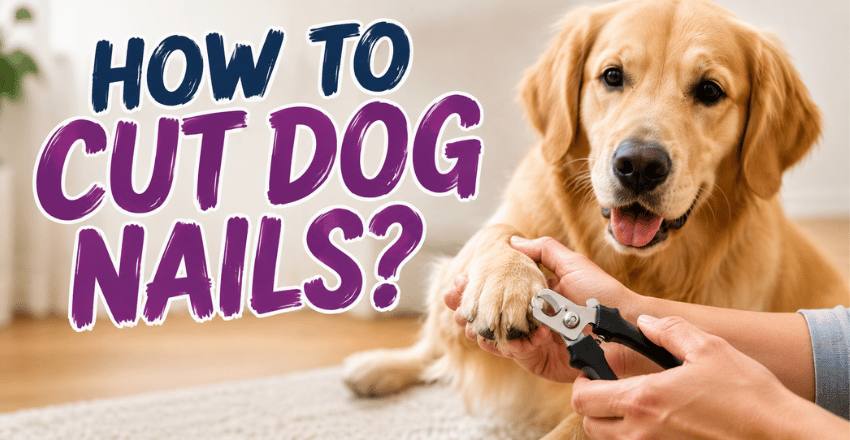
Inside every claw is the quick, soft tissue containing blood vessels and nerves. How to Cut Dog Nails? Know where the quick ends before trimming. Cutting into it causes bleeding and pain, making many owners afraid to trim again.
On a pale or clear nail, you can see it. Hold the paw up to a window, and the quick appears as a pink wedge, stopping short of the tip. The hollow part past that pink is what you remove, and it has no feeling.
Black nails hide it completely, which is why dogs with dark claws often go untrimmed for years while their owners are told to be careful. You are not meant to see the quick through a black nail. You find it by cutting, then looking at the exposed surface.
Our dog care and wellness guides cover the rest of the grooming routine, though nail length is the job owners skip most. Dewclaws deserve a mention. They sit higher on the inside of the leg, never touch the ground, and never wear down. They curl into the skin more often than any other nail.
What you’ll need?
Set everything out first. Hunting for the styptic powder halfway through a paw is how a small nick turns into a memorable event your dog carries into the next trim.
- Clippers sized to your dog. Scissor or plier style for medium and large dogs, small scissor style for toy breeds.
- Styptic powder. A small jar runs around $8.99 in Chewy and lasts years. It clots a nicked quick in seconds.
- Cornstarch or plain flour as the household backup if you have no powder tonight.
- A bright light. A phone flashlight under a pale nail makes the quick glow.
- Small, high value treats. Something your dog gets at no other time.
- A towel or a non-slip mat so nobody slides on a hard floor.
Skip human nail clippers. They squeeze the nail flat instead of slicing it, and crushed nail splits.
How to cut dog nails, step by step
- Settle your dog and take one paw. Sit on the floor beside them rather than looming over them, and hold the paw without pulling the leg.
- Separate one toe and look at the nail from the side. Press the pad lightly so the nail extends and find where it hooks downward.
- Take the first slice off the tip. Remove the thickness of a matchstick, angled slightly downward to follow the curve of the nail.
- Turn the nail and read the cut face. This step separates a confident trim from a guess, and the next section covers it in detail.
- Take another thin slice or stop. Chalky and dry across the whole face means there is room left. Anything darker or damp in the middle means that nail is done.
- Do the dewclaws. Check the inside of each front leg, plus the back legs on breeds that have them.
- Pay your dog and stop while it is going well. Two good paws today beats four paws and a dog who hides next time.
You do not have to finish every nail in one session. Splitting the job across two evenings is fine, and for a nervous dog it is better.
Reading the cut face: the signal that tells you to stop
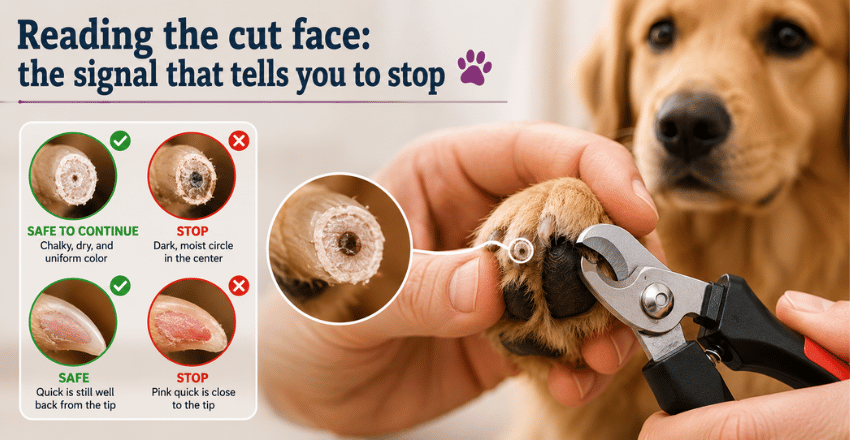
Most guides say to trim a little at a time and leave it there. That is not enough. The useful part is what happens between slices, because the cut end of the nail changes appearance as you get closer to the quick.
Look straight at the flat face you have exposed, not at the nail from the side. On a black nail, the outer shell cuts as a dry, chalky white or gray ring. Keep taking thin slices, and a small circle appears in the center of that ring. It looks darker, slightly moist, sometimes faintly pink or gray, brown.
That circle is the leading edge of the quick under a thin layer of nail. Stop there. One more slice and you are into a blood vessel.
| Nail color | What the cut face shows | What it means |
| White or clear | Solid white across, pink wedge still well back | Safe to take another slice |
| White or clear | Pink within about a nail’s thickness of the tip | Stop |
| Black | Uniform chalky white or gray, dry looking | Safe to take another slice |
| Black | Small dark, moist circle in the center of the chalky ring | Stop immediately |
| Striped or mixed | Pale nails sit at a similar depth | Use them as your guide |
If you cut the quick
It bleeds more than the size of the cut suggests, and it keeps going for a while. Your dog will pull the paw back and may yelp. Stay calm. A panicked owner makes the next trim harder than the injury does.
Press a pinch of styptic powder against the end of the nail and hold firm, steady pressure for about two minutes. Do not dab and peek every few seconds, since lifting off restarts the bleed. No powder in the house? Pack the nail with cornstarch or plain flour and apply the same pressure.
Keep your dog quiet on a clean surface for the next 20 minutes, so the clot is not knocked off. A little seeping afterward is normal.
Call your vet if the bleeding has not stopped after 20 minutes of pressure. Call too if the nail is split rather than cut short, or if the toe swells or stays sore over the following days. Dogs on blood thinners need to call sooner.
Overgrown nails: why one session will not fix them
Here is the expectation nobody sets. When a nail is left to grow long, the quick grows along with it. A nail untrimmed for six months is not a long nail with a normal quick inside. It is a long nail with a long quick inside, and no safe cut shortens it today.
Overgrown claws are a clinical problem, not a cosmetic one. A 2025 study in the Journal of Small Animal Practice reviewed 3,380 nail clipping events at UK veterinary practices. Overgrown or ingrown nails were the recorded reason in 12.66% of them.
The fix is patience. Take a small amount off every one to two weeks, stopping at the first sign of the quick. The quick then recedes toward the toe, letting you take a fraction more next time. Six to eight weeks of these returns most overgrown nails to a sensible length.
Nails that have curled into the pads are a vet visit, not a home job. Those toes are usually infected and sore.
How often should you trim?
Forget the calendar and use two tests instead. First, listen. Stand your dog on tile, laminate, or hardwood and listen as they walk away from you across the room. Clicking means the nails are hitting the floor and they are due.
Second, look. With your dog standing square on a flat surface, no nail should touch the ground. If a sheet of paper slides under each nail, the length is right.
Most dogs land between two and four weeks. Dogs who walk daily on sidewalks wear their nails down and go longer, while lap dogs and older dogs on soft ground need trimming more often. The Petistra pet care blog carries more routine care advice, and nail length is worth checking every time you brush.
If your dog fights having their paws held

Paw handling is the real obstacle for a lot of dogs, and no clipper technique gets round it. Fix that first. A dog quickened once remembered it for months. Work in short sessions spread over several days rather than one long wrestling match. A rough shape that suits most dogs:
- Days 1 to 2. Touch a paw, feed a treat, let go. Ten seconds, five times a day.
- Days 3 to 4. Hold the paw longer and separate the toes. Treat, release.
- Days 5 to 6. Bring the clippers out and touch them to a nail without cutting.
- Day 7. Cut one nail. Then stop whatever else you had planned.
End every session before your dog gets uncomfortable. Peanut butter on a licking mat buys a surprising amount of cooperation. Some dogs need a groomer or a vet tech, and choosing that is not a failure.
Your next step
Put the clippers, the treats, and a jar of styptic powder in one spot tonight. Then cut a single nail on the front paw and read the face of that cut. One nail. It tells you where the quick sits on your own dog, and the rest of the paw follows from there.
Frequently Asked Questions
Yes, for most healthy dogs. The risk is a nicked quick, which bleeds and stings but is not dangerous once styptic powder is applied. Dogs with clotting problems, or a history of biting during handling, should see a professional.
Stop before the quick, not at it. On black nails, that means stopping at the first dark circle in the cut face, which leaves a sliver of dead nail as your margin.
Yes. A grinder removes less per pass, so it is more forgiving on dark nails. Introduce the noise gradually and keep the tool moving so heat does not build.
Reapply pressure with styptic powder or cornstarch for two minutes. Bleeding that restarts repeatedly, or a nail to split down its length, needs a vet.