

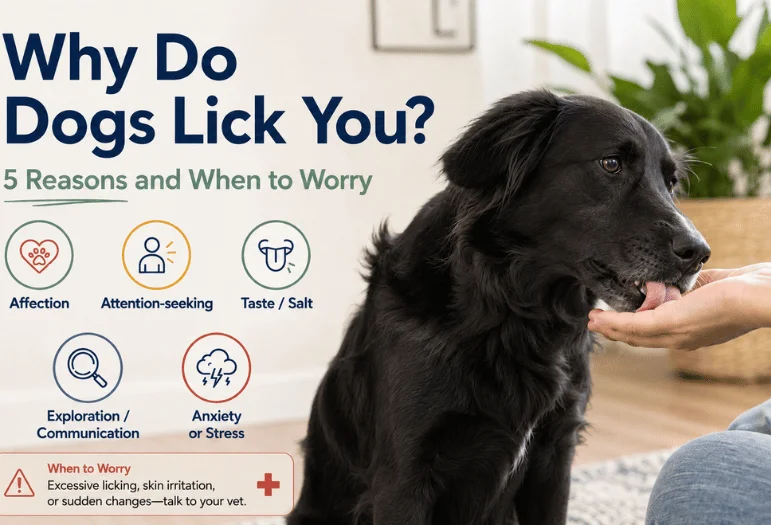
Why do dogs lick you, and nearly every answer says “affection” and then moves on? That answer is incomplete. Licking is several different behaviors wearing the same face, and one of them is a reason to book a vet appointment rather than take a photo. For a closer look at this, see Why Do Dogs Roll in the Grass.
Short answer: Dogs lick people for four everyday reasons. Inherited social grooming, appeasement toward someone they want to keep calm, and the salt and food residue on human skin. The fourth is learned attention, because a lick reliably makes you look up and talk. Sudden, constant licking is a fifth case, and it needs a vet.
What your dog’s licking probably means
| Why Do Dogs Lick You? What you notice | Most likely cause | What to do |
| Fast licks at your face or chin the second you walk in | Greeting and appeasement, inherited from puppy behavior | Greet calmly, turn your face away, reward four paws on the floor |
| Hard, focused licking of forearms and calves after a run | Salt and sweat | Rinse off or change your shirt; nothing else needed |
| Licking that begins when you sit down and stops when you stand | Learned attention | Withdraw attention and reward a settled alternative |
| Slow licking of your hand while you stroke a loose, sleepy dog | Social bonding | Leave it alone; this one is genuinely affectionate |
| Constant licking of floors, carpet, walls or furniture | Possible gastrointestinal problem | Vet workup, not a training plan |
| Licking one patch of their own leg or paw raw | Itch, allergy, joint pain or anxiety | Vet first, behaviorist second |
Key takeaways
- Licking is at least four behaviors, and they look identical from a foot away.
- Face licking is often a calming signal, not a kiss, especially toward strangers.
- Dog saliva carries oral bacteria, so open wounds, infants, and immunocompromised people are a real exception.
- Licking that will not stop, and that spreads to floors and furniture, is a medical sign.
- You reduce licking by ignoring it and paying for something else, never by scolding.
Why do dogs lick you? The four everyday causes
1. Social grooming they never stopped doing
Newborn puppies are licked constantly by their mother, who cleans them and stimulates them to eliminate. The puppies return the favor upward. Around weaning, they lick at her muzzle, a behavior that in wild canids prompts an adult to bring up a meal for them.
That mouth-to-face habit does not switch off at eight weeks. Adult dogs groom each other around the ears and eyes, and they do the same to us with whatever is available, usually hands and faces. If you want the background on that early feeding stage, our guide to whether dogs and puppies can have milk covers the nursing period in detail.
2. Appeasement, which people read as adoration
Here is the part page one skips. In dog-to-dog communication, a low approach with a lifted, licking muzzle is an appeasement signal. It says, “I am no trouble.” Puppies do it to adults, and adults do it to dogs and people they want to keep relaxed.
So a dog who mobs a visitor’s hands at the door may not be in love with them at all. They may be defusing a situation they find slightly too much. That distinction matters, because the standard advice, encourage it and enjoy it,” is wrong for a dog who is already uneasy.
3. You taste interesting
Human skin is a salty, greasy, food-scented surface, and dogs investigate the world with their mouths. Sweat leaves sodium and trace minerals behind. Cooking leaves residue on your hands that you cannot smell and your dog can.
A dog who ignores you all afternoon and then works over your legs after a workout is telling on you. Salt genuinely appeals to them, which is also why salty human food causes trouble. One dill spear holds more sodium than a small dog should get in a day, as our breakdown of how much sodium a pickle actually contains sets out.
4. It works, so it keeps happening
Licking is one of the most heavily rewarded behaviors in the average home, and almost nobody notices they are doing the rewarding.
Your dog licks your hand. You look down, say their name, and maybe push them away with a laugh. Eye contact, speech, and touch arrived within a second of the lick. To a dog, “Stop it” and “good boy” are both attention, and attention is the payment. Repeat that a few hundred times and you have trained a habit without meaning to.
Appeasement or affection? Read the rest of the dog’s

The licking looks the same either way, so judge the body it is attached to. Affectionate, relaxed licking comes with a loose body, a soft face, wide-sweeping tail movement, and a dog who stops on their own and flops down.
Appeasement licking travels with different signals:
- Ears back and flat against the head, brows tight
- Low body carriage, weight shifted back, sometimes a lowered rear
- Fast tail wag held low, near or under the bodyline
- Lip licking directed at the air when nobody is close enough to lick
- Yawning, turning the head away, then licking again
- Frantic pace, and no ability to stop when you move your hand
Two or three of those together mean your dog wants the pressure to drop. Give them room instead of leaning in for more.
When licking is a medical sign
A dog who has always been a licker is a licker. A dog who suddenly becomes one and who starts licking the floor, the rug, the sofa arm, and the wall is a different case entirely. Vets call this excessive licking of surfaces, and it has been studied as a possible symptom rather than a quirk.
A 2020 peer-reviewed review of pain and problem behavior in cats and dogs, published in the journal Animals, reports the outcome after treatment. Once the underlying gut problem was treated, 59% of these dogs improved greatly within three months, rising to 76% by six months. Underlying causes included gastritis, enteritis, delayed gastric emptying, chronic pancreatitis, giardiasis, and foreign bodies.
Take that seriously. If your dog cannot be redirected off the carpet, a training plan is the wrong tool, and a workup with your veterinarian comes first. The same goes for a dog licking one patch of their own body raw, which usually traces back to an itch, an allergy, or a sore joint underneath.
Is dog saliva a health risk?
The honest answer is that it depends entirely on who is being licked and where. Dog mouths carry their own bacterial population, including Capnocytophaga species. Guidance from the US Centers for Disease Control and Prevention says these germs spread through bites and through saliva reaching an open wound or sore.
Most people who live with a dog never get sick from them. A few groups sit outside that reassurance.
Skip the face licks and keep saliva away from broken skin for anyone in these groups.
- An infant or a young child
- Immunocompromised, including anyone on chemotherapy or living with HIV
- Without a functioning spleen
- Recently out of surgery, or carrying a fresh wound, graze, or eczema patch
A healthy adult with intact skin who gets a hand licked is at low risk, and washing up afterward covers the rest. Diet raises the stakes, though, because a dog fed raw meat can carry pathogens in the mouth and pass them along on your hands. That route is spelled out in our guide to what raw chicken means for the rest of the household.
How to reduce licking: take out punishing it
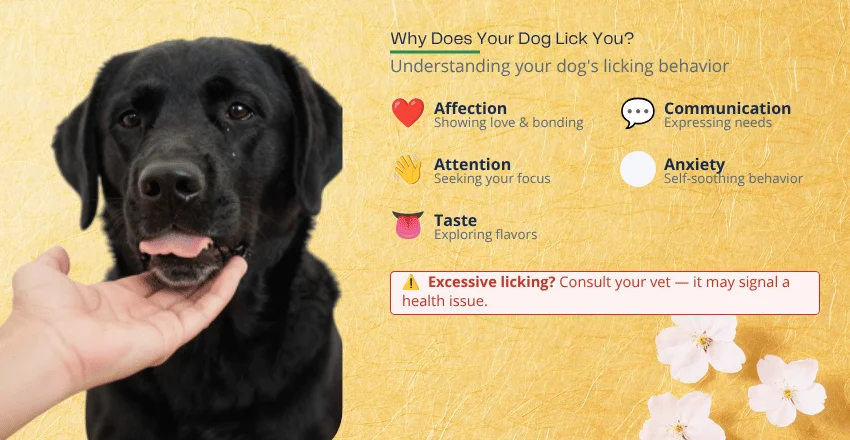
Scolding a dog for licking can make things worse, especially if the licking was appeasement in the first place. You would be adding pressure to a dog already asking for less of it. Use the behavior’s own logic instead.
- Rule out pain and illness first. Book the vet visit before the training, especially if the licking started recently.
- Remove the payment. When the licking starts, stand up and walk away without a word. No eye contact, no touch, no “no.”
- Come back within a few seconds. The lesson is that licking ends the interaction, not that you disappear.
- Reward something else instead. Mark a chin rest, settle on a mat, or hold a toy with food and praise every time.
- Give the mouth a legal job. A licking mat with wet food, a stuffed rubber toy, or a snuffle mat drains the same urge.
- Rinse the temptation off. Wash your hands after cooking and change out of a sweaty shirt.
- Keep everyone consistent. One household member who giggles and rewards the licking will hold the habit in place on their own.
Give it two weeks of consistency. Most attention-driven licking fades noticeably in that window.
What to do next
Spend one week watching the licking instead of reacting to it. Note when it starts, what your dog’s ears and tail are doing, and what happens in the two seconds afterward. That short record answers most of it. You will see a habit you accidentally built, a dog asking for space, or a symptom that belongs in front of a veterinarian.
Frequently asked questions
They are responding to a change in you: different sounds, different movement, and different smells. Licking is their standard tool for calming another individual, so they reach for it. Reading it as sympathy is a stretch, but the intent to settle you is real enough.
For a healthy adult, it is a personal call rather than a safety one. Keep it away from your mouth, eyes, and any broken skin. For babies, older relatives, and anyone with a weakened immune system, the answer is no.
Feet are the saltiest, most scent-heavy part of you, and they sit at dog height. Sweat and skin cells make them an easy target. It is a taste-and-information habit, not a comment on your hygiene.
No. Licking upward at a face is the opposite signal, closer to deference than to control. Dominance framing has largely fallen out of use in modern behavior work.
That pattern usually means arousal is climbing. A dog licks its lips into its mouth when it gets excited or overstimulated. End the session before it gets there, and redirect to a toy.
It can. Repetitive licking with no target, especially lip licking into empty air, is a stress signal. Look at the situation around it, then talk to your vet or a qualified behaviorist if it repeats.