

Why do dogs roll in the grass? Nobody has proved it. Every page that hands you one confident cause is guessing, and four explanations still compete for the honor.
The short version: dogs flop and wriggle on the lawn for scent reasons, to scratch a spot their paws cannot reach, or out of pure excitement. Cool ground on a warm day is the fourth answer. None of it is settled science. Brief, loose rolling is recreation. Repetitive rolling aimed at the same body parts is an itch.
The four competing hypotheses, side by side
Each theory below has something real behind it. Each also leaves something unexplained, which is exactly why the cause stays unsettled.
| Theory | What supports it | What it fails to explain |
| Scent rolling | Wolves do the same thing, and canids rub hardest on odors that are new to them | Why a freshly bathed dog with nothing smelly nearby still does it |
| Scratching | The motion presses the back, shoulders and tail base, which teeth and paws cannot reach | Why dogs with flawless skin roll just as happily |
| Play and excitement | It clusters around greetings, new ground, and the minutes after a bath | Why some dogs do it alone, quietly, with no audience |
| Temperature | Shaded turf runs several degrees cooler than a sunny patio or a warm kitchen floor.r | Why it happens in January too |
Key takeaways
- Four theories, no winner. Honest sources say the behavior is not fully understood.
- Fun rolling is short, loose, and self-limiting. Itch rolling repeats and targets the same spots.
- Rolling plus scooting usually points at the back end, not the skin.
- Treated lawns and rotting yard debris are the two outdoor risks to manage.
Why do dogs roll in the grass? Start with scent
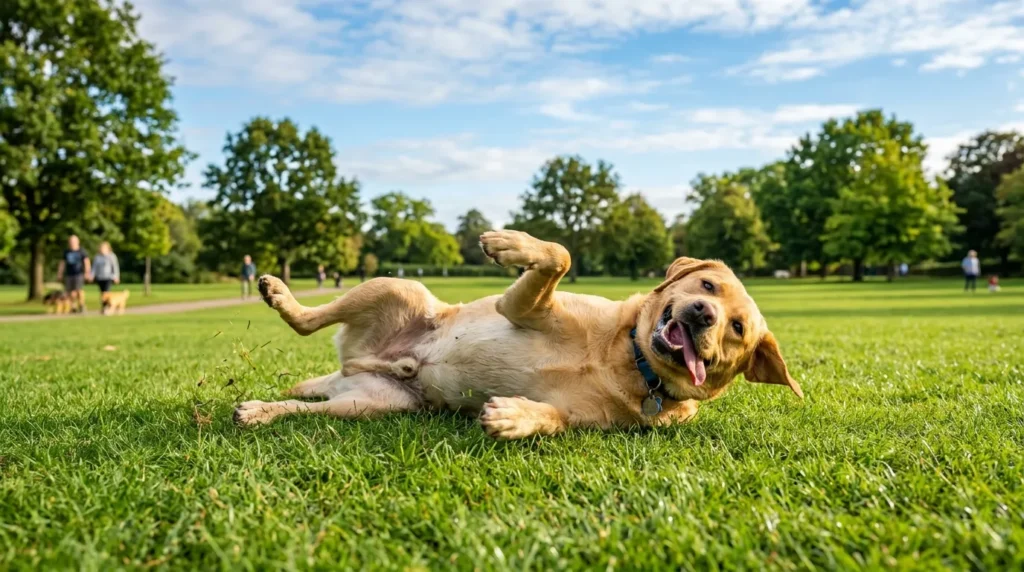
The oldest explanation is that this is scent rolling, and it comes from wolves rather than from pets. Wild canids press their necks and shoulders into strong smells, from carrion to spilled motor oil. Researchers have documented the behavior in captive wolves for decades, and it is more intense when the odor is unfamiliar.
Two hypotheses split from there, and neither has won. One says the animal is masking its own odor so prey or rivals cannot read it. The other says the animal is carrying an interesting smell back to the group, a sort of scent bulletin about where it has been. That research shows the behavior clearly. It does not settle the reason for it, and dogs are not wolves anyway.
What this theory does explain is the dog who beelines for the one foul patch of the yard. If yours does that regularly, read up on canine scent communication in our dog and cat behavior hub before assuming something is wrong with him.
Three simpler theories that need no wolves
A scratch your dog cannot reach any other way
Try scratching your own shoulder blade. Now imagine doing it with a hind foot and a short muzzle. The back, the neck and the base of the tail are the hardest places for a dog to service. One long wriggle on the lawn handles all three.
Excitement, and the post-bath protest
Ask any groomer what happens right after a bath. He hits the yard and immediately drops a shoulder into the turf. Part of that is the zoomies, the loose, bouncy energy dogs release after being held still in a tub. Part of it may be the shampoo, which smells like coconut and does not smell like the dog. Our related guide, Coconut Oil for Dogs, goes further into this.
Whether a dog dislikes a floral shampoo or enjoys the friction, we cannot ask him. That pattern is consistent enough that most owners can predict it to the minute.
Cool ground on a warm day
This one is measurable. Shaded turf holds moisture and sits noticeably cooler than concrete or an indoor floor near a sunny window. A dog who has been running will look for that cool patch, roll onto his side and stay there. So yes, cool grass genuinely helps an overheated dog, though it is a comfort measure and not a treatment for real heat stress.
Fun or itch? The comparison nobody prints
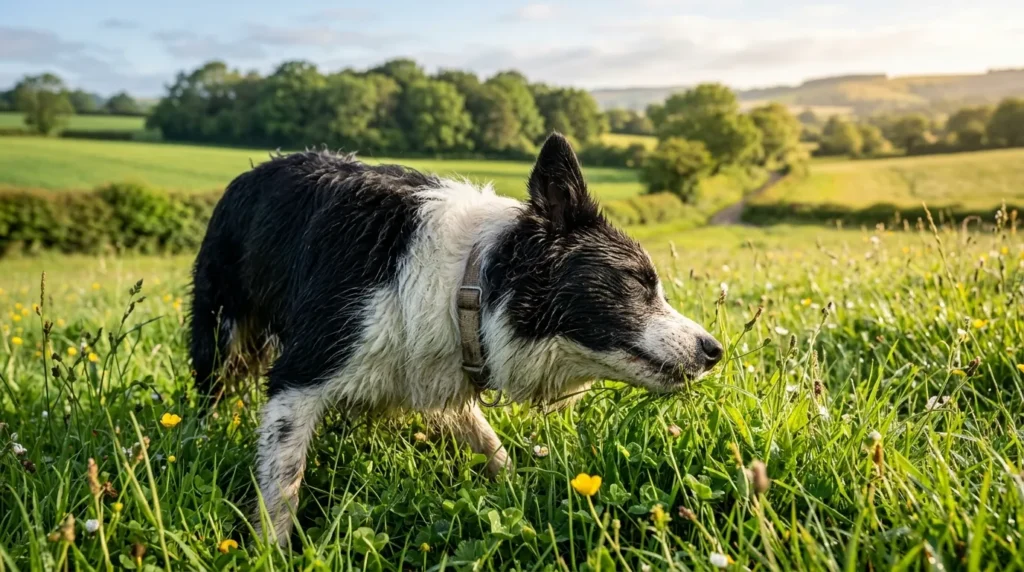
This is the part page one skips. Recreational rolling and itch-driven rolling look similar for about three seconds, then they diverge sharply.
| Signal | Recreational rolling | Itch-driven rolling |
| Duration | Seconds, then he moves on | Goes on, resumes indoors, repeats daily |
| Target | Whole body, whichever way he lands | Same areas every time: face, ears, flanks, tail base |
| Body language | Loose, wiggly, often a play bow first | Tense, focused, grumbling or whining |
| Trigger | New ground, a bath, a greeting, a mood | No obvious trigger, or worse in spring and fall |
| What comes with it | Nothing | Scratching, foot chewing, head shaking, scooting |
| How it ends | He gets bored and wanders off | It does not resolve |
One roll after a bath is a dog being a dog. Rolling that shows up with foot licking and head shaking is a medical sign, and treating it as a personality quirk delays the fix by months.
What actually makes an itchy dog roll
Chronic rubbing has a short list of medical causes behind it, and a vet works through them in roughly this order. Why Do Dogs Roll in the Grass? involve:.
- Flea allergy dermatitis. A single bite triggers days of itching in a sensitized dog—most of the damage lands on the tail base and rear flanks.
- Environmental allergy, or atopy. Pollen, mold, and dust mites. Cornell University’s College of Veterinary Medicine estimates that atopic dermatitis may affect as much as 10 to 15% of the dog population. Listed signs include rubbing the face, chewing the feet, and scooting. That prevalence figure comes from a veterinary school, not from a pet blog.
- Mites. Sarcoptic mange itches ferociously and spreads to people. Demodex tends to cause hair loss with less frantic scratching.
- Skin or ear infection. Yeast and bacteria move into skin that has already been damaged, and a dog with sore ears will grind his head along the ground.
- Full or infected anal glands. Pressure sits under the tail, so the dog rubs his rear end on anything with texture.
When scooting joins in
Watch where the pressure goes. A dog working his shoulders and flanks into the lawn is talking about his skin. A dog dragging his bottom along the ground, then twisting to lick under the tail, is telling you about his anal glands. Scooting alongside rolling points at the back end, and a vet can empty and check those glands in a few minutes.
Book the appointment if the rubbing is daily, if the skin is red or smells yeasty, if hair is thinning, or if he wakes up at night to scratch.
Yard safety when the rolling happens outdoors
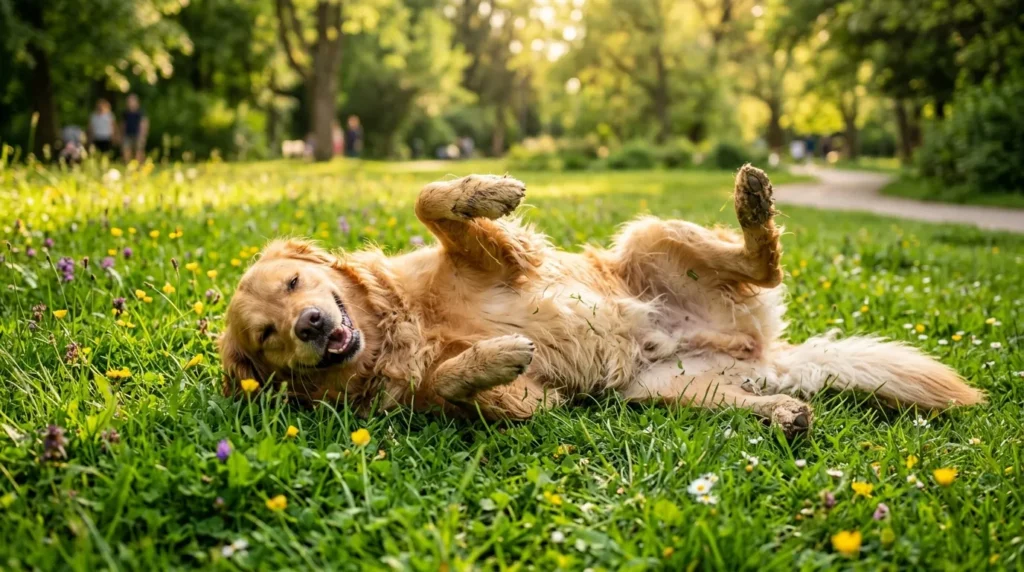
Your dog is pressing his belly, armpits, and face into whatever is on the ground, then licking it off. So the lawn itself deserves a second look.
Fertilizer and weed treatment labels carry a re-entry interval, usually stated as keeping pets off until the product is watered in and the surface is fully dry. Follow the label on the bag rather than a rule of thumb, and rinse yourdog’ss paws and belly if he gets onto a lawn you did not treat yourself. A treated lawn is a real exposure route for a dog who rolls, not a theoretical one.
A second sweep should catch what has fallen. Windfall fruit ferments fast in July heat. If you have a stone fruit tree, the risks around fallen nectarines and their pits deserve a look before your dog finds them. Rake it up.
One more practical rule: a dog who rolls in something foul needs washing before he licks himself clean. Carrion, droppings and dead worms all carry bacteria and parasites, and the tongue is the shortcut from his coat to his gut.
Should you stop it, or let him get on with it?
Let him roll. On a clean, untreated lawn, with a dog whose skin is healthy, this is free enrichment that asks nothing of you but a quick brush.
Step in for three reasons only. The surface is treated or dirty, he is rolling in something you will have to wash off, or the rolling has turned into a symptom. A solid recall and a handful of treats handle the first two. The third needs a vet.
Want more on reading your dog’s odd habits? The rest of our latest pet care articles cover the behaviors owners ask about most.
The bottom line
Four explanations, no proven winner, and an industry that would rather sound certain. What you can judge at home is the difference between a dog enjoying himself and a dog asking for help. Time it, watch where he aims, and check what comes with it. If the pattern looks like the right-hand column of that table, call your vet this week.
Frequently asked questions
Yes. Rolling on the lawn is normal canine behavior, seen across breeds and ages. Frequency is what matters. Occasional rolling is fine, while several times a day with scratching in between is not.
Two things at once. A bath ends with a burst of pent-up energy, and the shampoo leaves a smell the dog did not choose. Rolling scratches the itch of drying fur and puts his own scent back on top.
They can. Pollen from turf species is a common environmental allergen, and contact with the blades irritates some dogs on top of that. Suspect it when the itching is seasonal and worst on the belly, paws, and armpits.
Usually not. A face full of pollen and dust makes most dogs sneeze a few times. Persistent sneezing, one-sided nasal discharge, or pawing at the muzzle suggests something lodged up there and needs checking.
Possibly, but it is unproven. Scent transfer works in both directions, and researchers disagree about whether the dog is depositing his smell or collecting one. Treat it as one plausible theory among several.