

Ask the internet about coconut oil for dogs, and you get a tidy list of nine benefits, none of them graded. Two of them have real research behind them. Most don’t. One or two point the other way entirely.
Short answer: the oil is safe for most healthy dogs in small amounts, and it does more good rubbed on a dry coat than spooned into a bowl. The skin claims hold up best. Weight loss, joint, and dental claims do not. Every teaspoon is pure fat, so dose it by body weight.
Here is every popular claim with the evidence beside it, so you can see which the research supports and which it quietly contradicts.
| The claim | What the evidence actually shows | Verdict |
| Softer skin, shinier coat | Any fat worked into a dry coat softens flaking and adds shine. Most of the support is topical and borrowed from human skin studies. | Partly holds up |
| Stops itching | No canine trial shows it controls allergic itch. A greasy coat traps pollen and invites more licking. | Thin, and it can backfire |
| Aids digestion | The usual result is soft, greasy stool within a day or two. | Points the other way |
| Fresher breath, cleaner teeth | Lauric acid kills bacteria in a dish. Nothing shows it lowers plaque on a living tooth. | No support |
| Helps a dog lose weight | 121 calories per tablespoon, all of it fat, on top of a full dinner. | Points the other way |
| Eases stiff joints | Almost no EPA or DHA, and no arthritis study in this species. | No support |
Key takeaways before you open the jar
- Coconut oil for dogs works better on the coat than in the bowl.
- One teaspoon carries roughly 40 calories. One tablespoon carries 121 calories.
- Loose stool is the most common side effect, and it shows up fast.
- Dogs with a history of pancreatitis, high blood fats, or extra weight should skip it.
- MCT oil and the jar in your pantry are not the same product.
Grading six popular claims, one at a time
Skin and coat: partly holds up
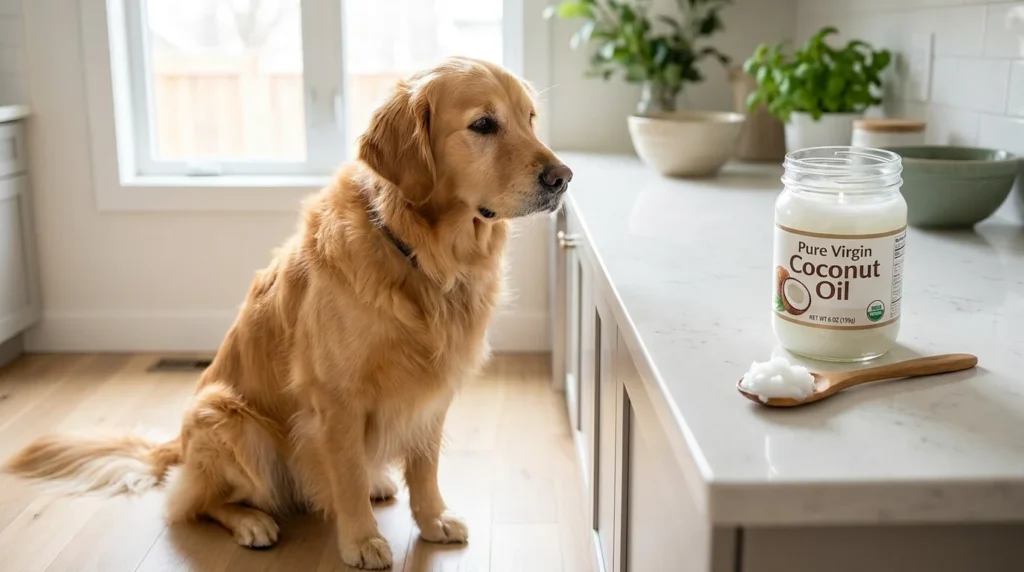
This claim has the most behind it, and even here the support is indirect. Rubbing a plant fat into a dry coat does what any emollient does. It sits on the hair shaft, softens flaky patches, and leaves the coat glossier for a few days.
Human dermatology trials on virgin coconut oil have measured real improvement in skin dryness. Dogs have different skin: thinner, less acidic, and hidden under a coat. Treat the human results as a hint rather than a promise.
Fed by mouth, the coat effect is weaker. Adding any fat to a lean diet perks up a dull coat. Nothing shows this particular fat beats the salmon oil sitting next to it on the shelf.
Itching: thin, and it can backfire
No canine trial shows the oil controls allergic itch. Itchy dogs usually have one of three things going on: fleas, a food allergy, or atopic dermatitis. None of the three answers to greasy fur. Slick fur also traps dirt and pollen against inflamed skin, and plenty of dogs lick the treated spot until it turns into a hot spot.
A dog who scratches all night has a diagnosis problem, not a pantry problem. Our dog health articles go into what actually drives seasonal scratching and when to stop experimenting at home.
Digestion: the evidence points the other way
Soft stool is the single most common thing owners report after starting it.
Medium-chain fats absorb fast, and a gut that has never seen them pulls water into the bowel in response. Greasy output follows. Some dogs handle a small amount without a problem, but calling that “aids digestion” is a stretch when the usual side effect is diarrhea.
Breath and teeth: nothing behind it
Lauric acid kills bacteria in a petri dish. That’s true, and it’s also where the evidence stops.
Bad breath in a dog is nearly always dental disease under the gum line, and no oil dissolves tartar. Brushing helps. Professional cleaning fixes it. Adding fat only loads more calories onto a mouth that needs a scale and polish.
Weight loss: the opposite is more likely
One tablespoon carries 121 calories, every one of them from fat. A 20-pound terrier eats roughly 500 calories a day, so that spoonful spends about a quarter of her budget on something with no protein and no fiber.
Human research on medium-chain fats and fullness does exist. It used purified MCT oil in people, and the effects were small. Nobody has shown a dog will lose weight by eating more fat.
Joints and stiffness: no canine support
Someone borrowed this claim from fish oil, and nobody checked it. This oil holds almost no EPA or DHA, the two omega-3 fats with genuine arthritis data in dogs. It’s a saturated fat with no anti-inflammatory track record in this species, and pain that changes how your dog moves deserves a real workup.
Why MCT oil and that jar are not the same thing
Nearly every benefits list leans on the phrase “rich in MCTs”. That phrase is doing work it hasn’t earned. About half of coconut oil is lauric acid, a twelve-carbon fat. Chemists file it under medium chain. But the body treats much of it like a long-chain fat, which makes it behave differently from the quick-energy fuel the marketing describes. Purified MCT oil is mostly the shorter C8 and C10 fats.
The dog research people quote is MCT research. A 2010 controlled feeding trial in the British Journal of Nutrition fed 24 aged Beagles a diet containing 5.5% medium-chain triacylglycerol for eight months. Those dogs beat the control group on landmark discrimination and attention tasks.
That was a formulated diet built by nutritionists. It was not a spoonful from a jar.
Rubbing it on and feeding it are two separate decisions
Most pages treat these as one topic. They aren’t. Evidence, dose, and risk all change depending on which end of the dog you’re aiming at.
| On the coat | In the bowl | |
| What it plausibly does | Softens dry patches, adds shine for a few days | Adds fat calories, may loosen stool |
| Main risk | Licking, greasy furniture, clogged follicles | Weight gain, pancreatitis flare |
| Sensible frequency | Once a week at most | Daily doses add up quickly |
| Evidence quality | Modest, mostly human skin trials | Weak to negative |
To use it topically, warm a pea-sized amount between your palms and work it into the dry patches only, not the whole animal. Rinse most of it out after five minutes. Once a week fits neatly into normal grooming, and our everyday pet care routines cover the brushing and bathing that surrounds it.
Feeding it is a nutrition decision. Treat it like one.
How much coconut oil for dogs is safe by body weight
Start lower than every chart you’ll find online, then hold that amount for four or five days before you move up. Dose by pounds of body weight, never by eye.
| Your dog’s weight | Starting dose, daily | Ceiling, daily | Calories at the ceiling |
| Under 10 lbs | 1/8 tsp | 1/2 tsp | about 20 |
| 10 to 25 lbs | 1/4 tsp | 1 tsp | about 40 |
| 25 to 50 lbs | 1/2 tsp | 2 tsp | about 80 |
| 50 to 90 lbs | 1 tsp | 1 tbsp | about 121 |
| Over 90 lbs | 1 tsp | 1 1/2 tbsp | about 180 |
Both numbers assume a healthy adult at a normal weight. The ceiling covers everything: the spoonful in dinner, the smear on a lick mat, the fat baked into a homemade biscuit. Treats and extras should stay under a tenth of daily calories, and this one eats that allowance fast.
Expect to pay about $8 to $15 for a jar of virgin coconut oil at most US grocery stores. Unrefined and cold-pressed is worth the extra dollar, since refined versions get bleached and deodorized. More feeding advice sits in our pet food and nutrition guides.
The part almost nobody leads with: it’s 100% fat
Coconut oil is not a supplement in the way a joint chew is. It’s fat, and adding fat to a dog’s dinner carries a specific risk that benefit lists tend to bury three scrolls down.
Pancreatitis is the one to know. The pancreas inflames, the dog vomits, refuses food, and goes painfully quiet, and severe cases land in hospital. A 2008 case-control study in the Journal of the American Veterinary Medical Association compared 198 dogs with pancreatitis against 186 control dogs. Those that had eaten table scraps in the week before admission had 2.2 times the odds of pancreatitis.
Nobody has run that study on this oil specifically. What the veterinary research shows is that dietary indiscretion, meaning rich extras dropped on top of a normal diet, tracks with pancreatitis in dogs. That is exactly what a daily spoonful of pure fat becomes.
Some dogs should never be given it at all.
- any dog with a history of pancreatitis, at any point in life
- dogs diagnosed with high blood fats, which Miniature Schnauzers are prone to
- overweight dogs, where the calories work against the whole plan
- dogs on a prescription low-fat diet for gut or liver disease
- puppies and pregnant dogs, unless your vet has said otherwise
Vomiting, a hunched back, or a dog who won’t settle after a fatty meal is a same-day phone call to the clinic.
What has better evidence than this jar

Want a calmer coat? Marine omega-3s, meaning EPA and DHA, carry far more canine data, and prescription dermatology diets are built around them. Bad breath is a dental problem, so brushing and a professional cleaning fix the cause. For weight loss, the lever is less fat, not more.
None of that is exciting. All of it works better.
Where that leaves you
Use it on the outside for dry patches and cracked pads. Feed it only in measured amounts, and only to a dog with a clean pancreas history and a healthy waistline. Skip it for itching, joints, teeth, or weight loss, because better tools exist for all four.
Still unsure? Take the dosing table to your next appointment and ask your vet, who knows your dog’s history in a way a chart never will.
FAQs
Yes, if he’s healthy, lean, and staying inside the ceiling in the table above. Watch the stool closely for the first week. Soft or greasy output means back off, or stop.
Paws are one of the better spots for it, because cracked pads respond well to any occlusive fat. Use a thin film, then keep your dog busy for ten minutes so it soaks in instead of getting licked straight off.
It can loosen stool, which is not the same as treating constipation. Repeated straining needs a vet, since the causes run from simple dehydration to an enlarged prostate.
No. It sits nowhere near grapes or xylitol on the danger scale. Its problems are dose problems: too much fat, too many calories, too quickly.
Nothing in your kitchen replaces a vet-recommended parasite preventive. Lauric acid has shown some activity against insects in lab settings, and that sits a long way from protecting a dog in a backyard.