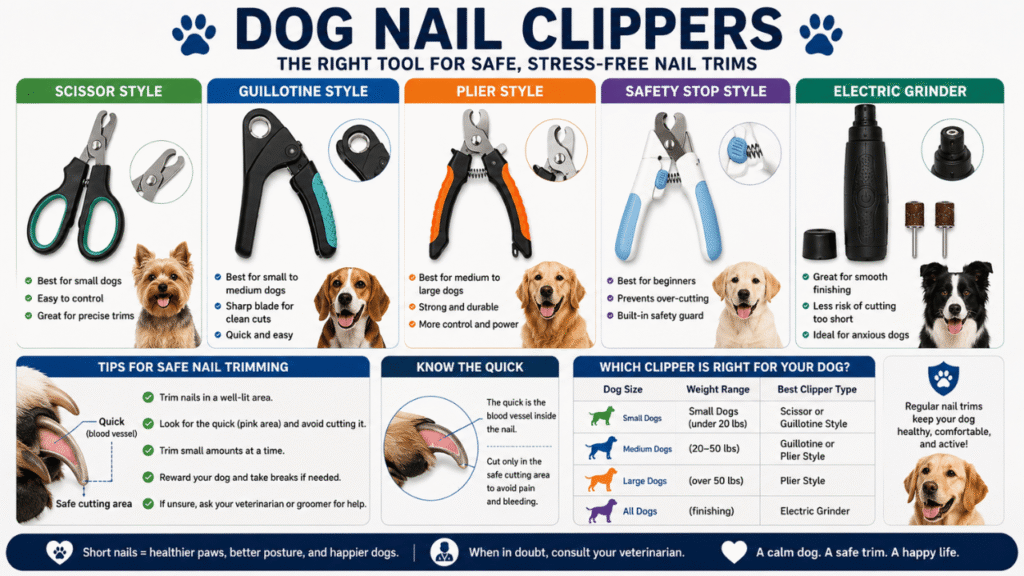


Most homemade dog food recipes you’ll find online stop at the ingredient list. They tell you to brown three pounds of turkey, stir in rice and vegetables, and serve. What they skip decides whether your dog stays healthy: how much to feed, and what goes in the pot that isn’t food.
This guide gives you both. Real quantities in cups and pounds, a numbered method, portion sizes by body weight, and an honest answer on supplements.
The short version: cook a lean meat, a starch, and two vegetables in one pot, then weigh the batch. Stir in a canine multivitamin and a measured calcium source before you portion it. Feed by calories, not by eye. A 40-pound dog eats roughly 3 1/3 cups a day.
Portion sizes and daily calories by body weight
This is the table the recipe blogs leave out. Every figure below assumes a neutered adult with normal activity, eating food that runs about 300 calories per cup, which is where all three recipes here land. A 14-cup batch is one Sunday afternoon of cooking.
| Dog’s weight | Daily calories | Cups per day | One 14-cup batch lasts |
| 5 lbs | 210 | 3/4 cup | 18 days |
| 10 lbs | 350 | 1 1/4 cups | 11 days |
| 20 lbs | 585 | 2 cups | 7 days |
| 30 lbs | 795 | 2 2/3 cups | 5 days |
| 40 lbs | 985 | 3 1/3 cups | 4 days |
| 50 lbs | 1,165 | 4 cups | 3 1/2 days |
| 70 lbs | 1,500 | 5 cups | 3 days |
| 100 lbs | 1,960 | 6 1/2 cups | 2 days |
Split the daily amount across two meals. Puppies, nursing mothers, and working dogs need considerably more, sometimes double, so those numbers don’t apply to them.
TL;DR
- Cook one protein, one starch, and two vegetables, then cool, weigh, and portion.
- A recipe on its own is not a complete diet. It needs a canine multivitamin and added calcium.
- Calcium is the deficiency that does visible damage fastest, especially in growing puppies.
- Feed by calories per pound of body weight, not by the size of the bowl.
- Fridge life is 3 to 4 days. Freezer life is about 3 months.
- Expect $30 to $38 a week in groceries for a 40-pound dog.
- A board-certified veterinary nutritionist formulating for your individual dog is the right answer if you can afford it.
What you’ll need before you cook
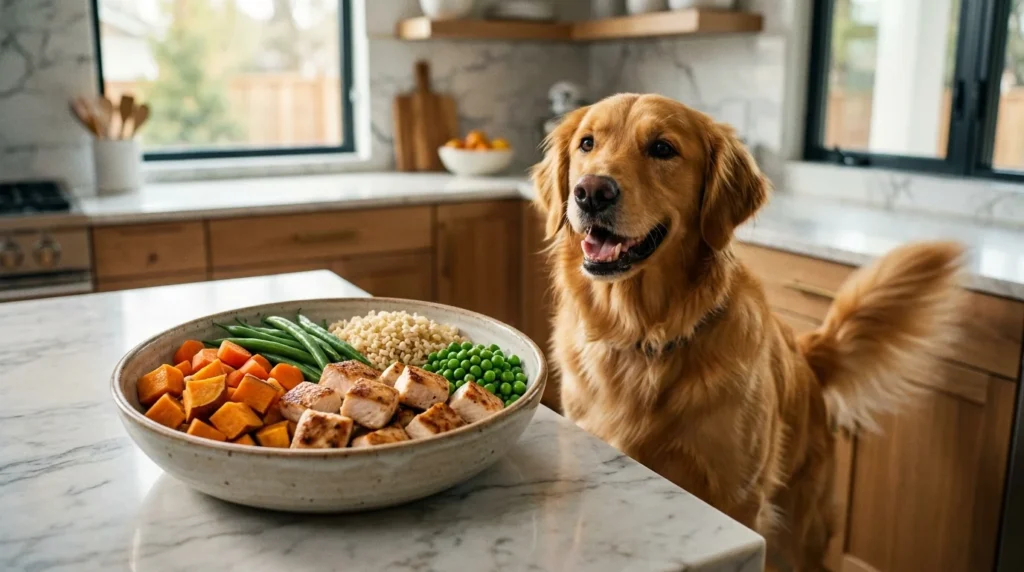
Nothing here is specialist kitchen equipment. You almost certainly own most of it.
- A 6 to 8-quart stockpot or a large Dutch oven.
- One kitchen scale that reads in ounces.
- Dry measuring cups, the nested kind.
- Eight to ten airtight containers, roughly 2 cups each.
- A canine multivitamin made for home-cooked diets.
- A calcium source: ground eggshell powder, calcium carbonate, or bone meal sold for animal feeding.
Groceries are short too. One lean protein, one starch, two or three vegetables, and a fat source such as sunflower or fish oil. Stock the pantry the way you would for any fresh feeding plan, and our pet food guides cover the staples worth keeping in.
Buy the meat on sale and freeze it. That single habit does more for the cost of this diet than any recipe swap.
The method, step by step
- Weigh your dog, or get the number from your vet’s last visit, and find the daily calorie target in the table above.
- Rinse and drain the starch, then cook it in a separate pot according to its package timing.
- Brown the ground meat in the stockpot over medium heat until no pink remains, breaking it up as it cooks.
- Drain off the rendered fat, keeping about a tablespoon in the pot.
- Add the chopped vegetables and half a cup of water, then cover and steam them until a fork goes through easily, roughly 10 minutes.
- Stir the cooked starch into the meat and vegetables, then turn off the heat.
- Let the whole batch cool to room temperature before anything else goes in, because heat destroys several of the vitamins you’re about to add.
- Stir in the oil, the multivitamin dose from the label, and the measured calcium.
- Measure the finished batch in cups so you know exactly what you made.
- Portion into containers, label each with the date, and refrigerate or freeze.
Total hands-on time is about 40 minutes. Cooling is the slow part, so start it early.
Three homemade dog food recipes with real quantities
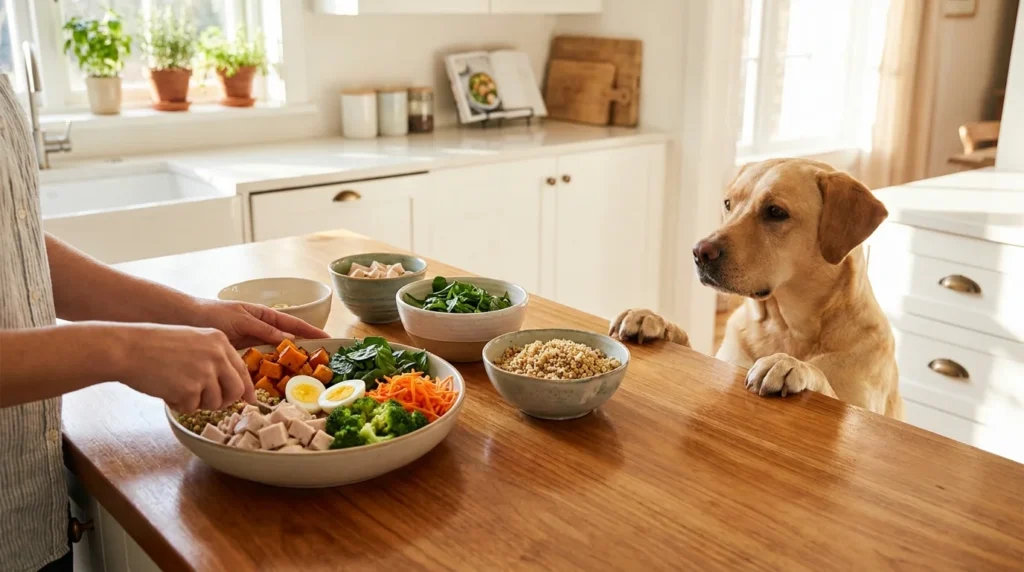
Each batch below yields roughly 14 cups at about 300 calories per cup. Adjust upward or downward in proportion if your dog is at either end of the weight table.
1. Turkey, brown rice and pumpkin
Everyday food. Mild, cheap, and easy on most adult stomachs.
- 3 lbs ground turkey, 93% lean
- 2 cups dry brown rice, which cooks up to about 6 cups
- 1 can (15 oz) plain pumpkin puree, not pie filling
- 2 cups chopped carrots
- 1 1/2 cups chopped green beans
- 2 tablespoons sunflower oil
- Multivitamin and calcium, added after cooling
2. Beef, sweet potato and zucchini
Higher in fat and richer in iron. Good for a lean dog who struggles to hold weight.
- 3 lbs ground beef, 90% lean
- 2 lbs sweet potato, peeled and cubed
- 3 cups chopped green beans
- 1 1/2 cups diced zucchini
- 2 tablespoons olive oil
- Multivitamin and calcium, added after cooling
3. Chicken, oats and butternut squash
The gentle option, and the one to try first after a stomach upset. Thighs rather than breast, because the extra fat carries flavor and calories.
- 3 lbs boneless skinless chicken thighs, diced
- 2 cups dry rolled oats, cooked
- 3 cups butternut squash, cubed
- 2 cups chopped broccoli, steamed soft
- 2 tablespoons fish oil
- Multivitamin and calcium, added after cooling
Supplements, and why calcium is the deficiency that bites
Here’s the part the recipe cards skip. Fresh meat, rice, and vegetables in a bowl will not meet a dog’s nutrient requirements, no matter how good the ingredients are. Meat is high in phosphorus and almost devoid of calcium. Grains carry little zinc that a dog can absorb. Nothing in the pot supplies enough choline or copper.
The research on this is blunt. Veterinary researchers at the University of California, Davis analyzed 200 published home-prepared maintenance recipes. Their 2013 paper in the Journal of the American Veterinary Medical Association found only 9 met minimum nutrient levels, and 95% fell short on at least one essential nutrient.
Zinc was missing in 69% of them. Choline in 64.5%. Calcium in 35%.
Nothing has improved since. A 2025 analysis of 1,726 home-prepared diets in the American Journal of Veterinary Research found only 6% could be nutritionally complete.
Calcium sits fifth on that list, and it still worries vets most. A diet of meat and rice can run ten times more phosphorus than calcium. The body responds by pulling calcium out of the skeleton to keep blood levels steady, a process called nutritional secondary hyperparathyroidism. In an adult dog it takes months to show. In a growing puppy it can produce bowed legs and fractures from ordinary play within weeks. Deficiency signs creep up slowly, and our animal health articles cover the symptoms worth watching for.
So measure the calcium. Adult maintenance works out to roughly 1,250 mg of calcium per 1,000 calories of food.
Do the arithmetic for a batch. Fourteen cups at 300 calories each is 4,200 calories, so the batch needs about 5,250 mg of calcium. One level teaspoon of finely ground eggshell powder holds roughly 2,000 mg, which puts you at about 2 1/2 teaspoons per batch. Calcium carbonate powder is easier to dose accurately if you’d rather not grind shells.
Your multivitamin covers zinc, copper, choline, vitamin D, and vitamin E. Follow the label dose for your dog’s weight, and don’t stack two products hoping for insurance, because vitamin D and copper are both toxic in excess.
One honest caveat, and it matters more than anything else on this page. A supplement plus a generic recipe gets you close. It does not account for your dog’s age, kidney values, allergies, or body condition. If your dog has any diagnosed condition, a board-certified veterinary nutritionist should formulate the diet, and your vet can refer you. That is the responsible route, and no article can replace it.
Feeding amounts and the seven-day switch
Don’t swap diets overnight. Gut bacteria need time to adjust, and a sudden change usually means a week of loose stool and a frustrated owner who blames the food.
Run it over seven days:
- Days 1 and 2: one quarter fresh food, three quarters current food.
- Midweek, days 3 and 4: half and half.
- By days 5 and 6: three-quarters fresh.
- Day 7: all fresh.
Watch the stool through the switch. Soft is normal for a day or two. Watery, bloody, or lasting past a week means stop and call your vet.
Then weigh your dog every two weeks for the first two months. Gaining? Cut the daily amount by 10%. Losing? Add 10%. The table is a starting point, and every dog burns calories at its own rate.
Storage, batch cooking and how long it keeps
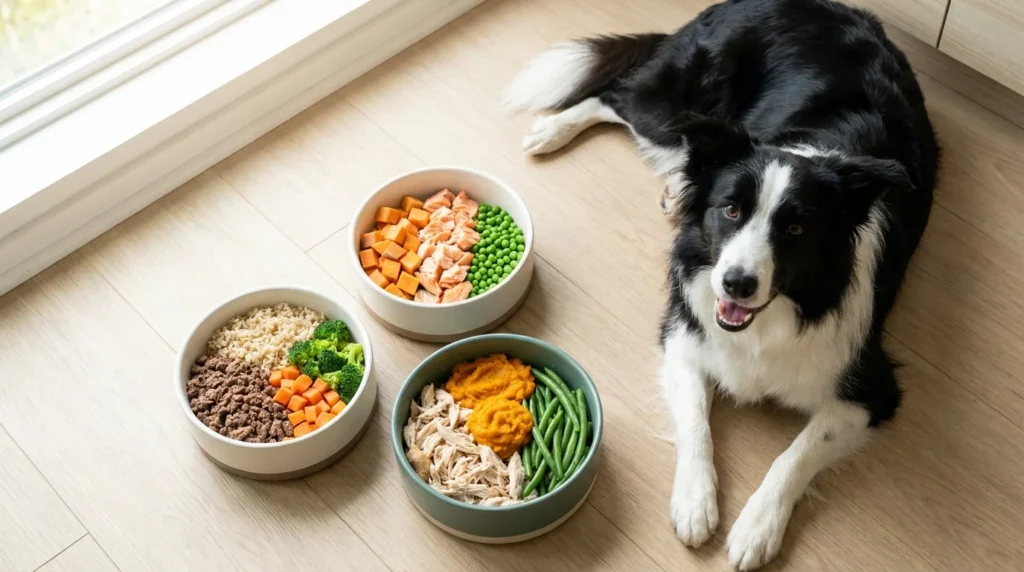
Cool the batch fully before it goes anywhere near a lid, or condensation will speed up spoilage. In the refrigerator, cooked food holds for 3 to 4 days. In the freezer, it keeps about 3 months before the fat starts to taste stale, and dogs notice.
Freeze in daily portions rather than one block, then move tomorrow’s container to the fridge each night. Never thaw on the counter, and throw out anything left in the bowl after 20 minutes.
Airtight glass containers and a scale that reads in ounces earn their keep here, and our pet accessories guides go through the gear worth buying.
On cost: expect $30 to $38 a week in groceries for a 40-pound dog, against roughly $12 to $18 for mid-range kibble. Cooking at home is not the cheaper option. Buy the protein on offer, and it narrows, but it rarely closes.
Ingredients that never go in the pot
Some of these are famous. Others show up in family recipes and get scooped into the dog’s bowl without a second thought.
| Ingredient | Why it stays out |
| Onion, chives, leeks, shallots | Damage red blood cells and cause anemia, even cooked |
| Garlic | Same plant family, same risk at the amounts a daily diet would use |
| Grapes and raisins | Linked to sudden kidney failure, with no known safe dose |
| Macadamia nuts | Cause weakness, tremors, and vomiting |
| Xylitol, also sold as birch sugar | Crashes blood sugar and damages the liver |
| Chocolate, cocoa, coffee grounds | Theobromine and caffeine hit the heart and nervous system |
| Cooked bones of any kind | Splinter, and can perforate the gut wall |
| Raw bread dough | Ferments in the stomach, expands, and releases alcohol |
| Bouillon cubes and heavy salt | A sodium load the kidneys have no use for |
| Fat trimmings and poultry skin | A common trigger for pancreatitis |
Keep the seasoning shelf out of it entirely. Your dog’s food needs no salt, no stock, and no butter.
Where to go from here
Pick one recipe, cook a single batch, and feed it alongside your dog’s current food for a week before committing. Weigh the batch, measure the calcium, and write the date on every container.
Then book the conversation that matters. Take your recipe to your vet at the next checkup and ask whether your dog’s age and health make a nutritionist referral worthwhile. Good homemade dog food recipes are a starting point, and your vet turns them into a diet built for the animal in front of you.
Frequently asked questions
Not automatically. A properly formulated commercial diet beats an unbalanced homemade one every time. Fresh food wins on palatability and digestibility, and it lets you control every ingredient, which helps with allergies. Balance is what decides the outcome, not freshness.
Yes, for anything fed long term. A few days of home cooking after an upset stomach is fine unsupplemented. Anything beyond about two weeks needs a multivitamin and added calcium, or the deficiencies start accumulating quietly.
They can, but the margin for error is much smaller. Growing bones need a tight calcium-to-phosphorus ratio, and getting it wrong causes permanent skeletal problems. Have a veterinary nutritionist formulate a growth diet rather than scaling an adult recipe down.
Watch four things over six weeks: stable weight, firm stool, a coat that isn’t dull or flaking, and normal energy. Ask your vet for bloodwork at the six-month mark.
Raw carries a real risk of salmonella and listeria, for the dog and for whoever handles the bowl. Households with young children or anyone immunosuppressed should cook the food.