

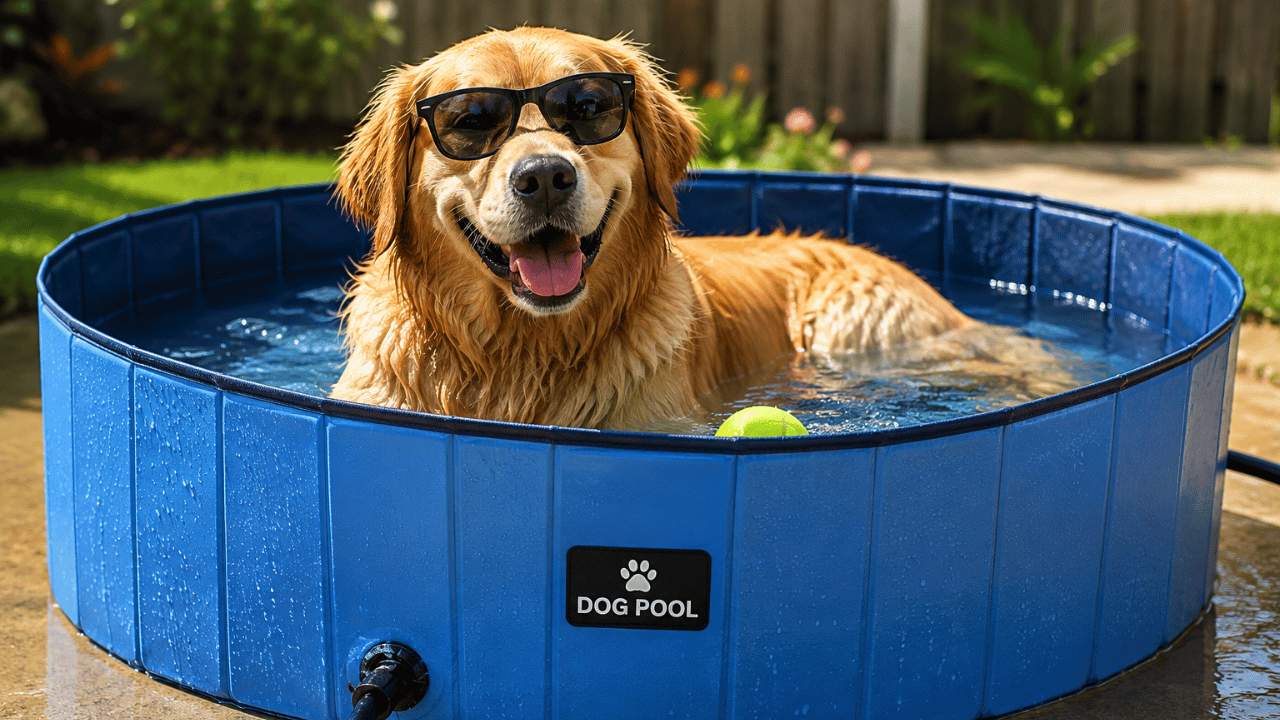
A dog gets into water claws first. That one habit decides whether a dog pool lasts a summer or springs a leak by the third weekend, and it is why ordinary inflatable kiddie pools fail so fast. Three constructions dominate the market. They are not equally tough. Elsewhere on the site: Dog Boat Ramp.
Short answer: hard-molded polyethylene survives claws and chewing best, so it is the pick for big dogs in a fixed yard spot. Heavy-folding PVC costs a third as much and stores flat. Vinyl stretched over a metal frame suits small dogs and doubles as a bath.
Material Comparison At a Glance
| Construction | What it shrugs off | Weak point | Typical size range | Price seen |
| Heavy-folding PVC. | Claws in normal use, folding, and hose rinsing. | Seams split if dragged across concrete, though they patch. | 32 to 63 inches across. | $24.58 to $40.99. |
| Hard-molded polyethylene. | Claws, chewing, sun, and years of outdoor life. | Heavy and rigid, so it needs real storage space. | 39 to 66 inches long. | Not published by the maker. |
| Vinyl on a metal frame. | Claws, indoor bath duty, repeated setup. | Frame corners rust if stored damp, and sizes stop small. | 30 to 50 inches long. | $69.98 to $89.98. |
Key Takeaways
- Puncture resistance is the buying decision. Everything else is secondary.
- A “large” box often means 47 inches, which a Labrador cannot turn around in.
- Skip anything without a drain plug. Tipping out 85 gallons is not realistic.
- Change the water every one or two days in hot weather, and never add chlorine.
- Dry the ears afterward, especially on floppy-eared breeds.
What a Dog Pool Has to Survive

Nails are the whole problem. Dog Pool Claws wins every time. Your dog steps over the rim, plants four claws on a thin vinyl floor, then spins, scrambles, and pushes off hard enough to shift the whole tub. Human kiddie tubs are built for bare feet on a bladder of air, so one nail through a seam ends it. That is why a separate product category exists. Our related guide, best dog toys for chewers, goes further into this.
Toughness comes from two things: the thickness of the material and whether the walls hold their shape without air. Nothing here inflates. Claw resistance is only part of the warm weather checklist, and the rest of it sits with our other dog care basics.
The Three Types, with Their Trade-offs
Heavy-Folding PVC
These are the round tubs you see everywhere. Thick PVC forms the skin, and a stiffened rim holds the walls up once water goes in. Chewy listed the Frisco Outdoor Dog Swimming Pool in XX-Large at $40.99 on August 2, 2026. The Niubya Collapsible sat at $32.39 and the TRIXIE Dog Splash Pool at $24.58, which puts the whole folding category inside a twenty-dollar band. Most ship with a patch kit, which tells you something honest about the material.
- Good: cheapest way in, folds to a bag, easy to empty and move, and sizes go past 60 inches.
- Bad: seams are the failure point, dragging it loaded across a patio wears the base, and a determined chewer will win.
Hard-Molded Polyethylene
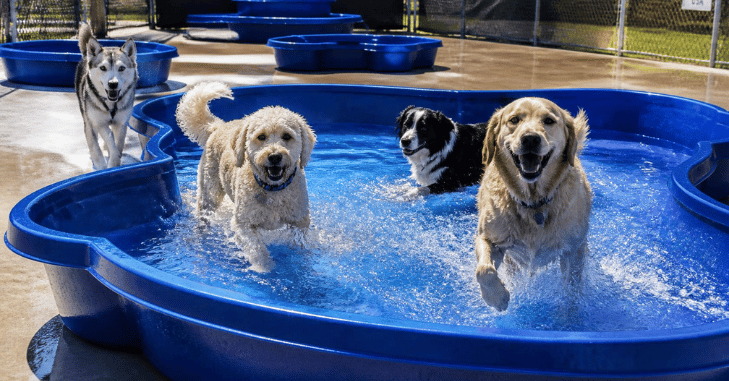
One Dog One Bone molds its bone-shaped tub from high-molecular-weight polyethylene. The maker lists it as 66 inches long, 44 inches wide, and 11 inches deep, holding 85 gallons at 23 lbs empty. The smaller paw-shaped version is 39 by 38 by 6 inches and holds 20 gallons. Both are described as chew-resistant and UV-resistant, and both are made in the USA, which is unusual in a category dominated by imported vinyl.
The company publishes no price of its own and sells through retailers, so budget from whatever your store shows rather than from a figure quoted online.
- Good: nothing to puncture, survives chewing and sun, and the wide, shallow shape means nervous dogs will step in.
- Bad: rigid and bulky, awkward to store, and you are not taking it to the lake.
Vinyl over a Metal Frame
K&H Pet Products takes a third route: non-slip vinyl stretched on a metal frame. Its own site lists the X-Large at 32 by 50 by 9 inches for $89.98. The Large runs 30 by 42 by 7 inches at $69.98, with a drain plug at the base, a patch kit, and a one-year limited warranty. Tractor Supply lists the same line at a higher price, from $109.99 to $139.99, so the spread is worth checking before you buy.
- Good: the rectangular footprint fits narrow yards, it works indoors as a bath, and the drain hardware is real.
- Bad: sizes stop around 50 inches, and the frame needs to dry fully before it goes in the shed.
Sizing to Your Dog, Not to the Label
Marketing sizes are close to meaningless. Ignore them. The number that matters is whether your dog can turn around without climbing a wall. That takes roughly twice its nose-to-tail-base length across the floor.
| Dog | Rough body length | Minimum width across | Water depth |
| Under 20 lbs. | About 14 inches. | 32 inches. | 4 to 6 inches. |
| 20 to 50 lbs. | About 20 inches. | 47 inches. | 6 to 8 inches. |
| 50 to 80 lbs. | About 26 inches. | 55 to 63 inches. | 8 to 10 inches. |
| Over 80 lbs. | About 32 inches. | 66 inches and up. | 10 to 12 inches. |
Depth is the other half. Chest-deep, an inch or two above the elbow, lets a dog wade, cool off, and lie flat. Real swimming needs far more water than any of these holds. Treat the whole category as cooling rather than exercise.
The Features That Decide Whether It Keeps Getting Used
Buyers rarely quit because a tub failed. They quit because emptying it is miserable.
A drain plug is the feature that keeps the thing in service. Water weighs about 8.34 lbs per gallon, so 85 gallons comes to roughly 710 lbs. You are not tipping that. A side plug at floor level empties it onto the lawn in two minutes. That is the difference between a weekly refill and a tub that sits empty from July.
Textured, non-slip flooring matters almost as much. Smooth vinyl under wet paws makes dogs scrabble for grip, and that scrabbling, repeated across a whole summer, is what wears through the floor before anything else does.
Storage Splits the Three Types Cleanly
- Folding PVC: rinse it, dry both sides fully, fold it, then store it in its bag indoors.
- Frame types: pull the frame apart, dry the corners, and keep them off a damp floor.
- Molded polyethylene: leave it outside upside down, or stand it on its edge in a garage.
Anything folded while damp comes out of winter with mildew stains that never fully wash off.
Safety and Hygiene, The Part Most Roundups Skip
Shallow water sitting in the sun goes warm and still, and skin bacteria build up within hours. Change it every one or two days in hot weather. Do it sooner if the water turns cloudy or your dog gets in muddy water. Rinse the floor and let it dry before refilling, because a quick top-up leaves the biofilm in place.
Never add chlorine tablets, shock, or any chemical sold for a swimming pool. Dogs drink what they stand in, and those products are dosed for a body of water thousands of times larger than the twenty gallons sitting in your yard. Plain water and frequent changes do the job. Keep a bowl of cool drinking water in the shade too. If you have ever wondered whether dogs can drink milk on a hot day, water is the safer answer.
Ears need drying afterward, and this is not fussiness. A 2021 study in the peer-reviewed journal Canine Medicine and Genetics reviewed the clinical records of 22,333 dogs in primary care practice. It found 7.30% were diagnosed with otitis externa, an outer ear infection, in a single year. Dogs with pendulous ears carried 1.76 times the odds of erect-eared breeds. Wipe the canal opening with a dry cotton pad after every session.
Two More Risks Are Worth Naming Plainly
- Water intoxication. A dog that bites at the water or snaps at a hose stream can swallow enough to dilute its blood sodium. Signs include staggering, vomiting, bloating, and glazed eyes. It needs a vet the same hour. The condition is rare, and it hits small dogs fastest.
- Unsupervised time. A dog can drown in a few inches of water if it panics or slips. Stay outside with it every time.
Breed matters as well. Flat-faced dogs such as pugs and French bulldogs tire fast, and they hold their heads at an awkward angle in water. Heavy-boned breeds, including bulldogs and basset hounds, sink rather than float. Keep both groups in water below the chest, and skip the deeper options entirely.
The verdict, by case

No single product wins in every yard, so pick by situation:
- Big dog, permanent spot, heavy chewer: the One Dog One Bone bone-shaped tub. At 66 inches and 85 gallons, it is the only option here a retriever can turn around in comfortably, and there is nothing on it to puncture.
- Renters, small yards, road trips, tight budget: a heavy folding PVC tub such as the Frisco XX-Large at around $41. Accept that it is a two-season or three-season purchase, and keep the patch kit.
- Small or senior dogs, or a tub that has to double as a bath: the K&H Dog Pool & Pet Bath. You get the drain plug, the non-slip floor, and a one-year warranty.
Our pick overall is the molded polyethylene tub. It costs more up front and eats storage space. It is also the only one of the three without a failure mode built into it.
What To Do Next?
Dog Pool: Measure your dog’s nose-to-tail base, double it, and shop only at or above that width. Then check the listing for a drain plug and a textured floor before you look at the price. For more seasonal write-ups on keeping dogs comfortable, see the rest of our pet care articles.
FAQs
Briefly, an inflatable one usually leaks within days of a clawed dog using it. Rigid plastic kiddie tubs have slick walls that most dogs struggle to climb out of. A purpose-built tub has a lower rim and a textured floor.
Chest deep, an inch or two above the elbow, for most healthy dogs. Go shallower for puppies, seniors, and flat-faced breeds.
Empty it, scrub the floor with hot water and a stiff brush, then rinse and refill. Algae grows in water left standing in the sun for days. A shorter change interval prevents it better than any additive.
Yes, with two inches of water and someone in arm’s reach. Let them walk in themselves rather than lifting them in.
Only in shallow water, with you beside it. Brachycephalic breeds are poor swimmers, and they overheat quickly even while wet.