
“It’s raining cats and dogs” means rain is falling extremely hard, often during a sudden downpour or storm. It is a figurative English idiom, not a description of animals falling from the sky. American speakers understand it, although simpler phrases like “it’s pouring” often sound more current.
| Quick fact | Answer |
|---|---|
| Meaning | It is raining very heavily. |
| Type of expression | Idiom |
| Literal or figurative? | Figurative |
| Exact origin | Unknown |
| Early related wording | Seventeenth-century English |
| Familiar exact wording | Recorded by Jonathan Swift in 1738 |
| U.S. usage today | Defined in U.S. dictionaries and often treated as old-fashioned |
The phrase means that rain is falling very heavily. Its exact origin is unknown, despite several colorful stories about roofs, floods, mythology, and old words. Written relatives appear in seventeenth-century English, while Jonathan Swift used the familiar wording in 1738.
Key Takeaways
- The expression describes heavy rain, not falling animals.
- Its precise etymology remains unsettled.
- Similar wording appeared in English writing during the 1600s.
- Jonathan Swift used the familiar phrase in 1738.
- The thatched-roof explanation is popular, but evidence for it is weak.
- U.S. speakers understand the idiom, though “it’s pouring” offers a simpler alternative.
What Does “It’s Raining Cats and Dogs” Mean?
The expression means that rain is coming down hard and fast. You might use it when a light shower suddenly becomes a soaking downpour. The phrase adds humor and exaggeration rather than giving a precise weather measurement.
For example, someone leaving a restaurant might warn friends about the storm outside. A parent might say it while watching water run down the windows. A child may hear it and imagine pets tumbling through the clouds.
Example sentences, from the idiom to plainer wording.
- “Bring an umbrella because it’s raining cats and dogs outside.”
- “We delayed the walk because the rain was coming down hard.”
- “The game stopped when the storm turned into a downpour.”
- “We stayed inside until the heavy rain finally eased.”
In American English, the meaning remains clear even when the phrase sounds playful. Cambridge currently labels the idiom “old-fashioned,” which helps explain its slightly nostalgic tone. Everyday alternatives usually sound less colorful and more conversational.
Where Did Raining Cats and Dogs Come From?
No single origin story has been proven. The Library of Congress lists several proposed explanations and clearly says the answer remains unknown. That uncertainty matters because many websites repeat colorful stories as established history.
The written record does provide useful clues. Henry Vaughan used related wording in a 1651 poetry collection. Richard Brome used another related form soon afterward.
Jonathan Swift later used the familiar wording in 1738. Oxford’s Anatoly Liberman notes that the Oxford English Dictionary cites Swift as an early literary attestation. Earlier material suggests the idea had already been circulating before Swift wrote it.
| Date | Historical clue | What it tells us |
|---|---|---|
| 1651 | Henry Vaughan used related “dogs and cats” wording. | The animal-rain image already existed. |
| 1652–1653 | Richard Brome wrote about “dogs and polecats.” | A similar comic rain phrase was circulating. |
| 1738 | Jonathan Swift used “rain cats and dogs.”dogs.” | The modern wording was clearly established. |
Popular Origin Stories and What the Evidence Shows
Several explanations try to make the strange wording logical. None has enough evidence to settle the question. Treat them as theories rather than facts.
The Flooded-Streets Theory
One theory connects the saying with filthy streets in old London. Heavy rain could wash debris and dead animals through poorly drained streets. Swift described such grim storm scenes, which may have strengthened the later association.
The problem is timing and proof. A vivid scene can explain why readers understood the image without proving how the idiom began. Phrase Finder also treats this connection as possible rather than certain.
The Thatched-Roof Story
A popular internet story claims cats and dogs sheltered inside thatched roofs. Heavy rain supposedly made the roofs slippery, causing the animals to fall. Reliable etymology sources do not support this explanation as established history.
The explanation also lacks a documented path to the expression. Etymology sources provide no convincing evidence that falling household pets created the saying. It is better treated as modern folklore than established language history.
The “Catadupe” and Greek Theories
Another theory links the idiom with “catadupe,” an old word connected with a waterfall. A separate proposal points to a Greek expression that sounds somewhat similar. Both ideas try to explain the sound of the phrase through older language.
Oxford’s etymology discussion urges caution with these claims. Similar sound alone does not show how a foreign expression entered everyday English. Without a documented borrowing path, these explanations remain speculative.
The Mythology Theory
Some accounts connect dogs with storms and cats with rain or witchcraft. Norse mythology and later superstition are often mentioned in this version. The theory is imaginative, but direct evidence connecting it to the English idiom is thin.
That does not make the story useless. It shows how people search for patterns when a phrase feels absurd. The safest conclusion remains that the real origin is uncertain.
Is It an Idiom, a Metaphor, or a Literal Statement?
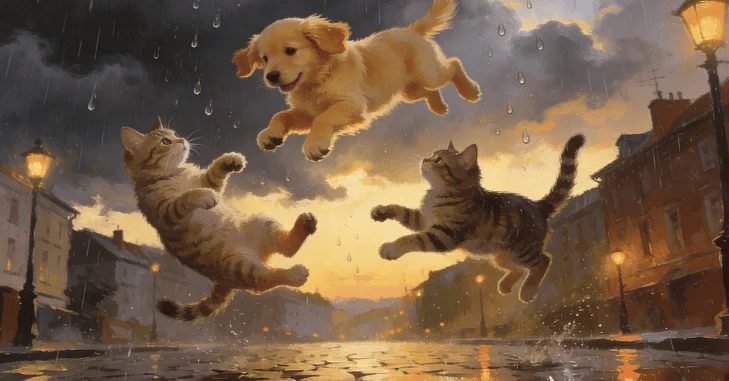
The expression is an idiom because its meaning cannot be built from each word literally. Someone hearing the sentence for the first time might picture falling pets. A fluent speaker instead understands it as a familiar description of heavy rain.
It can also feel metaphorical because the image creates an exaggerated comparison. Still, dictionaries classify it as an idiom. That label best explains how speakers learn and use the expression.
The phrase also shows why animal language sticks in memory. Pet words create vivid mental pictures, even when the meaning has nothing to do with animals. Petistra explores another language question in its guide to whether dogs understand English.
Do Americans Still Say It Today?
The phrase remains understandable in American English, though usage varies by speaker. That does not mean everyone uses it often in ordinary conversation. Cambridge’s U.S. dictionary currently labels the expression old-fashioned.
In casual U.S. speech, shorter alternatives can sound more neutral. “It’s pouring” is direct and easy to understand. “It’s really coming down” also fits everyday conversation.
Useful alternatives include:
- It’s pouring.
- It’s coming down hard.
- It’s really coming down.
- We’re getting a downpour.
- The rain is coming down in sheets.
- It’s raining buckets.
Use the animal idiom when you want personality or humor. Use the simpler phrases when you want current, neutral wording. Both choices communicate the same basic weather idea.
Why Cats and Dogs Make the Phrase So Memorable
Cats and dogs are familiar animals with strong personalities in popular culture. Putting them into a weather phrase creates an impossible picture that is hard to forget. That absurd image likely helps the saying survive even when speakers use it less often.
The same mix of familiarity and impossibility drives Petra’s cat-dog-dogcat-dog impossibility that hybrid myth explains: why such an animal cannot exist biologically. The comparison differs, but both ideas show how quickly vivid animal images attract attention.
Pet references also stay memorable through books, television, and film. That cultural link appears in Petistra’s list of dog names from movies. Familiar animals give language an easy route into humor, memory, and storytelling.
How to Use the Phrase Naturally
Use the idiom only for heavy rain. A drizzle or brief sprinkle does not match the expression. The wording works best when the weather feels dramatic enough to justify exaggeration.
You can use it before, during, or after a storm. Keep the sentence casual because the phrase itself is informal. A playful tone usually sounds more natural than formal reporting.
Natural ways to describe a heavy downpour.
- “Don’t take the dog out yet because it’s pouring.”
- “We were halfway home when the rain became intense.”
- “The picnic ended early because the storm got heavy.”
- “By sunset, the streets were soaked after hours of hard rain.”
For weather reports, school assignments, or formal writing, “heavy rain” is clearer. For conversation, stories, and humor, the idiom adds character. Choosing between them depends on tone rather than meaning.
Frequently Asked Questions
What Does “It’s Raining Cats and Dogs” Mean?
It means the rain is falling very heavily. The words are not meant literally. The phrase is a colorful English idiom for a strong downpour.
Where Did the Expression Come From?
Its exact origin is unknown. Similar animal-and-rain wording appears in English texts from the seventeenth century. Jonathan Swift used the familiar form in 1738.
Did Cats and Dogs Really Fall From Thatched Roofs?
There is no strong evidence supporting that popular explanation. The story spread widely because it sounds memorable and plausible at first. Reliable etymology sources treat it as folklore, not proven history.
Is the Phrase “Old-Fashioned” in the United States?
Many Americans understand the expression, but individual usage varies. Cambridge currently labels the phrase old-fashioned. “It’s pouring” offers a simpler choice for everyday U.S. conversation.
What Is a Modern Alternative for Heavy Rain?
“It’s pouring” is one of the simplest modern choices. “It’s really coming down” also sounds natural in American speech. “Heavy rain” is a clear choice for formal writing.
The Bottom Line
Raining cats and dogs is a memorable idiom for heavy rain with an uncertain history. Early English writing proves the image is centuries old, but no origin theory has won. The safest explanation separates documented history from colorful guesswork.
For pet lovers, the phrase also shows how strongly animals shape everyday language. Explore more pet myths, behavior questions, and cultural curiosities across Petistra. You can enjoy the image without expecting a single paw to fall from the clouds.