

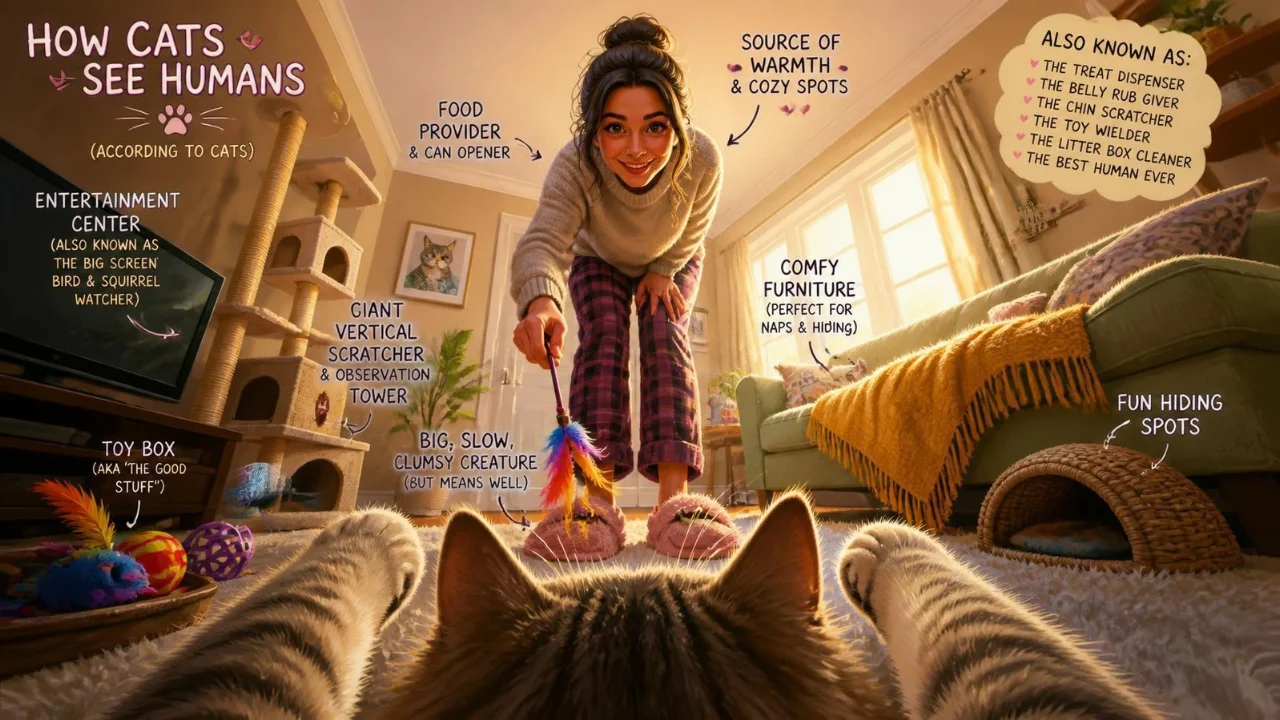
If you have ever caught your cat staring at you, you may wonder what they see. How do cats see humans compared with how we see each other? Your cat sees a less detailed, differently colored version of you and relies heavily on movement, scent, and sound.
Cats do not depend on sharp facial detail as much as people do. Their eyes favor low-light vision and motion detection over fine detail and rich color. Your voice, smell, movements, and familiar routines also help your cat know exactly who you are.
How Cats See Humans at a Glance
| Feature | What humans experience | What cats likely experience |
| Fine detail | Sharp at normal distances | Less detailed |
| Colors | Broad color spectrum | More limited and muted |
| Dim light | Limited | Much stronger vision |
| Complete darkness | Cannot see | Cannot see |
| Peripheral vision | About 180 degrees | About 200 degrees |
| Motion | Strong daytime detection | Well adapted to detecting movement |
| Recognizing people | Strong facial recognition | Vision plus voice, scent, and behavior |
Quick answer: Cats probably see humans as large, somewhat less sharply detailed figures with more muted colors than we see ourselves. Their visual system favors movement and dim light instead of fine facial detail. Cats also identify familiar people using other information, especially voice, scent, movement, and learned routines.
What Does Your Face Look Like to a Cat?
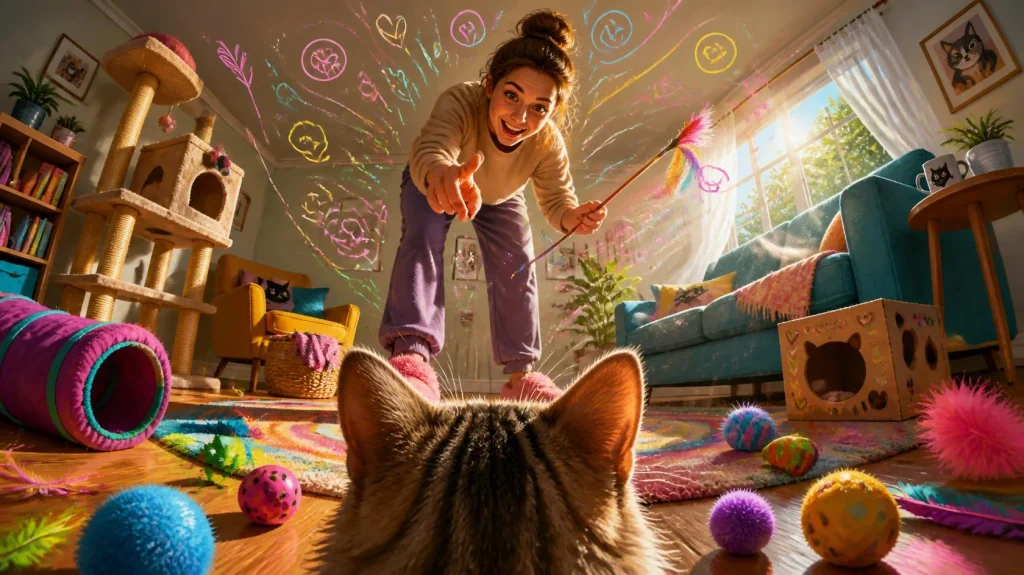
Your face probably does not look as crisp to your cat as another person’s face does. Feline eyes are not designed to resolve fine visual details as efficiently as healthy human eyes. From farther away, your overall shape and movements may provide more useful information about How Do Cats See Humans.
That does not mean your face is meaningless to your pet. Research has found evidence that cats can connect information from human voices and faces. A 2019 study, for example, found evidence of cross-modal representation of humans in cats under certain experimental conditions.
Scientists cannot recreate a cat’s subjective visual experience with complete accuracy. Measurements of eye anatomy and behavior tell us what their visual system can detect. They cannot produce a perfect photograph of what exists inside a cat’s mind.
How Do Cats See Humans in Color?
Cats do see color, despite the old belief that their world is black and white. Their color experience is more limited than ours. Blues and yellowish tones seem easier for them to distinguish.
Reds and some other colors probably appear less vivid or distinct. That means your bright red shirt may not look nearly as striking to your pet. Shape, contrast, movement, and brightness can matter more than the exact shade.
This difference comes from photoreceptors in the retina. called cones. Human and feline retinas differ in their proportions and use of these light-sensitive cells. Those differences help explain why our visual worlds are not identical.
Cat Vision vs. Human Vision
The biggest difference is not simply whether one species has “better” eyesight. Human and feline vision evolved to meet different needs. People excel at detailed daytime vision, while cats have adaptations that support hunting under dim conditions.
Cats also have a wider visual field than humans. Veterinary sources commonly place feline vision around 200 degrees, compared with roughly 180 degrees for people. That extra peripheral coverage can help a small predator notice movement.
Their eyes also contain a reflective structure called the tapetum lucidum. It reflects light through the retina again, improving sensitivity in low light. It also helps produce the familiar glow seen when light hits a cat’s eyes at night.
Can Cats See Humans in the Dark?
Cats can see you in much dimmer conditions than you can see them. They still need some light, however. A cat cannot navigate a completely lightless room by sight alone.
Cornell University’s Feline Health Center explains that the tapetum gives incoming light another opportunity to reach the retina. Other feline eye adaptations also support low-light vision. These features suit an animal naturally active around dawn and dusk.
Your silhouette and movement may therefore remain useful visual signals as a room becomes darker. You might struggle to spot your cat beside the sofa, even as your pet still tracks your movements. This ability should not be confused with true vision in total darkness.
Do Cats Recognize Their Owners?
Yes, cats can distinguish familiar humans, but recognition involves more than looking at a face. Research shows that domestic cats can discriminate between human voices. More recent research also indicates they distinguish odors from familiar and unfamiliar people.
A 2013 study found cats responded differently when hearing their owners’ voices among unfamiliar voices. Their responses often involved orienting movements of the ears and head. This suggests vocal information can identify a familiar person without visual information.
A 2025 study added evidence about smell. Cats spent longer investigating odors from unfamiliar people than odors from known people. The results indicate that human scent provides meaningful information, although researchers cautioned against stronger conclusions about individual recognition from scent alone.
These findings explain an everyday experience many owners recognize. Your cat may react before you enter the room because your footsteps, voice, smell, or routine already identify you. Seeing your face is only one part of that sensory picture.
Do Cats Think Humans Are Other Cats?
No solid science shows that cats really mistake you for an oversized feline. Cats do direct several familiar social behaviors toward humans. That similarity does not prove they believe people belong to their own species.
Rubbing, kneading, grooming, following, and sleeping nearby can all occur in human-cat relationships. Cats also adapt their communication to living with people. Those behaviors tell us more reliably bout social relationships than guessing what species label exists in a cat’s mind.
Watch the complete context when interpreting these signals. A nip during petting, for example, can indicate overstimulation rather than dislike. Petistra’s guide to why cats bite their owners explains how different biting situations change the meaning.
Why Does Your Cat Stare at You?
A staring cat may be collecting information rather than expressing one specific emotion. Your movements can predict food, play, an opening door, or a favorite resting place. Cats learn these household patterns through repeated experience.
Body language helps you interpret the stare more accurately. Relaxed posture and soft eyes suggest a different emotional state from flattened ears and a tense body. Large pupils can also occur for several reasons, including low light, excitement, or fear.
Context matters more than any single facial feature. If staring appears alongside sudden hiding, collisions, trouble finding objects, or unusual pupils, consider a veterinary examination. Behavior changes can sometimes accompany an eye problem.
Does Your Cat Know What You Look Like?
Your appearance provides information, but your cat doesn’t need a perfect visual portrait to recognize you. Voice, scent, movement, location, and routine can reinforce one another. Together, those cues create a much richer identity than facial detail alone.
This also helps explain why a familiar person can briefly make a cat cautious after becoming noticeable. A large hat, bulky coat, unusual movement, or unfamiliar smell can alter several normal cues. Once other familiar signals appear, many cats can reassess the situation.
Young cats also learn extensively through early social experiences. Their interactions with their mother, littermates, environments, and people shape later behavior. Petistra’s guide on when kittens can leave their mother explains why that developmental period matters.
How to Make Your Home Easier for Your Cat to See
You do not need to redesign your house around feline eyesight. A few choices can make toys, pathways, and interactions easier for your pet to notice. These adjustments are especially useful when you understand that contrast and movement may matter more than decorative color.
- Choose toys with strong visual contrast against your flooring.
- Move wand toys like prey instead of shaking them randomly.
- Keep important pathways reasonably consistent.
- Provide gentle lighting for older cats navigating at night.
- Approach nervous cats where they can see or hear you.
- Avoid relying on color alone to distinguish important objects.
Movement can be especially engaging during play. A toy disappearing behind furniture and reappearing can resemble prey behavior better than an object sitting still. Always give your cat opportunities to catch the toy so play has a satisfying endpoint.
Travel creates a different visual and sensory environment. Motion, strange surroundings, unfamiliar odors, and restricted space can overwhelm some animals. Petistra’s cat backpack safety guide covers body-language signals that indicate a cat needs a break.
What Cat Vision Tells Us About Their Behavior
Understanding feline eyesight can explain behaviors that otherwise seem strange. A cat may detect a tiny moving object while seeming less interested in a nearby stationary object. Different parts of its visual system favor different kinds of information.
It also explains why cats use multiple senses when dealing with people. Your pet does not need to study your face lasanother human would. Familiar sounds, smells, posture, and routines can fill gaps left by less detailed vision.
Social context matters too, especially in multi-cat homes. Domestic cats can form relationships while still needing space and predictable resources. Petistra’s explanation of cat colonies provides more context on social organization.
When Changes in Vision Need a Veterinarian
Normal feline eyesight differs from human eyesight, but sudden visual changes are not normal. Bumping into objects, missing jumps, appearing disoriented, or struggling to find familiar items can warrant attention. Cloudiness, squinting, discharge, or unequal pupils also deserve veterinary evaluation.
Cornell’s Feline Health Center advises owners to watch for behavioral and physical changes involving the eyes. Early evaluation can matter because some causes of impaired vision are treatable. Older cats deserve particular attention when their navigation or confidence changes.
Do not test suspected vision loss by frightening your pet or moving obstacles into its path. Keep the environment predictable and contact your veterinarian. A professional eye examination can separate normal feline visual behavior from a medical problem.
The Bottom Line
So, how do cats see humans? Visually, you are probably less sharply detailed and less colorful than you appear to another person. Yet your cat has far more information about you than eyesight alone provides.
Your voice, smell, movements, habits, and interactions all help make you recognizable. Cats experience people through a combination of senses, not just facial image alone. Understanding that difference can make their behavior easier to read and your daily interactions more rewarding.
For more practical explanations of feline behavior, health, and everyday care, explore the latest Petistra pet guides. Learning how cats sense their environment can help you choose better play, handling, travel, and home routines.
Frequently Asked Questions About How Cats See Humans
Do cats see human faces clearly?
Cats can see human faces, but their vision emphasizes different information than ours. Fine visual detail is generally less important to feline eyesight than it is to human eyesight. Familiar movement, voice, scent, and context can also help identify a person.
What colors do cats see when they look at people?
Cats have limited color perception compared with humans. Evidence suggests they perceive blues and yellowish colors well, while other hues appear less distinct. Your skin, clothes, and surroundings therefore do not look the same to your cat.
Can cats recognize their owners by sight?
Visual information can contribute to recognition, but it is not the whole system. Experimental research shows cats can distinguish familiar human voices and respond differently to human odors. Some research also suggests cats can connect human facial and vocal information.
Can cats see you at night?
Cats see much better than humans in dim light. Their retinal adaptations and reflective tapetum help them use limited available light efficiently. They cannot see in a room containing absolutely no light.
Do cats think humans are giant cats?
Science has not established that cats believe humans are giant versions of themselves. They perform several cat-like social behaviors with people, which may explain the popular idea. Similar behavior does not tell us exactly how a cat mentally categorizes humans.