
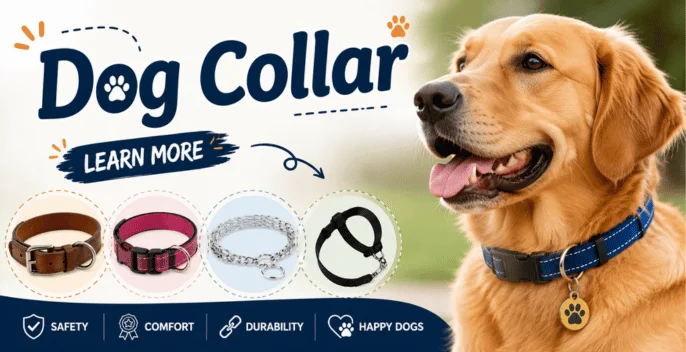
Most owners buy one dog collar and ask it to do every job. That habit sits behind a lot of failed walks, escaped pets, and avoidable vet visits. Neckwear is a set of specialized tools, and the flat band on your dog right now has a narrower purpose than you think.
Short answer: a flat buckle band is for carrying ID and little else. Pick a martingale if your dog backs out of gear. A breakaway suits time alone in a crate or yard, and a head halter steers a strong puller. Move hard pullers onto a harness instead.
| Type of dog collar | Main job | Suits | Wrong tool for |
| Flat buckle or quick release | Carrying tags and ID | Almost every dog, all day | Holding a dog that pulls hard |
| Martingale (limited slip) | Staying on a head narrower than the neck | Greyhounds, whippets, backers-out | Tie-outs and unsupervised wear |
| Breakaway safety | Releasing if it snags | Crated dogs, yard time, home alone | Clipping a leash to on its own |
| Head halter | Steering the head | Strong pullers, patient owners | Long lines and sudden lunging |
| Choke or slip chain | Tightening without a limit | See the evidence section below | Everyday pet handling |
| Prong | Pinching evenly around the neck | See the evidence section below | Unsupervised home use |
| Electronic | Sending a shock, vibration, or tone | See the evidence section below | Fear and aggression cases |
Key takeaways
- Identification is the flat band’s real job. Control is a different problem with a different answer.
- Two fingers should slide under it flat. Any looser and the dog reverses out of it.
- A martingale must never close to choking tightness, so leave a gap between the rings.
- Breakaway buckles save dogs left alone, and they are not built for leash work.
- Growing puppies need a fit check every week. Embedded collars start as a fit nobody rechecked.
Dog Collar: Start With the Job, Not the Style
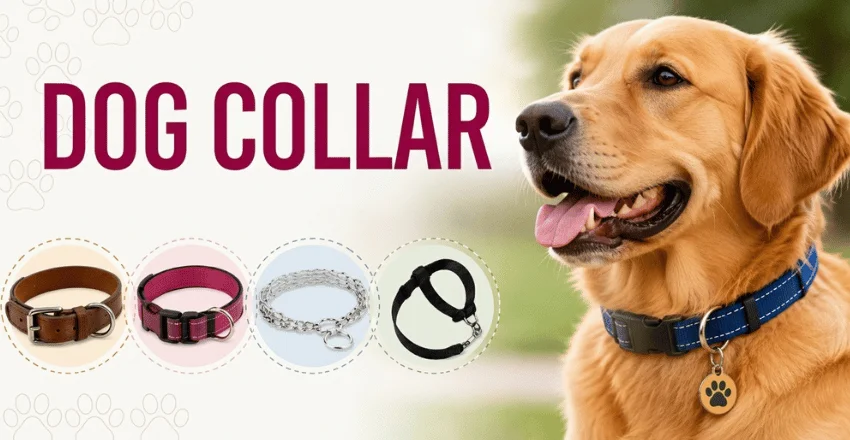
A dog collar with a flat band around the neck holds identification. That is the whole assignment: a hanger for a tag and a rabies license, and a weak control device. It comes down to where the force lands. When a dog leans into a leash, the pull concentrates on the front of the throat, right over the windpipe and the vessels feeding the head.
A 2026 review in Frontiers in Veterinary Science by Marcella Ridgway pulls the research together. It reports that a healthy canine windpipe stays open under about 20 mmHg of direct compressive Force. In dogs that already have tracheal collapse, the review says, 20 mmHg of pressure from neck gear severely compromised the airway.
Ridgway also cites work by Pauli and colleagues. Dogs pulling against neckwear showed significant rises in pressure inside the eye. Harness use did not. So a stronger band is not the fix for a puller. It concentrates the same Force on the same fragile spot.
Trainers move heavy pullers onto a harness for exactly that reason, and the neckwear goes back to carrying tags. Gear is only half the answer. Our pets care guides cover the training and handling side that no buckle can solve.
Flat buckle and quick release: everyday identification
This is the default, and for most households it is the right one. Metal buckles adjust in fixed holes and rarely fail. Plastic side releases snap on faster.
- Good: cheap, washable, holds tags well, fits nearly every neck.
- Bad: a determined dog can reverse out of one, and it gives you no real braking power.
LupinePet sells its Basic Solids nylon range from $9.10, and its Original Designs range from $12.10. Both use welded steel D-rings and carry an Even-if-Chewed guarantee covering accidental damage for life. That guarantee is unusual, and it beats a nicer pattern for a chewer.
Martingale collars: for dogs that back out
Every martingale carries a main loop plus a smaller control loop. Pressure on the leash shortens the main loop until it stops at a preset point. It cannot keep tightening—any dog whose head is narrower than its neck needs one. Greyhounds, whippets, salukis and plenty of nervous rescues fall in that group.
Here is the fitting detail nobody prints on the packaging. When the control loop is pulled fully tight, the two rings should still sit an inch or two apart. If they touch, it is too big and will close past snug into choking tightness. Size the tightened loop to match the neck.
2 Hounds Design lists its 1.5-inch nylon buckle martingale at $21.98, in four sizes covering 14 to 34 inches of neck, with stainless steel hardware. That version suits heads too broad to slip a fixed loop over. LupinePet’s starts at $18.10 in a 3/4 inch width for 15 to 20-inch necks.
Breakaway safety collars: for time alone
Breakaway buckles are designed to fail. That is the point. If the strap catches on a crate wire, a fence, a heating vent, or another dog’s jaw, the buckle separates under load, and the dog walks away. PetSafe sells its KeepSafe model at $14.99 in three sizes spanning 10 to 28 inch necks, and describes the patented buckle as separating when pressure is applied. That trade-off is unavoidable. A buckle built to open under pressure cannot hold a leash.
Head halters and their real learning curve
Head halters loop over the muzzle and behind the ears, so a pull turns the head toward you instead of loading the throat. Now the part the product photos never show. Most dogs hate it at first. They paw, they rub their face on the carpet, they sulk.
PetSafe’s own advice is to let the dog wear it during dinner and play, with treats, before any leash goes on—budget one to two weeks. Owners who skip that step decide the halter failed, when the introduction did.
Choke, prong and electronic collars: what the evidence says.
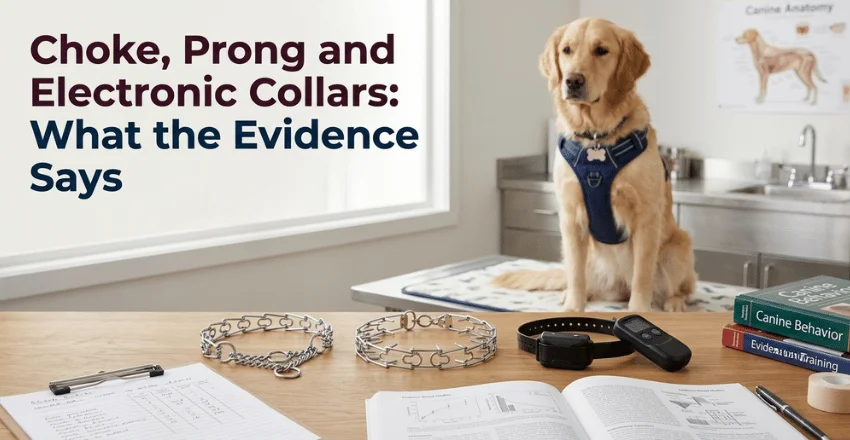
These deserve a straight answer rather than a shrug. How each one works. Choke and slip chains tighten without any stopping point, so pressure keeps rising while the leash stays tight. Prong models distribute blunt metal tips around the neck, pinching skin when the links close. Electronic units deliver a static shock, vibration, or tone by remote or automatically.
The American Veterinary Society of Animal Behavior published its humane dog training position statement in 2021. It concluded that aversive methods “should not be used in canine training or for the treatment of behavioral disorders”.
Choke chains, prong collars and shock collars are named there as tools to avoid. Ridgway’s 2026 review flags unlimited-slip chains as the riskiest of the group. It records a German Shepherd left disoriented, ataxic and blind after roughly 60 seconds of strangulation by one during training.
Several countries restrict the electronic kind. According to the Animal Welfare (Electronic Collars) (Wales) Regulations 2010, published by the Welsh government, using a shock collar on a cat or dog is an offense there. That rule does not bind US owners. It does show where one regulator landed.
The fair opposing view. Trainers who use these tools argue that effectiveness matters too. Ridgway’s review reports a leash-pulling comparison by Johnson and Wynne in which shelter dogs pulled least on a metal prong and most on a martingale.
Ridgway also finds no reported documentation of tracheal trauma from long-term training use of neck gear, which cuts against the strongest version of the injury argument. Where does that leave a pet owner? The effectiveness gap is real but narrow, the welfare risk is asymmetric, and the veterinary behavior bodies have taken a clear position.
Fitting a dog collar without guesswork
Measure the base of the neck with a soft tape, then add room. Then apply the two-finger rule: with the strap fastened, two fingers should slide flat between webbing and coat, snug but not tight. Too loose is the more common error. A dog that can drop its head and reverse will do it in traffic, at the worst moment.
Puppies are the real hazard. Ridgway’s review calls embedded collars a commonly encountered though under-reported problem, seen in dogs that grew without the strap ever being resized. Long coats hide the early swelling. Check the fit weekly until your dog stops growing, and part the coat on any fluffy breed. You can browse everything else Petistra has published on the blog index.
Materials and the hardware that actually fails
Webbing rarely breaks first. Hardware does.
- Nylon webbing: cheap, dyeable, machine washable, holds odor when wet.
- Coated webbing such as BioThane: waterproof, wipes clean, ideal for swimmers and mud.
- Leather: softens with wear and lasts years, but hates repeated soaking.
- Rolled leather: less coat breakage on long-haired dogs.
Look for a welded D-ring rather than a bent wire loop with a visible gap, because that gap is where a clip works loose. Check the stitching monthly, and replace frayed webbing or a cracked buckle housing instead of chasing one more season.
ID tags and microchips do different jobs.
Engrave your cell number with the area code, plus a second number if someone else can answer it. Many US owners add their city and state, then a line reading “microchipped” or a flag such as “needs meds daily”. Leaving the dog’s name off is a reasonable precaution, since a stranger who can call your dog can lure it more easily.
Microchips are not a substitute. The tag gets your dog home from two streets away, because the neighbor who finds it can read it. The chip gets your dog home from a shelter weeks later, and only if the registry still holds your current number. Update it when you move.
Collars worth looking at right now

Every price below came off the maker’s own site in August 2026. We have not tested these ourselves, so treat it as a shortlist built from published specifications.
| Product | Type | Price | Sizes | Why it makes the list |
| LupinePet Basic Solids | Flat buckle | From $9.10 | Multiple widths and lengths | Even-if-Chewed lifetime guarantee |
| LupinePet Original Designs Martingale | Martingale | From $18.10 | 3/4 in wide, 15 to 20 in neck | Same guarantee, limited-slip action |
| 2 Hounds Design 1.5 in Nylon Buckle Martingale | Buckled martingale | $21.98 | 14 to 34 in neck | Stainless hardware, fits broad heads |
| PetSafe KeepSafe | Breakaway | $14.99 | 10 to 28 in neck | Patented buckle releases under load |
| PetSafe Gentle Leader | Head halter | $19.99 | Under 5 lbs to over 130 lbs | Padded neoprene nose loop |
One note on availability. Ruffwear’s Front Range and Web Reaction models are well regarded. On August 2, 2026, both showed as out of stock in every size on Ruffwear’s own site, so we left them out.
The verdict, by case
- Ordinary family dog: a flat buckle model for tags, plus a harness for walks. LupinePet Basic Solids is our pick on price and the guarantee.
- Slips out or has a narrow head: the 2 Hounds Design buckle martingale, fitted with the rings apart.
- Home alone, crated or loose in a yard: PetSafe KeepSafe, with a separate walking harness.
- Strong puller and a committed owner: the Gentle Leader, after two weeks of conditioning.
- Choke, prong, or electronic: not our recommendation for home use.
No single dog collar covers all five cases. Two pieces of gear, one for identity and one for control, solve almost every household.
FAQ
Snug enough that two fingers slide flat underneath, and no looser. On a puppy, recheck weekly.
Yes, for control and safety. Force spreads across the chest rather than the windpipe, which is why the eye pressure research favors it.
Not by itself. That buckle is meant to open under load, so pair it with a harness for walks.
Bare neck is safest in a crate. If your dog must stay tagged, use a breakaway design.
Your cell number with the area code, a backup number, your city and state, and any urgent medical note.