

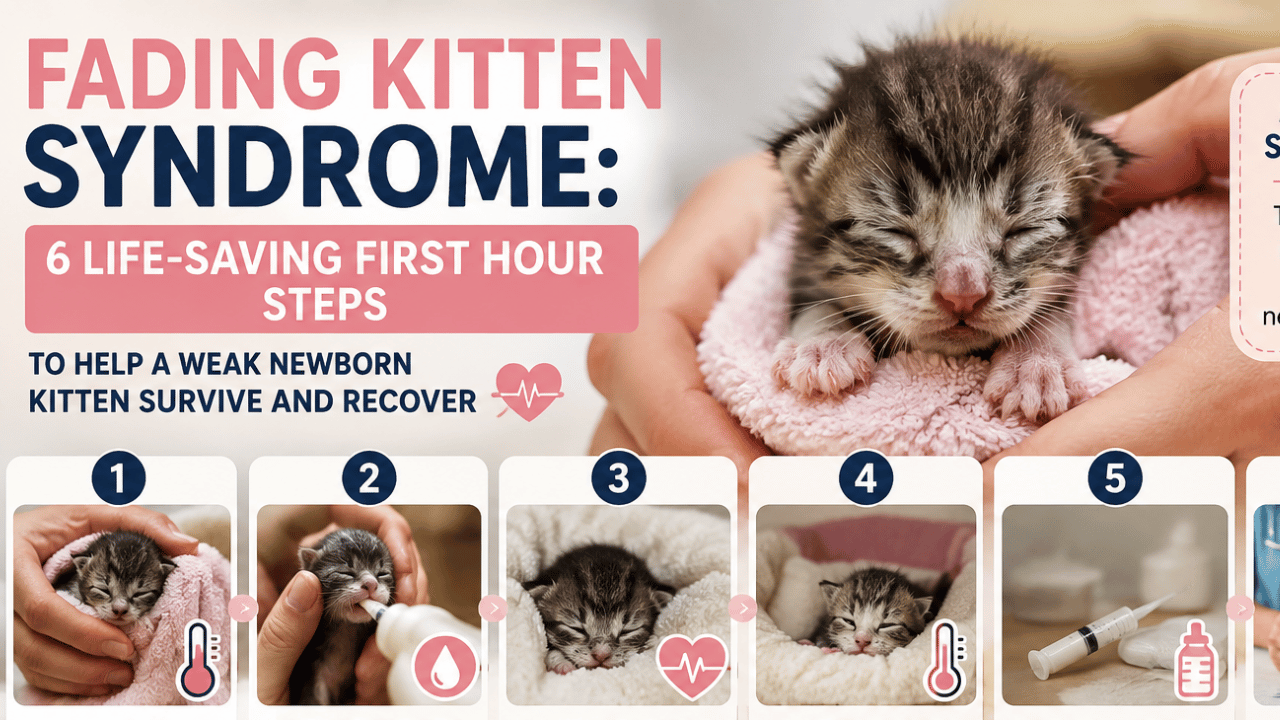
Newborns can go from squirming to limp in a few hours. Fading kitten syndrome is the name for that decline, and it is not one disease. Warm the baby slowly; never feed it while it feels cold. Then get a vet on the phone. The order of those actions matters more than anything else you do tonight.
Quick answer: the term describes a neonatal kitten who weakens and dies, usually from chilling, low blood sugar, dehydration, infection, or a congenital disability. Warm the kitten gradually over an hour or more. Then put sugar on the gums, then offer warmed fluids, then formula. Call a veterinarian while you work.
Normal Newborn Numbers At a Glance
Half the panic at 3 am comes from not knowing what normal looks like. Newborns run far cooler than adult cats. Readings that would frighten you in a grown cat are ordinary in a two-day-old, and owners either panic or miss real trouble because of it.
| 101°F: What you are checking | Week 1 | Weeks 2 to 3 | Week 4 |
| Rectal temperature | 95 to 99 F | 97 to 100 F | 99 to 101°F |
| Typical weight | about 3.5 oz at birth, roughly 2.6 to 4.2 oz | doubles birth weight by day 10 to 14 | around 12 oz |
| Daily gain | 0.25 to 0.5 oz | 0.25 to 0.5 oz | 0.25 to 0.5 oz |
| Feeds | every 2 hours | every 3 to 4 hours | every 4 to 5 hours |
| Holds its own body heat? | No | Barely | Mostly |
Key Takeaways
- Warm before you feed. Milk sits in a chilled gut, and feeding a cold kitten can kill it.
- Rewarming should take one to three hours. Fast heat causes its own damage.
- Weigh daily. Flat weight is the earliest measurable sign, often before the kitten looks sick.
- 99°F: A normal newborn temperature sits between 95 and 99°F, well below an adult cat.
- This label is a description, not a diagnosis. A vet still has to find the cause underneath.
Never Feed a Cold Kitten

If you take one line from this page, take that one. Below roughly 95 F, a neonate’s gut slows down and then stops. Milk poured into a stopped gut sits there and ferments. The kitten bloats, may inhale the formula, and gets sicker rather than stronger. People lose kittens this way while genuinely trying to help.
Fading Kitten Syndrome You can check without a thermometer. Slip a finger onto the belly or inside an ear. If it feels cool against your skin, treat that as hypothermia and put the bottle down. That rule is not negotiable. Warm first, feed second.
The First Hour, Step-By-Step
- Put heat under the kitten, not on it. A heating pad on its lowest setting, under one half of the box, with a towel between the pad and the skin. Leave the other half cool so the kitten can move away.
- Take one to three hours for warming. Fast rewarming opens blood vessels in cold limbs and drops blood pressure. Slow is the safe speed here.
- Skip direct heat sources. Heat lamps, hair dryers, radiators, and hot water bottles applied directly to skin can burn or dry out a neonate quickly. Cover every heat source with fabric.
- Rub sugar on the gums. Once the kitten is warming but still floppy, smear a drop of corn syrup on the gums every 15 minutes. It absorbs through the tissue and needs no digestion.
- Rehydrate, then feed. Offer warmed unflavored electrolyte solution by dropper first. Only when the kitten feels warm to the touch should you move to kitten milk replacer, always belly down and never on its back. Cow’s milk is the wrong fuel for any newborn mammal, and our guide to why cow’s milk fails a newborn puppy lays out the same nutritional gap that applies here.
- Get a veterinarian involved now. Ring the clinic while the kitten warms rather than after. Ask for an emergency slot the moment it responds, and go anyway if it does not.
Warning Signs, Ranked By How Fast You Need To Move

| hours. What you notice | What it usually means | How urgent |
| Cool to the touch, limp, no suckle reflex | Hypothermia, often with low blood sugar | Act now, warm before anything else |
| Pale or grayish gums, weak cry | Poor circulation, anemia or shock | Emergency vet, same hour |
| Same weight or lower two days running | Not getting enough milk, or an underlying illness | Vet call today |
| Skin stays tented when pinched, dry gums | Dehydration | Fluids and a vet call today |
| Constant crying that feeding does not settle | Pain, hunger, cold or infection | Assess within hours |
| Diarrhea, vomiting, discharge from eyes or nose | Infection | Vet the same day |
| Kitten separates from the litter pile. | Illness, or the queen rejecting it | Assess within hours. |
Why Cold, Low Blood Sugar, and Dehydration Feed Each Other
These three do most of the killing, and they arrive as a set. A kitten under about four weeks cannot hold its own body heat and relies on its mother and littermates for warmth.
Once it chills, digestion stalls. That stalled gut means the last feed never turns into energy, so blood sugar crashes. Low blood sugar leaves it too weak to suckle, so it takes in no fluid, and dehydration follows within hours. Dehydration then makes it harder to hold temperature, and the loop tightens.
That is why the sequence is fixed. Break the loop at heat, then sugar, then fluid. Attack it out of order, and you feed a gut that cannot work.
Every day, weigh every kitten

The most useful thing a fosterer owns is a digital kitchen scale that reads in grams. Weigh at the same time each day and compare the number with yesterday.
Healthy neonates gain steadily, roughly a quarter to half an ounce a day, and double their birth weight inside two weeks. A kitten that holds flat for 24 hours is already telling you something. One that drops has moved into a genuine emergency. This shows up on the scale days before the kitten looks unwell, which is exactly why the scale beats watching.
What Actually Causes Fading Kitten Syndrome
There is no single culprit, which is the whole point of the label. It names an outcome and leaves the cause open. Common ones include:
- hypoglycemia, hypothermia, and dehydration, alone or together
- prematurity, low birth weight, prematurity, or a difficult birth
- Bacterial or viral infection, including feline panleukopenia, herpesvirus, and calicivirus
- Congenital disabilities such as a cleft palate or a heart malformation
- Neonatal isoerythrolysis, where a type B queen’s colostrum destroys a type A kitten’s red blood cells
- Parasites, or a queen with a poor milk supply and poor nutrition
Several of those infections also cause trouble in adult cats, which we cover across our cat and dog care articles. In a neonate, they move faster.
When Home Care Stops, and the Vet Takes Over
Home stabilization buys time. It does not find the cause, and it cannot treat sepsis, a heart defect, or blood type incompatibility.
Call a clinic straight away if the kitten stays limp after warming, has pale gums, or gasps and breathes with effort. Do the same for a bulging belly or no urine in several hours. Go in if a littermate has already died. Necropsy on that kitten often explains what the rest of the litter is facing, and that answer can save the ones still alive.
Preventing It in the Next Litter
Prevention starts before the kittens arrive. A queen in good condition, fully vaccinated and free of parasites, hands her litter antibodies through colostrum in the first 12 to 16 hours. Miss that window and the whole litter starts exposed.
Feed the queen a diet built for pregnancy and nursing, which our nutrition and feeding guides go into. Keep the nesting box clean and dry, with no drafts. Wash your hands between litters, since a fosterer moving between boxes is a common route for infection. Breeders should know both parents’ blood types, which is the one reliable way to avoid neonatal isoerythrolysis.
Some Kittens Cannot Be Saved
You should hear this plainly. Even with fast warming, correct feeding, and good veterinary care, some kittens die. In the Journal of Feline Medicine and Surgery, a 2022 review by Veronesi and Fusi reported stillbirth rates of 5% to 12.5% across studies from 2006 to 2019. The same review found that most deaths after birth happen inside the first week.
A congenital heart defect or a severe infection cannot be undone with a heating pad. If you did the steps in order and called for help, you did the job. Keep the scale and the heating pad ready, because the next kitten who needs them will arrive with no warning.
What To Do Next
Fading Kitten Syndrome: If a kitten in your care is cool, floppy, or has not gained weight today, start warming now and phone a veterinary clinic while you do it. Then buy a gram scale and start a daily weight chart for every kitten in the litter. That one habit catches trouble earlier than any other thing you can do at home.
Frequently Asked Questions
Yes, many do, and the deciding factor is usually how fast someone intervenes. Kittens caught while still responsive, warmed correctly, and then seen by a vet have a real chance. Once a kitten is cold and unresponsive, survival drops sharply.
Faster than most people expect. A neonate can go from feeding normally to critical in six to twelve hours. That speed is why daily weighing matters so much.
Below 95 F in the first week counts as hypothermia and needs slow warming immediately. Between 95 and 99°F is normal for that age, even though it would be alarmingly low in an adult cat.
A drop of corn syrup rubbed on the gums is the standard first move for suspected low blood sugar. Do not pour liquid into the mouth of a limp kitten, since it can be inhaled. Rub, do not pour.
Only if a vet or an experienced fosterer has shown you how, in person; a misplaced tube puts formula into the lungs and kills quickly. Syringe- or bottle-feeding is safer for a first-time carer.