

Can dogs eat green beans? Yes, and they are one of the cheapest safe treats in the produce aisle. Where it goes wrong is in the weight-loss plan built on them. Somebody at the dog park has probably told you to swap half your dog’s dinner for a vegetable, and that advice has circulated since the 1990s. For a closer look at this, see Can Dogs Eat Papaya.
The short answer: plain green beans, raw, steamed, or frozen, are safe for dogs and contain about 30 calories per cup. The problem is the diet built around them. Pods hold almost no protein, calcium, or phosphorus, so whatever they displace in a complete food takes those nutrients out of the bowl too. Keep it under a quarter.
Green beans for dogs at a glance
| Question: Can dogs eat green beans? | Answer |
| Safe? | Yes, plain and unseasoned, in any of the fresh or frozen forms |
| Calories | Roughly 30 per cup, against 350 to 450 for a cup of dry dog food |
| Best form | Steamed plain, chopped into one-inch pieces |
| Worst form | Regular canned, seasoned canned, and anything with butter or bacon |
| Treat ceiling | 10% of daily calories, the standard rule for any extra |
| Meal replacement ceiling | 25% of the food’s volume, short term, with a vet watching |
| Real risk | Nutrient dilution over weeks, plus sodium from cans |
Key takeaways
- The vegetable is safe. The diet is the thing to be careful with.
- Swapping food for pods cuts protein, calcium, and phosphorus by the same share you swapped.
- Canned versions run around 310 mg of sodium a cup, and rinsing barely touches it.
- Chop everything. A whole pod is a swallowing problem for a small dog.
- Past a quarter of the bowl, a prescription weight management food is the honest answer.
Can dogs eat green beans every day?
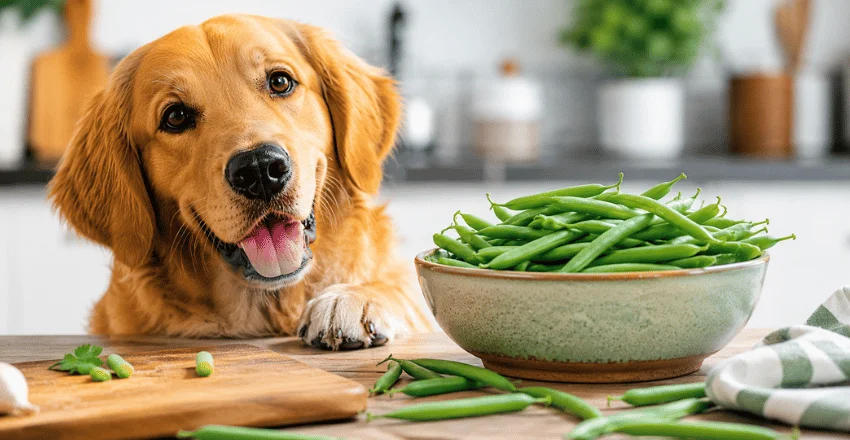
Can dogs eat green beans? Yes, as long as the daily amount stays inside the 10% treat allowance and the rest of the diet is complete. Portion green beans by body weight, not by handful:
- Under 10 lbs: 1 to 2 pieces, each about an inch
- 10 to 25 lbs: 3 to 4 pieces
- 25 to 50 lbs: a small handful, roughly 1/4 cup
- 50 to 90 lbs: about 1/2 cup
- Over 90 lbs: up to 3/4 cup
Introduce them on a day you are home. Fiber that a gut has never met tends to announce itself, usually as wind and a softer stool for a day or two. Start with a single piece and build up over a week.
The diet works on calories and fails on nutrition.
Here is why the trick is so popular. Dry food is calorie dense, vegetables are not, so the swap does exactly what it promises on the energy side. Take a 50 lb dog eating two cups a day, roughly 760 calories.
| Share of food replaced | Calories removed | Calories added back | Net daily cut | Protein, calcium and phosphorus lost |
| 10% (about 1/5 cup) | 76 | 6 | 70 (9%) | 10% |
| 25% (1/2 cup) | 190 | 15 | 175 (23%) | 25% |
| 50% (1 cup) | 380 | 30 | 350 (46%) | 50% |
Look at the last column rather than the third. Complete foods are formulated so that a full portion delivers a full day of minerals and amino acids. Cut the portion in half, and you cut the calcium in half. Pods put none of it back.
Choline intake still fell below the National Research Council recommended allowance in 24 of the 27 dogs, and magnesium fell below it in all of them. That was on food designed for the job. A bowl half filled with a vegetable has no such formulation behind it.
The 25% rule for replacing food
So where is the line? Keep the swap at or under a quarter of the food by volume, run it for weeks rather than months, and weigh the dog every two weeks. Some veterinary nutritionists draw the line closer to 20%. Nobody who works in the field defends the 50 percent version that circulates online.
Notice that no page ranking for this question commits to a number. That is the real gap. Owners are told to be careful, then handed a 50 percent figure by a friend, with nothing in between. A vegetable may replace a quarter of the bowl. Past that, you are formulating a diet, and you are doing it blind.
That ceiling is arithmetic, not caution for its own sake. At 25%, your dog still receives three-quarters of a balanced formula, and most complete foods are built with enough margin above the minimum to absorb that. At 50%, the margin is gone. A dog can lose weight beautifully and be short of calcium at the same time. You will not see it until months later, in a blood panel or a fracture.
One footnote on the botany, since it comes up. A green bean is a legume, the same family as peas and lentils. The grain-free heart disease question that follows legumes into dog food is about the dried seed used as a protein source in the recipe. A fresh pod fed as a treat is different. Our guide to which peas are safe for dogs covers that investigation properly.
Canned green beans and the rinsing myth
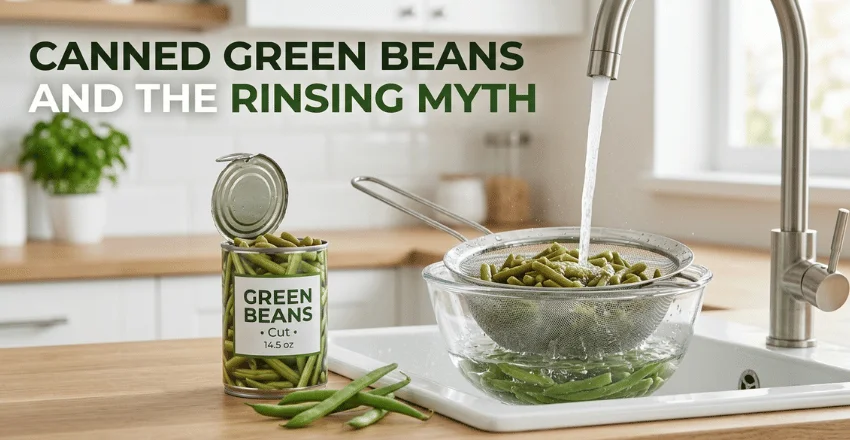
This is where a harmless vegetable turns into a genuine problem. Regular canned green beans are packed in salt brine, and a cup of the drained solids carries somewhere near 310 mg of sodium.
Compare that with the plate scraps owners already worry about, such as the sodium risk in pickles, and the can starts looking less innocent. A complete food already supplies every milligram of sodium a healthy dog needs before you add anything.
Rinsing is the standard fix, and it hardly works. The USDA Agricultural Research Service measured the drained solids at 231 mg of sodium per 3.5 ounces. After a rinse under running water, the figure fell to 214 mg. That is a 7% reduction. You can read the full draining-and-rinsing analysis from the agency’s Nutrient Data Laboratory. Salt does not sit on the outside of the pod waiting to be washed off. It has soaked in.
Buy the no-salt-added can instead, which is a different product rather than a marketing phrase. Read the panel, not the front label. “Low sodium” and “no salt added” are not the same claim, and the gap between them is large.
Raw, steamed, frozen or canned
| Form | Verdict | What to watch |
| Fresh, raw | Fine | Pull the string, chop the pod, skip it for dogs with worn teeth |
| Steamed plain | Best | Softest and easiest to digest, no downside |
| Frozen plain | Fine | Chop before serving; a frozen pod is slippery and hard |
| Canned, no salt added | Acceptable | Rinse anyway, check the panel |
| Canned, regular | Avoid | About 310 mg sodium a cup; rinsing removes under 10% |
| Canned, seasoned or “with bacon” | Never | Onion and garlic powder, added fat |
| Casserole from the holiday table | Never | Cream soup, fried onions, heavy salt |
Seasoned cans deserve their own warning. Onion and garlic powder are concentrated forms of two Allium vegetables that damage canine red blood cells, and powder hits harder per spoonful than a fresh clove. Our breakdown of the toxic garlic dose by body weight shows how quickly that adds up in a small dog. Cook the pods in plain water and nothing else.
Strings, pods and small dogs
Modern varieties are mostly stringless, but not all of them, and older beans from a garden or a farm stand often are not. That tough fiber running along the seam does not break down when a dog gulps rather than chews.
Chop everything into one-inch pieces for a dog under 25 lbs. Whole pods are the shape that causes trouble: long, smooth, and easy to swallow sideways. Seniors with missing molars and puppies still learning to chew both fall in the same category.
When a prescription diet is the honest answer
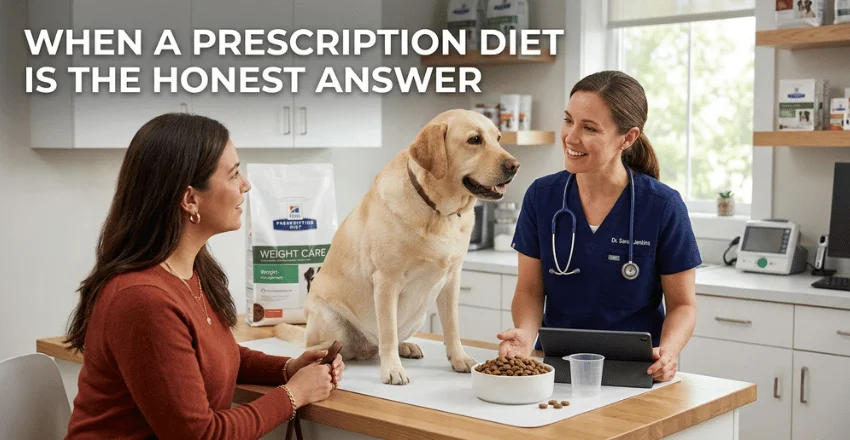
Vegetables are a tool for the last few pounds, not for obesity. If your dog needs to lose more than about 10% of its body weight, the vegetable approach is the wrong instrument. Stretching it to 50% of the bowl is how dogs end up thin and deficient at once.
Therapeutic weight management food solves the problem the swap creates. It is built to be fed at a restricted calorie level while still delivering full protein, mineral, and vitamin levels, so the dog loses fat instead of muscle. Ask your vet for a body condition score, a target weight, and a calorie number. Then use the pods as the treat they are good at being.
What to do next
Weigh your dog this week and write the number down. Then measure the food with a proper cup rather than guessing, because the portion is where nearly every weight problem starts.
If the math says your dog needs to lose more than a couple of pounds, book the vet visit and get a target weight before you change anything. Vegetables can help you hold the line. They cannot do the job on their own.
Frequently asked questions
Ask the vet first. Dogs on a prescription renal or cardiac diet are managed on tightly controlled phosphorus, sodium, and potassium, and adding anything unmeasured undoes that control. The vegetable itself is not the issue; the departure from a calculated plan is.
Often, at first. Legume fiber ferments in the large intestine, and a gut that has never seen it will react. Introducing a few pieces at a time over a week usually settles it.
Yes, chopped small and in tiny amounts. Puppies have a much narrower margin for error on calcium and phosphorus than adults, so keep extras well under the 10% treat line while they are growing.
Slightly. Steaming softens the cell walls, makes nutrients more available, and removes the chewing problem for small or elderly dogs. Raw is still fine for a healthy adult who chews properly.
No. Calorie reduction drives most of canine weight loss, but muscle mass and joint health come from movement. Dogs losing weight on food alone lose lean tissue along with fat.