
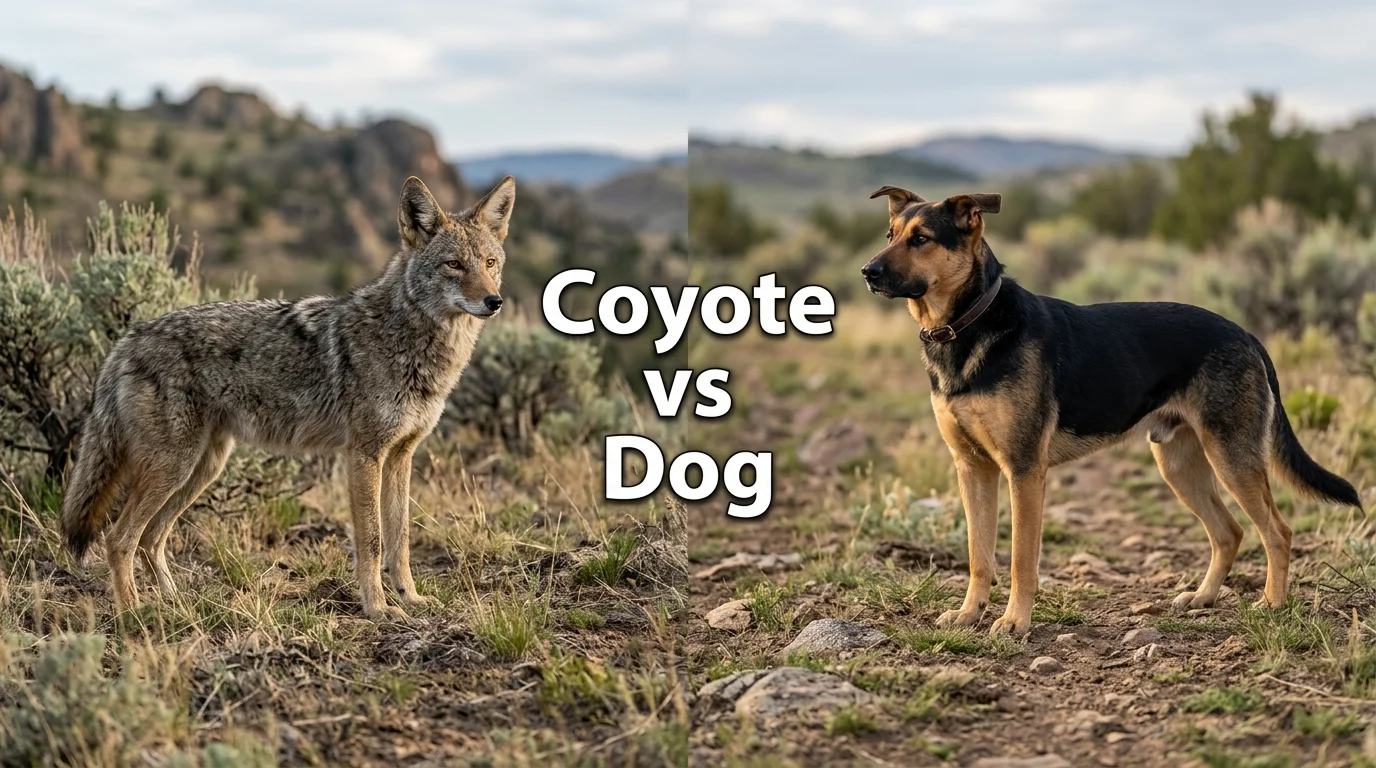
Coyote vs dog identification can be tricky when a lean pet resembles a wild canid. The safest approach is to compare several traits, not just coat color or size. That matters across the United States, where wild canids share parks and neighborhoods with pets.
| Feature | Wild coyote | Domestic dog |
|---|---|---|
| Scientific classification | Canis latrans | Canis lupus familiaris |
| Adult size | Often medium-sized, with regional variation | Ranges from toy breeds to giant breeds |
| Build | Lean, narrow-chested, long-legged | Highly variable by breed |
| Ears and muzzle | Usually upright ears and a long, narrow muzzle | Ear and muzzle shape vary widely |
| Tail | Bushy and commonly carried low while moving | May hang, curl, rise, or wag |
| Tracks | Usually compact, oval, and aligned in a direct trail | Often rounder, wider, and more wandering |
| Human relationship | Wild and normally wary of people | Domesticated and usually human-socialized |
| Pet risk | Small pets may be viewed as prey | Other dogs are usually social competitors or companions |
Table sources: USDA APHIS, U.S. Geological Survey, and National Park Service.
Coyotes are wild canids with lean bodies, long legs, pointed muzzles, upright ears, and low-carried bushy tails. Dogs vary far more in size, shape, coat, and tail carriage. When identification matters, combine body shape, movement, tracks, behavior, and context instead of trusting one feature.
Key Takeaways
- Coyotes usually look lean, long-legged, narrow-faced, and alert, with a bushy tail carried low.
- A trail of several tracks tells you more than one paw print in soft ground.
- Daytime activity is normal, so a daylight sighting does not automatically signal illness.
- Small dogs face predation risk, while larger dogs can trigger territorial behavior.
- Keep pets close, remove outdoor food, and create distance during a close encounter.
Coyote vs Dog: Seven Differences That Matter
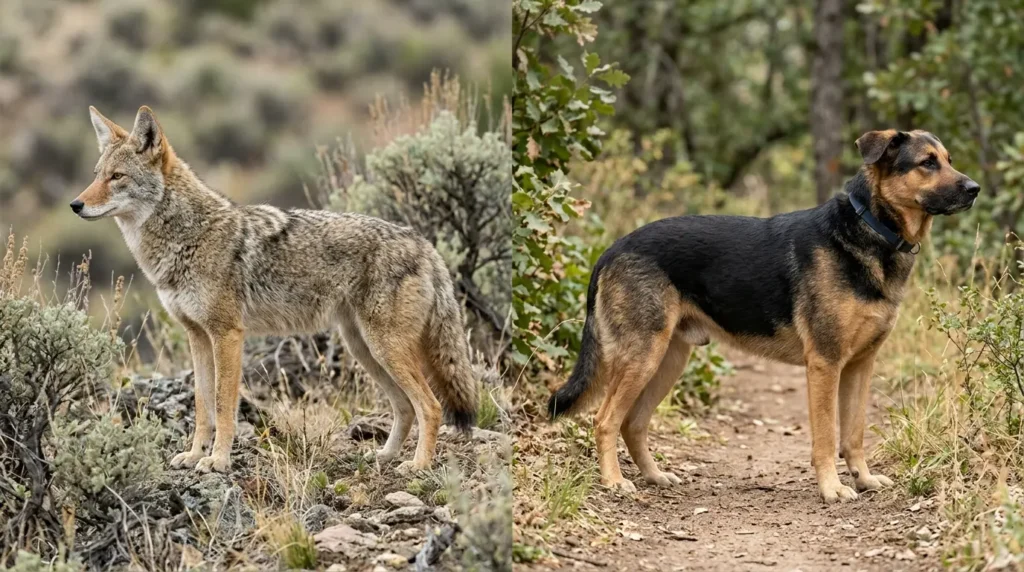
The two animals share the Canidae family, so some resemblance is expected. Dogs were shaped by domestication and selective breeding, while coyotes remain wild animals. That difference affects body form, behavior, movement, and responses to people.
1. Size and body shape
Coyotes are generally medium-sized, but their weight varies by region and sex. USDA guidance notes larger average body weights in eastern populations than western populations. Dogs span a much broader range, so size alone cannot identify an unknown animal.
Proportion is a better clue than pounds. Wild individuals usually look lean, long-legged, narrow-chested, and light-footed. Many shepherd-like dogs look similar, so pair body shape with tail, ears, and movement.
2. Head, ears, and tail
Wild species usually have large, upright ears relative to their narrow heads. Its muzzle is long and pointed, while the tail looks full and bushy. National Park Service guidance notes that the tail commonly stays low while the animal runs.
Domestic breeds show far more variation in these features. A dog may have floppy ears, a shorter muzzle, or a tail carried high. Huskies and shepherds can blur these clues, so no single feature should settle the identification.
3. Tracks and trail pattern
Wild tracks often look more oval and compact than prints from similar-sized pets. The middle toes tend to sit closer together, while the trail often follows a straighter line. Several clear prints are more useful than one distorted mark in mud or snow.
Dogs commonly leave rounder or more splayed prints, though breed and ground conditions can change the shape. Their travel line often wanders because they stop, sniff, and investigate. Look at the full trail before deciding what made it.
4. Movement and posture
Wild canids often travel with an efficient, purposeful trot across open ground. Their movement can look smooth and direct, especially when crossing roads or fields. A low tail can remain one of the clearest supporting clues.
Dogs often move according to breed, training, excitement, and the nearby environment. They may bounce, circle, pause, or return toward a person. A loose dog can still move quietly, so context remains important.
5. Behavior around people
Coyotes usually avoid close contact with people, though urban individuals can become less wary. Feeding wildlife can encourage unwanted proximity and bolder behavior over time. A calm daytime sighting alone does not prove aggression or disease.
Dogs have been bred to live around humans and usually show more human-directed behavior. They may approach, seek attention, follow cues, or look toward people for information. Petristas’s guide to how dogs understand English explains why trained responses depend on context and reinforcement.
6. Sounds and social behavior
Coyotes can bark, yip, whine, and howl, sometimes creating the impression of a larger group. National Park Service guidance says family groups may sound more numerous than they are. Vocalizations alone are a weak identification tool.
Dogs also bark and howl, and some breeds sound surprisingly wild. A better clue is the full pattern, along with posture, location, and movement. Never approach an unknown canid because its sounds seem familiar.
7. Habitat and daily activity
USDA reports populations across all 48 contiguous states and Alaska. Coyotes use deserts, forests, farms, suburbs, parks, and city edges. Urban animals may shift more activity toward quieter hours, but they can appear during daylight.
Dogs can appear anywhere people live, travel, hike, camp, or work. A collar, leash, nearby person, or repeated return to homes strongly supports a domestic identification. Still, an uncollared animal near houses is not automatically wild.
Will Coyotes Attack Dogs?
Small unattended pets can be vulnerable because they overlap with the size of natural prey. Larger dogs may instead be treated as competitors or territorial threats. National Park Service guidance warns that conflict can rise around mating, denning, and pup-rearing periods.
Research on recorded encounters shows that interactions are not purely predator-and-prey events. A USGS study found playful, agonistic, and predatory behavior among observed dog encounters. That variety is another reason owners should prevent direct contact rather than test an animal’s intent. Also worth reading: Wolf Compared to Dog.
Body size changes the risk, but no breed should be treated as guaranteed protection. Even livestock guardians need controlled management around wildlife and secure boundaries. Petistra’s Great Pyrenees behavior guide explains how guarding instincts differ from reliable obedience.
What to Do During a Close Encounter
Keep your dog close before trying to change the wild animal’s behavior. A short, fixed leash gives you more control than a long line. Petistra’s dog leash guide can help you choose practical lengths for daily walks and open areas.
If the animal approaches, make yourself noticeable without moving closer. Stand tall, use a firm voice, clap, and create space while keeping an escape route open. National Park Service guidance advises against running or allowing your dog to approach.
Use these steps when you encounter a wild canid near your pet. Keep each action focused on distance and control. Do not turn the moment into a test of your dog’s courage.
- Shorten the leash and bring your dog beside you.
- Pick up a small dog only when it is safe and controlled.
- Face the animal and make yourself look larger.
- Use a firm voice, clapping, or another loud deterrent.
- Back away slowly while keeping the animal in view.
- Never feed, corner, chase, or encourage your dog to engage.
- Report repeated bold or aggressive behavior to local wildlife authorities.
Good equipment helps only when it fits and stays secure. Identification tags also matter if a frightened dog slips away during an encounter. Petistra’s dog collar guide covers fit, identification use, and control limitations.
Reducing Risk Around Your Home
The simplest prevention step is removing reasons for wildlife to visit your property. Secure garbage, feed pets indoors, clean fallen fruit, and avoid leaving pet food outside. These measures reduce easy food rewards that can encourage repeated visits.
Supervision matters even inside many fenced yards. Wildlife agencies warn that fences do not remove every risk, especially for small unattended pets. Bring dogs indoors at night when local activity is frequent, and watch them during yard time.
Recall training is useful, but it should not replace a leash where wildlife encounters are possible. Excitement, fear, prey drive, or movement can compete with a familiar cue. Practice around controlled distractions before expecting reliable responses outdoors.
Can Coyotes and Dogs Breed?
Coyotes and domestic dogs can produce hybrid offspring. Urban Coyote Research notes that captive hybrid litters have been documented. That biological possibility does not mean hybrids are common around U.S. neighborhoods.
Wild hybrids appear uncommon because breeding biology and social behavior create several barriers. Genetic surveys have rarely found recent dog ancestry in sampled wild populations. An unusual-looking animal is more likely to need careful identification than a hybrid label.
Frequently Asked Questions
What is the coyote vs dog size difference?
No single size cutoff separates them. Wild adults are usually medium-sized, while domestic breeds range from tiny to giant. Use body proportions, tail carriage, tracks, and behavior, along with estimated size.
How can I tell their tracks apart?
Wild prints tend to look compact and oval, with toes held closer together. Their trail often follows a direct line across the ground. Dog prints are commonly rounder and may appear in a wider, wandering path.
Is a daytime sighting a sign of rabies?
No, daylight activity by itself is normal. National Park Service guidance says these animals can be active during both day and night. Concern rises when behavior includes unusual aggression, staggering, seizures, or other serious abnormalities.
Are small dogs more at risk?
Small dogs can be vulnerable because their size overlaps with common prey. Wildlife agencies recommend leashing and close supervision where encounters are possible. Do not leave a small pet outside alone simply because the yard is fenced.
Can a large dog safely chase one away?
No owner should send a pet after wildlife. Larger dogs can trigger defensive or territorial responses, especially near young animals. Keep your dog under control and create distance instead.
What should I do after an attack?
Move to safety and contact a veterinarian promptly for any bite or puncture wound. Report the incident to local animal control or wildlife officials as appropriate. Ask your veterinarian about rabies vaccination status and follow-up care.
The Bottom Line for U.S. Pet Owners
Reliable identification comes from several clues working together, not one dramatic feature. Focus on body proportions, low tail carriage, tracks, movement, and behavior before reaching a conclusion. Treat any unknown wild canid as wildlife and give it space.
Pet safety depends more on prevention than confrontation. Keep dogs leashed where encounters are possible, supervise yard time, and remove outdoor food attractants. Those habits protect pets while helping wild animals remain wary of people.