
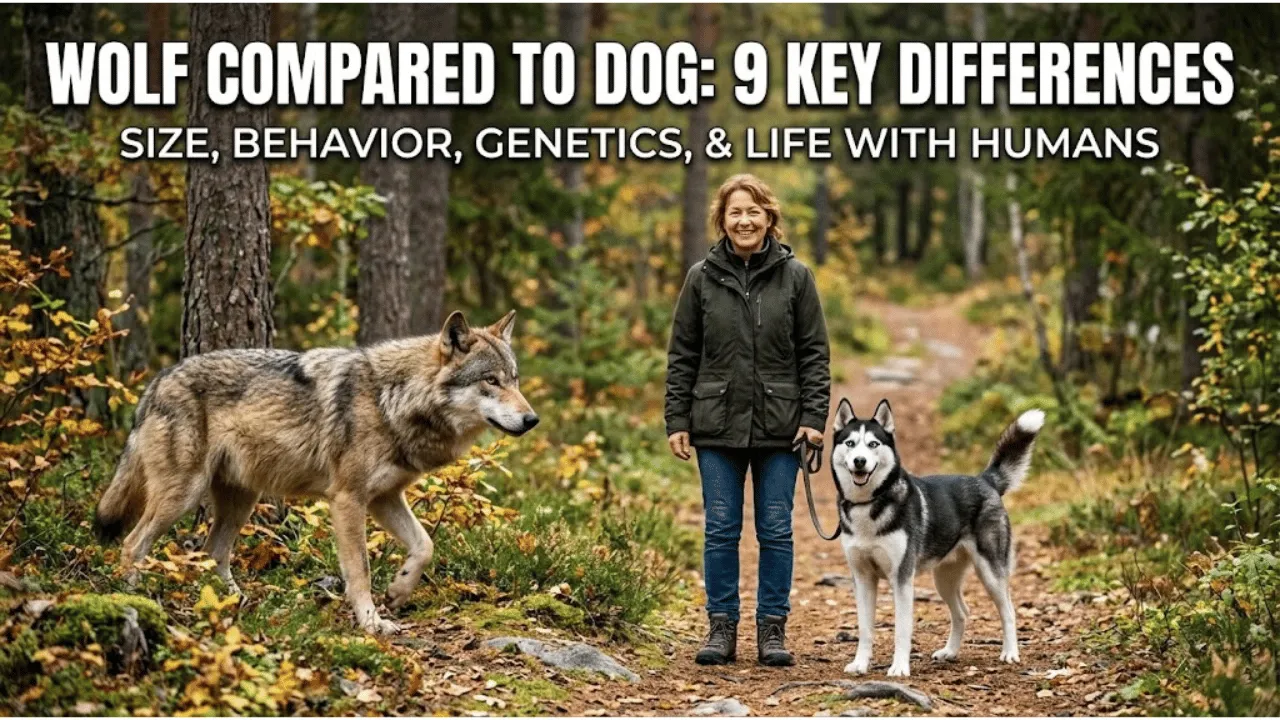
A wolf compared to dog may look surprisingly similar, especially beside a husky or malamute. The resemblance reflects shared ancestry, not identical behavior or needs. Domestication changed dogs profoundly while wild canids stayed adapted to survival without human care.
Short answer: Gray wolves and domestic dogs are close canid relatives, but domestication changed how dogs look, behave, and relate to people. Wolves retain body proportions and behaviors suited to hunting, travel, and family-pack cooperation. Dogs show far greater physical variety and usually adapt more easily to human homes, training, and routines.
Quick Comparison at a Glance
| Difference | Gray wolves | Domestic dogs |
|---|---|---|
| 1. Domestication | Wild canids | Domesticated companions and working animals |
| 2. Body shape | Long legs, narrow chest, large feet | Huge variation among breeds |
| 3. Skull and teeth | Large skull and teeth suited to large prey | Usually smaller skulls and teeth at similar body size |
| 4. External features | Erect ears, long muzzle, straighter tail | Ears, tails, faces, and coats vary widely |
| 5. Travel build | Adapted for efficient long-distance movement | Movement style varies by breed and purpose |
| 6. Human response | Less tractable, even when socialized | More responsive to human guidance |
| 7. Social ecology | Family groups depend heavily on cooperation | Social organization is more flexible |
| 8. Food strategy | Hunts and scavenges natural prey | Adapted to human-linked food environments |
| 9. Home suitability | Wild animal with demanding needs | Domesticated for life alongside people |
TL;DR: Key Takeaways
- Dogs and modern gray wolves share ancient ancestry, but dogs did not simply come from today’s wild populations.
- Wolves usually have longer legs, larger feet, narrower chests, and larger skulls than similar-sized dogs.
- Dogs are generally easier for people to handle because domestication changed how they respond to human guidance.
- Wolves often show stronger persistence in independent problem-solving, while dogs more readily recruit human help.
- Wolfdogs can exist, but they are not the same as wolf-like dog breeds.
- United States rules for wolfdog ownership differ by state and locality.
Dogs and Wolves Are Close Relatives, Not Interchangeable Animals
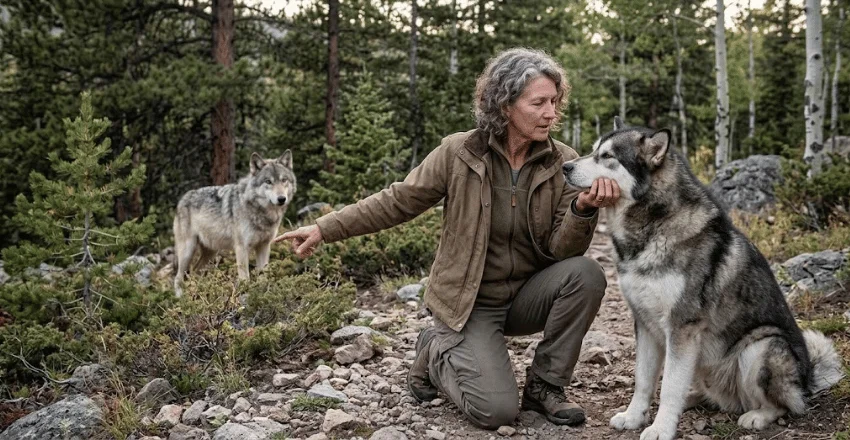
Modern dogs did not simply descend from the gray wolves living in North America today. Genetic research points to ancient wolf populations as the source of dog ancestry. Modern gray wolves remain the closest living wild relatives of domestic dogs.
Dogs and gray wolves can still interbreed and produce fertile offspring. That biological compatibility does not erase their major behavioral differences. It also contrasts sharply with the genetics covered in Petistra’s guide to cat-dog hybrid myths.
Wolf Compared to Dog: 9 Differences That Matter Most
The clearest differences come from domestication, anatomy, social behavior, and relationships with people. No single feature identifies every animal because dog breeds vary enormously. Looking at several traits together gives a more useful comparison.
1. Domestication Changed One Lineage
Gray wolves remain wild animals shaped by natural selection in demanding environments. Domestic dogs evolved within a human-dominated niche and experienced strong selection from people. That history changed temperament, body form, and behavior across generations.
2. Wolves Usually Have a Longer, Leaner Frame
Gray wolves are the largest wild members of the dog family. United States Fish and Wildlife Service data places adult weights between 40 and 175 pounds. Dogs span a broader range, so large breeds can overlap with individual wild canids.
Proportions often tell you more than weight alone. Wolves usually show longer legs, larger feet, and a narrower chest than large domestic dogs. National Park Service guidance warns that size alone is unreliable for identification.
3. The Skull and Teeth Are Built for Different Jobs
Wild canids have large skulls, strong jaws, and large teeth suited to catching substantial prey. Dogs often have smaller skulls and teeth when body size is similar. Centuries of breeding also produced canine head shapes absent from wild populations.
A bigger jaw does not make every individual stronger in every context. Body size, skull shape, and the task being measured all matter. Anatomy therefore gives a better comparison than dramatic online strength rankings.
4. Dogs Show Much Greater Variation in Ears, Tails, Faces, and Coats
A typical gray wolf has erect ears, a long muzzle, and a tail without a breed-style curl. Domestic dogs can have floppy ears, shortened faces, curled tails, or dramatically different coat types. Selective breeding created far more visible variety within dogs.
Facial anatomy also changed during domestication. Research has found differences around the eye muscles of dogs and gray wolves. Those changes may support the expressive eye movements people often notice in pets.
5. Feet and Movement Reflect a Life Built Around Travel
Both animals are digitigrade, meaning they move with the heel raised above the ground. Petistra explains this structure in its guide to digitigrade anatomy in dogs and cats. Wolves combine that posture with long limbs and large feet suited to sustained travel.
Domestic breeds use the same basic canine skeleton in different ways. A greyhound, bulldog, and dachshund do not move with the same proportions. Breeding for work and appearance changed limb length, chest shape, and stride across dog populations.
6. Dogs Are More Tractable Around Humans
Hand-raised studies show an important difference between trainability and tractability. Intensively socialized wolves can learn tasks, yet they remain harder to handle across everyday situations. Dogs more readily follow human initiation and accept limits around resources.
That difference helps explain why pets fit into homes, workplaces, and training systems. It also connects with how dogs respond to human communication. Petistra’s guide to how dogs understand English explains how words become useful cues.
7. Their Social Lives Solve Different Problems
Wild packs are usually family groups rather than constant dominance contests. Members cooperate in hunting, territorial defense, and raising young. Their survival depends heavily on coordination with other pack members.
Free-ranging dogs often rely more on human-linked food and show different group structures. Researchers argue these ecological differences help explain behavior beyond simple tameness. Domestication changed both human relationships and the social problems dogs needed to solve.
8. Problem-Solving and Feeding Strategies Differ
Comparative studies often find wolves more persistent in independent problem-solving tasks. Dogs are more likely to look toward people when a problem becomes difficult. Neither pattern proves one animal is generally smarter than the other.
Their feeding ecology also differs sharply. Wild packs hunt medium and large mammals, while dogs adapted to human-associated food environments. Those pressures rewarded different strategies for finding food and responding to uncertainty.
9. A Wolf Is Not a Substitute for a Dog
Even intensive socialization does not turn a wild animal into a domesticated pet. Captive care must meet demanding behavioral, space, containment, and social needs. A household environment designed for dogs may not meet those needs safely.
Wolfdogs add another layer of complexity for American owners. Laws can vary between states, counties, and cities. Anyone considering one should verify current local rules before acquiring an animal.
Similarities Still Show Up in Everyday Dog Behavior
Shared ancestry remains visible in scent use, social signals, play, digging, and food-related behavior. Dogs may still perform behaviors resembling those seen in wild canids. Similar actions do not mean the motivation is always identical.
Scent rolling offers a good example. Petistra’s guide to why dogs roll in the grass covers competing explanations and evidence from captive wolves. Researchers can observe the shared behavior without claiming one proven reason for every case.
How to Tell a Wolf From a Large Dog in the United States
Start with body proportions rather than color. Look for long legs, a narrow chest, large feet, and a relatively large head. Remember that huskies, malamutes, shepherds, and other breeds can look convincing.
Do not approach a wild canid to get a better view. A brief sighting may not let you distinguish a wolfdog, dog, coyote, or gray wolf with certainty. If identification matters, use wildlife authorities, verified records, or genetic testing rather than appearance alone.
Frequently Asked Questions
Are Dogs Basically Wolves?
No. Dogs and modern gray wolves share ancient ancestry, but domestication created major behavioral and anatomical differences. Calling a pet a tame wolf ignores thousands of years of adaptation to human life.
Are Wolves Stronger Than Dogs?
Wild canids are powerful endurance predators with large skulls and jaws built to handle prey. Yet domestic breeds vary too widely for one universal strength comparison. A fair answer depends on body size and the kind of strength being measured.
What Should I Notice in a Wolf Compared to Dog Sighting?
Look at proportions, feet, chest width, tail carriage, and overall movement rather than coat color alone. Large dog breeds can overlap in size with wild canids. National Park Service guidance specifically warns that size by itself can mislead.
Can Wolves and Dogs Have Puppies Together?
Yes. Gray wolves and domestic dogs can interbreed and produce fertile offspring. Those hybrids can show combinations of inherited appearance and behavior.
Is a Wolfdog the Same as a Wolf-Like Dog Breed?
No. A wolfdog has recent wild ancestry, while a wolf-like breed is still a domesticated dog. Breeds such as Siberian Huskies can resemble wildlife without being recent hybrids.
Can You Legally Keep a Wolfdog in the United States?
Rules vary by state and local jurisdiction. Some places regulate hybrids as wildlife, while others treat them more like domestic dogs. Check state wildlife agencies and local animal-control rules before considering ownership.
The Bottom Line
Dogs and wolves remain close relatives, but domestication created a real biological and behavioral divide. Compare several traits instead of relying on size, color, or one dramatic strength claim. The safest comparison looks at anatomy, behavior, ecology, and the animal’s relationship with people.
Use this guide as a starting point, not a field identification test. If you see an unfamiliar wild canid, keep your distance and contact wildlife authorities when needed. Then explore Petistra’s dog behavior and anatomy guides for traits you can observe safely at home.