

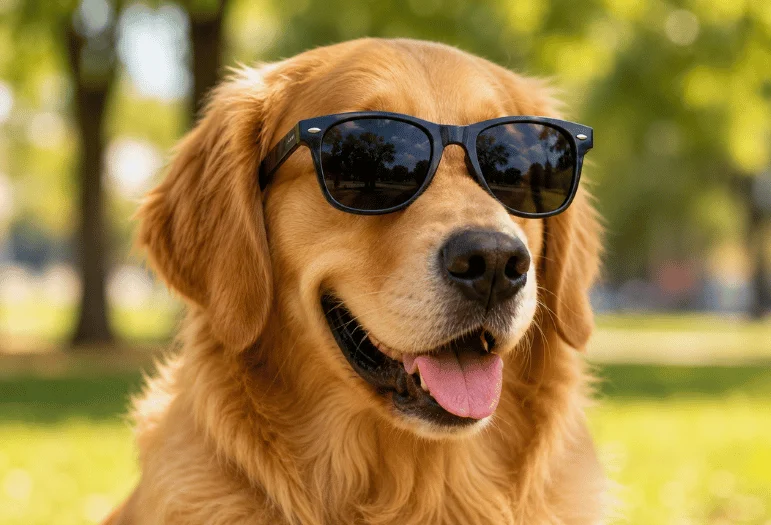
Most dogs don’t need dog sunglasses. A healthy dog on an ordinary daylight walk gets no established medical benefit from a pair, so buying them for photos is a costume purchase, not a medical one. Five kinds of dogs are different, and for those dogs, eyewear is equipment. This page sorts out which group yours is in. Our related guide, How to Choose The Right Dog Collar, goes further into this.
| The dog | Why it matters | What the eyewear has to do |
| Healthy dog, ordinary walks | No established benefit | Nothing. Buy for looks, and know that’s the reason |
| Diagnosed with pannus | Ultraviolet light aggravates the disease | Carry a stated UV rating and go on every daylight outing |
| Recovering from eye surgery or a corneal injury | Your vet may prescribe protection | Whatever the veterinary ophthalmologist specifies |
| Reduced or absent vision | The eye surface meets things the dog can’t see | Impact-resistant lens, snug and stable fit |
| Working or sporting dog in snow, water or sand | Real glare plus airborne debris | Sealed fit, swappable clear and tinted lenses |
| Rides with its head out the car window | Grit at 50 mph is a debris injury risk | Keep the head inside. Eyewear is second best |
Key takeaways
- No study shows a healthy pet dog needs eye protection on a normal walk.
- Pannus, post-surgical eyes, low vision, snow work, and car windows turn eyewear into equipment.
- A tinted lens is not UV protection. Look for a stated UV400 or 99 percent claim from the maker.
- Fit is measured at the muzzle in inches, never by the dog’s weight.
- Prices run from $19.79 to $92.99 across the two makers that dominate the category.
The honest split: costume or equipment
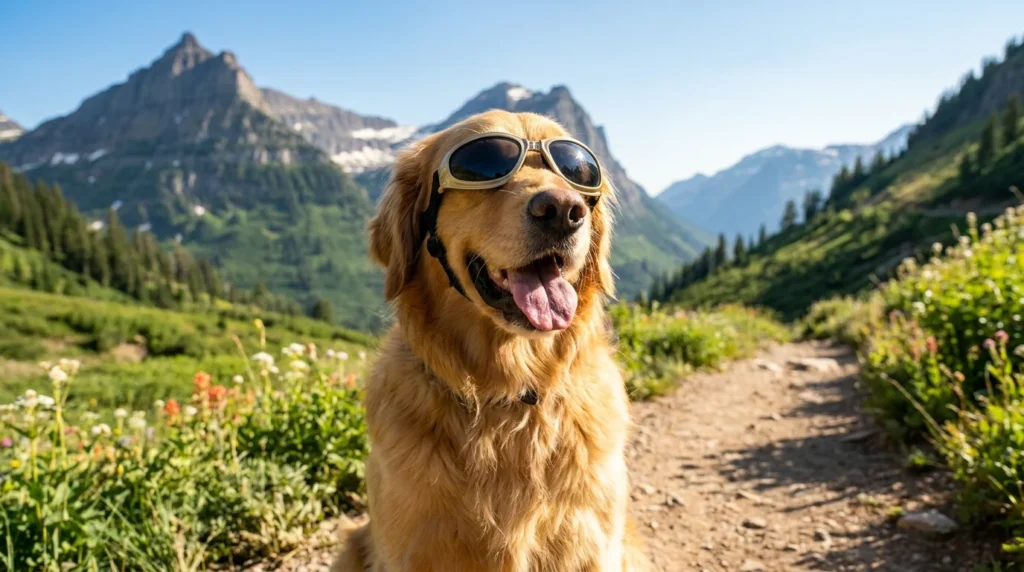
Dogs already handle a bright afternoon with a pupil, a third eyelid and a squint. Nobody has published evidence that a pet dog walking a neighborhood at noon suffers eye damage from sunlight. So if you want a pair because your dog looks great in them, that’s a fine reason. It’s a costume purchase, and nothing is wrong with saying so. Also worth reading: Laser Pointer for Cats.
The medical cases deserve to be taken seriously. Through the lens, it does a measurable job. It blocks ultraviolet light, or it sits between a cornea and a piece of grit. Weighing this up alongside other gear? Our pet care and wellness advice covers the same ground for collars and travel kits.
The 5 dogs that genuinely need eye protection
1. Dogs with pannus, also called chronic superficial keratitis
Pannus is an immune-mediated corneal disease. Blood vessels and pigment creep in from the outer edge, and left alone they can reach the visual axis. German Shepherds are the classic patient. The American College of Veterinary Ophthalmologists says the condition is “most frequently identified in Shepherd breeds, Greyhounds and Dachshunds”, and that “there is no cure for ‘Pannus’- only control”.
Ultraviolet exposure makes it worse, and altitude is the cleanest proxy for that exposure. Chavkin and colleagues reviewed records from 16 US veterinary teaching hospitals. Their peer-reviewed 1994 study in the Journal of the American Veterinary Medical Association put a figure on it. Dogs living above 7,000 feet were 7.75 times more likely to develop lesions than dogs at 3,000 to 5,000 feet. Prevalence tracked altitude at a correlation of 0.90, and not latitude or humidity.
That’s why UV-blocking eyewear is part of the management plan for these dogs. It doesn’t replace the prescribed topical medication. It cuts the trigger that keeps the disease flaring.
2. Dogs recovering from eye surgery or a corneal injury
After corneal surgery, an ulcer repair or a grass-seed injury, a vet may want the eye shielded outdoors. Goggles can also stop a dog rubbing the eye on furniture, which a cone does badly. Ask the surgeon first. Tint, wear schedule and suitability are clinical calls, not shopping ones.
3. Dogs with reduced or absent vision
Dogs that can’t see a branch walk into it. Blind and low-vision dogs bump the eye surface on doorframes and undergrowth. Clear impact-resistant lenses take those hits instead of the cornea. Here, a plain clear lens beats a dark one, since the dog gains nothing from a tint.
4. Working and sporting dogs in snow, water or blowing sand
Glare off snow and water is real, and so is the debris. Sled dogs, water rescue dogs and dogs riding in open helicopters meet airborne grit at speed. Military and search teams have used goggles for years for this. Swappable lenses matter most here: clear for dawn, tinted for midday on white ground.
5. Dogs that ride with their head out the car window
It gets treated as a joke online, and it isn’t one. At 50 mph, a grain of road grit carries enough energy to scratch a cornea. Insects and gravel arrive at the same speed. Goggles help. Keeping the head inside helps more, and that’s the honest advice.
What to look for in dog sunglasses
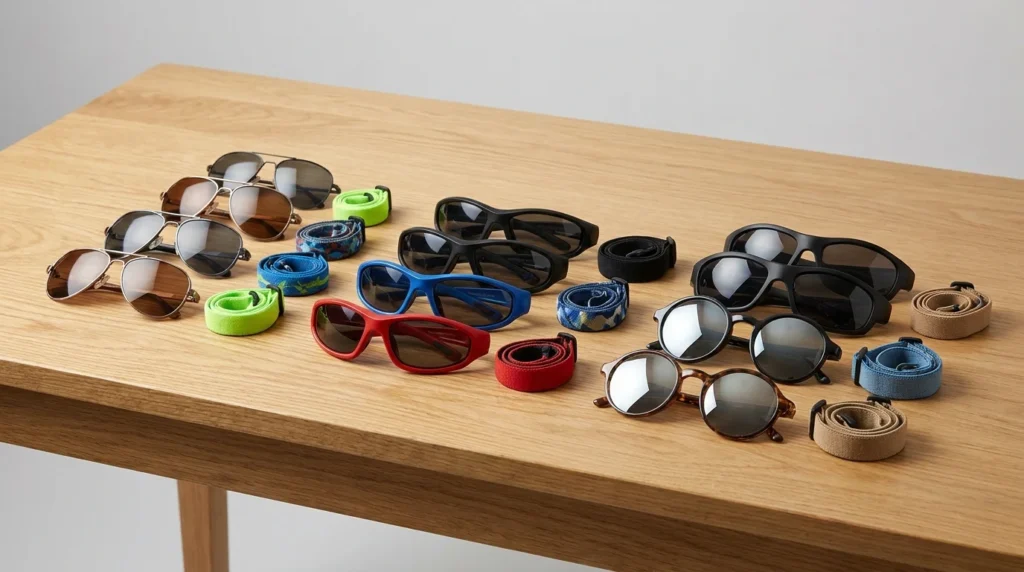
Five things separate working eyewear from a novelty. The rest is color choice.
- A stated UV rating, not a tint. Dark plastic blocks glare and blocks nothing else. Rex Specs states that all its lenses, the clear one included, block 99.9 percent of harmful UV rays, and calls them UV400 rated. Doggles states “100% UV protection” across its ILS and ORIGINALZ lines. A tint with no UV number is decoration.
- An impact rating is a plus if the dog will work. Both makers specify polycarbonate and call the lenses shatterproof. Neither publishes an ANSI Z87.1 certification, so shatterproof is the strongest claim on offer.
- Fit measured at the muzzle, never by weight. Two 60 lb dogs can need different sizes.
- Two straps. A single head strap slides back the first time a dog shakes. The chin strap is what holds the frame on the muzzle.
- Interchangeable lenses. One frame with clear and tinted lenses covers a dawn hike and a snowfield alike.
How to measure your dog
Rex Specs publishes the numbers, which most sellers don’t. It tells owners to “measure the circumference of your dog’s muzzle where you expect the goggle to land on their nose”, usually near the back of the mouth. Its ranges:
- XS: 4 to 6 inches
- S: 6 to 8 inches
- M: 8 to 9 inches
- L: 9 to 11.5 inches
- XL: 11.5 to 14 inches
- S-W: 6 to 9 inches, built for short-nosed breeds such as French Bulldogs and Boston Terriers
Four models compared on their published specs
Prices and claims below were checked on each maker’s own product page on August 2, 2026. None of this is first-hand testing. It’s what the makers publish.
| Model | Price | Maker’s UV claim | Sizes | Straps |
| Rex Specs Goggles V2 | $92.99 | 99.9% of UV rays blocked, all lenses | XS to XL by muzzle circumference, plus S-W for short noses | Fully adjustable multi-strap system |
| Doggles ILS | $35.99 | 100% UV protection | XS to XL | Soft elastic head and chin straps |
| Doggles ORIGINALZ | $20.89 | 100% UV protection, anti-fog | Not published | Soft elastic head and chin strap |
| Doggles K9 Optix Rubber Frame | $19.79 | 100% UV protection | XXS to L | Not published |
- Rex Specs V2. Pros: the only published muzzle chart in inches, two lenses in the box, replacements from $6.71, and a wide size for flat faces. Cons: the highest price by a distance.
- Doggles ILS. Pros: a full size run, a clear lens option, both straps, under half the Rex Specs price. Cons: no size chart at a working link, so you’re guessing at fit.
- Doggles ORIGINALZ. Pros: anti-fog lenses and a shallow cup the maker says suits recessed eyes. Cons: no sizes on the product page.
- Doggles K9 Optix. Pros: cheapest here, one-piece rubber, a flexible nose bridge, a tiny XXS. Cons: no published strap detail, so treat it as light-duty.
The verdict, case by case
For a dog with pannus, a working dog on snow, or a dog recovering from surgery, our pick is the Rex Specs V2. The published muzzle chart and the two included lenses are the difference between a fit that stays on and a $90 mistake.
The picture changes for a low-vision dog in a yard, or an owner who wants sun cover on hikes without a working-dog budget. For both, the Doggles ILS does the same UV job at $35.99. Buying a photo prop? Pick whichever you like the look of and skip this section.
Getting a dog to keep them on
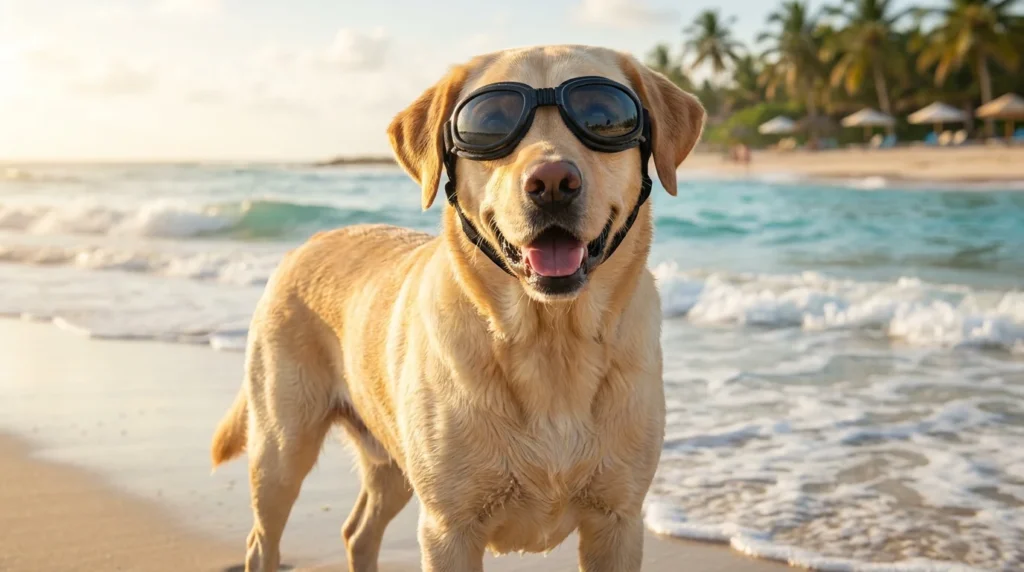
A dog will paw eyewear off within seconds if you strap it on cold. Acclimation runs over days, not minutes. Rex Specs tells owners to introduce the goggles slowly, start with the lenses removed, and reward with food until the dog brings its own face to the frame. Only then do you build duration, add the straps, and add movement.
The maker’s guidance is candid about the timeline: “this may only take a few sessions for some dogs, but for others, several days”. Wrestling a frame onto a squirming dog teaches it that the frame is the problem.
Fit problems: flat faces and prominent eyes
Brachycephalic breeds are the hardest fit here. Pugs, French Bulldogs, and Shih Tzus have almost no muzzle to anchor a frame, and prominent eyes that sit close to the lens. Rex Specs is the only maker publishing a wide short-nosed size, the S-W at 6 to 9 inches. Doggles points recessed eyes at its shallower ORIGINALZ cup instead.
If the lens touches the cornea, stop. Contact is worse than no protection, and a bad frame on a bulging eye can abrade the surface it was bought to defend.
FAQs
They do when the maker states a rating. Rex Specs and Doggles both publish UV figures for their lenses. Generic tinted plastic with no stated rating cuts brightness and nothing more.
They can be, with a size built for a short muzzle and a check that the lens never touches the eye. Many standard frames won’t fit these dogs safely.
Between $19.79 and $92.99 covers the field. Spend at the top end only when a vet has given you a medical reason.
Yes, and it beats bare eyes at speed. Better still is a harness or crate that keeps the head inside the vehicle.