

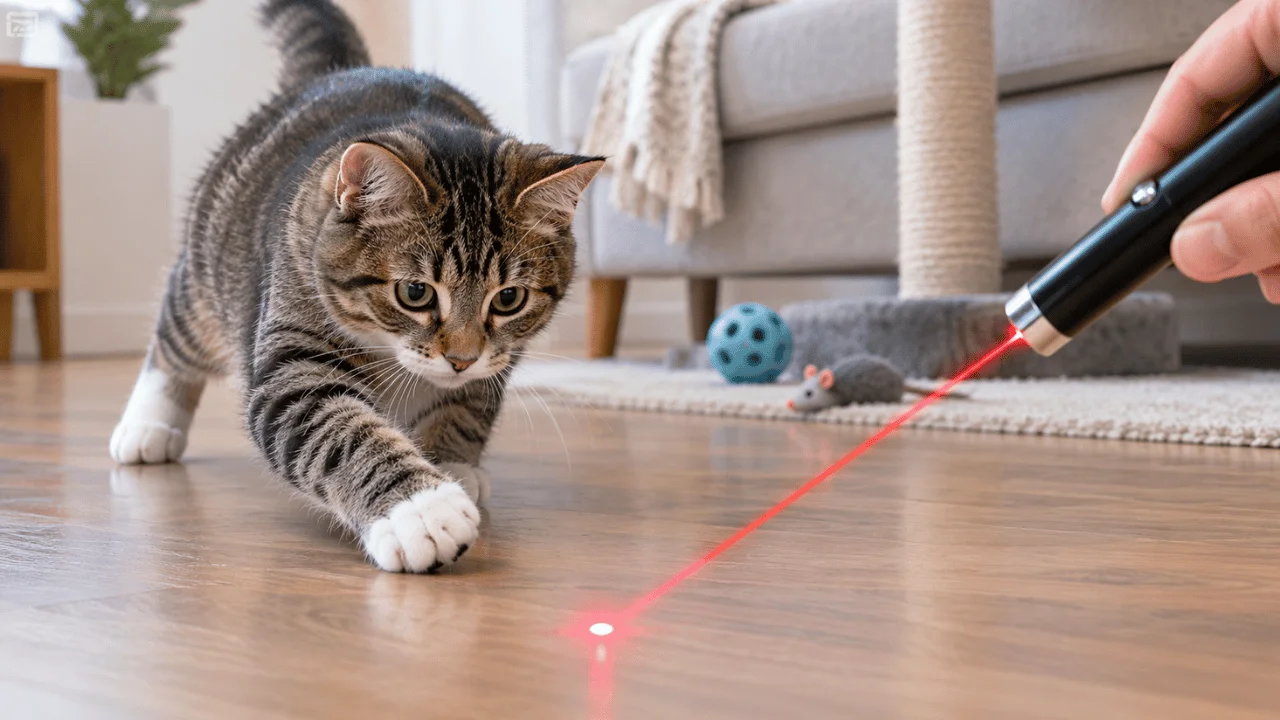
A laser pointer for cats can turn a quiet room into an active hunting game within seconds. The moving dot encourages stalking, chasing, and pouncing without requiring much floor space. Safe play still depends on choosing the right device and controlling how each session ends.
Used carefully, a laser toy can provide exercise and mental stimulation for many indoor cats. The beam should never enter your cat’s eyes or bounce from reflective surfaces. Play should also finish with something physical your cat can catch.
Laser Toys for Cats at a Glance
| Factor | What to Look For | Why It Matters |
|---|---|---|
| Laser labeling | Clear class and power information | Helps you avoid unknown or excessive output |
| Play style | Manual or controlled automatic movement | Lets you match the toy to your routine. |
| Movement | Low, prey-like paths across the floor | Reduces risky jumping |
| Session length | Short, supervised play | Helps prevent overexertion or frustration |
| Ending | Physical toy or small reward | Gives the hunt a tangible finish |
| Safety | No direct eye exposure | Protects sensitive eye tissue |
Quick Answer
A laser toy can be safe when you control the beam, keep sessions short, and avoid eye exposure. Move the dot across safe floor areas instead of high walls or slippery furniture. Finish by guiding your cat toward a physical toy or reward they can catch.
Why Cats Chase a Moving Laser Dot
Cats are predators, so quick movement naturally attracts their attention. A darting point of light can resemble small prey changing direction across the ground. That motion can encourage stalking, running, crouching, and pouncing during indoor play.
Cats also notice movement extremely well, even when visual detail is less important. Petistra’s guide to how cats see humans explains how feline vision favors motion and low-light performance. That visual specialization helps explain why a tiny moving dot can become so interesting.
The attraction does not mean every cat enjoys the activity equally. Some cats chase immediately, while others prefer wands, balls, or soft toys. A cat that walks away should never be pressured into continuing.
Are Laser Pointers Safe for Cats?
A laser pointer for cats requires more care than a simple ball or plush mouse. Direct laser exposure can damage eyes, so the beam should never target an animal or person. The FDA also warns consumers against treating hand-held lasers casually as toys.
Safety also depends on where the light travels. Avoid mirrors, polished metal, reflective decorations, and other surfaces that could redirect the beam. Keep movement on open floors where your cat can chase without dangerous jumps.
Color alone does not tell you whether a device is safe. The FDA notes that visible brightness is not a reliable measure of laser power. Check the product label and avoid devices with missing or unclear safety information.
Choosing a Laser Pointer for Cats
The safest purchase is not necessarily the brightest or most powerful model. Look for clear manufacturer information, laser classification, power details, and safety warnings. Products marketed without meaningful labeling deserve extra caution.
For U.S. buyers, FDA guidance provides a useful screening rule. Consumer laser products should carry required safety labeling and information about their hazard class. Avoid high-powered products or anything that lacks enough information to judge its output.
A simple manual model often gives owners the greatest control over movement and duration. Automatic models can be convenient, but placement and programming matter more than novelty. Supervise initial sessions before deciding whether automated movement suits your home.
Manual vs. Automatic Laser Toys
| Type | Main Advantage | Main Drawback | Best Fit |
|---|---|---|---|
| Manual | Maximum control | Requires your attention | Interactive bonding |
| Rechargeable manual | Easy repeated use | Needs charging | Frequent short sessions |
| Automatic | Hands-free movement | Less direct control | Busy households |
| Motion-activated | Starts when activity occurs | May activate unexpectedly | Cats are already comfortable with laser play |
A manual model is the better starting point for most first-time users. You control the direction, pace, stopping point, and final physical reward. That makes it easier to learn how your individual cat responds.
Automatic products can still work for suitable cats and controlled spaces. Test one while you are present before relying on its programmed movement. Stop using it if your pet becomes fixated, distressed, or physically reckless.
How to Use a Laser Toy Safely
Safe play should resemble a short hunt rather than an endless sprint. The goal is controlled movement, mental engagement, and a satisfying finish. Use the following routine until you understand your cat’s limits.
- Choose an open play area. Remove slippery rugs, fragile objects, and obstacles that could cause a collision.
- Start the dot away from your cat. Never activate the beam near their face or eyes.
- Move it like small prey. Use short runs, pauses, turns, and hiding movements across the floor.
- Keep the pace realistic. Avoid forcing repeated jumps or frantic wall climbing.
- Watch body language. Stop if your cat appears distressed, exhausted, or unusually agitated.
- Guide the dot toward a real toy. Let your cat pounce on something they can physically grab.
- End calmly. Follow with a toy, a normal meal, or a small appropriate reward.
This routine gives the chase a clearer ending. Veterinary-reviewed guidance also recommends allowing a tangible catch after light-based play. That small change can make the activity more satisfying.
Why the Physical Catch Matters
A dot of light disappears when you switch off the device. Your cat cannot bite it, hold it, or carry it away afterward. Repeatedly ending at that point may leave some cats searching for a target.
Veterinary sources describe frustration as a concern when cats repeatedly chase something they can never capture. A physical toy gives the final pounce a real object. You can use a soft mouse, ball, kicker, or wand attachment.
Watch what happens after each session instead of assuming excitement always means enjoyment. Persistent searching, shadow chasing, agitation, or redirected biting may signal that the game is not ending well. Petistra’s guide to common causes of cat biting can help distinguish play behavior from other triggers.
How Long Should Laser Play Last?
There is no single session length that fits every animal. Age, fitness, health, temperament, and room temperature can change how quickly a cat becomes tired. Short controlled sessions are generally easier to manage than long periods of continuous chasing.
Start conservatively if your pet has been inactive or rarely plays. Stop before breathing, movement, or behavior suggests exhaustion. Older cats and animals with health problems may need gentler activity chosen with veterinary guidance.
Kittens may show intense enthusiasm because play occupies much of their daily routine. They still need variety rather than one repeated activity. Petistra’s 8-week-old kitten care guide covers safe play habits for young cats settling into a home.
Common Laser Play Mistakes
Several mistakes can turn a useful enrichment activity into a stressful or unsafe one. Most are easy to prevent once everyone in the household follows the same rules. Children should not handle a laser device without responsible adult control.
- Pointing the beam toward the eyes.
- Using reflective surfaces during play.
- Sending the dot high up walls.
- Encouraging dangerous jumps.
- Running sessions until exhaustion.
- Ending suddenly without a catch.
- Using an unlabeled or questionable device.
- Allowing fixation to continue after play.
The FDA specifically warns against aiming laser beams at people or animals. It also cautions consumers about improperly labeled or unusually powerful products sold online. Those warnings make careful purchasing as important as careful play.
When a Different Cat Toy Is Better
Some cats simply do better with toys they can grab from the beginning. Wand toys provide movement while offering a physical target during each pounce. Balls and plush mice can also support chasing without introducing a laser beam.
A different option is sensible when your cat becomes unusually fixated after the light disappears. It is also appropriate when safe aiming is difficult inside your home. Play should reduce boredom rather than create repeated frustration.
Young cats benefit from learning that toys, rather than human hands, are proper targets. That lesson can support better boundaries as play becomes stronger. Petistra’s kitten guide recommends object-based play for the same reason.
Our Verdict: What Type Should Most Owners Choose?
For most households, a clearly labeled manual or rechargeable pet laser is the simplest choice. It gives you direct control over direction, speed, session length, and the final catch. Avoid choosing based on brightness, beam distance, or novelty alone.
Automatic toys can suit experienced owners whose cats already respond well to light-based play. They should be tested under supervision before becoming part of a routine. A timer does not replace safe placement or observation.
The best play setup also includes several non-laser options. Rotate wands, balls, soft mice, scratching areas, and food-based enrichment when appropriate. Variety allows different hunting and exploration behaviors without making one stimulus dominate the day.
Frequently Asked Questions
Is a laser pointer for cats bad for their eyes?
Direct exposure can be dangerous to the eyes, so never point the beam at your cat. Reflections from shiny surfaces can also create unnecessary risk. Keep the light low, controlled, and directed across nonreflective floor areas.
Can cats become frustrated with laser toys?
Yes, some cats may become frustrated because the moving dot cannot be physically captured. Ending with a soft toy or another catchable target provides a more complete finish. Stop using the device if unwanted fixation continues after sessions.
Are red laser toys safer than green ones?
Color alone does not establish safety. The FDA states that visible brightness does not reliably indicate power or potential eye hazard. Read the classification, output, manufacturer information, and safety label instead.
Can I leave an automatic laser toy running alone?
Supervision is the safer starting approach, especially with a new device. First confirm where the beam travels and how your cat reacts. A toy should not direct repeated movement toward hazards or create prolonged fixation.
What should I do after a laser play session?
Guide the final chase toward a physical object your cat can catch. Let them grab, kick, or hold that toy before ending the game. A normal meal or suitable small reward can follow when it fits your routine.
Make the Red Dot One Part of Better Play
Laser play works best as one activity within a varied enrichment routine. Choose a properly labeled device, protect the eyes, and control where the beam travels. Most importantly, give your cat something real to catch before the game ends.
Pay attention to the individual animal rather than chasing a fixed play schedule. Cats differ in fitness, hunting drive, confidence, and preferred toys. For more everyday feline care, visit the Petistra home page and build a routine around your cat’s response.