

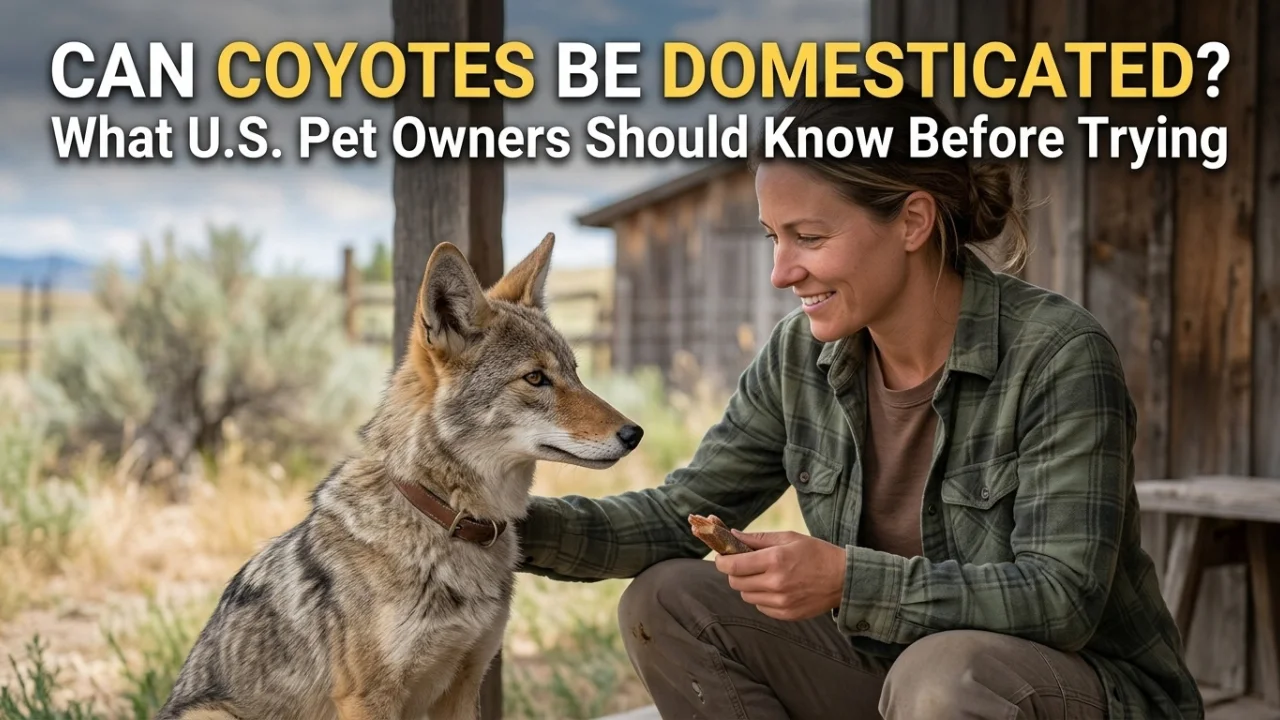
People sometimes see a hand-fed coyote behaving calmly and assume domestication has started. If you’re asking can coyotes be domesticated, the practical answer is no for an animal living today. An individual may accept familiar people, but that is taming or habituation rather than domestication.
| Question | Practical answer |
|---|---|
| Domesticated species? | No modern domestic coyote population exists. |
| Can one individual become tame? | Some individuals can become accustomed to familiar people. |
| Good household pet? | No. Wild behavior, containment, welfare, and public-health issues remain. |
| Legal everywhere in the U.S.? | No. State and local wildlife rules vary. |
| Same as a domestic dog? | No. Shared canine ancestry does not erase major domestication differences. |
Direct answer: Can coyotes be domesticated? Not in the practical sense meant by pet ownership today. A coyote can be hand-raised and may tolerate familiar people. Domestication requires heritable population change across generations, and researchers report no modern domestic coyote population.
Key Takeaways
- Taming changes one animal’s learned response, while domestication changes populations across generations.
- Hand-raising can increase familiarity without producing dog-like reliability.
- Feeding wild animals can reduce natural wariness and increase human-wildlife conflict.
- Private possession rules differ across the United States.
- Rabies rules are complicated because no parenteral rabies vaccine is licensed for wild animals.
Can Coyotes Be Domesticated? Taming Is Not Domestication
Taming is an individual learning process, while domestication is a population-level evolutionary process. A hand-raised animal can learn that certain people provide food and pose no immediate danger. Its offspring do not automatically inherit a safe, predictable household temperament.
| Term | Affects | Main change | Inherited? | Timescale |
|---|---|---|---|---|
| Taming | One animal | Learned tolerance or response to people | No | One lifetime |
| Domestication | A population | Heritable changes through selection | Yes | Many generations |
A USDA-supported study tested 12 coyotes on their ability to follow a human pointing gesture. Only one hand-reared male performed above chance in the study. Hand-reared animals also did not outperform coyote-reared animals as a group.
Could Humans Domesticate Them Over Generations?
In theory, sustained selective breeding could change a population over many generations. That would be a breeding program, not one person taming one animal. USDA researchers note that no concerted modern controlled-breeding effort has created a domestic population.
Why Domestic Dogs Are Different
Dogs come from a lineage shaped by a long history of breeding and living around people. That history affected development, behavior, and responsiveness to human social signals. Petistra’s guide to how dogs understand human words explains learned human cues within a domesticated species.
A coyote can learn associations too, but learning does not equal domestication. Familiarity with a handler does not erase territorial behavior, prey drive, or escape motivation. Those traits can become harder to manage as a young animal matures.
Why Hand-Raising Does Not Create a Normal Pet
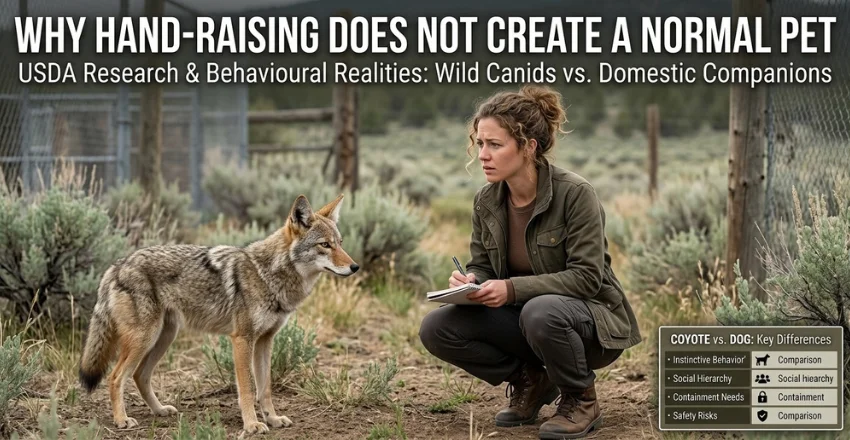
Wild behavior does not disappear because an animal sleeps indoors or accepts food from a hand. USDA research shows that previous human experiences can alter how captive coyotes approach people. Animals repeatedly fed by people may become more willing to approach humans despite deterrence.
Professional research facilities also provide a useful reality check about housing and containment. One USDA study used outdoor experimental pens measuring about 1,000 square meters. That figure is not a household-care recommendation, but it shows how different research housing can be.
Physical similarity to a dog can make those differences easy to underestimate. Petistra’s coyote versus dog comparison covers appearance, tracks, behavior, and pet-safety differences. Shared canine anatomy does not make a wild canid a substitute for a domestic companion.
Are Wild Coyotes Friendly to People?
Most wild individuals tend to avoid people unless they have learned to associate humans with rewards. A daytime sighting by itself does not prove aggression, illness, or abnormal behavior. Wildlife organizations advise people not to feed or intentionally tame them.
Food can teach an animal to associate homes, yards, or people with an easy reward. That association may reduce the distance it normally keeps from humans. Removing pet food, unsecured garbage, and other attractants helps discourage repeated approaches.
Is It Legal to Keep a Coyote as a Pet in the United States?
U.S. law does not provide one nationwide answer for private possession. California says restricted-wildlife permits are not issued for pet purposes. Georgia likewise says native-wildlife licenses are not issued simply to keep wildlife as pets.
Texas treats possession differently, yet additional restrictions still apply. The state has a rabies quarantine affecting transport and sale of live coyotes. Local ordinances can create further requirements beyond state wildlife rules.
Check current rules before acquiring any wild canid, even if someone says it was captive-bred. Start with your state wildlife agency, then check county and municipal animal-control rules. Ask a local veterinarian whether they can legally provide care for that species.
Rabies and Veterinary Care Create Extra Problems
The CDC states that no parenteral rabies vaccines are licensed for use in wild animals. A coyote therefore cannot simply receive the same recognized vaccination status as an ordinary pet dog. Bite or exposure decisions may require case-specific consultation with public-health officials.
This complication remains even when an animal appears healthy and has lived around people. An owner would need plans for bites, escapes, and possible wildlife exposure. Boarding facilities or veterinary clinics may also be unable or unwilling to accept a wild canid.
Can a Coyote Be Trained?
A coyote can learn associations, routines, and responses to familiar people. USDA experiments show that previous human experiences can influence approach behavior in captive animals. Training still does not convert wild behavioral tendencies into the predictability expected from domestic dogs.
Even domestic breeds can retain strong inherited behaviors after many generations of human selection. Petistra’s Great Pyrenees behavior guide shows how a dog’s original job can influence daily behavior. A wild canid begins much farther from the behavioral profile expected in a household companion.
What Should You Do If You Find a Coyote Pup?
Do not assume a pup is abandoned because no adult is visible nearby. Wildlife parents may remain out of sight while people are present or while they forage. Removing a healthy youngster can disrupt learning needed for survival in the wild.
Keep people and pets away, then contact a licensed wildlife rehabilitator or state wildlife agency. Follow professional instructions if the animal is injured or faces an immediate threat. Do not feed it unless a qualified wildlife professional specifically directs you to do so.
What About Coydogs and Other Hybrids?
A coyote and a domestic dog can produce hybrid offspring under biologically possible circumstances. Genetic research has documented historic dog ancestry within some wild coyote populations. The existence of hybrids does not mean the wild parent species has been domesticated.
Petistra’s guide to animal hybrid claims explains why appearance alone never proves reproductive compatibility. Coyote-dog crosses are possible because both parents are closely related canids. The ASPCA opposes keeping wild-domestic hybrids as family pets over welfare and public-safety concerns.
Safer Ways to Appreciate Wild Canids
You do not need to own a wild animal to learn from one. Observe from a distance, support licensed wildlife centers, or volunteer with approved rehabilitation organizations. These choices help preserve natural behavior while reducing unnecessary contact with people.
If you want a canine companion, choose a domestic dog whose adult needs suit your household. Research energy level, prey drive, guarding tendencies, and veterinary needs before choosing a breed. Petistra’s digitigrade animal guide can also help you compare canine anatomy without confusing anatomy with temperament.
The Bottom Line
The practical answer remains no: taming one animal is not the same as domesticating a species. For U.S. readers, wildlife laws and rabies policy add serious complications to private ownership. Keeping wild canids wild is safer than trying to turn one into a household companion.
If you encounter a bold animal near your property, remove attractants and protect pets first. Contact local wildlife professionals when an animal is injured, trapped, or repeatedly approaching people. Responsible distance helps protect both the animal and your household.
Frequently Asked Questions
Can Coyotes Be Domesticated if Raised From Birth?
No individual animal can become domesticated during one lifetime. A hand-raised pup may become comfortable with familiar people and household routines. That process is socialization or taming, not inherited population-level domestication.
Can a Coyote Be Tamed?
Some individuals can become accustomed to human handling, especially after extensive early exposure. Tameness can vary across situations and may change with age, stress, or surroundings. A tame wild animal still retains the biological needs of its species.
Is It Legal to Own a Coyote in the U.S.?
The answer depends on state, local, and public-health rules. Some jurisdictions restrict pet possession, while others regulate permits, transport, or sale differently. Check current wildlife and animal-control rules where you live before taking any action.
Are Coyotes Dangerous as Pets?
A hand-raised animal can still bite, escape, guard resources, or react defensively. Reduced fear of people can also create problems if the animal begins approaching strangers. Risk depends on the individual, surroundings, human exposure, and management.
Can a Coyote Breed With a Dog?
Yes, the two can produce hybrid offspring. Genetic research has documented dog ancestry entering some wild populations in the past. A hybrid is not a domesticated coyote and may present demanding behavioral or legal issues.