

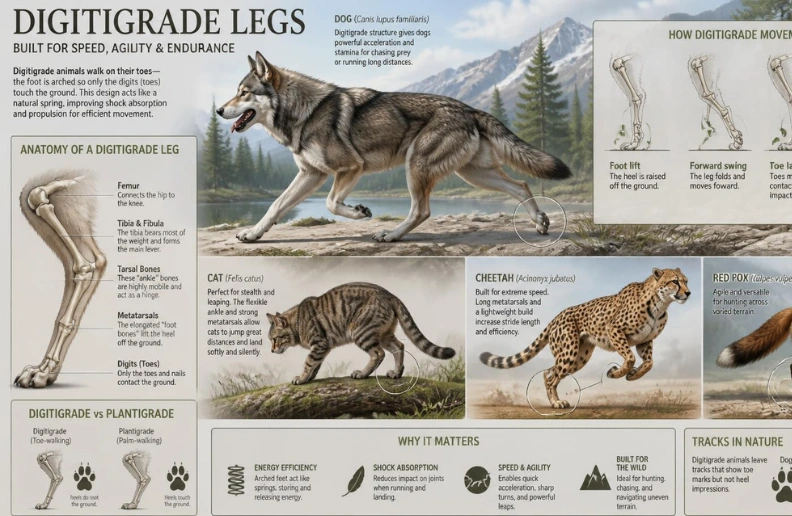
Look closely at a dog or cat standing sideways, and something about its back legs may look unusual. The heel sits high above the floor, while the paw touches down much farther forward. People sometimes mistake that angled profile for a “backward knee.” It comes from digitigrade legs, a normal anatomical arrangement that helps explain how many familiar animals stand, walk, run, jump, and stalk.
Short answer: Digitigrade legs are limbs adapted for walking on the toes, with the heel raised off the ground. Dogs and cats are digitigrade, so the joint that looks like a backward knee is usually the hock, or ankle region, rather than the knee. This posture effectively lengthens the limb and supports agile movement.
What Are Digitigrade Legs?
The word digitigrade describes animals that support themselves primarily on their digits, or toes, rather than placing the whole foot flat on the ground. In dogs and cats, the heel remains elevated and the toes and paw pads form the main contact area with the surface below. Humans, by contrast, normally place the heel, midfoot, and toes on the ground while standing and walking, which makes us plantigrade.
This distinction is easier to understand when you stop thinking of a pet’s paw as equivalent to an entire human foot. Part of the structure that looks like the lower leg of a dog or cat actually corresponds to bones inside a human foot. The elevated position of those bones is what gives a digitigrade animal its characteristic long, angled lower limb.
How Digitigrade Leg Anatomy Actually Works
In a dog’s or cat’s hind limb, the femur runs from the hip to the true knee, commonly called the stifle in veterinary anatomy. Below that are the tibia and fibula, followed by the hock or tarsal region, which is broadly comparable to the human ankle. The metatarsal bones then extend from the hock toward the toes, rather than lying flat along the ground as they largely do in the human foot.
This arrangement creates the illusion that an extra joint appears halfway down the animal’s leg. No extra joint exists, and the animal’s knee has not somehow reversed direction. The prominent rear-facing angle lower on the leg is the hock, while the actual knee sits considerably higher and bends in the same basic direction as a human knee.
The front limbs follow a comparable pattern, although the anatomical names change. A dog’s or cat’s carpus corresponds roughly to the wrist, and the metacarpal bones extend between that area and the digits of the front paw. Looking at the skeleton instead of the fur-covered outline makes it much easier to see why a paw represents only the far end of a longer functional foot structure.
Digitigrade vs. Plantigrade vs. Unguligrade Legs
Terrestrial vertebrate foot posture is commonly discussed in three broad categories: plantigrade, digitigrade, and unguligrade. The important difference is how much of the foot or digit contacts the ground during normal standing and movement. These categories help explain why human feet, dog paws, and horse hooves look and function so differently.
| Leg posture | What contacts the ground | Familiar examples | Easy way to picture it |
| Plantigrade | Heel, foot, and toes | Humans, bears | Whole foot lies relatively flat |
| Digitigrade | Primarily digits/toes and associated pads | Dogs, cats, many birds | Heel stays raised |
| Unguligrade | Tips of the digits, usually protected by hooves | Horses, deer, cattle | Animal stands on the extreme ends of its toes |
A horse is therefore not simply an exaggerated digitigrade dog. Horses and many other hoofed mammals are unguligrade, with the limb elevated even farther so that body weight is supported at the distal end of the digit. Dogs and cats occupy the middle pattern, while humans represent the familiar plantigrade arrangement.
Which Animals Have Digitigrade Legs?
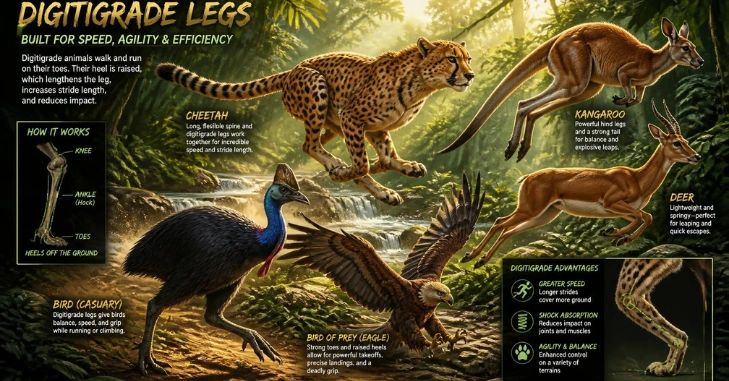
Digitigrade Legs and cats are probably the digitigrade animals most Americans see every day, but the posture is much more widespread. Many members of the order Carnivora use digitigrade or closely related foot postures, and many birds also stand and move with their heels elevated. Different species modify the basic arrangement according to their size, habitat, hunting strategy, and usual method of locomotion.
Even within the broad category, not every digitigrade animal is built exactly like a domestic dog. Limb proportions, toe number, joint mobility, muscle arrangement, paw pads, and gait can vary substantially from one species to another. Calling an animal digitigrade therefore describes its general foot posture rather than giving you a complete blueprint of its legs.
Why Do Dogs and Cats Walk on Their Toes?
Raising the heel effectively incorporates more of the foot into the visible length of the limb. That arrangement can contribute to a longer functional limb and different leverage during locomotion, which fits well with animals adapted for running, accelerating, jumping, or rapidly changing direction. Digitigrade posture is only one piece of the system, however, because muscles, tendons, the spine, body proportions, gait, and the surface underfoot all affect how efficiently an animal moves.
Cats provide an especially clear example because their entire movement system is adapted for controlled, agile locomotion. Their raised heels are not an isolated “speed feature”; they work alongside flexible bodies, specialized paws, claws, and characteristic gait patterns. A cat’s ability to stalk quietly or launch into a jump comes from the interaction of all those structures, not from digitigrade legs alone.
Dogs show the same basic toe-walking posture even though their proportions vary enormously among breeds. A Greyhound, Dachshund, Labrador Retriever, and Chihuahua can look radically different while retaining the same general digitigrade arrangement. Selective breeding changes limb length, bone proportions, muscle mass, and foot shape, but a healthy dog’s heel normally remains raised when it stands and walks.
What Digitigrade Legs Mean for Everyday Pet Care
Understanding the anatomy makes everyday paw care easier because you can see that a pet continually loads its toes during normal movement. Excessively long nails can change how a dog places its paw and may interfere with comfortable contact between the toes and the ground. Petistra’s guide on how to cut dog nails safely explains how to judge nail length and trim gradually without cutting into the quick.
Watching your pet walk is also one of the simplest ways to learn what is normal for that individual. A relaxed walk on a loose leash lets you notice whether both hind hocks remain at similar heights, whether the paws land evenly, and whether stride length changes from side to side. Pet owners working on comfortable daily walks can also use Petistra’s guide to choosing the right dog leash length so constant leash tension doesn’t obscure the dog’s natural pace.
Normal variation still matters, especially because age, breed, body condition, previous injuries, and the walking surface can change how an animal moves. A senior dog will not necessarily have the same stride as a young athletic dog even though both remain digitigrade. When reduced mobility makes longer outings difficult, Petistra’s guide to when a dog stroller is genuinely useful covers situations such as arthritis, post-operative exercise restrictions, and limited endurance.
When Digitigrade Legs Suddenly Look Flat-Footed
A healthy dog or cat should not suddenly begin dropping its hocks toward the floor simply because digitigrade animals can flex their joints. A new flat-footed or plantigrade stance can be a clinical sign rather than a harmless variation, particularly when it appears alongside weakness, limping, swelling, pain, or changes in activity. You can’t reliably determine the cause from appearance alone because nerve, tendon, joint, muscular, and metabolic problems can produce superficially similar postures.
Cats offer an important example because diabetic neuropathy can damage nerves supplying the hind limbs and cause the hocks to sink toward or touch the floor. Cornell University’s College of Veterinary Medicine notes that uncontrolled feline diabetes can occasionally produce this plantigrade posture, often alongside more familiar signs such as increased thirst, increased urination, increased appetite, or weight loss. The abnormal stance may improve when the underlying diabetes is appropriately treated, but it warrants veterinary assessment rather than home diagnosis.
Tendon injuries can cause similar changes in both dogs and cats. The American College of Veterinary Surgeons lists a dropped or plantigrade stance as a sign of Achilles tendon injury, along with lameness and swelling around the affected region. More substantial tendon disruption can allow abnormal flexion at the hock because the structures that normally maintain limb position are no longer functioning correctly.
A sudden change after a fall, collision, awkward landing, or intense exercise deserves prompt veterinary attention, especially when the animal will not bear weight normally. The same applies when a pet begins dragging a paw, stumbling, showing obvious pain, or progressively losing strength even without a known injury. Digitigrade anatomy tells you what the normal outline should look like, but only a veterinary examination can determine why that outline has changed.
Do Digitigrade Animals Have Backward Knees?
No, dogs, cats, and other digitigrade mammals do not have knees that bend backward. The joint most people identify as a reversed knee is usually the hock, which sits in a position comparable to the ankle region in the human limb. The true knee, or stifle, sits higher, often partly hidden by muscle and fur, and follows the familiar basic bending direction.
This misconception persists because people naturally compare only the visible silhouettes of human and animal legs. A better comparison is to imagine a person raising the heel and standing high on the front of the foot, although human toe-standing is only an approximation rather than a conversion to true digitigrade anatomy. Comparative anatomy sources specifically distinguish normal human plantigrade posture from the structural digitigrade condition seen in animals such as dogs and cats.
Are Humans Digitigrade When They Walk on Their Toes?
Humans are anatomically plantigrade even when temporarily walking on their toes. Raising your heels can imitate part of the posture because it reduces heel contact, but it does not reorganize the proportions and habitual weight-bearing anatomy of the human foot and lower limb. Scientific comparisons therefore describe human toe-walking as approaching a digitigrade position rather than making a person a digitigrade animal.
That distinction also explains why digitigrade-looking costumes, stilts, fictional creatures, and character designs should not be treated as anatomical models for real pets. Artists often exaggerate hock height or the angles between limb segments to create a stronger animal-like silhouette. Real dogs and cats provide a better reference when the goal is to understand actual skeletal relationships and normal pet movement.
The Bottom Line
Digitigrade legs are not strangely bent versions of human legs; they organize the foot and lower limb around toe-based weight bearing. Once you recognize that the visible “backward knee” is actually the hock region, dog and cat anatomy becomes much easier to understand. More importantly for pet owners, knowing what a normal raised-heel stance looks like makes it easier to notice when gait or posture changes enough to justify a veterinary check.
Frequently Asked Questions About Digitigrade Legs
Do dogs have digitigrade legs?
Yes, dogs normally stand and walk in a digitigrade posture, which means their heels remain elevated while their toes and paw pads contact the ground. The characteristic angled shape is easiest to see in the hind limb, where the hock sits well above the paw. This is normal canine anatomy, not a bent or deformed leg.
Are cats digitigrade?
Yes, domestic cats are digitigrade and usually move with their hocks raised off the ground. Their limb structure works together with their paws, muscles, flexible body, and gait to support the agile movement associated with feline hunting and climbing. A cat that unexpectedly begins standing with the rear hocks close to the floor should be evaluated because this differs from normal digitigrade posture.
Are horses digitigrade?
No, horses are generally classified as unguligrade rather than digitigrade. They support themselves on the extreme distal portion of a digit encased in the hoof, making their foot posture even more elevated than that of dogs and cats. That is why simply grouping every animal with a raised heel into the digitigrade category can be misleading.
Do digitigrade legs make animals faster?
Digitigrade posture can contribute to limb proportions and mechanics well suited to rapid or agile movement, but it does not determine speed by itself. Muscle architecture, tendon elasticity, spinal movement, body mass, limb length, gait, and many other adaptations affect an animal’s performance. It is more accurate to view digitigrade anatomy as one part of an integrated locomotor system rather than a universal speed advantage.