
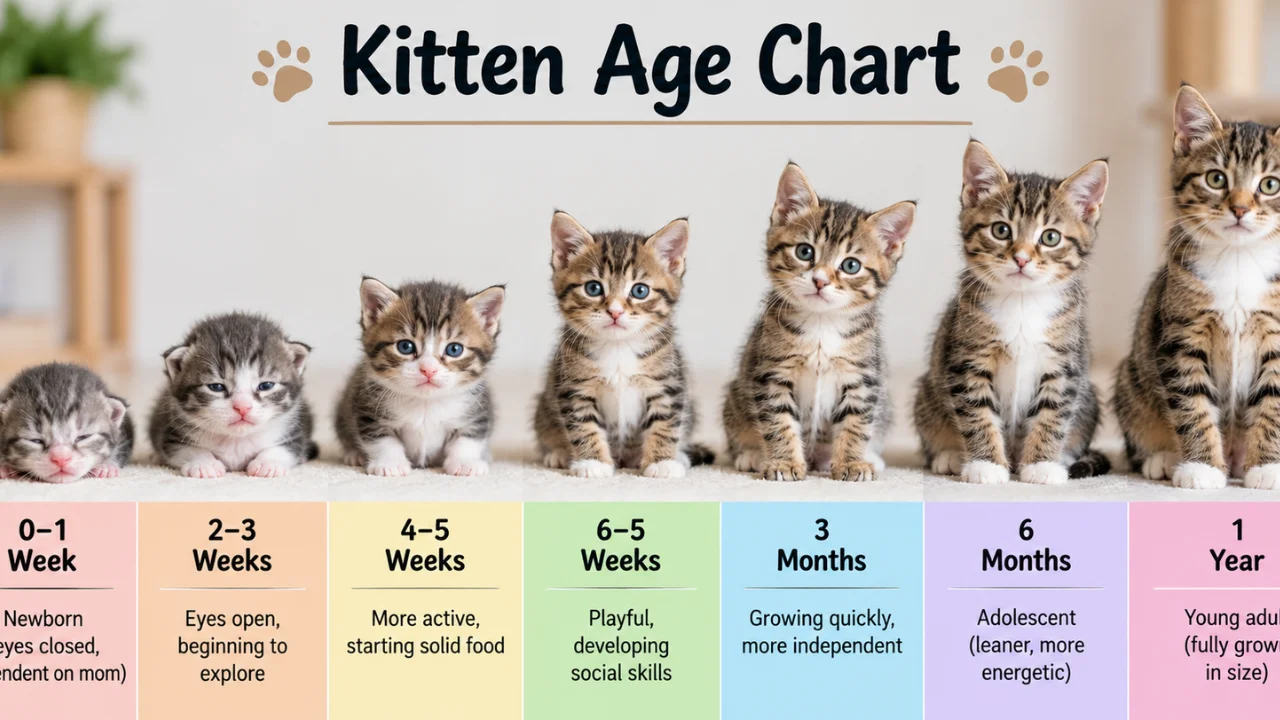
If you are trying to work out how old a stray, rescue, or newly adopted kitten is, this kitten age chart gives you a practical starting point. The first eight weeks bring rapid changes in weight, teeth, movement, hearing, vision, and eating habits. No single clue yields a perfect birthday, so the safest estimate comes from comparing several signs.
Quick answer: To estimate a kitten’s age, check several clues together: eye opening, ear position, weight, walking, teeth, and weaning. Eyes usually begin opening at 8–12 days, walking starts around 3 weeks, baby teeth appear around 3 weeks, and a healthy 2-pound kitten is often close to 8 weeks old.
Kitten Age Chart: Newborn to 8 Weeks
| Age | Typical weight in the Kitten Age Chart | Development clues |
|---|---|---|
| Newborn | 1.8–5.3 oz (50–150 g) | Eyes closed, ears folded, toothless, umbilical cord may remain attached |
| 1 week | 5.3–8.8 oz (150–250 g) | Eyes usually closed, ears beginning to open, limited mobility |
| 2 weeks | 8.8–12.3 oz (250–350 g) | Blue eyes open, ears more open, first wobbly steps |
| 3 weeks | 12.3–15.9 oz (350–450 g) | Incisors emerging, ears pointing upward, walking and exploring |
| 4 weeks | 15.9 oz to 1.2 lb (450–550 g) | Canine teeth emerging, more coordinated play, litter-box interest |
| 5 weeks | 1.2–1.4 lb (550–650 g) | Premolars emerging, running confidently, weaning beginning |
| 6 weeks | 1.4–1.7 lb (650–750 g) | Vision and hearing well developed, active play, eating more independently |
| 7 weeks | 1.7–1.9 lb (750–850 g) | Baby teeth present, eye color may change, better coordination |
| 8 weeks | 1.9–2.1 lb (850–950 g) | Energetic, coordinated, eating independently, adult eye color appearing |
Chart basis: PetMD’s DVM-reviewed 2026 development guide, cross-checked against ASPCApro age-assessment guidance.
Key takeaways
- Eyes typically open at 8–12 days and are usually open by 2 weeks.
- Walking starts as an unsteady attempt around 2–3 weeks and becomes more coordinated around four weeks.
- Baby incisors usually begin appearing at roughly 3 weeks.
- A healthy kitten near 2 pounds is often around eight weeks old, but weight is only an estimate.
- Weaning commonly starts around five weeks, with many kittens eating independently by seven to eight weeks.
Why Knowing a Kitten’s Age Matters
Age affects far more than knowing when to celebrate a birthday. A newborn may still depend on its mother for warmth, nutrition, and basic care, while an eight-week-old normally eats and moves independently. Age also helps a veterinarian plan vaccinations, parasite control, nutrition, and other preventive care at the right stage.
Pet parents bringing home an older youngster can use Petistra’s 8-week-old kitten care guide for feeding, litter, behavior, and first-vet-visit planning. That stage is a major transition from early development into more independent life at home. Knowing the approximate age makes those first routines easier to match to the animal’s needs.
How to Tell How Old a Kitten Is Using Four Clues
The most useful estimate comes from matching several physical and behavioral signs instead of relying on size alone. Eyes and ears are especially helpful during the first two weeks, while teeth become more informative from about three weeks onward. Weight and movement add another check when two kittens of similar size appear to be at different developmental stages.
- Eyes and ears: Closed eyes and folded ears point toward the newborn stage. Eyes generally begin opening at 8–12 days, while the ears unfold during the early weeks.
- Movement: Crawling comes first, followed by wobbly attempts at standing and walking. A kitten walking and playing confidently is usually at least several weeks old.
- Teeth: Incisors start emerging at roughly three weeks. Canines and premolars follow, while permanent teeth begin replacing baby teeth later.
- Weight: Healthy youngsters tend to gain weight steadily. ASPCApro uses practical estimates of about 1 pound at four weeks, 2 pounds at eight weeks, and 2.5 pounds at 10 weeks.
Why Weight Alone Can Give You the Wrong Age
Weight is most useful when the kitten is healthy and in good body condition. ASPCApro notes that its weight-based estimate is most reliable during the first roughly 10 weeks, while nutrition and health can affect how large an individual appears. An underfed or ill animal may weigh less than expected and look younger than its true developmental age.
That is why teeth, eyes, ears, and coordination should be used to confirm the number on the scale. A small kitten with developed teeth and confident movement may be older than its weight suggests. A veterinarian can also assess body condition and development when the clues do not agree.
What Happens After 8 Weeks?
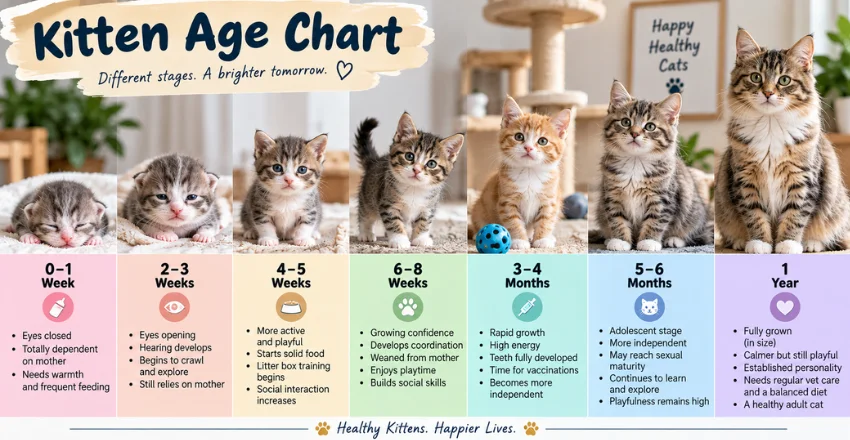
The rapid week-by-week changes become less useful for estimating age after the first two months. Teeth become one of the better physical clues because permanent incisors can begin to appear around 12 weeks, with more adult teeth replacing the baby set in the following months. By about one year, many domestic cats have reached their mature physical size, although development remains individual.
| Approximate age | What you may notice |
|---|---|
| 10–12 weeks | A larger, stronger body; highly coordinated play; permanent incisors may begin appearing. |
| 3–4 months | Baby teeth increasingly replaced by permanent teeth |
| Around 6 months | Adult teeth are generally present; adolescent behavior and activity remain common. |
| Around 12 months | Most cats are considered physically mature adults. |
If your estimate puts the animal at about eight weeks, the next concern is less about guessing the exact day and more about establishing a routine. Feeding, litter habits, safe play, and veterinary care become the practical priorities. Petistra’s cat litter guide can help when setting up an easy-to-use litter area for a young cat.
What to Do Once You Estimate the Age
For U.S. pet owners, a veterinary visit should turn the home estimate into an individual care plan. The Cornell Feline Health Center notes that kittens receive a series of vaccines over a 12 to 16-week period, beginning between six and eight weeks of age. Earlier doses are blocked by the protective antibodies a kitten takes in from its mother’s milk. Rabies timing depends on factors including the vaccine used and applicable state or local requirements.
- Under 4 weeks: If the mother is absent, contact a veterinarian, rescue, or experienced neonatal foster promptly for specialized care.
- About 4–7 weeks: Monitor growth, support gradual weaning, and provide an accessible litter area as coordination improves.
- About 8 weeks or older: Arrange a veterinary examination and review vaccination, deworming, nutrition, and preventive care.
- Before the first clinic trip: Make the carrier familiar at home rather than introducing it only when travel begins. Petistra’s cat carrier guide explains a calmer setup.
Vaccination is especially important because young, unvaccinated cats are vulnerable to diseases such as feline panleukopenia. Petistra’s panleukopenia prevention guide explains why the full FVRCP series matters rather than relying on a single early dose. Your veterinarian should set the schedule around the animal’s health, previous records, lifestyle, and local requirements.
Young kittens can decline faster than healthy adult cats, so behavior matters as much as age. Seek veterinary help promptly for weakness, weight loss, refusal to eat, repeated vomiting or diarrhea, or difficulty breathing. A chart is useful for estimating development, but it should never delay care when a young animal appears sick. There is more on this in When Can Kittens Leave Their Mom? The Safest Age for a Healthy.
Your Next Step
Record the estimated age range, current weight, tooth development, eye color, and how confidently the kitten moves. Bring those observations, along with any shelter or rescue records, to the first veterinary appointment. Once the age range is clear, you can match feeding, preventive care, litter setup, and socialization to the stage instead of guessing.
Frequently Asked Questions
Most begin opening their eyes at roughly 8–12 days old. The eyes are usually fully open by around two weeks, although vision is still developing at that point. Never force the eyelids open if they remain closed naturally.
A healthy kitten weighing about 2 pounds is often about 8 weeks old. ASPCApro uses weight as a useful early estimate when the animal is in good body condition. Teeth, movement, eyes, and overall development should still support the estimate before you rely on it.
The first baby incisors usually begin to emerge at roughly 3 weeks. Permanent middle incisors can begin to appear around 12 weeks, with more permanent teeth following over the next several months. Teeth are especially useful for age estimates once eye opening and early walking milestones have passed.
Wobbly walking attempts commonly begin around two to three weeks, with better coordination developing afterward. Weaning and interest in wet food commonly begin around five weeks. Many kittens are eating independently by roughly seven to eight weeks.
A kitten age chart provides an estimate rather than an exact birth date. Development varies, and poor nutrition or illness can make an animal look smaller or less developed than expected. Combining weight, teeth, eyes, ears, and movement yields a more accurate estimate, while a veterinarian can provide the most professional assessment.